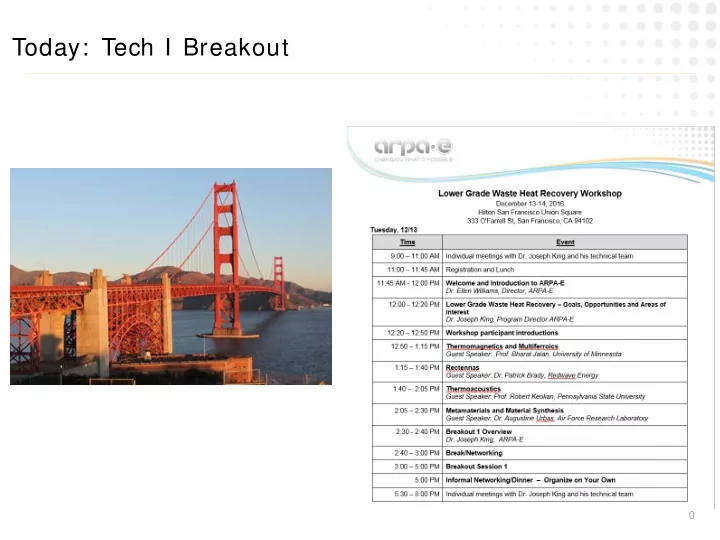
Today: Tech I Breakout 0 Breakout Session Goals - Identify and - - PowerPoint PPT Presentation

today tech i breakout
SMART_READER_LITE
LIVE PREVIEW

Today: Tech I Breakout 0 Breakout Session Goals - Identify and - - PowerPoint PPT Presentation

Today: Tech I Breakout 0 Breakout Session Goals - Identify and Capture 1. What is the current state-of-the-art? 2. What are the three biggest performance limitations in the field? 3. If solved, what would be the biggest break though or


slide-1
SLIDE 1

Today: Tech I Breakout

slide-2
SLIDE 2

Breakout Session Goals -

26

1. What is the current state-of-the-art? 2. What are the three biggest performance limitations in the field? 3. If solved, what would be the biggest break though or quantum leap forward for this technology? 4. Are there challenging but reasonable approaches to address the limitations? 5. What is the biggest opportunity/application for this technology were the limitations to be surmounted?

Identify and Capture

slide-3
SLIDE 3

Seed Questions By Area

5

Multiferroics & Thermomagnetics:

  • Tend to be metal or mixed (bi)metal oxides
  • Materials that are both ferroelectric & multiferroic are rare
  • Ultrafast switching in the pico – attosecond scale range
  • Non-equilibrium dynamics governed using resonance

(e.g. switching)

  • Spintronic devices with electric field tunable functions

Q1: Can the thermomagnetic effect be used to enhance a traditional thermoelectric device

such as its ZT?

Q2: Can ferroelectric or multiferroic techniques* be used to enhance conduction (electron

mobility) or limit phonon transport in thermoelectric devices?

Q3: What ferroelectric driving mechanism must be present for electric and magnetic ferroic

  • rder to occur simultaneously; what materials and structures would have this? What are the

challenges to do this?

Q4: Can one fabricate a terahertz to femtosecond range magnetoelectric multiferroic which

might act as a diode; the direct control of spin waves with terahertz (IR) radiation?

*magnetically driven multiferroics are mostly insulating bimetallic oxides.

slide-4
SLIDE 4

Seed Questions By Area

5

Rectennas:

  • Specific frequency/wavelength range
  • Coherence constraints (out of phase cancellation)
  • Switching frequency of diode limited (IR: ~30THz)
  • Diode-antenna resistance matching
  • Design Constraints
  • Potentially very high efficient (> 44%)

Q1: What are the challenges to capturing a broader spectral absorption band efficiently? Are there designs,

concentrators or other technologies which would might do this efffectively?

Q2: Are there designs or materials which would allow faster diode switching with no loss of rectification or

resistance (impedance) matching?

Q3: Where in the waste heat (IR) spectral range does a rectenna have the highest probability of effective

  • peration?

Q4: Does an infrared rectenna follow a Maxwellian view of electromagnetic radiation and rectification or a

Bose-Einstein view?

slide-5
SLIDE 5

Seed Questions

5

Thermoacoustics:

  • Low Power to volume ratio
  • Very high density fluids required to reach high power densities
  • Acoustic waves at high pressure ratios suffer many non-linearities
  • e.g. turbulence and harmonic generation/distortion
  • Linear alternators (energy convertor) have relatively low efficiency
  • Heat exchange process in oscillating media is problematic

Q1: Are there effective methods to manage the harmonic distortion to amplify the desired fundamental mode? Q2: Are there consistent, efficient ways to match (by design) the pressure wave frequency to the resonance

frequency required by the load device?

Q3: Are there flexible designs which match the resultant variation of wave frequency with device operating

temperature?

Q4: Are there designs/methods which can effectively manage the stack temperature gradient between the hot

and cold-side heat exchangers, particularly below 250-500oC?