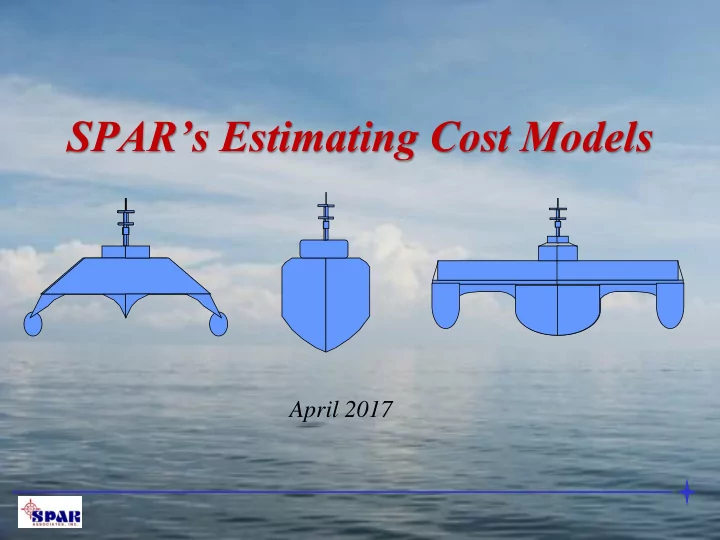
SLIDE 1 SPAR’s Estimating Cost Models
April 2017
SLIDE 2 PERCEPTION ESTI-MATE is a powerful database-
- riented estimating system within which the user can
store a wide range of cost data (cost estimating relationships, or CERs) to generate estimates at any level of detail. Typically, these CERs reflect the user’s own cost experience and the way it does business. Options are available to purchase a comprehensive set
- f generic CERs for either new construction or ship
repair or both.
SLIDE 3 The SPAR Cost Models are pre-developed cost models
- f specific hull forms and are organized with generic
CERs already installed and ready to use. These cost models can be run outside ESTI-MATE or fully integrated within ESTI-MATE.
SLIDE 4
The SPAR Cost Models are used to estimate concept and preliminary ship designs. The cost models permit quick assessments of costs, risk, and design/mission trade-off and build strategy alternatives.
SLIDE 5
The models provide a range of structural and powering selections to predict costs and various performance characteristics.
SLIDE 6 Separate models are available for different hull types (Mono-Hulls, Catamarans and Trimarans).
Special variant mono-hull cost models include:
- Tankers & Product Carriers
- Ro/PAX/Container Carrier Ships
- Patrol Boats, Cutters & Frigates
- Research & Hydrographic Vessels
- Replacement Fore Bodies: Tankers & Bulk Carriers
- Ice Breaking Ships
SLIDE 7
The cost models substitute default ship design parameters developed from statistical data analyses until actual design data can be determined. In this way, the cost estimate can follow the design evolution and can produce quickly cost changes due to design trade off alternatives.
SLIDE 8
Costs are generated at relatively low levels of detail and summed according to an abbreviated Ships Work Breakdown Structure (SWBS). Reports are available in various levels of detail, both tabular and graphical.
SLIDE 9 Detail Cost Estimate Reports
SLIDE 10 Construction Totals Non-Recurring Totals Non-Recurring & Construction Totals
Summary Cost Estimate Reports
SLIDE 11
The models estimate both recurring and non- recurring costs
SLIDE 12
Non- Recurring Cost Estimate
SLIDE 13
Lead Ship Cost Estimate
SLIDE 14
Lead Ship Material Cost Estimate
SLIDE 15 Summary Non-Recurring & Lead Ship Cost Estimate
SLIDE 16 16
Ship Type: Version: A
Basic Research - Concept Design
Date: 25-May-07
Contract Design Validation 39,071 $ Functional Design 533,964 $ Production Engineering & Construction 4,961,958 $
Pricing:
Non-Recurring Engineering & Production Planning Production Planning & Scheduling 384,601 $ Technical Wage $/Mhr:
24.42 $ 54.95 $
w/ overhead Standard Work Week:
40.00 hours/week
Purchase Specs & Support 97,676 $ Production Wage $/Mhr:
20.28 $ 45.63 $
w/ overhead Labor Rates: ILS, Spares & Load Items 48,838 $ % Overhead:
125 %
263% Senior Professional/Manager
120.00 $ per hour
Contract Engineering Management 175,003 $ % G&A Labor:
208% Engineer
95.00 $ per hour
Contingency Labor: 233,054 $ % G&A Material:
10 %
164% Designer/Draftsperson/Planner
75.00 $ per hour
Contract Detail Design Package
% Profit:
10 %
110% Clerical
50.00 $ per hour
Miscellaneous Material & Support: 1,483,729 $ % Contingency Margin
10 %
196% Contingency (weighted average)
89.47 $ per hour
Jigs, Cradles, & Templates, Tools & Inst 832,151 $ Navy C4ISR
No
TOTAL NON-RECURRING COSTS: 8,796,232 $ Jones Act Premium Material Factor:
No 1.00
Current Year:
2007
Shipyard Tech Support Labor Factor:
1.0000 Estimated Schedules
Additional Material Escalation:
1.0000
1.000 = none Steel Productivity Factor:
1.0000
- Est. Detail Engineering Time:
4.0000
Months Shipyard Material Cost Factor: 1.0000 MILSPEC Prem.=1.21 Outfit Productivity Factor:
1.0000
8.0000
Months
Combined Material Cost Factor: 1.0000
On-Block Paint Factor:
0.9500
40 % Hours On Block Overlap:
2.0000
Months
25.0%
566
0.0%
SWBS Weight M-Hrs Labor Production $ $ $ G&A 2007 $ G&A $ Profit $ $ Group MTons Per Mton Efficiency M-Hrs Labor Overhead Labor Only $ Material Material Only Labor + Material Total Cum.Total Structures 1 6,775 45.48 1.00 308,146 6,249,202 7,811,503
676,918 2,150,680 23,657,480 Propulsion 2 389 26.31 1.00 10,228 207,433 259,291
558,730 661,275 7,274,029 Electrical 3 189 105.23 1.00 19,921 403,999 504,998
281,217 400,239 4,402,627 Electronics & Navigation 4 11 359.89 1.00 4,000 81,120 101,400
119,469 149,668 1,646,351 Auxiliary Systems 5 762 236.75 1.00 180,316 3,656,812 4,571,015
959,407 1,878,130 20,659,430 Outfit & Furnishings 6 834 82.30 1.00 68,629 1,391,799 1,739,749
371,717 722,044 7,942,483 Armament 7
8
7.5% 44,343 1,082,858 1,353,572
2,500 246,393 2,710,323 Shipyard Services 9
15.0% 88,686 1,798,555 2,248,193
175,974 598,246 6,580,705 Margin, Bonds & Insurance 10
1,013,958 1,115,354 12,268,892 Lead Ship Totals: 8,960 80.83 724,270 14,871,778 $ 18,589,722 $
41,598,901 $ 4,159,890 $ 7,922,029 87,142,320 $ 87,142,320 $ Non-Recurring Costs: % Total Lead Ship G1-7 Man-Hours: 10% 72,427 6,480,351 $
2,315,881 $
879,623 9,675,855 $ 96,818,175 $ Technical Support: 4.13% Production $ Costs Estimated Cost for Prime Contractor Management Team:
Shipyard Services: 10.03% Production $ Costs Over-All Program Management Fee: 0%
Fees & Insurance: 18.71% Production $ Costs Total Price with Prime Contractor Management: 96,818,175 $ Non-Recurring Costs: 14.75% Production $ Costs Estimated Construction Risk: 6,924,314 $ w/o Profit Production Costs (1-7): 65,582,400 $ 75.3% GR 1-10 Estimated Rework Risk: 964,930 $ w/o Profit 0.80
- Est. Experience Rating (0-1):
11,633,942 $ w/o Profit 0.75 Engineering Performance (0-1): 17,474,560 $ w/o Profit Production Schedule Cost Risk: 2,142,676 $ w/o Profit Learning % Mat'l Savings Total Price with Risk: 135,958,597 $ 0.850 0.950 Non-Recurring Lead Ship 1 100.00% 0% 724,270 14,871,778 $ 18,589,722 $
41,598,901 $ 4,159,890 $ 7,922,029 $ 87,142,320 $ 9,675,855 $ #2 Follow Ship: 2 85.00% 5% 615,630 12,641,011 $ 15,801,264 $
39,518,956 $ 3,951,896 $ 7,191,313 $ 79,104,439 $
#3 Follow Ship: 3 77.29% 8% 559,799 11,494,618 $ 14,368,272 $
38,350,816 $ 3,835,082 $ 6,804,879 $ 74,853,666 $
#4 Follow Ship: 4 72.25% 10% 523,285 10,744,859 $ 13,431,074 $
37,543,009 $ 3,754,301 $ 6,547,324 $ 72,020,567 $
#5 Follow Ship: 5 68.57% 11% 496,611 10,197,148 $ 12,746,434 $
36,928,161 $ 3,692,816 $ 6,356,456 $ 69,921,014 $
#6 Follow Ship: 6 65.70% 12% 475,829 9,770,425 $ 12,213,031 $
36,433,275 $ 3,643,328 $ 6,206,006 $ 68,266,065 $
#7 Follow Ship: 7 63.37% 13% 458,938 9,423,598 $ 11,779,498 $
36,020,034 $ 3,602,003 $ 6,082,513 $ 66,907,646 $
See Shipyard Productivity Factors
NON-RECURRING COSTS 35,000 DWT Product Carrier
Construction Cost
Tanker & Product Carrier Cost Model
(Model Version March 2007)
Instructions: Fill in light gray data fields
indicated with red characters. The model will provide the remaining information. References in blue refer to additional information available on indicated worksheets.
Summary Non-Recurring Costs SWBS Summary Costs Estimated Multi-Ship Costs (Includes Learning & Allocated Non-Recurring Costs) Summary Cost Risk Rates & Escalation Productivity Factors
SLIDE 17
The models generate average ship costs for multiple-ship construction programs.
SLIDE 18 Estimating Costs for a Multi-Ship Construction Program with Learning Curves & Apportioned Non-Recurring Costs
SLIDE 19 Estimating Multi-Ship Production Schedule & Manpower Requirements Quickly & Easily
SLIDE 20 Estimating Multi-Ship Costs Quickly & Easily
SLIDE 21 Estimating Multi-Ship Costs Quickly & Easily
SLIDE 22 Estimating Multi-Ship Annual Cash Flow Quickly & Easily
SLIDE 23 Estimating Multi-Ship Delivery Schedule Quickly & Easily
SLIDE 24 Defining Ship Characteristics
Basic design information (ship characteristics) is required as input into the
- model. This includes dimensional and
structural data, powering specifications, and details of special equipment and functional areas of the ship.
SLIDE 25 The models also can generate some information not provided by the user from sets of default assumptions and functional relationships. NOTE: Any default values used by the model should not be regarded as having been validated by any formal naval architectural
- r engineering review process.
SLIDE 26
Ship Characteristics Data Entry Worksheet
SLIDE 27
Defining Structural Components with Material Codes
SLIDE 28 Wide Selection of Type Structural Materials to Assign to Structural Components
SLIDE 29
Wide Selection of Type Propulsion & Electric Generation Systems
SLIDE 30 Electric Systems:
- Electrical Generation
- Cable & Hangers
- Appliances & Electrical
Components
Electronics:
Communications
- Navigation Systems
- Miscellaneous Electronics
Wide Selection of Ship Systems & Support Services from which to Choose:
SLIDE 31 Auxiliary Systems:
- HVAC
- Engine Room Piping (fuel, Lube,
Cooling, Exhaust)
- Bilge & Ballast Systems
- Habitation Piping (Potable &
Sanitary)
- Fire Protection Systems
- Cargo Piping Systems
Outfit Systems:
- Exterior & Interior Coating
- General Hull Outfit (Rails,
Stanchions, Davits, Insulation, etc.)
- Rescue & Life Saving Systems
- Cranes, Lifts & Elevators
- Machinery Space Outfit
- Superstructure Outfit
- Accommodation Outfit
- Fire Fighting & Pollution
Control Systems
Equipment
SLIDE 32 Technical Support:
- Planning & Program Management
- Production Engineering Support
- Tests & Inspections
- Contract Administration
Production Support:
- Material Control
- Quality Control
- Supervision
- Production Services
All CERs can be modified, added or deleted by the user.
SLIDE 33 Cost Estimating Relationships
The cost estimating relationships (CERs) used in the cost models apply to a generic mid-size commercial U.S. shipyard having reasonably productive manufacturing and assembly facilities, and technical and management competence. The CERs are based upon a comprehensive analysis of U.S. shipbuilding costs gathered from SPAR’s working experience with a variety of shipyards, large and small, commercial and naval contractors.
SLIDE 34 The generic CERS are based upon a notional modern mid-size U.S. commercial shipbuilding facility having the following general operating characteristics:
a) Current technology CAD and resource planning and management systems b) Moderate levels of pre-outfitted hull block and module construction c) N/C plasma plate cutting d) Automated panel line e) Large hull block assembly hall f) Automated shot blast and painting facilities g) Steel manufacturing capacity of approximately 20,000 MTONs (steel or equivalent) per annum.
SLIDE 35 Adjustments are made to the model’s standard CERs to reflect differences in ship types, complexity of design, difficulty to assemble, shipbuilder’s productivity, and other considerations.
SLIDE 36 Cost Drivers – Automated Reports
Some costs are more important than others and should be reviewed more carefully. They represent costs that may contribute the most towards whether or not a ship design and construction program produces the “biggest bang for the buck.” If too high, a contract bid will likely fail in a competitive market.
SLIDE 37 Labor & Material Cost Drivers Across 2-Digit SWBS
SLIDE 38 Labor & Material Cost Drivers within Auxiliary Systems
SLIDE 39 Labor & Material Cost Drivers within Outfit & Furnishing Systems
SLIDE 40 Design Outfit Density Cost Driver Drivers of Cost Risk
SLIDE 41
Productivity Factors
Productivity factors may be applied to the generic commercial shipbuilding CERs. They are based upon a cross-industry analysis of cost performance data collected from various sources. Separate factors may be applied for structural work, outfit and technical.
SLIDE 42
SLIDE 43
SLIDE 44 Material costs also can vary, depending
- n the type of
- shipyard. Mil-Spec
materials are generally regarded as being of higher standards, such as for added shock protection.
SLIDE 45
The cost models provide special features for additional cost savings build strategies
SLIDE 46 46
- Maximize under-cover work
- Maximize down-hand work
- Maximize assurance that correct material is available on time to support
production
- Minimize material handling and storage requirements
- Eliminate all instances of non-value labor costs
- Maximize access to work for not only the worker, but also the supply of material for
the worker
- Minimize number and complexity of parts
- Maximize opportunities for repeatable standardized parts and assemblies
- Maximize responsibility and problem solving down to the worker level
The efficient shipyard pursues strategies that maximize productivity of the assembly processes:
SLIDE 47 47
Modules can be developed in a wide variety of ways:
- Outfit and equipment modules,
- Hull assembly blocks,
- Outfitted hull blocks, and
- Outfitted panel assemblies
SLIDE 48 48
Typical Hull Modular Blocks
SLIDE 49 49 On unit outfit may be as small as a single piece of equipment mounted on its foundation and ready to install on panel, on block
Or, on unit outfit can be a complex assembly of equipment, piping, electrical and other systems all pre-mounted on a support structure.
Expanded use of modules carry the concept of early stage construction cost savings even further.
SLIDE 50 50
Accommodation Module Turbocharger Lube Oil Module Alfa Laval Module Lube Oil w/Pumps Module Westfalia Separator Module
SLIDE 51 51
Hydrophore Module Sewage Treatment Module Refrigeration Compressor Module
SLIDE 52
The cost models offer options for developing cost estimates that reflect significant savings potential from extended modularization of design and construction
SLIDE 53
SLIDE 54
Cost Escalation
Material costs are summarized and escalated to a common, base year value.
SLIDE 55 All materials and equipment escalation and forecast for the future using commodity- based escalation tables that are updated on a regular basis.
SLIDE 56
The Cost Model provides a user-defined entry for a currency exchange rate to convert from US$ to another local currency. The Cost Model will apply this rate to all material cost generated by the model. Still another factor can be defined that reflects a general increase or decrease in local material costs relative to average purchases of materials in the US.
Other Cost Model Adjustment Features
SLIDE 57 Contingencies
The models allow for defined contingency costs for the following:
- Systems not yet defined or so far left out of the
details;
- Limited owner changes; and
- Any design margin traditionally allocated for a
preliminary design.
SLIDE 58
Cost Risk
The cost models generate estimates of cost risk.
SLIDE 59 The cost models break out cost risk into five primary categories:
1. The production cost risk for labor and material. 2. Cost risk of rework due to immature engineering. 3. The inexperience cost risk that may be associated with a shipyard that has not built this type of ship before. 4. The cost risk when detail design, engineering and planning cannot complete quality work in time to meet production schedules. 5. The cost risk due to production schedules are so short that excessive manpower must be applied to meet a planned delivery.
SLIDE 60 TOTALS:
$896,184
- Est. Engineering Performance Risk
$31,758,173
- Est. SY Experience Cost Risk
$24,878,754
$160,092
$24,380,805
- Est. Price of Construction
$189,798,000 Non-Recurring Design, Engineering & Planning $17,529,659 $18 $190 $24 $25 $32 $- $50 $100 $150 $200 $250 $300 $350 Millions
Lead Ship Estimated Price & Cost Risk 2012US$
200,735 1,014 157,545 184,105 5,675
100,000 150,000 200,000 250,000 Est. Construction/Technol
Estimated Overlap Rework Risk:
Experience Risk:
Performance Risk: Production Schedule Cost Risk:
Production Risk of Labor Hours Lead Ship
SLIDE 61
SLIDE 62
Estimating Potential Schedule Delays from Cost Risk
SLIDE 63
Estimating Manpower Requirements
The cost models automatically generate estimated engineering and shipyard production manpower requirements. This is a good cross-check on the defined schedule and the estimated labor hours.
SLIDE 64 Production Manpower Distribution Over Construction Period (Not Including Non-Recurring Costs)
200 300 400 500 600 700 800 900 1,000
3 5 6 8 10 11 13 14 16 18 19 21 22 24 26 27 29 30 32 Construction Weeks Manpower Requirements Services Technical Outfit Aux.Syst. Electronics Electrical Machinery Structures Production Manpower Requirements Over Construction Period (Not Including Non-Recurring Costs)
100 150 200 250 300 350 400 450 500
3 5 6 8 10 11 13 14 16 18 19 21 22 24 26 27 29 30 32 Construction Weeks Manpower Requirements Aux.Syst. Electrical Structures Services Machinery Electronics Outfit Technical Non-Recurring Detail Engineering & Planning Manpower Requirements
40 60 80 100 120
2 2 3 4 5 6 6 7 8 9 10 10 11 12 13 14 14 15 16 Detail Engineering & Planning Period (Weeks) Manpower Requirements Labor Hours Over Construction Period (Not Including Non-Recurring Costs)
200,000 300,000 400,000 500,000 600,000 700,000 800,000
3 5 6 8 10 11 13 14 16 18 19 21 22 24 26 27 29 30 32 Weeks Labor Hours Services Technical Outfit Aux.Syst. Electronics Electrical Machinery Structures
SLIDE 65 Estimating Multi-Ship Production Schedule & Manpower Requirements Quickly & Easily
SLIDE 66 Design Trade-Off Studies
The model can quickly generate costs across a wide range of ship design parameters, materials alternatives and propulsion system
SLIDE 67 The model can quickly compare the cost of various materials and their weight characteristics. Both of these variables impact the cost per available payload of the design displacement.
SLIDE 68
Annual Operating Cost Forecasts
For the specified trade route and business plan, the model summarizes the annual operating costs per ship.
SLIDE 69
SLIDE 70 The model summarizes the annual cargo throughput of the trade route business plan.
SLIDE 71 Required Freight Rate Evaluation
The models compute the required freight rate (RFR) necessary for the shipping company to recover its capital and operating costs. The RFR is broken down by its component costs. This rate is based not only on the trade route characteristics, but also the anticipated cargo carrying capacity, the amortized capital costs, the operating costs over the route, and the estimated port charges for loading and unloading, etc.
SLIDE 72
Estimating Required Freight Rates: per Unit, per ton, and per Mile
SLIDE 73
SLIDE 74 Freight Rate Trade-Off Studies
Required Freight Rate is sensitive to a number of different cost variables. In summary, it includes both capital and
- perating costs to carry variable
payloads over variable distance and speed of transit.
SLIDE 75 As changes
fuel costs, the model can quickly identify their impact upon the RFR.
SLIDE 76 The RFR is directly affected by the amount of cargo that is transported over the trade route. Full ship capacity translates to a lower RFR.
SLIDE 77 RFR is affected by the amount of time that the ship spends
The more days the ship is not working the trade route, the less time is available for maximizing its cargo carrying potential. With fewer trips, the RFR will be higher.
SLIDE 78 Similarly, RFR is very much affected by the amount of time spent in port. The greater the port time, the less time is available for making additional trips over the route. With fewer trips, the RFR will be higher.
SLIDE 79 The RFR is directly affected by the ship speed over the route. The faster the speed, the more cargo can be transported on an annual basis, thus decreasing the RFR.
There is a point, however, where the RFR begins to increase with additional speed. This is the point where the operating cost of additional speed exceeds the cost benefits of carrying more cargo over time.
SLIDE 80 Since capital costs are high, they are a major component
Capital costs per ship can be reduced from a series ship construction program.
SLIDE 81 Capital costs will depend upon the type of shipyard that builds the ship. These differences can be seen to be reflected in the RFR.
SLIDE 82 As changes are made to the ship design, the model can quickly identify their impact upon the RFR.
SLIDE 83
Other variables may be evaluated, such as financing costs, terms and conditions.
SLIDE 84
40 Years Serving the Shipbuilding & Repair Industry