Todays outline Main purpose: to understand what happens in the body - - PDF document

today s outline
SMART_READER_LITE
LIVE PREVIEW

Todays outline Main purpose: to understand what happens in the body - - PDF document

19-10-01 Todays outline Main purpose: to understand what happens in the body when we get Stress Management stressed & Check-in round Personal Development Present course outline/content Different components


slide-1
SLIDE 1

19-­‑10-­‑01 ¡ 1 ¡

Stress Management

&

Personal Development

  • 4. BIOLOGICAL & PHYSIOLOGICAL

PERSPECTIVES ON STRESS

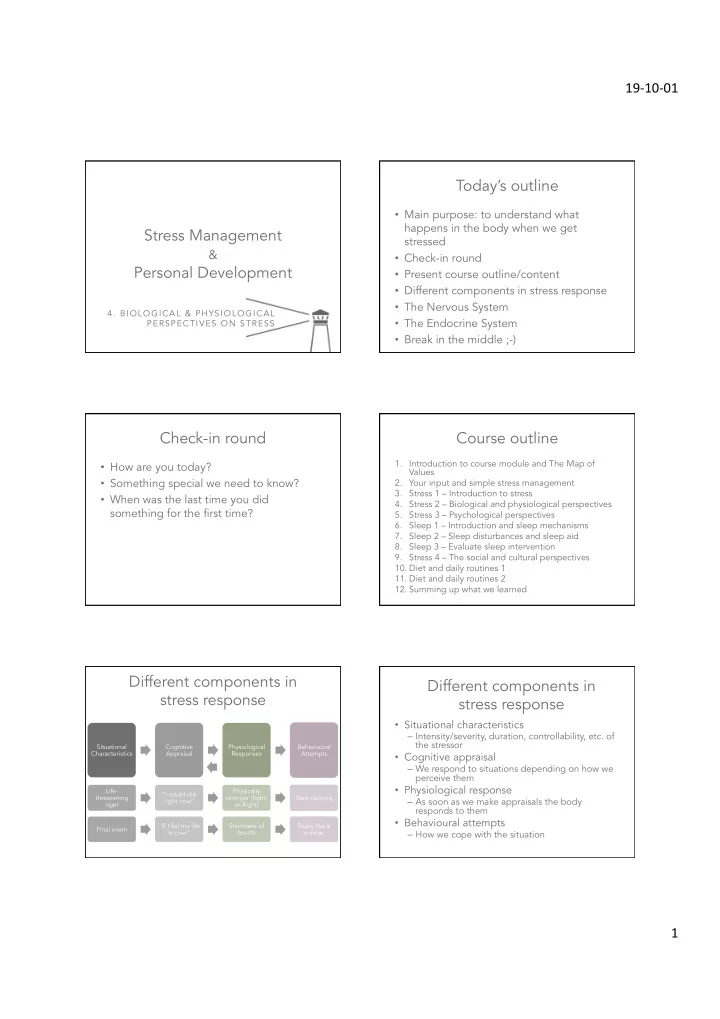
Today’s outline

  • Main purpose: to understand what

happens in the body when we get stressed

  • Check-in round
  • Present course outline/content
  • Different components in stress response
  • The Nervous System
  • The Endocrine System
  • Break in the middle ;-)

Check-in round

  • How are you today?
  • Something special we need to know?
  • When was the last time you did

something for the first time?

Course outline

  • 1. Introduction to course module and The Map of

Values

  • 2. Your input and simple stress management
  • 3. Stress 1 – Introduction to stress
  • 4. Stress 2 – Biological and physiological perspectives
  • 5. Stress 3 – Psychological perspectives
  • 6. Sleep 1 – Introduction and sleep mechanisms
  • 7. Sleep 2 – Sleep disturbances and sleep aid
  • 8. Sleep 3 – Evaluate sleep intervention
  • 9. Stress 4 – The social and cultural perspectives
  • 10. Diet and daily routines 1
  • 11. Diet and daily routines 2
  • 12. Summing up what we learned

Different components in stress response

Situational Characteristics Cognitive Appraisal Physiological Responses Behavioural Attempts Life- threatening tiger “I could die right now” Physically stronger (fight-

  • r-flight)

Start running Final exam “If I fail my life is over” Shortness of breath Study like a maniac

  • Situational characteristics

– Intensity/severity, duration, controllability, etc. of the stressor

  • Cognitive appraisal

– We respond to situations depending on how we perceive them

  • Physiological response

– As soon as we make appraisals the body responds to them

  • Behavioural attempts

– How we cope with the situation

Different components in stress response

slide-2
SLIDE 2

19-­‑10-­‑01 ¡ 2 ¡

Biological & Physiological perspectives on stress

  • Physiological response to mobilize energy
  • We need our stress systems to survive
  • Stress is not bad or dangerous
  • Positive vs. negative stress
  • Two main systems involved in stress:

– Sympathetic nervous system – HPA axis (endocrine system à stress hormones)

Physiological stress systems

  • The Autonomic Nervous System (ANS)

– Sympathetic Nervous System (SNS) – Activates our body

  • HPA axis

– Hypothalamus, Pituitary gland, Adrenal glands – Stress hormones

  • The Immune System

– Acute stress enhances – Chronic stress supresses

  • Amygdala

– Organizes motivational and emotional response patterns (fear and aggression) – Signals danger! – Unconscious emotional response

Stress in the Nervous System

The Nervous System

Spinal Cord Brain Central Nervous System (CNS) Peripheral Nervous System (PNS) Somatic System Autonomic System Sympathetic Parasympathetic

Stress in the Nervous System

The Nervous System

Spinal Cord Brain Central Nervous System (CNS) Peripheral Nervous System (PNS) Somatic System Autonomic System Sympathetic Parasympathetic

Parasympathetic Sympathetic

Contracts pupils

Eyes

Dilates pupils (enhance vision) Constricts bronchi

Lungs

Relaxes bronchi (increased air to lungs) Slows heart beat

Heart

Strengthens heart beat (increased oxygen) Stimulates activity

Stomach /intestines

Inhibits activity (blood sent to muscles) Dilates vessels

Blood vessels

  • f internal organs

Contracts vessels (increased blood pressure)

Autonomic Nervous System

  • The system of the hormones
  • Hormones = chemical messengers
  • Numerous hormone-secreting glands:

– Hypothalamus – Pituitary – Thyroid – Adrenal – Pancreas – Ovaries (females) – Testes (males)

  • HPA axis for stress response
  • Adrenal à the stress hormones

The Endocrine System

slide-3
SLIDE 3

19-­‑10-­‑01 ¡ 3 ¡

The Endocrine System

  • Stress hormones:

– Adrenalin (epinephrine) – Noradrenaline (norepinephrine) – Cortisol

  • Short-term positive stress
  • Long-term negative stress
  • Stress hormones suppress immune system

functioning

The HPA axis

  • Hypothalamus (CRF/CRH)
  • Pituitary gland (ACTH)
  • Adrenal gland (cortisol)

Summary

  • Stress response have several components:

– Situational (stressors’ characteristics) – Cognitive (how we perceive situation) – Physiological (body responds, prepares us) – Behavioural (we act)

  • Two major stress systems:

– SNS (activates; blood, oxygen, vision…) – HPA (secretes stress hormones)

  • Stress response, an awesome system for survival!
  • Positive, short-term stress is okay
  • Negative, long-term stress à disease

Until next time…

  • Doing one thing differently per day:

– Balance activity with rest – Focus on your main activity – Do something slowly

  • Follow-up group contract
  • Don’t forget area 5-8 in the map of values

(until next Thursday)

  • See you Thursday!