Todays Agenda 08:30 Welcome and broader context (Saman Amarasinghe) - - PowerPoint PPT Presentation

today s agenda
SMART_READER_LITE
LIVE PREVIEW

Todays Agenda 08:30 Welcome and broader context (Saman Amarasinghe) - - PowerPoint PPT Presentation

Todays Agenda 08:30 Welcome and broader context (Saman Amarasinghe) 08:40 Introduction to OpenTuner (Jason Ansel) 09:10 Search techniques (Kalyan Veeramachaneni) 09:35 In depth example (Jeffrey Bosboom) 10:00 Break 10:15


slide-1
SLIDE 1

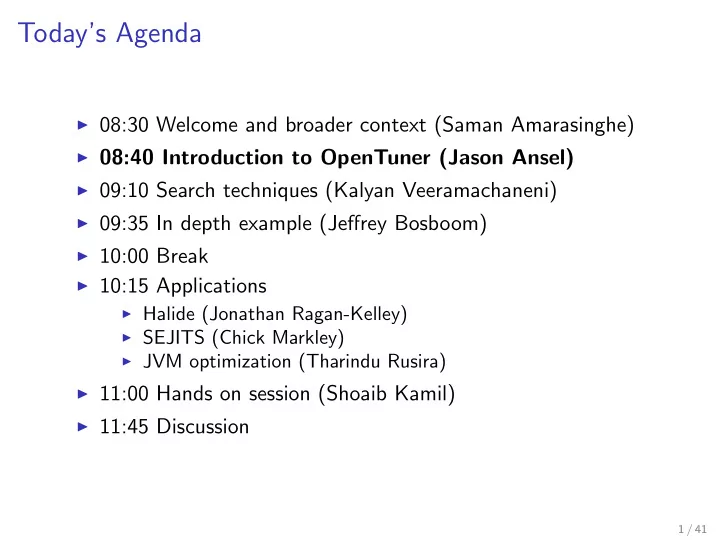
Today’s Agenda

◮ 08:30 Welcome and broader context (Saman Amarasinghe) ◮ 08:40 Introduction to OpenTuner (Jason Ansel) ◮ 09:10 Search techniques (Kalyan Veeramachaneni) ◮ 09:35 In depth example (Jeffrey Bosboom) ◮ 10:00 Break ◮ 10:15 Applications

◮ Halide (Jonathan Ragan-Kelley) ◮ SEJITS (Chick Markley) ◮ JVM optimization (Tharindu Rusira)

◮ 11:00 Hands on session (Shoaib Kamil) ◮ 11:45 Discussion

1 / 41

slide-2
SLIDE 2

Introduction to OpenTuner

Jason Ansel

MIT - CSAIL

Febuary 8, 2015

2 / 41

slide-3
SLIDE 3

Raytracer Example

An example ray tracer program: raytracer.cpp

3 / 41

slide-4
SLIDE 4

Raytracer Example

An example ray tracer program: raytracer.cpp

$ g++ −O3 −o r a y t r a c e r a r a y t r a c e r . cpp $ time ./ r a y t r a c e r a . / r a y t r a c e r a 0.17 s u s e r 0.00 s system 99% cpu 0.175 t o t a l 3 / 41

slide-5
SLIDE 5

Raytracer Example

An example ray tracer program: raytracer.cpp

$ g++ −O3 −o r a y t r a c e r a r a y t r a c e r . cpp $ time ./ r a y t r a c e r a . / r a y t r a c e r a 0.17 s u s e r 0.00 s system 99% cpu 0.175 t o t a l

1.47x speedup with:

$ g++ −O3 −o r a y t r a c e r b apps / r a y t r a c e r . cpp −funsafe−math−o p t i m i z a t i o n s −fwrapv ֒ → −fno−expensive−o p t i m i z a t i o n s − −param=max−peel−branches =115 −fweb −fno− ֒ → cx−f o r t r a n −r u l e s − −param=max−i n l i n e −r e c u r s i v e −depth=25 −fno−btr−bb− ֒ → e x c l u s i v e −fno−tree−ch − −param=iv−max−considered−uses=69 −fgcse−l a s − ֒ → f t r e e −loop−d i s t r i b u t i o n − −param=max−goto−d u p l i c a t i o n −i n s n s =11 − −param= ֒ → max−h o i s t−depth=44 −fsched−s t a l l e d −insns−dep − −param=max−once−peeled− ֒ → i n s n s =165 − −param=max−p i p e l i n e −region−i n s n s =316 − −param=iv−c o n s i d e r−a l l ֒ → −candidates−bound=75 $ time ./ r a y t r a c e r b . / r a y t r a c e r b 0.12 s u s e r 0.00 s system 99% cpu 0.119 t o t a l 3 / 41

slide-6
SLIDE 6

iv-consider-all-candidates-bound what???

This command is brittle and confusing:

$ g++ −O3 −o r a y t r a c e r b apps / r a y t r a c e r . cpp −funsafe−math−o p t i m i z a t i o n s −fwrapv ֒ → −fno−expensive−o p t i m i z a t i o n s − −param=max−peel−branches =115 −fweb −fno− ֒ → cx−f o r t r a n −r u l e s − −param=max−i n l i n e −r e c u r s i v e −depth=25 −fno−btr−bb− ֒ → e x c l u s i v e −fno−tree−ch − −param=iv−max−considered−uses=69 −fgcse−l a s − ֒ → f t r e e −loop−d i s t r i b u t i o n − −param=max−goto−d u p l i c a t i o n −i n s n s =11 − −param= ֒ → max−h o i s t−depth=44 −fsched−s t a l l e d −insns−dep − −param=max−once−peeled− ֒ → i n s n s =165 − −param=max−p i p e l i n e −region−i n s n s =316 − −param=iv−c o n s i d e r−a l l ֒ → −candidates−bound=75 4 / 41

slide-7
SLIDE 7

iv-consider-all-candidates-bound what???

This command is brittle and confusing:

$ g++ −O3 −o r a y t r a c e r b apps / r a y t r a c e r . cpp −funsafe−math−o p t i m i z a t i o n s −fwrapv ֒ → −fno−expensive−o p t i m i z a t i o n s − −param=max−peel−branches =115 −fweb −fno− ֒ → cx−f o r t r a n −r u l e s − −param=max−i n l i n e −r e c u r s i v e −depth=25 −fno−btr−bb− ֒ → e x c l u s i v e −fno−tree−ch − −param=iv−max−considered−uses=69 −fgcse−l a s − ֒ → f t r e e −loop−d i s t r i b u t i o n − −param=max−goto−d u p l i c a t i o n −i n s n s =11 − −param= ֒ → max−h o i s t−depth=44 −fsched−s t a l l e d −insns−dep − −param=max−once−peeled− ֒ → i n s n s =165 − −param=max−p i p e l i n e −region−i n s n s =316 − −param=iv−c o n s i d e r−a l l ֒ → −candidates−bound=75

◮ Specific to:

◮ raytracer.cpp ◮ Same flags are 1.42x slower than -O1 for fft.c ◮ GCC 4.8.2-19ubuntu1 ◮ Intel Core i7-4770S 4 / 41

slide-8
SLIDE 8

iv-consider-all-candidates-bound what???

This command is brittle and confusing:

$ g++ −O3 −o r a y t r a c e r b apps / r a y t r a c e r . cpp −funsafe−math−o p t i m i z a t i o n s −fwrapv ֒ → −fno−expensive−o p t i m i z a t i o n s − −param=max−peel−branches =115 −fweb −fno− ֒ → cx−f o r t r a n −r u l e s − −param=max−i n l i n e −r e c u r s i v e −depth=25 −fno−btr−bb− ֒ → e x c l u s i v e −fno−tree−ch − −param=iv−max−considered−uses=69 −fgcse−l a s − ֒ → f t r e e −loop−d i s t r i b u t i o n − −param=max−goto−d u p l i c a t i o n −i n s n s =11 − −param= ֒ → max−h o i s t−depth=44 −fsched−s t a l l e d −insns−dep − −param=max−once−peeled− ֒ → i n s n s =165 − −param=max−p i p e l i n e −region−i n s n s =316 − −param=iv−c o n s i d e r−a l l ֒ → −candidates−bound=75

◮ Specific to:

◮ raytracer.cpp ◮ Same flags are 1.42x slower than -O1 for fft.c ◮ GCC 4.8.2-19ubuntu1 ◮ Intel Core i7-4770S

◮ Autotuners can help!

4 / 41

slide-9
SLIDE 9

How to Autotune a Program

Program

5 / 41

slide-10
SLIDE 10

How to Autotune a Program

Program Search Space Definition Run Method

Executes

5 / 41

slide-11
SLIDE 11

How to Autotune a Program

Configuration

Program Search Space Definition Run Method

Measurement Executes

Program Autotuner Machine Learning Search Technique(s)

5 / 41

slide-12
SLIDE 12

How to Autotune a Program

Configuration

Program Search Space Definition Run Method

Measurement Executes

Program Autotuner Machine Learning Search Technique(s) Optimized Configuration

5 / 41

slide-13
SLIDE 13

OpenTuner

◮ OpenTuner is an general framework for program autotuning

◮ Extensible configuration representation ◮ Uses ensembles of techniques to provide robustness to different

search spaces

Search Space Definition Run Method (1) (2)

6 / 41

slide-14
SLIDE 14

OpenTuner

◮ OpenTuner is an general framework for program autotuning

◮ Extensible configuration representation ◮ Uses ensembles of techniques to provide robustness to different

search spaces

◮ As an example, lets implement a GCC flags autotuner with

OpenTuner

Search Space Definition Run Method (1) (2)

6 / 41

slide-15
SLIDE 15

Define the Search Space with OpenTuner

◮ Optimization level: O0, O1, O2, O3

manipulator = ConfigurationManipulator ( ) manipulator . add parameter ( IntegerParameter ( ’ o p t l e v e l ’ , 0 , 3) ) 7 / 41

slide-16
SLIDE 16

Define the Search Space with OpenTuner

◮ Optimization level: O0, O1, O2, O3

manipulator = ConfigurationManipulator ( ) manipulator . add parameter ( IntegerParameter ( ’ o p t l e v e l ’ , 0 , 3) )

◮ On/off flags, eg: ’-falign-functions’ vs

’-fno-align-functions’

GCC FLAGS = [ ’ a l i g n−f u n c t i o n s ’ , ’ a l i g n−jumps ’ , ’ a l i g n−l a b e l s ’ , ’ branch−count−reg ’ , ’ branch−p r o b a b i l i t i e s ’ , # . . . (176 t o t a l ) ] f o r f l a g i n GCC FLAGS : manipulator . add parameter ( EnumParameter ( f l a g , [ ’ on ’ , ’ o f f ’ , ’ d e f a u l t ’ ] ) ) 7 / 41

slide-17
SLIDE 17

Define the Search Space with OpenTuner

◮ Optimization level: O0, O1, O2, O3

manipulator = ConfigurationManipulator ( ) manipulator . add parameter ( IntegerParameter ( ’ o p t l e v e l ’ , 0 , 3) )

◮ On/off flags, eg: ’-falign-functions’ vs

’-fno-align-functions’

GCC FLAGS = [ ’ a l i g n−f u n c t i o n s ’ , ’ a l i g n−jumps ’ , ’ a l i g n−l a b e l s ’ , ’ branch−count−reg ’ , ’ branch−p r o b a b i l i t i e s ’ , # . . . (176 t o t a l ) ] f o r f l a g i n GCC FLAGS : manipulator . add parameter ( EnumParameter ( f l a g , [ ’ on ’ , ’ o f f ’ , ’ d e f a u l t ’ ] ) )

◮ Parameters, eg: ’--param early-inlining-insns=512’

# (name , min , max) GCC PARAMS = [ ( ’ e a r l y −i n l i n i n g −i n s n s ’ , 0 , 1000) , ( ’ gcse−cost−d i s t a n c e−r a t i o ’ , 0 , 100) , # . . . (145 t o t a l ) ] f o r param , min val , max val i n GCC PARAMS: manipulator . add parameter ( IntegerParameter ( param , min val , max val ) ) 7 / 41

slide-18
SLIDE 18

Defining the Run Function

◮ Optimization level: O0, O1, O2, O3

def run ( s e l f , d e s i r e d r e s u l t , program input , l i m i t ) : cfg = d e s i r e d r e s u l t . c o n f i g u r a t i o n . data gcc cmd = ’ g++ r a y t r a c e r . cpp −o . / tmp . bin ’ gcc cmd += ’ − O{0} ’ . format ( cfg [ ’ o p t l e v e l ’ ] ) 8 / 41

slide-19
SLIDE 19

Defining the Run Function

◮ Optimization level: O0, O1, O2, O3

def run ( s e l f , d e s i r e d r e s u l t , program input , l i m i t ) : cfg = d e s i r e d r e s u l t . c o n f i g u r a t i o n . data gcc cmd = ’ g++ r a y t r a c e r . cpp −o . / tmp . bin ’ gcc cmd += ’ − O{0} ’ . format ( cfg [ ’ o p t l e v e l ’ ] )

◮ On/off flags:

f o r f l a g i n GCC FLAGS : i f cfg [ f l a g ] == ’ on ’ : gcc cmd += ’ −f {0} ’ . format ( f l a g ) e l i f cfg [ f l a g ] == ’ o f f ’ : gcc cmd += ’ −fno −{0} ’ . format ( f l a g )

◮ Parameters:

f o r param , min value , max value i n GCC PARAMS: gcc cmd += ’ − −param {0}={1} ’ . format ( param , cfg [ param ] ) 8 / 41

slide-20
SLIDE 20

Defining the Run Function

◮ Optimization level: O0, O1, O2, O3

def run ( s e l f , d e s i r e d r e s u l t , program input , l i m i t ) : cfg = d e s i r e d r e s u l t . c o n f i g u r a t i o n . data gcc cmd = ’ g++ r a y t r a c e r . cpp −o . / tmp . bin ’ gcc cmd += ’ − O{0} ’ . format ( cfg [ ’ o p t l e v e l ’ ] )

◮ On/off flags:

f o r f l a g i n GCC FLAGS : i f cfg [ f l a g ] == ’ on ’ : gcc cmd += ’ −f {0} ’ . format ( f l a g ) e l i f cfg [ f l a g ] == ’ o f f ’ : gcc cmd += ’ −fno −{0} ’ . format ( f l a g )

◮ Parameters:

f o r param , min value , max value i n GCC PARAMS: gcc cmd += ’ − −param {0}={1} ’ . format ( param , cfg [ param ] )

◮ Measure how well it performs:

c o m p i l e r e s u l t = s e l f . call program ( gcc cmd ) r u n r e s u l t = s e l f . call program ( ’ . / tmp . bin ’ ) return R e s u l t ( time=r u n r e s u l t [ ’ time ’ ] ) 8 / 41

slide-21
SLIDE 21

OpenTuner Results for GCC Flags

0.4 0.45 0.5 0.55 0.6 0.65 0.7 0.75 300 600 900 1200 1500 1800 Execution Time (seconds) Autotuning Time (seconds) g++ -O1 g++ -O2 g++ -O3 OpenTuner

Autotune GCC flags for Ray Tracer. Median of 30 runs, error bars are 20th and 80th percentiles.

9 / 41

slide-22
SLIDE 22

OpenTuner Results for GCC Flags

0.4 0.45 0.5 0.55 0.6 300 600 900 1200 1500 1800 Execution Time (seconds) Autotuning Time (seconds) g++ -O1 g++ -O2 g++ -O3 OpenTuner

Autotune GCC flags for TSP GA. Median of 30 runs, error bars are 20th and 80th percentiles.

10 / 41

slide-23
SLIDE 23

OpenTuner Results for GCC Flags

0.8 0.85 0.9 0.95 1 300 600 900 1200 1500 1800 Execution Time (seconds) Autotuning Time (seconds) gcc -O1 gcc -O2 gcc -O3 OpenTuner

Autotune GCC flags for FFT. Median of 30 runs, error bars are 20th and 80th percentiles.

11 / 41

slide-24
SLIDE 24

OpenTuner Results for GCC Flags

0.1 0.15 0.2 0.25 0.3 300 600 900 1200 1500 1800 Execution Time (seconds) Autotuning Time (seconds) g++ -O1 g++ -O2 g++ -O3 OpenTuner

Autotune GCC flags for Matrix Multiply. Median of 30 runs, error bars are 20th and 80th percentiles.

12 / 41

slide-25
SLIDE 25

Related Projects

A small selection of many related projects:

Package Domain Search Method ATLAS Dense Linear Algebra Exhaustive Code Perforation Compiler Exhaustive + Simulated Annealing FFTW Fast Fourier Transform Exhaustive / Dynamic Prog. OSKI Sparse Linear Algebra Exhaustive + Heuristic Periscope HPC Exhaustive + Nelder-Mead Active Harmony Runtime System Nelder-Mead PATUS Stencil Computations Nelder-Mead or Evolutionary Sepya Stencil Computations Random-Restart Gradient Ascent Dynamic Knobs Runtime System Control Theory Milepost GCC / cTuning Compiler IID Model + Central DB SEEC / Heartbeats Runtime System Control Theory Insieme Compiler Differential Evolution PetaBricks Programming Language Bottom-up Evolutionary SPIRAL DSP Algorithms Pareto Active Learning

13 / 41

slide-26
SLIDE 26

Related Projects

A small selection of many related projects:

Package Domain Search Method ATLAS Dense Linear Algebra Exhaustive Code Perforation Compiler Exhaustive + Simulated Annealing FFTW Fast Fourier Transform Exhaustive / Dynamic Prog. OSKI Sparse Linear Algebra Exhaustive + Heuristic Periscope HPC Exhaustive + Nelder-Mead Active Harmony Runtime System Nelder-Mead PATUS Stencil Computations Nelder-Mead or Evolutionary Sepya Stencil Computations Random-Restart Gradient Ascent Dynamic Knobs Runtime System Control Theory Milepost GCC / cTuning Compiler IID Model + Central DB SEEC / Heartbeats Runtime System Control Theory Insieme Compiler Differential Evolution PetaBricks Programming Language Bottom-up Evolutionary SPIRAL DSP Algorithms Pareto Active Learning ◮ Simple techniques (exhaustive, hill climbers, etc) are popular

◮ No single technique is best for all problems

◮ Representations are often just integers/floats/booleans

13 / 41

slide-27
SLIDE 27

Limits of Current Approaches

◮ We believe simple techniques limit the scope and efficiency of

autotuning

◮ A hill climber works great for a block size, but fails for more

complex applications

◮ Many users of autotuning work hard to prune their search

spaces to fit techniques such as exhaustive search

14 / 41

slide-28
SLIDE 28

Limits of Current Approaches

◮ We believe simple techniques limit the scope and efficiency of

autotuning

◮ A hill climber works great for a block size, but fails for more

complex applications

◮ Many users of autotuning work hard to prune their search

spaces to fit techniques such as exhaustive search

◮ Real problems have large search spaces

14 / 41

slide-29
SLIDE 29

Over 10806 Combinations of GCC Optimizations

g++ apps/raytracer.cpp -o ./raytracer c -O3 -fno-align-functions -fno-align-loops -fasynchronous-unwind-tables -fbranch-count-reg -fbranch-probabilities

  • fno-branch-target-load-optimize -fbtr-bb-exclusive -fno-combine-stack-adjustments -fno-common -fcompare-elim -fcrossjumping -fcse-follow-jumps
  • fcx-fortran-rules -fcx-limited-range -fdata-sections -fno-dce -fdelete-null-pointer-checks -fno-devirtualize -fno-dse -fearly-inlining -fexceptions
  • ffinite-math-only -fforward-propagate -fgcse -fgcse-after-reload -fno-gcse-las -fno-graphite-identity -fno-if-conversion2 -fno-inline-functions
  • fno-inline-small-functions -fno-ipa-cp -fno-ipa-matrix-reorg -fno-ipa-profile -fno-ipa-pta -fipa-pure-const -fipa-reference -fno-ipa-sra -fno-ivopts
  • fno-loop-block -fno-loop-flatten -floop-interchange -fno-loop-parallelize-all -floop-strip-mine -fmath-errno -fno-merge-all-constants -fno-modulo-sched
  • fno-non-call-exceptions -fno-optimize-sibling-calls -fno-optimize-strlen -fpeel-loops -fpeephole -fno-peephole2 -fno-predictive-commoning
  • fno-prefetch-loop-arrays -fno-reg-struct-return -fno-regmove -frename-registers -fno-reorder-blocks -freorder-blocks-and-partition -freorder-functions
  • fno-rerun-cse-after-loop -fno-rounding-math -fno-rtti -fno-sched-critical-path-heuristic -fno-sched-dep-count-heuristic -fno-sched-group-heuristic
  • fno-sched-interblock -fno-sched-pressure -fsched-rank-heuristic -fsched-spec-insn-heuristic -fsched-spec-load -fno-sched-stalled-insns -fsched-stalled-insns-dep
  • fno-sched2-use-superblocks -fno-schedule-insns -fschedule-insns2 -fno-sel-sched-pipelining -fno-sel-sched-pipelining-outer-loops -fsel-sched-reschedule-pipelined
  • fno-short-wchar -fno-shrink-wrap -fsignaling-nans -fsingle-precision-constant -fno-split-ivs-in-unroller -fstrict-enums -fno-thread-jumps
  • ftrapping-math -fno-trapv -fno-tree-builtin-call-dce -fno-tree-ccp -fno-tree-copy-prop -ftree-copyrename -fno-tree-cselim -fno-tree-dce -ftree-dse
  • fno-tree-forwprop -ftree-fre -ftree-loop-distribute-patterns -fno-tree-loop-distribution -ftree-loop-if-convert -fno-tree-loop-if-convert-stores
  • fno-tree-loop-ivcanon -ftree-pta -fno-tree-reassoc -fno-tree-scev-cprop -fno-tree-slp-vectorize -ftree-sra -ftree-switch-conversion -fno-tree-ter
  • fno-tree-vectorize -ftree-vrp -fno-unit-at-a-time -fno-unroll-all-loops -fno-unroll-loops -funsafe-loop-optimizations -funwind-tables -fno-var-tracking
  • fvar-tracking-assignments-toggle -fno-var-tracking-uninit -fno-vect-cost-model -fno-vpt -fweb -fwhole-program -fwrapv --param=align-loop-iterations=16
  • -param=align-threshold=28 --param=allow-load-data-races=1 --param=allow-packed-load-data-races=1 --param=allow-packed-store-data-races=0
  • -param=allow-store-data-races=1 --param=case-values-threshold=3 --param=comdat-sharing-probability=14 --param=cxx-max-namespaces-for-diagnostic-help=1008
  • -param=early-inlining-insns=19 --param=gcse-after-reload-critical-fraction=15 --param=gcse-after-reload-partial-fraction=10 --param=gcse-cost-distance-ratio=14
  • -param=gcse-unrestricted-cost=5 --param=ggc-min-expand=66 --param=ggc-min-heapsize=15449 --param=graphite-max-bbs-per-function=248 --param=graphite-max-nb-scop-params=10
  • -param=hot-bb-count-ws-permille=271 --param=hot-bb-frequency-fraction=2357 --param=inline-min-speedup=36 --param=inline-unit-growth=26 --param=integer-share-limit=511
  • -param=ipa-cp-eval-threshold=222 --param=ipa-cp-loop-hint-bonus=18 --param=ipa-cp-value-list-size=18 --param=ipa-max-agg-items=13 --param=ipa-sra-ptr-growth-factor=6
  • -param=ipcp-unit-growth=3 --param=ira-loop-reserved-regs=8 --param=ira-max-conflict-table-size=261 --param=ira-max-loops-num=25 --param=iv-always-prune-cand-set-bound=17
  • -param=iv-consider-all-candidates-bound=26 --param=iv-max-considered-uses=85 --param=l1-cache-line-size=128 --param=l1-cache-size=24 --param=l2-cache-size=356
  • -param=large-function-growth=237 --param=large-function-insns=4444 --param=large-stack-frame=431 --param=large-stack-frame-growth=250 --param=large-unit-insns=2520
  • -param=lim-expensive=10 --param=loop-block-tile-size=40 --param=loop-invariant-max-bbs-in-loop=2500 --param=loop-max-datarefs-for-datadeps=816
  • -param=lto-min-partition=261 --param=lto-partitions=96 --param=max-average-unrolled-insns=22 --param=max-completely-peel-loop-nest-depth=18
  • -param=max-completely-peel-times=31 --param=max-completely-peeled-insns=325 --param=max-crossjump-edges=30 --param=max-cse-insns=251 --param=max-cse-path-length=8
  • -param=max-cselib-memory-locations=1202 --param=max-delay-slot-insn-search=137 --param=max-delay-slot-live-search=84 --param=max-dse-active-local-stores=1250
  • -param=max-early-inliner-iterations=2 --param=max-fields-for-field-sensitive=0 --param=max-gcse-insertion-ratio=50 --param=max-gcse-memory=13107200
  • -param=max-goto-duplication-insns=15 --param=max-grow-copy-bb-insns=23 --param=max-hoist-depth=101 --param=max-inline-insns-auto=43 --param=max-inline-insns-recursive=126
  • -param=max-inline-insns-recursive-auto=135 --param=max-inline-insns-single=421 --param=max-inline-recursive-depth=24 --param=max-inline-recursive-depth-auto=28
  • -param=max-iterations-computation-cost=24 --param=max-iterations-to-track=253 --param=max-jump-thread-duplication-stmts=21 --param=max-last-value-rtl=2794
  • -param=max-modulo-backtrack-attempts=14 --param=max-once-peeled-insns=105 --param=max-partial-antic-length=25 --param=max-peel-branches=84
  • -param=max-peel-times=23 --param=max-peeled-insns=25 --param=max-pending-list-length=10 --param=max-pipeline-region-blocks=44 --param=max-pipeline-region-insns=578
  • -param=max-predicted-iterations=28 --param=max-reload-search-insns=356 --param=max-sched-extend-regions-iters=1 --param=max-sched-insn-conflict-delay=1
  • -param=max-sched-ready-insns=101 --param=max-sched-region-blocks=15 --param=max-sched-region-insns=36 --param=max-slsr-cand-scan=12 --param=max-stores-to-sink=2
  • -param=max-tail-merge-comparisons=24 --param=max-tail-merge-iterations=1 --param=max-tracked-strlens=351 --param=max-unroll-times=26 --param=max-unrolled-insns=570
  • -param=max-unswitch-insns=17 --param=max-unswitch-level=11 --param=max-variable-expansions-in-unroller=0 --param=max-vartrack-expr-depth=14
  • -param=max-vartrack-reverse-op-size=15 --param=max-vartrack-size=12500164 --param=min-crossjump-insns=18 --param=min-inline-recursive-probability=9
  • -param=min-insn-to-prefetch-ratio=23 --param=min-spec-prob=15 --param=min-vect-loop-bound=2 --param=omega-eliminate-redundant-constraints=0
  • -param=omega-hash-table-size=138 --param=omega-max-eqs=43 --param=omega-max-geqs=68 --param=omega-max-keys=378 --param=omega-max-vars=32
  • -param=omega-max-wild-cards=55 --param=partial-inlining-entry-probability=68 --param=predictable-branch-outcome=0 --param=prefetch-latency=115
  • -param=prefetch-min-insn-to-mem-ratio=2 --param=sccvn-max-alias-queries-per-access=2543 --param=sccvn-max-scc-size=2504 --param=scev-max-expr-complexity=32
  • -param=scev-max-expr-size=45 --param=sched-mem-true-dep-cost=0 --param=sched-pressure-algorithm=1 --param=sched-spec-prob-cutoff=79 --param=sched-state-edge-prob-cutoff=2
  • -param=selsched-insns-to-rename=6 --param=selsched-max-lookahead=14 --param=selsched-max-sched-times=1 --param=simultaneous-prefetches=9
  • -param=sink-frequency-threshold=53 --param=slp-max-insns-in-bb=279 --param=sms-dfa-history=3 --param=sms-loop-average-count-threshold=2
  • -param=sms-max-ii-factor=35 --param=sms-min-sc=3 --param=ssp-buffer-size=13 --param=switch-conversion-max-branch-ratio=2 --param=tm-max-aggregate-size=32
  • -param=tracer-dynamic-coverage=66 --param=tracer-dynamic-coverage-feedback=46 --param=tracer-max-code-growth=200 --param=tracer-min-branch-probability=82
  • -param=tracer-min-branch-probability-feedback=70 --param=tracer-min-branch-ratio=21 --param=tree-reassoc-width=2 --param=uninit-control-dep-attempts=415
  • -param=use-canonical-types=0 --param=vect-max-version-for-alias-checks=11 --param=vect-max-version-for-alignment-checks=23

15 / 41

slide-30
SLIDE 30

Large Search Spaces are a Challenge

Project Benchmark Possible Configurations GCC/G++ Flags all 10806 Halide Blur 1025 Halide Wavelet 1032 Halide Bilateral 10176 HPL n/a 109.9 PetaBricks Poisson 103657 PetaBricks Sort 1090 PetaBricks Strassen 10188 PetaBricks TriSolve 101559 Stencil all 106.5 Unitary n/a 1021 Mario n/a 106328

16 / 41

slide-31
SLIDE 31

OpenTuner’s General Representation

◮ Large search spaces do not mean haphazard ones ◮ Choosing the right representation is critical ◮ OpenTuner allows programmers to easily express structured

search spaces

◮ Supports complex parameter types such as permutations,

schedules, mappings

◮ User defined parameter types 17 / 41

slide-32
SLIDE 32

OpenTuner Model

Configuration Manipulator Configuration Data Meta Technique Parameter Parameter Configuration Data Parameter Technique Technique Technique Measurement Run Method Objective Configuration Data Results

18 / 41

slide-33
SLIDE 33

OpenTuner Configuration Manipulator Parameters

Parameter Primitive Complex Integer ScaledNumeric Float LogInteger LogFloat PowerOfTwo Switch Enum Permutation Schedule Selector Boolean

◮ Hierarchical structure of parameters, user defined parameter

types can be added at any point

◮ Primitive parameters behave like bounded integers or floats ◮ Complex parameters have a set of stochastic mutation

  • perators

◮ Technique-specific operators

19 / 41

slide-34
SLIDE 34

Ensembles of Techniques

◮ OpenTuner contains many techniques such as:

◮ Differential Evolution ◮ Genetic Algorithms ◮ Greedy Mutation ◮ Multi-armed Bandit ◮ Nelder Mead ◮ Partial Swarm Optimization ◮ Pattern Search ◮ Pseudo Annealing ◮ Torczon

◮ Uses ensembles of techniques to provide robustness to

different search spaces

20 / 41

slide-35
SLIDE 35

Ensembles of Techniques in OpenTuner

Differential Evolution Particle Swarm Optimization Torczon Hill Climber

21 / 41

slide-36
SLIDE 36

Ensembles of Techniques in OpenTuner

Differential Evolution Particle Swarm Optimization Torczon Hill Climber Information sharing through ResultsDB

21 / 41

slide-37
SLIDE 37

Ensembles of Techniques in OpenTuner

Differential Evolution Particle Swarm Optimization Torczon Hill Climber Information sharing through ResultsDB AUC Bandit

21 / 41

slide-38
SLIDE 38

Ensembles of Techniques in OpenTuner

Differential Evolution Particle Swarm Optimization Torczon Hill Climber Information sharing through ResultsDB AUC Bandit Which configuration should we try next?

?

21 / 41

slide-39
SLIDE 39

Ensembles of Techniques in OpenTuner

Differential Evolution Particle Swarm Optimization Torczon Hill Climber Information sharing through ResultsDB AUC Bandit Which configuration should we try next? 33%

Exploration

33% 33%

21 / 41

slide-40
SLIDE 40

Ensembles of Techniques in OpenTuner

Differential Evolution Particle Swarm Optimization Torczon Hill Climber Information sharing through ResultsDB AUC Bandit Which configuration should we try next? 100%

Exploitation

0% 0%

21 / 41

slide-41
SLIDE 41

AUC Bandit1

◮ |H| is the length of the sliding history window ◮ Ht is the number of times the technique has been used in that

history window,

◮ C is a constant controlling the exploration/exploitation

trade-off

◮ AUC t is the credit assignment term

1Based on strategy in Fialho PPSN’10 22 / 41

slide-42
SLIDE 42

AUC Bandit1

Exploitation Exploration

◮ |H| is the length of the sliding history window ◮ Ht is the number of times the technique has been used in that

history window,

◮ C is a constant controlling the exploration/exploitation

trade-off

◮ AUC t is the credit assignment term

1Based on strategy in Fialho PPSN’10 22 / 41

slide-43
SLIDE 43

OpenTuner System Overview

Results Database Search Techniques Search Driver Search

Reads: Results Writes: Desired Results

Measurement User Defined Measurement Function Measurement Driver Configuration Manipulator

Reads: Desired Results Writes: Results

23 / 41

slide-44
SLIDE 44

Conclusions

◮ A lot of performance is left on the

floor due to poorly optimized programs

◮ OpenTuner makes state of the art

machine learning accessible to all

◮ Extensible configuration

representation

◮ Ensembles of techniques

◮ Conventional wisdom

underestimates the size tractable search spaces

◮ However, choosing the right

representation is critical to successful autouners

http://opentuner.org/

24 / 41

slide-45
SLIDE 45

Today’s Agenda

◮ 08:30 Welcome and broader context (Saman Amarasinghe) ◮ 08:40 Introduction to OpenTuner (Jason Ansel) ◮ 09:10 Search techniques (Kalyan Veeramachaneni) ◮ 09:35 In depth example (Jeffrey Bosboom) ◮ 10:00 Break ◮ 10:15 Applications

◮ Halide (Jonathan Ragan-Kelley) ◮ SEJITS (Chick Markley) ◮ JVM optimization (Tharindu Rusira)

◮ 11:00 Hands on session (Shoaib Kamil) ◮ 11:45 Discussion

25 / 41

slide-46
SLIDE 46

Backup Slides: Mario

26 / 41

slide-47
SLIDE 47

OpenTuner Can Play Super Mario Bros!

(Video 2)

2http://youtu.be/pTi_tHpj6Ow 27 / 41

slide-48
SLIDE 48

OpenTuner Can Play Super Mario Bros!

◮ Only feedback is number of pixels moved to the right

◮ e.g. approximately 1500 pixels for first pit

◮ OpenTuner doesn’t see the screen ◮ Super Mario Bros is deterministic, single run suffices

28 / 41

slide-49
SLIDE 49

Naive Representation

3http://youtu.be/nyYdq1jJQrw 29 / 41

slide-50
SLIDE 50

Naive Representation

◮ Bad, because most configurations make no sense. ◮ Just mashing random buttons. ◮ Doesn’t work at all (Video 3).

3http://youtu.be/nyYdq1jJQrw 29 / 41

slide-51
SLIDE 51

Better Representation

◮ Movements (list):

◮ Direction (left, right, run left, or run right) ◮ Duration (frames) 30 / 41

slide-52
SLIDE 52

Better Representation

◮ Movements (list):

◮ Direction (left, right, run left, or run right) ◮ Duration (frames)

◮ Jumps (list):

◮ Start frame ◮ Duration (frames) 30 / 41

slide-53
SLIDE 53

Better Representation

◮ Movements (list):

◮ Direction (left, right, run left, or run right) ◮ Duration (frames)

◮ Jumps (list):

◮ Start frame ◮ Duration (frames)

Choosing the right representation is critical

◮ Search space size 106328 ◮ Winning run found in 13641 (≈ 104) attempts ◮ Under 5 minutes of training time

30 / 41

slide-54
SLIDE 54

Super Mario Bros Results

1000 1500 2000 2500 3000 3500 60 120 180 240 300 Pixels Moved Right (Progress) Autotuning Time (seconds) Win Level OpenTuner

31 / 41

slide-55
SLIDE 55

A Final Video 4

◮ OpenTuner learning to play Super

Mario Bros

◮ Every run that achieves a high

score

◮ Runs that don’t make

improvements are skipped

◮ Run # in top left caption ◮ Thanks!

http://opentuner.org/ pip install opentuner Try OpenTuner today!

4http://youtu.be/O5IK9f2nBsE 32 / 41

slide-56
SLIDE 56

Backup Slides: Halide

33 / 41

slide-57
SLIDE 57

OpenTuner Generating Halide Schedules

◮ A domain specific language for image

processing and photography

◮ Used for camera pipeline in Google Glass,

HDR+ in Android, some filters in Photoshop

◮ Separate algorithm language and

scheduling language

◮ We use OpenTuner to generate the

scheduling language

34 / 41

slide-58
SLIDE 58

Simple Halide Example

Algorithm:

ImageParam input ( UInt (16) , 2) ; Func a ( ”a” ) , a ( ”b” ) , a ( ”c” ) ; Var x ( ”x” ) , y ( ”y” ) ; a ( x , y ) = input ( x , y ) ; b ( x , y ) = a ( x , y ) ; c ( x , y ) = b ( x , y ) ;

35 / 41

slide-59
SLIDE 59

Simple Halide Example

Algorithm:

ImageParam input ( UInt (16) , 2) ; Func a ( ”a” ) , a ( ”b” ) , a ( ”c” ) ; Var x ( ”x” ) , y ( ”y” ) ; a ( x , y ) = input ( x , y ) ; b ( x , y ) = a ( x , y ) ; c ( x , y ) = b ( x , y ) ;

OpenTuner Generated Schedule:

Var x0 , y1 , x2 , x4 , y5 ; a . s p l i t ( x , x , x0 , 4) . s p l i t ( y , y , y1 , 16) . reorder ( y1 , x0 , y , x ) . vectorize ( y1 , 4) . compute at (b , y ) ; b . s p l i t ( x , x , x2 , 64) . reorder ( x2 , x , y ) . reorder storage ( y , x ) . vectorize ( x2 , 8) . compute at ( c , x4 ) ; c . s p l i t ( x , x , x4 , 8) . s p l i t ( y , y , y5 , 2) . reorder ( x4 , y5 , y , x ) . p a r a l l e l ( x ) . compute root () ;

35 / 41

slide-60
SLIDE 60

Simple Halide Example

Algorithm:

ImageParam input ( UInt (16) , 2) ; Func a ( ”a” ) , a ( ”b” ) , a ( ”c” ) ; Var x ( ”x” ) , y ( ”y” ) ; a ( x , y ) = input ( x , y ) ; b ( x , y ) = a ( x , y ) ; c ( x , y ) = b ( x , y ) ;

Complex schedules:

◮ Split ◮ Reorder / reorder storage ◮ Vectorize / Parallel ◮ Compute at / compute root

OpenTuner Generated Schedule:

Var x0 , y1 , x2 , x4 , y5 ; a . s p l i t ( x , x , x0 , 4) . s p l i t ( y , y , y1 , 16) . reorder ( y1 , x0 , y , x ) . vectorize ( y1 , 4) . compute at (b , y ) ; b . s p l i t ( x , x , x2 , 64) . reorder ( x2 , x , y ) . reorder storage ( y , x ) . vectorize ( x2 , 8) . compute at ( c , x4 ) ; c . s p l i t ( x , x , x4 , 8) . s p l i t ( y , y , y5 , 2) . reorder ( x4 , y5 , y , x ) . p a r a l l e l ( x ) . compute root () ;

35 / 41

slide-61
SLIDE 61

Simple Halide Example

Algorithm:

ImageParam input ( UInt (16) , 2) ; Func a ( ”a” ) , a ( ”b” ) , a ( ”c” ) ; Var x ( ”x” ) , y ( ”y” ) ; a ( x , y ) = input ( x , y ) ; b ( x , y ) = a ( x , y ) ; c ( x , y ) = b ( x , y ) ;

Complex schedules:

◮ Split ◮ Reorder / reorder storage ◮ Vectorize / Parallel ◮ Compute at / compute root

OpenTuner Generated Schedule:

Var x0 , y1 , x2 , x4 , y5 ; a . s p l i t ( x , x , x0 , 4) . s p l i t ( y , y , y1 , 16) . reorder ( y1 , x0 , y , x ) . vectorize ( y1 , 4) . compute at (b , y ) ; b . s p l i t ( x , x , x2 , 64) . reorder ( x2 , x , y ) . reorder storage ( y , x ) . vectorize ( x2 , 8) . compute at ( c , x4 ) ; c . s p l i t ( x , x , x4 , 8) . s p l i t ( y , y , y5 , 2) . reorder ( x4 , y5 , y , x ) . p a r a l l e l ( x ) . compute root () ;

35 / 41

slide-62
SLIDE 62

Simplified Schedules (Placement Only)

Schedule:

a.compute at(b, y) b.compute at(c, x) c.compute root()

36 / 41

slide-63
SLIDE 63

Simplified Schedules (Placement Only)

Schedule:

a.compute at(b, y) b.compute at(c, x) c.compute root()

Logical Loop Structure:

36 / 41

slide-64
SLIDE 64

Simplified Schedules (Placement Only)

Schedule:

a.compute at(b, y) b.compute at(c, x) c.compute root()

Logical Loop Structure:

for c x: for c y: compute c()

36 / 41

slide-65
SLIDE 65

Simplified Schedules (Placement Only)

Schedule:

a.compute at(b, y) b.compute at(c, x) c.compute root()

Logical Loop Structure:

for c x: for b x: for b y: compute b() for c y: compute c()

36 / 41

slide-66
SLIDE 66

Simplified Schedules (Placement Only)

Schedule:

a.compute at(b, y) b.compute at(c, x) c.compute root()

Logical Loop Structure:

for c x: for b x: for b y: for a x: for a y: compute a() compute b() for c y: compute c()

36 / 41

slide-67
SLIDE 67

Simplified Schedules (Placement Only)

Schedule:

a.compute at(b, y) b.compute at(c, x) c.compute root()

Logical Loop Structure:

for c x: for b x: for b y: for a x: for a y: compute a() compute b() for c y: compute c()

Resulting Code:

for x: for y: tmp a = input[x, y] tmp b[y] = tmp a for y:

  • utput[x, y] = tmp b[y]

36 / 41

slide-68
SLIDE 68

Naive Halide Representation

Based on Halide scheduling language:

a.compute at(b, y) b.compute at(c, x) c.compute root()

37 / 41

slide-69
SLIDE 69

Naive Halide Representation

Based on Halide scheduling language:

a.compute at(b, y) b.compute at(c, x) c.compute root()

◮ 8 possible placements:

◮ compute at(a, x), ◮ compute at(a, y), ◮ compute at(b, x), ◮ compute at(b, y), ◮ compute at(c, x), ◮ compute at(c, y), ◮ compute root(), ◮ inline 37 / 41

slide-70
SLIDE 70

Naive Halide Representation

Based on Halide scheduling language:

a.compute at(b, y) b.compute at(c, x) c.compute root()

◮ 8 possible placements:

◮ compute at(a, x), ◮ compute at(a, y), ◮ compute at(b, x), ◮ compute at(b, y), ◮ compute at(c, x), ◮ compute at(c, y), ◮ compute root(), ◮ inline

◮ 3 computations that must be

placed (a, b, c):

◮ 512 possible schedules

37 / 41

slide-71
SLIDE 71

Naive Representation Does Not Work

◮ Naive representation works for

simple halide programs

◮ Fails completely for more complex

programs

38 / 41

slide-72
SLIDE 72

Naive Representation Does Not Work

◮ Naive representation works for

simple halide programs

◮ Fails completely for more complex

programs

◮ 474 of 512 schedules are invalid

◮ Callgraph orderings not respected ◮ Exponentially worse with larger

programs

◮ Poor locality

◮ Small changes move large

subtrees around

38 / 41

slide-73
SLIDE 73

Better Representation

for c x: for b x: for b y: for a x: for a y: compute a() compute b() for c y: compute c()

◮ Representation based logical loop structure ◮ Loop structure can be reconstructed from token order ◮ Representation is a permutation of tokens that:

39 / 41

slide-74
SLIDE 74

Better Representation

for c x: for b x: for b y: for a x: for a y: compute a() compute b() for c y: compute c()

◮ Representation based logical loop structure ◮ Loop structure can be reconstructed from token order ◮ Representation is a permutation of tokens that:

◮ Respects callgraph orderings 39 / 41

slide-75
SLIDE 75

Better Representation

for c x: for b x: for b y: for a x: for a y: compute a() compute b() for c y: compute c()

◮ Representation based logical loop structure ◮ Loop structure can be reconstructed from token order ◮ Representation is a permutation of tokens that:

◮ Respects callgraph orderings ◮ Respects loop orderings 39 / 41

slide-76
SLIDE 76

Better Representation

for c x: for b x: for b y: for a x: for a y: compute a() compute b() for c y: compute c()

◮ Representation based logical loop structure ◮ Loop structure can be reconstructed from token order ◮ Representation is a permutation of tokens that:

◮ Respects callgraph orderings ◮ Respects loop orderings

◮ Handling of some subtle corner cases and reorder()

discussed in the paper

39 / 41

slide-77
SLIDE 77

Halide Blur

0.005 0.01 0.015 0.02 0.025 0.03 100 200 300 400 500 Execution Time (seconds) Autotuning Time (seconds) Hand-optimized OpenTuner

40 / 41

slide-78
SLIDE 78

Halide Bilateral Grid

0.2 0.4 0.6 0.8 1 1.2 1.4 5000 10000 15000 Execution Time (seconds) Autotuning Time (seconds) Hand-optimized OpenTuner

41 / 41