Todays Agenda Upcoming Homework Section 5.2: The Definite Integral - - PowerPoint PPT Presentation

today s agenda
SMART_READER_LITE
LIVE PREVIEW

Todays Agenda Upcoming Homework Section 5.2: The Definite Integral - - PowerPoint PPT Presentation

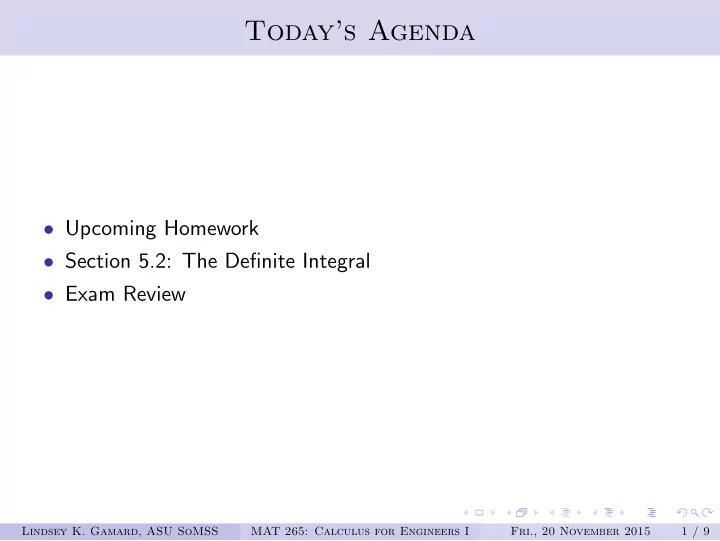
Todays Agenda Upcoming Homework Section 5.2: The Definite Integral Exam Review Lindsey K. Gamard, ASU SoMSS MAT 265: Calculus for Engineers I Fri., 20 November 2015 1 / 9 Upcoming Homework Study for Exam 3 on 11/23/2015.


slide-1
SLIDE 1

Today’s Agenda

  • Upcoming Homework
  • Section 5.2: The Definite Integral
  • Exam Review

Lindsey K. Gamard, ASU SoMSS MAT 265: Calculus for Engineers I Fri., 20 November 2015 1 / 9

slide-2
SLIDE 2

Upcoming Homework

  • Study for Exam 3 on 11/23/2015.
  • WeBWorK HW 23: Section 5.2, due 11/25/2015.
  • Written HW M: Section 5.1, #4. Section 5.2, #10,16,18,30,34,44.

Due 11/30/2015.

  • WeBWorK HW 24: Section 5.3, due 12/2/2015.

Lindsey K. Gamard, ASU SoMSS MAT 265: Calculus for Engineers I Fri., 20 November 2015 2 / 9

slide-3
SLIDE 3

Suggestions for studying for Test 3

Topics covered on Test 3: Integrals in terms of areas using basic geometry, absolute maxima and minima, Mean Value Theorem, inflection points, right and left Riemann sums, properties of definite integrals, optimization problems, antiderivatives, concave up/concave down, intervals of increase/decrease, distance/velocity/acceleration problems.

1 Take the Old Exam 3 found at https://math.asu.edu/

first-year-math/mat-265-calculus-engineers-i. Consider timing yourself while you take the practice exam.

2 Do the Exam 3 review found at the same link. 3 Suggested practice problems from the textbook: 1

Chapter 4 Review, pages 254-256: Exercises (not concept check or true-false) #1-4, 9-14, 36-41, 51-58.

2

Section 4.5, pages 238-239: #7,8,11,12,14.

3

Section 4.5, Example 1, page 232.

4

Section 5.2, pages 279-281: #1-3, 31-36, 38-42 .

Lindsey K. Gamard, ASU SoMSS MAT 265: Calculus for Engineers I Fri., 20 November 2015 3 / 9

slide-4
SLIDE 4

Section 5.2

Evaluating Integrals in Terms of Areas Recall the familiar formulas for the areas of circles, triangles, and rectangles from basic geometry: Acircle = πr2, Atriangle = 1 2bh, Arectangle = bh. If we seek to evaluate an integral that represents the area of a familiar shape, we can simply use the formulas above to evaluate the integral. Let’s try three examples: 5 x − 1 dx 6

  • 36 − x2 dx

10 2x + 5 dx

Lindsey K. Gamard, ASU SoMSS MAT 265: Calculus for Engineers I Fri., 20 November 2015 4 / 9

slide-5
SLIDE 5

Section 5.2

Properties of Integrals

1 b

a c dx = c(b − a), where c is any constant

2 b

a f (x) + g(x) dx =

b

a f (x) dx +

b

a g(x) dx

3 b

a cf (x) dx = c

b

a f (x) dx

4 b

a f (x) − g(x) dx =

b

a f (x) dx −

b

a g(x) dx

5 c

a f (x) dx +

b

c f (x) dx =

b

a f (x) dx (it doesn’t matter how large c

is in comparison to a and b)

6 b

a f (x) dx = −

a

b f (x) dx

7 If f (x) ≥ 0 for a ≤ x ≤ b, then

b

a f (x) dx ≥ 0

8 If f (x) ≥ g(x) for a ≤ x ≤ b, then

b

a f (x) dx ≥

b

a g(x) dx

9 If there are constants m and M such that m ≤ f (x) ≤ M for

a ≤ x ≤ b, then m(b − a) ≤ b

a f (x) dx ≤ M(b − a)

Lindsey K. Gamard, ASU SoMSS MAT 265: Calculus for Engineers I Fri., 20 November 2015 5 / 9
slide-6
SLIDE 6

Section 5.2

Example: Evaluate the following definite integral. 1 4 + 3x2 dx. Using the properties of integrals, we have that 1 4 + 3x2 dx = 1 4 dx + 3 1 x2 dx = 4 + 3 1 x2 dx. Then we can use the limit/Riemann sum definition of the integral to find the simpler integral 1

0 x2 dx.

Lindsey K. Gamard, ASU SoMSS MAT 265: Calculus for Engineers I Fri., 20 November 2015 6 / 9

slide-7
SLIDE 7

Section 5.2

1 x2 dx = lim

n→∞

n

  • i=1

1 n i n 2 = lim

n→∞

  • 1

n3

n

  • i=1

i2

  • = lim

n→∞

1 n2 n(n + 1)(2n + 1) 6

  • = lim

n→∞

1 n3 2n3 + 3n2 + n 6

  • = lim

n→∞

1 3 + 1 2n + 1 6n2

  • = 1

3, so 1 4 + 3x2 dx = 4 + 3 1 x2 dx = 4 + 3 1 3

  • = 5.

Lindsey K. Gamard, ASU SoMSS MAT 265: Calculus for Engineers I Fri., 20 November 2015 7 / 9

slide-8
SLIDE 8

Section 5.2

Suppose that 10

0 f (x) dx = 17 and 8 3f (x) dx = 12. Find

10

8 f (x) dx.

Using the properties of integrals, we have that

8

3f (x) dx = −3 8 f (x) dx = 12, so 8

0 f (x) = −4. Then,

8 f (x) dx + 10

8

f (x) dx = 10 f (x) dx, so 10

8

f (x) dx = 17 − (−4) = 21.

Lindsey K. Gamard, ASU SoMSS MAT 265: Calculus for Engineers I Fri., 20 November 2015 8 / 9

slide-9
SLIDE 9

Section 5.2

(Alternative method.) Suppose that 10

0 f (x) dx = 17 and 8 3f (x) dx = 12. Find

10

8 f (x) dx.

10

8

f (x) dx =

8

f (x) dx + 10 f (x) dx = 1 3

8

3f (x) dx + 10 f (x) dx = 1 3(12) + 17 = 21.

Lindsey K. Gamard, ASU SoMSS MAT 265: Calculus for Engineers I Fri., 20 November 2015 9 / 9