Today Final Presentation Ubiquitous Computing Project Report - - PDF document

today
SMART_READER_LITE
LIVE PREVIEW

Today Final Presentation Ubiquitous Computing Project Report - - PDF document

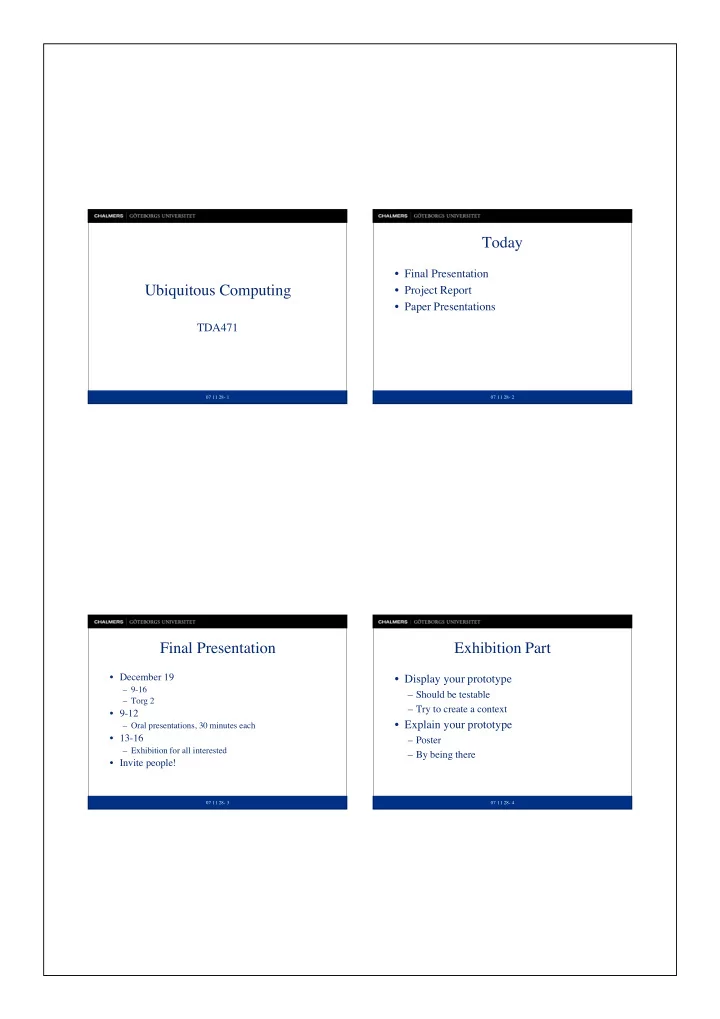
Today Final Presentation Ubiquitous Computing Project Report Paper Presentations TDA471 07 11 28- 1 07 11 28- 2 Final Presentation Exhibition Part December 19 Display your prototype 9-16 Should be testable


slide-1
SLIDE 1

07 11 28- 1

Ubiquitous Computing

TDA471

07 11 28- 2

Today

  • Final Presentation
  • Project Report
  • Paper Presentations

07 11 28- 3

Final Presentation

  • December 19

– 9-16 – Torg 2

  • 9-12

– Oral presentations, 30 minutes each

  • 13-16

– Exhibition for all interested

  • Invite people!

07 11 28- 4

Exhibition Part

  • Display your prototype

– Should be testable – Try to create a context

  • Explain your prototype

– Poster – By being there

slide-2
SLIDE 2

07 11 28- 5

Project Report

  • Two parts

– Web site – Written report

  • As a download from web site
  • Deadline 21/12
  • Course home page contains info

07 11 28- 6

Web Site

  • Explain the project for a wide audience
  • Should contain at least

– Short abstract in Swedish and English – Description of the project – Video (if there is one) – Pictures and/or powerpoint – Downloads of source code, technical specifications etc, required to re-create the project.

07 11 28- 7

Web Site

  • Must be on Chalmers’ server
  • Path to your space
  • /chalmers/groups/uc07-1
  • /chalmers/groups/uc07-2
  • Servers
  • remote1.studat.chalmers.se
  • remote2.studat.chalmers.se

07 11 28- 8

Web Site

  • Mount in Windows

– \\file.chalmers.se\uc07-1 – \\file.chalmers.se\uc07-1

  • GUI Tools for remote access

– WinSCP – Fugu

slide-3
SLIDE 3

07 11 28- 9

Web Site

  • Web site in directory www
  • Group directory will only appear if you

actually request it

07 11 28- 10

Written Report

  • Should contain

– project concept – an introduction to the context of your design, – main goals of the project, – possible related work, – the design process and critical design decisions made, – how the project was realized, including a description of the technology behind it,

07 11 28- 11

Written report

  • Should contain, continued

– evaluation against goals, – discussion; what worked, what did not, possible improvements, interesting findings,... – conclusion, lessons learned, – technical documentation, as appendix, – project plan as appendix.

07 11 28- 12

Possible Outline

  • 1. Introduction
  • 2. Background
  • 3. Concept
  • 4. Realisation
  • 5. Evaluation
  • 6. Related Work
  • 7. Discussion
  • 8. Appendix: Technical documentation and project

plan

slide-4
SLIDE 4

07 11 28- 13

Possible Outline 2

  • 1. Introduction
  • 2. Concept
  • 3. Realisation
  • 4. Evaluation
  • 5. Related Work
  • 6. Discussion
  • 7. Appendix: Technical documentation and project

plan

07 11 28- 14

Papers

  • Theme: Place, Space and Context

– Re-Place-ing Space: The Roles of Place and Space in Collaborative Systems – The is more to context than location – Multi-Sensor Context-Awareness in Mobile Devices and Smart Artefacts

07 11 28- 15

Re-Place-ing Space: The Roles of Place and Space in Collaborative Systems

  • Key point
  • Dsign for place not space

07 11 28- 16

Context

  • Published 1996
  • CSCW
  • MUDS
  • Collaborative environments
slide-5
SLIDE 5

07 11 28- 17 07 11 28- 18

Mantra

  • Space is the opportunity; place is the

understood reality

– About taking sociological issues into account – Borrow from architecture etc – Implications for design – Minor points, e.g. privacy is not absolute

07 11 28- 19 07 11 28- 20

Place

  • a place is a space which is invested with

understandings of behavioural appropriateness

  • House - home
  • Conference Hall - Concert Hall
  • Community Hall
  • Out of place - not out of space
slide-6
SLIDE 6

07 11 28- 21 07 11 28- 22

Space

  • Spatiality is important
  • Shared Knowledge

– Relational orientation and reciprocity. – Proximity and action – Partitioning – Presence and awareness

07 11 28- 23

Place is In Space

  • Places derive from their spatiality
  • But also call up cultural understandings

which help us to frame our behaviour

07 11 28- 24

Place in Social Analysis

  • what these analysts point to in human action

is the how it is framed not only by spaces, but by the pattern of understandings, associations and expectations with which they are infused

slide-7
SLIDE 7

07 11 28- 25

Place in the Built Environment

  • Place, as we have described it here, is a central

concern for architects and urban designers.

  • architects and urban designers are concerned not

simply with designing three-dimensional structures (spaces), but with places for people to

  • be. For them, the idea of place derives from a

tension between connectedness and distinction

07 11 28- 26

More Quotes

  • Placeness is created and sustained by

patterns of use; it's not something we can design in...can design for it

  • idea of a sense of place--a communally-

held sense of appropriate behaviour, and a context for engaging in and interpreting

  • action. This is essentially a cultural

phenomenon

07 11 28- 27

Space-less places

  • The distinction between ``space'' and ``place'' is

perhaps most strongly demonstrated by examples

  • f the emergence of place without notions of
  • space. Earlier, we introduced the concept of place

as space invested with social meaning. The spaces can be computational, as well as physical. What remains is the tension between connectedness and distinction which leads to placefulness

07 11 28- 28

Space-less places

  • On-line multiplayer games?
  • Communities
  • Forums
  • MUDS
  • USENET
slide-8
SLIDE 8

07 11 28- 29

Ubiquitous Computing

  • Computation in space
  • Distributed
  • Everyware
  • Essence of paper: Must take place into

account

  • Study and design for actual social

environment

07 11 28- 30

Rubrics for Design

  • Spaces are not places
  • Places, not spaces, frame appropriate

behaviour

  • Places have social meaning
  • Different media have different spatial

properties.

  • Space is the opportunity; place is the

understood reality

07 11 28- 31

The Rest?

  • Influential paper
  • Makes important points

– Design for place - not space – There can be places without place

  • Details about MUDS, Usenet etc somewhat

dated

  • Read in context

07 11 28- 32

Next Week

  • Discussion seminar
  • Read the papers