Today Dynamic memory alloca7on Size of data structures - - PDF document

today
SMART_READER_LITE
LIVE PREVIEW

Today Dynamic memory alloca7on Size of data structures - - PDF document

University of Washington Today Dynamic memory alloca7on Size of data structures may only be known at run 6me Need to allocate space on


slide-1
SLIDE 1

University ¡of ¡Washington ¡

Today ¡

¢ Dynamic ¡memory ¡alloca7on ¡

§ Size ¡of ¡data ¡structures ¡may ¡only ¡be ¡known ¡at ¡run ¡6me ¡ § Need ¡to ¡allocate ¡space ¡on ¡the ¡heap ¡ § Need ¡to ¡de-­‑allocate ¡(free) ¡unused ¡memory ¡so ¡it ¡can ¡be ¡re-­‑allocated ¡

¢ Implementa7on ¡ ¡

§ Implicit ¡free ¡lists ¡ § Explicit ¡free ¡lists ¡– ¡subject ¡of ¡next ¡programming ¡assignment ¡ § Segregated ¡free ¡lists ¡

¢ Garbage ¡collec7on ¡ ¢ Common ¡memory-­‑related ¡bugs ¡in ¡C ¡programs ¡

Autumn ¡2012 ¡ 1 ¡ Memory ¡Alloca7on ¡

University ¡of ¡Washington ¡

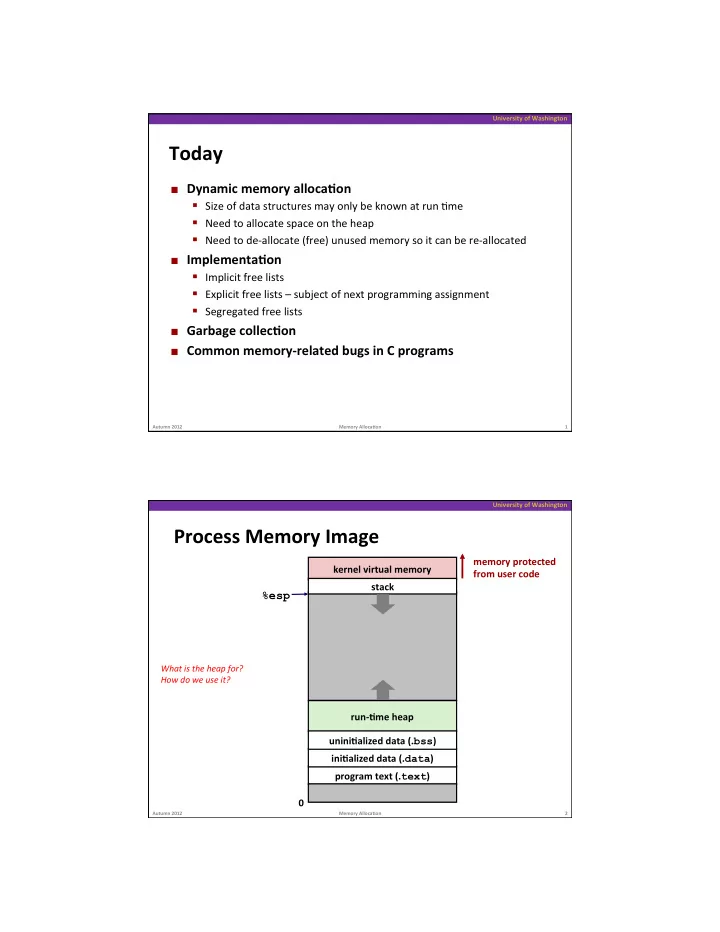
Process ¡Memory ¡Image ¡

kernel ¡virtual ¡memory ¡ run-­‑7me ¡heap ¡ program ¡text ¡(.text) ¡ ini7alized ¡data ¡(.data) ¡ unini7alized ¡data ¡(.bss) ¡ stack ¡ 0 ¡

%esp

memory ¡protected ¡ from ¡user ¡code ¡

2 ¡

What ¡is ¡the ¡heap ¡for? ¡ How ¡do ¡we ¡use ¡it? ¡

Autumn ¡2012 ¡ Memory ¡Alloca7on ¡

slide-2
SLIDE 2

University ¡of ¡Washington ¡

Process ¡Memory ¡Image ¡

kernel ¡virtual ¡memory ¡ run-­‑7me ¡heap ¡(via ¡malloc) ¡ program ¡text ¡(.text) ¡ ini7alized ¡data ¡(.data) ¡ unini7alized ¡data ¡(.bss) ¡ stack ¡ 0 ¡

%esp

memory ¡protected ¡ from ¡user ¡code ¡

the ¡“brk” ¡ptr ¡

Allocators ¡request ¡ addi7onal ¡heap ¡memory ¡ from ¡the ¡kernel ¡using ¡the ¡ ¡ sbrk() ¡func7on: ¡ ¡ error = sbrk(amt_more)

3 ¡ Autumn ¡2012 ¡ Memory ¡Alloca7on ¡

University ¡of ¡Washington ¡

Dynamic ¡Memory ¡Alloca7on ¡

¢ Memory ¡allocator? ¡

§ VM ¡hardware ¡and ¡kernel ¡allocate ¡pages ¡ § Applica6on ¡objects ¡are ¡typically ¡smaller ¡ § Allocator ¡manages ¡objects ¡within ¡pages ¡ ¡

¢ How ¡should ¡the ¡applica4on ¡code ¡allocate ¡memory? ¡

Applica7on ¡ Dynamic ¡Memory ¡Allocator ¡ Heap ¡Memory ¡

4 ¡ Autumn ¡2012 ¡ Memory ¡Alloca7on ¡

slide-3
SLIDE 3

University ¡of ¡Washington ¡

Dynamic ¡Memory ¡Alloca7on ¡

¢ Memory ¡allocator? ¡

§ VM ¡hardware ¡and ¡kernel ¡allocate ¡pages ¡ § Applica6on ¡objects ¡are ¡typically ¡smaller ¡ § Allocator ¡manages ¡objects ¡within ¡pages ¡ ¡

¢ Explicit ¡vs. ¡Implicit ¡Memory ¡Allocator ¡

§ Explicit: ¡ ¡applica6on ¡allocates ¡and ¡frees ¡space ¡ ¡

§ In ¡C: ¡ ¡malloc() ¡and ¡free() ¡

§ Implicit: ¡applica6on ¡allocates, ¡but ¡does ¡not ¡free ¡space ¡

§ In ¡Java, ¡ML, ¡Lisp: ¡ ¡garbage ¡collec6on ¡ ¢ Alloca7on ¡

§ A ¡memory ¡allocator ¡doles ¡out ¡memory ¡blocks ¡to ¡applica6on ¡ § A ¡“block” ¡is ¡a ¡con6guous ¡range ¡of ¡bytes ¡of ¡the ¡appropriate ¡size ¡

§ What ¡is ¡an ¡appropriate ¡size? ¡ ¡

Applica7on ¡ Dynamic ¡Memory ¡Allocator ¡ Heap ¡Memory ¡

5 ¡ Autumn ¡2012 ¡ Memory ¡Alloca7on ¡

University ¡of ¡Washington ¡

Malloc ¡Package ¡

¢ #include <stdlib.h> ¢ void *malloc(size_t size)

§ Successful: ¡

§ Returns ¡a ¡pointer ¡to ¡a ¡memory ¡block ¡of ¡at ¡least ¡size ¡bytes ¡

(typically) ¡aligned ¡to ¡8-­‑byte ¡boundary ¡

§ If ¡size == 0, ¡returns ¡NULL ¡

§ Unsuccessful: ¡returns ¡NULL ¡(0) ¡and ¡sets ¡errno ¡(a ¡global ¡variable) ¡

¢ Is ¡this ¡enough? ¡That’s ¡it? ¡J ¡

6 ¡ Autumn ¡2012 ¡ Memory ¡Alloca7on ¡

slide-4
SLIDE 4

University ¡of ¡Washington ¡

Malloc ¡Package ¡

¢ #include <stdlib.h> ¢ void *malloc(size_t size)

§ Successful: ¡

§ Returns ¡a ¡pointer ¡to ¡a ¡memory ¡block ¡of ¡at ¡least ¡size ¡bytes ¡

(typically) ¡aligned ¡to ¡8-­‑byte ¡boundary ¡

§ If ¡size == 0, ¡returns ¡NULL ¡

§ Unsuccessful: ¡returns ¡NULL ¡(0) ¡and ¡sets ¡errno ¡(a ¡global ¡variable) ¡

¢ void free(void *p)

§ Returns ¡the ¡block ¡pointed ¡at ¡by ¡p ¡to ¡the ¡pool ¡of ¡available ¡memory ¡ § p ¡must ¡come ¡from ¡a ¡previous ¡call ¡to ¡malloc or ¡realloc

¢ anything_else()? ¡J ¡

7 ¡ Autumn ¡2012 ¡ Memory ¡Alloca7on ¡

University ¡of ¡Washington ¡

Malloc ¡Package ¡

¢ #include <stdlib.h> ¢ void *malloc(size_t size)

§ Successful: ¡

§ Returns ¡a ¡pointer ¡to ¡a ¡memory ¡block ¡of ¡at ¡least ¡size ¡bytes ¡

(typically) ¡aligned ¡to ¡8-­‑byte ¡boundary ¡

§ If ¡size == 0, ¡returns ¡NULL ¡

§ Unsuccessful: ¡returns ¡NULL ¡(0) ¡and ¡sets ¡errno ¡(a ¡global ¡variable) ¡

¢ void free(void *p)

§ Returns ¡the ¡block ¡pointed ¡at ¡by ¡p ¡to ¡the ¡pool ¡of ¡available ¡memory ¡ § p ¡must ¡come ¡from ¡a ¡previous ¡call ¡to ¡malloc or ¡realloc

¢ void *realloc(void *p, size_t size)

§ Changes ¡size ¡of ¡block ¡p ¡and ¡returns ¡pointer ¡to ¡new ¡block ¡ § Contents ¡of ¡new ¡block ¡unchanged ¡up ¡to ¡min ¡of ¡old ¡and ¡new ¡size ¡ § Old ¡block ¡has ¡been ¡free'd ¡ ¡(logically, ¡if ¡new ¡!= ¡old) ¡

8 ¡ Autumn ¡2012 ¡ Memory ¡Alloca7on ¡

slide-5
SLIDE 5

University ¡of ¡Washington ¡

Malloc ¡Example ¡

void foo(int n, int m) { int i, *p; /* allocate a block of n ints */ p = (int *)malloc(n * sizeof(int)); if (p == NULL) { perror("malloc"); exit(0); } for (i=0; i<n; i++) p[i] = i; /* add m bytes to end of p block */ if ((p = (int *)realloc(p, (n+m) * sizeof(int))) == NULL) { perror("realloc"); exit(0); } for (i=n; i < n+m; i++) p[i] = i; /* print new array */ for (i=0; i<n+m; i++) printf("%d\n", p[i]); free(p); /* return p to available memory pool */ }

9 ¡

Why? ¡

Autumn ¡2012 ¡ Memory ¡Alloca7on ¡

University ¡of ¡Washington ¡

Assump7ons ¡Made ¡in ¡This ¡Lecture ¡

¢ Memory ¡is ¡word ¡addressed ¡(each ¡word ¡can ¡hold ¡a ¡pointer) ¡

§ block ¡size ¡is ¡a ¡mul6ple ¡of ¡words ¡

Allocated ¡block ¡ (4 ¡words) ¡ Free ¡block ¡ (3 ¡words) ¡ Free ¡word ¡ Allocated ¡word ¡

10 ¡ Autumn ¡2012 ¡ Memory ¡Alloca7on ¡

slide-6
SLIDE 6

University ¡of ¡Washington ¡

Alloca7on ¡Example ¡

p1 = malloc(4) p2 = malloc(5)

11 ¡ Autumn ¡2012 ¡ Memory ¡Alloca7on ¡

University ¡of ¡Washington ¡

Alloca7on ¡Example ¡

p1 = malloc(4) p2 = malloc(5)

12 ¡ Autumn ¡2012 ¡ Memory ¡Alloca7on ¡

slide-7
SLIDE 7

University ¡of ¡Washington ¡

Alloca7on ¡Example ¡

p1 = malloc(4) p2 = malloc(5) p3 = malloc(6)

13 ¡ Autumn ¡2012 ¡ Memory ¡Alloca7on ¡

University ¡of ¡Washington ¡

Alloca7on ¡Example ¡

p1 = malloc(4) p2 = malloc(5) p3 = malloc(6)

14 ¡ Autumn ¡2012 ¡ Memory ¡Alloca7on ¡

slide-8
SLIDE 8

University ¡of ¡Washington ¡

Alloca7on ¡Example ¡

p1 = malloc(4) p2 = malloc(5) p3 = malloc(6) free(p2)

15 ¡ Autumn ¡2012 ¡ Memory ¡Alloca7on ¡

University ¡of ¡Washington ¡

Alloca7on ¡Example ¡

p1 = malloc(4) p2 = malloc(5) p3 = malloc(6) free(p2)

16 ¡ Autumn ¡2012 ¡ Memory ¡Alloca7on ¡

slide-9
SLIDE 9

University ¡of ¡Washington ¡

Alloca7on ¡Example ¡

p1 = malloc(4) p2 = malloc(5) p3 = malloc(6) free(p2) p4 = malloc(2)

17 ¡ Autumn ¡2012 ¡ Memory ¡Alloca7on ¡

University ¡of ¡Washington ¡

Alloca7on ¡Example ¡

p1 = malloc(4) p2 = malloc(5) p3 = malloc(6) free(p2) p4 = malloc(2)

18 ¡ Autumn ¡2012 ¡ Memory ¡Alloca7on ¡

slide-10
SLIDE 10

University ¡of ¡Washington ¡

How ¡are ¡going ¡to ¡implement ¡that?!? ¡

¢ Ideas? ¡

19 ¡ Autumn ¡2012 ¡ Memory ¡Alloca7on ¡

University ¡of ¡Washington ¡

Constraints ¡

¢ Applica7ons ¡

§ Can ¡issue ¡arbitrary ¡sequence ¡of ¡malloc() ¡and ¡free() ¡requests ¡ § free() ¡requests ¡must ¡be ¡made ¡only ¡for ¡a ¡previously ¡malloc()’d ¡block ¡

20 ¡ Autumn ¡2012 ¡ Memory ¡Alloca7on ¡

slide-11
SLIDE 11

University ¡of ¡Washington ¡

Constraints ¡

¢ Applica7ons ¡

§ Can ¡issue ¡arbitrary ¡sequence ¡of ¡malloc() ¡and ¡free() ¡requests ¡ § free() ¡requests ¡must ¡be ¡made ¡only ¡for ¡a ¡previously ¡malloc()’d ¡block ¡

¢ Allocators ¡

§ Can’t ¡control ¡number ¡or ¡size ¡of ¡allocated ¡blocks ¡

21 ¡ Autumn ¡2012 ¡ Memory ¡Alloca7on ¡

University ¡of ¡Washington ¡

Constraints ¡

¢ Applica7ons ¡

§ Can ¡issue ¡arbitrary ¡sequence ¡of ¡malloc() ¡and ¡free() ¡requests ¡ § free() ¡requests ¡must ¡be ¡made ¡only ¡for ¡a ¡previously ¡malloc()’d ¡block ¡

¢ Allocators ¡

§ Can’t ¡control ¡number ¡or ¡size ¡of ¡allocated ¡blocks ¡ § Must ¡respond ¡immediately ¡to ¡malloc() ¡requests ¡

§ i.e., ¡can’t ¡reorder ¡or ¡buffer ¡requests ¡

22 ¡ Autumn ¡2012 ¡ Memory ¡Alloca7on ¡

slide-12
SLIDE 12

University ¡of ¡Washington ¡

Constraints ¡

¢ Applica7ons ¡

§ Can ¡issue ¡arbitrary ¡sequence ¡of ¡malloc() ¡and ¡free() ¡requests ¡ § free() ¡requests ¡must ¡be ¡made ¡only ¡for ¡a ¡previously ¡malloc()’d ¡block ¡

¢ Allocators ¡

§ Can’t ¡control ¡number ¡or ¡size ¡of ¡allocated ¡blocks ¡ § Must ¡respond ¡immediately ¡to ¡malloc() ¡requests ¡

§ i.e., ¡can’t ¡reorder ¡or ¡buffer ¡requests ¡

§ Must ¡allocate ¡blocks ¡from ¡free ¡memory ¡

§ i.e., ¡can ¡only ¡place ¡allocated ¡blocks ¡in ¡free ¡memory, ¡why? ¡

23 ¡ Autumn ¡2012 ¡ Memory ¡Alloca7on ¡

University ¡of ¡Washington ¡

Constraints ¡

¢ Applica7ons ¡

§ Can ¡issue ¡arbitrary ¡sequence ¡of ¡malloc() ¡and ¡free() ¡requests ¡ § free() ¡requests ¡must ¡be ¡made ¡only ¡for ¡a ¡previously ¡malloc()’d ¡block ¡

¢ Allocators ¡

§ Can’t ¡control ¡number ¡or ¡size ¡of ¡allocated ¡blocks ¡ § Must ¡respond ¡immediately ¡to ¡malloc() ¡requests ¡

§ i.e., ¡can’t ¡reorder ¡or ¡buffer ¡requests ¡

§ Must ¡allocate ¡blocks ¡from ¡free ¡memory ¡

§ i.e., ¡can ¡only ¡place ¡allocated ¡blocks ¡in ¡free ¡memory ¡

§ Must ¡align ¡blocks ¡so ¡they ¡sa6sfy ¡all ¡alignment ¡requirements ¡

§ 8 ¡byte ¡alignment ¡for ¡GNU ¡malloc ¡(libc ¡malloc) ¡on ¡Linux ¡boxes ¡

24 ¡ Autumn ¡2012 ¡ Memory ¡Alloca7on ¡

slide-13
SLIDE 13

University ¡of ¡Washington ¡

Constraints ¡

¢ Applica7ons ¡

§ Can ¡issue ¡arbitrary ¡sequence ¡of ¡malloc() ¡and ¡free() ¡requests ¡ § free() ¡requests ¡must ¡be ¡made ¡only ¡for ¡a ¡previously ¡malloc()’d ¡block ¡

¢ Allocators ¡

§ Can’t ¡control ¡number ¡or ¡size ¡of ¡allocated ¡blocks ¡ § Must ¡respond ¡immediately ¡to ¡malloc() ¡requests ¡

§ i.e., ¡can’t ¡reorder ¡or ¡buffer ¡requests ¡

§ Must ¡allocate ¡blocks ¡from ¡free ¡memory ¡

§ i.e., ¡can ¡only ¡place ¡allocated ¡blocks ¡in ¡free ¡memory ¡

§ Must ¡align ¡blocks ¡so ¡they ¡sa6sfy ¡all ¡alignment ¡requirements ¡

§ 8 ¡byte ¡alignment ¡for ¡GNU ¡malloc ¡(libc ¡malloc) ¡on ¡Linux ¡boxes ¡

§ Can’t ¡move ¡the ¡allocated ¡blocks ¡once ¡they ¡are ¡malloc()’d ¡

§ i.e., ¡compac6on ¡is ¡not ¡allowed. ¡Why ¡not? ¡

25 ¡ Autumn ¡2012 ¡ Memory ¡Alloca7on ¡

University ¡of ¡Washington ¡

Performance ¡Goal: ¡Throughput ¡

¢ Given ¡some ¡sequence ¡of ¡malloc ¡and ¡free ¡requests: ¡

§ ¡R0, ¡R1, ¡..., ¡Rk, ¡... ¡, ¡Rn-­‑1 ¡

¢ Goals: ¡maximize ¡throughput ¡and ¡peak ¡memory ¡u7liza7on ¡

§ These ¡goals ¡are ¡o^en ¡conflic6ng ¡ § What’s ¡throughput? ¡

26 ¡ Autumn ¡2012 ¡ Memory ¡Alloca7on ¡

slide-14
SLIDE 14

University ¡of ¡Washington ¡

Performance ¡Goal: ¡Throughput ¡

¢ Given ¡some ¡sequence ¡of ¡malloc ¡and ¡free ¡requests: ¡

§ ¡R0, ¡R1, ¡..., ¡Rk, ¡... ¡, ¡Rn-­‑1 ¡

¢ Goals: ¡maximize ¡throughput ¡and ¡peak ¡memory ¡u7liza7on ¡

§ These ¡goals ¡are ¡o^en ¡conflic6ng ¡

¢ Throughput: ¡

§ Number ¡of ¡completed ¡requests ¡per ¡unit ¡6me ¡ § Example: ¡

§ 5,000 ¡ ¡malloc() ¡calls ¡and ¡5,000 ¡free() ¡calls ¡in ¡10 ¡seconds ¡ ¡ § Throughput ¡is ¡1,000 ¡opera6ons/second ¡

§ How ¡to ¡do ¡malloc() ¡and ¡free() ¡in ¡O(1)? ¡What’s ¡the ¡problem? ¡

27 ¡ Autumn ¡2012 ¡ Memory ¡Alloca7on ¡

University ¡of ¡Washington ¡

Performance ¡Goal: ¡Peak ¡Memory ¡U7liza7on ¡

¢ Given ¡some ¡sequence ¡of ¡malloc ¡and ¡free ¡requests: ¡

§ ¡R0, ¡R1, ¡..., ¡Rk, ¡... ¡, ¡Rn-­‑1 ¡

¢ Def: ¡Aggregate ¡payload ¡Pk ¡ ¡

§ ¡malloc(p) ¡results ¡in ¡a ¡block ¡with ¡a ¡payload ¡of ¡p ¡bytes ¡ § A^er ¡request ¡Rk ¡has ¡completed, ¡the ¡aggregate ¡payload ¡Pk ¡ ¡is ¡the ¡sum ¡of ¡

currently ¡allocated ¡payloads ¡

28 ¡ Autumn ¡2012 ¡ Memory ¡Alloca7on ¡

slide-15
SLIDE 15

University ¡of ¡Washington ¡

Performance ¡Goal: ¡Peak ¡Memory ¡U7liza7on ¡

¢ Given ¡some ¡sequence ¡of ¡malloc ¡and ¡free ¡requests: ¡

§ ¡R0, ¡R1, ¡..., ¡Rk, ¡... ¡, ¡Rn-­‑1 ¡

¢ Def: ¡Aggregate ¡payload ¡Pk ¡ ¡

§ ¡malloc(p) ¡results ¡in ¡a ¡block ¡with ¡a ¡payload ¡of ¡p ¡bytes ¡ § A^er ¡request ¡Rk ¡has ¡completed, ¡the ¡aggregate ¡payload ¡Pk ¡ ¡is ¡the ¡sum ¡of ¡

currently ¡allocated ¡payloads ¡

¢ Def: ¡Current ¡heap ¡size ¡= ¡Hk ¡

§ Assume ¡Hk ¡is ¡monotonically ¡nondecreasing ¡

§ Allocator ¡can ¡increase ¡size ¡of ¡heap ¡using ¡sbrk()

29 ¡ Autumn ¡2012 ¡ Memory ¡Alloca7on ¡

University ¡of ¡Washington ¡

Performance ¡Goal: ¡Peak ¡Memory ¡U7liza7on ¡

¢ Given ¡some ¡sequence ¡of ¡malloc ¡and ¡free ¡requests: ¡

§ ¡R0, ¡R1, ¡..., ¡Rk, ¡... ¡, ¡Rn-­‑1 ¡

¢ Def: ¡Aggregate ¡payload ¡Pk ¡ ¡

§ ¡malloc(p) ¡results ¡in ¡a ¡block ¡with ¡a ¡payload ¡of ¡p ¡bytes ¡ § A^er ¡request ¡Rk ¡has ¡completed, ¡the ¡aggregate ¡payload ¡Pk ¡ ¡is ¡the ¡sum ¡of ¡

currently ¡allocated ¡payloads ¡

¢ Def: ¡Current ¡heap ¡size ¡= ¡Hk ¡

§ Assume ¡Hk ¡is ¡monotonically ¡nondecreasing ¡

§ Allocator ¡can ¡increase ¡size ¡of ¡heap ¡using ¡sbrk()

¢ Def: ¡Peak ¡memory ¡uIlizaIon ¡aJer ¡k ¡requests ¡ ¡

§ Uk ¡= ¡( ¡maxi<k ¡Pi ¡) ¡ ¡/ ¡ ¡Hk ¡ § Goal: ¡maximize ¡u6liza6on ¡for ¡a ¡sequence ¡of ¡requests. ¡ § Is ¡this ¡hard? ¡Why? ¡And ¡what ¡happens ¡to ¡throughput? ¡

30 ¡ Autumn ¡2012 ¡ Memory ¡Alloca7on ¡

slide-16
SLIDE 16

University ¡of ¡Washington ¡

Fragmenta7on ¡

¢ Poor ¡memory ¡u7liza7on ¡caused ¡by ¡fragmentaIon ¡

§ internal ¡fragmenta6on ¡ § external ¡fragmenta6on ¡

31 ¡ Autumn ¡2012 ¡ Memory ¡Alloca7on ¡

University ¡of ¡Washington ¡

Internal ¡Fragmenta7on ¡

¢ For ¡a ¡given ¡block, ¡internal ¡fragmentaIon ¡occurs ¡if ¡payload ¡is ¡smaller ¡than ¡

block ¡size ¡ ¡

¢ Caused ¡by ¡ ¡

§ overhead ¡of ¡maintaining ¡heap ¡data ¡structures ¡(inside ¡block, ¡outside ¡payload) ¡ § padding ¡for ¡alignment ¡purposes ¡ § explicit ¡policy ¡decisions ¡(e.g., ¡to ¡return ¡a ¡big ¡block ¡to ¡sa6sfy ¡a ¡small ¡request) ¡ ¡

¡ ¡ ¡ ¡ ¡ ¡why ¡would ¡anyone ¡do ¡that? ¡

¢ Depends ¡only ¡on ¡the ¡pa^ern ¡of ¡previous ¡requests ¡

§ thus, ¡easy ¡to ¡measure ¡

payload ¡ Internal ¡ ¡ fragmenta7on ¡ block ¡ Internal ¡ ¡ fragmenta7on ¡

32 ¡ Autumn ¡2012 ¡ Memory ¡Alloca7on ¡

slide-17
SLIDE 17

University ¡of ¡Washington ¡

External ¡Fragmenta7on ¡

¢ Occurs ¡when ¡there ¡is ¡enough ¡aggregate ¡heap ¡memory, ¡but ¡no ¡

single ¡free ¡block ¡is ¡large ¡enough ¡ ¡

p1 = malloc(4) p2 = malloc(5) p3 = malloc(6) free(p2)

33 ¡ Autumn ¡2012 ¡ Memory ¡Alloca7on ¡

University ¡of ¡Washington ¡

External ¡Fragmenta7on ¡

¢ Occurs ¡when ¡there ¡is ¡enough ¡aggregate ¡heap ¡memory, ¡but ¡no ¡

single ¡free ¡block ¡is ¡large ¡enough ¡ ¡

p1 = malloc(4) p2 = malloc(5) p3 = malloc(6) free(p2) p4 = malloc(6)

34 ¡ Autumn ¡2012 ¡ Memory ¡Alloca7on ¡

slide-18
SLIDE 18

University ¡of ¡Washington ¡

External ¡Fragmenta7on ¡

¢ Occurs ¡when ¡there ¡is ¡enough ¡aggregate ¡heap ¡memory, ¡but ¡no ¡

single ¡free ¡block ¡is ¡large ¡enough ¡

p1 = malloc(4) p2 = malloc(5) p3 = malloc(6) free(p2) p4 = malloc(6)

Oops! ¡(what ¡would ¡happen ¡now?) ¡

35 ¡ Autumn ¡2012 ¡ Memory ¡Alloca7on ¡

University ¡of ¡Washington ¡

External ¡Fragmenta7on ¡

¢ Occurs ¡when ¡there ¡is ¡enough ¡aggregate ¡heap ¡memory, ¡but ¡no ¡

single ¡free ¡block ¡is ¡large ¡enough ¡

¢ Depends ¡on ¡the ¡pa^ern ¡of ¡future ¡requests ¡

§ Thus, ¡difficult ¡to ¡measure ¡

¡

p1 = malloc(4) p2 = malloc(5) p3 = malloc(6) free(p2) p4 = malloc(6)

Oops! ¡(what ¡would ¡happen ¡now?) ¡

36 ¡ Autumn ¡2012 ¡ Memory ¡Alloca7on ¡

slide-19
SLIDE 19

University ¡of ¡Washington ¡

Implementa7on ¡Issues ¡

¢ How ¡to ¡know ¡how ¡much ¡memory ¡is ¡being ¡free()’d ¡when ¡

it ¡is ¡given ¡only ¡a ¡pointer ¡(and ¡no ¡length)? ¡

¢ How ¡to ¡keep ¡track ¡of ¡the ¡free ¡blocks? ¡ ¢ What ¡to ¡do ¡with ¡extra ¡space ¡when ¡alloca7ng ¡a ¡block ¡that ¡is ¡

smaller ¡than ¡the ¡free ¡block ¡it ¡is ¡placed ¡in? ¡

¢ How ¡to ¡pick ¡a ¡block ¡to ¡use ¡for ¡alloca7on—many ¡might ¡fit? ¡ ¢ How ¡to ¡reinsert ¡a ¡freed ¡block ¡into ¡the ¡heap? ¡

37 ¡ Autumn ¡2012 ¡ Memory ¡Alloca7on ¡

University ¡of ¡Washington ¡

Knowing ¡How ¡Much ¡to ¡Free ¡

¢ Standard ¡method ¡

§ Keep ¡the ¡length ¡of ¡a ¡block ¡in ¡the ¡word ¡preceding ¡the ¡block. ¡

§ This ¡word ¡is ¡o^en ¡called ¡the ¡header ¡field ¡or ¡header ¡

§ Requires ¡an ¡extra ¡word ¡for ¡every ¡allocated ¡block ¡

free(p0) p0 = malloc(4)

38 ¡ Autumn ¡2012 ¡ Memory ¡Alloca7on ¡

p0 block ¡size ¡ data ¡ 5 ¡

slide-20
SLIDE 20

University ¡of ¡Washington ¡

Keeping ¡Track ¡of ¡Free ¡Blocks ¡

¢ Method ¡1: ¡Implicit ¡list ¡using ¡length—links ¡all ¡blocks ¡ ¢ Method ¡2: ¡Explicit ¡list ¡among ¡the ¡free ¡blocks ¡using ¡pointers ¡

¡

¢ Method ¡3: ¡Segregated ¡free ¡list ¡

§ Different ¡free ¡lists ¡for ¡different ¡size ¡classes ¡

¢ Method ¡4: ¡Blocks ¡sorted ¡by ¡size ¡

§ Can ¡use ¡a ¡balanced ¡binary ¡tree ¡(e.g. ¡red-­‑black ¡tree) ¡with ¡pointers ¡

within ¡each ¡free ¡block, ¡and ¡the ¡length ¡used ¡as ¡a ¡key ¡

5 4 ¡ 2 ¡ 6 ¡ 5 4 ¡ 2 ¡ 6 ¡

39 ¡ Autumn ¡2012 ¡ Memory ¡Alloca7on ¡

University ¡of ¡Washington ¡

Implicit ¡List ¡

¢ For ¡each ¡block ¡we ¡need: ¡length, ¡is-­‑allocated? ¡

§ Could ¡store ¡this ¡informa6on ¡in ¡two ¡words: ¡wasteful! ¡

¢ Standard ¡trick ¡

§ If ¡blocks ¡are ¡aligned, ¡some ¡low-­‑order ¡address ¡bits ¡are ¡always ¡0 ¡ § Instead ¡of ¡storing ¡an ¡always-­‑0 ¡bit, ¡use ¡it ¡as ¡a ¡allocated/free ¡flag ¡ § When ¡reading ¡size, ¡must ¡remember ¡to ¡mask ¡out ¡this ¡bit ¡

size ¡ 1 ¡word ¡

Format ¡of ¡ allocated ¡and ¡ free ¡blocks ¡

payload ¡ a ¡= ¡1: ¡allocated ¡block ¡ ¡ ¡ a ¡= ¡0: ¡free ¡block ¡ ¡ size: ¡block ¡size ¡ ¡ payload: ¡applica7on ¡data ¡ (allocated ¡blocks ¡only) ¡ ¡ a ¡

  • p7onal ¡

padding ¡

40 ¡ Autumn ¡2012 ¡ Memory ¡Alloca7on ¡

slide-21
SLIDE 21

University ¡of ¡Washington ¡

Example ¡

¢ 8-­‑byte ¡alignment ¡

§ May ¡require ¡ini6al ¡unused ¡word ¡ § Causes ¡some ¡internal ¡fragmenta6on ¡

¢ One ¡word ¡(0/1) ¡to ¡mark ¡end ¡of ¡list ¡ ¢ Here: ¡block ¡size ¡in ¡words ¡for ¡simplicity ¡ 2/0 4/1 8/0 4/1 0/1

Free ¡word ¡ Allocated ¡word ¡ Allocated ¡word ¡ unused ¡

Start ¡of ¡heap ¡ 8 ¡bytes ¡= ¡2 ¡word ¡alignment ¡ Sequence ¡of ¡blocks ¡in ¡heap: ¡2/0, ¡4/1, ¡8/0, ¡4/1 ¡

41 ¡ Autumn ¡2012 ¡ Memory ¡Alloca7on ¡

University ¡of ¡Washington ¡

Implicit ¡List: ¡Finding ¡a ¡Free ¡Block ¡

¢ First ¡fit: ¡

§ Search ¡list ¡from ¡beginning, ¡choose ¡first ¡free ¡block ¡that ¡fits: ¡(Cost?) ¡

¡ ¡ ¡ ¡ ¡

§ Can ¡take ¡linear ¡6me ¡in ¡total ¡number ¡of ¡blocks ¡(allocated ¡and ¡free) ¡ § In ¡prac6ce ¡it ¡can ¡cause ¡“splinters” ¡at ¡beginning ¡of ¡list ¡

¢ Next ¡fit: ¡

§ Like ¡first-­‑fit, ¡but ¡search ¡list ¡star6ng ¡where ¡previous ¡search ¡finished ¡ § Should ¡o^en ¡be ¡faster ¡than ¡first-­‑fit: ¡avoids ¡re-­‑scanning ¡unhelpful ¡blocks ¡ § Some ¡research ¡suggests ¡that ¡fragmenta6on ¡is ¡worse ¡

¢ Best ¡fit: ¡

§ Search ¡the ¡list, ¡choose ¡the ¡best ¡free ¡block: ¡fits, ¡with ¡fewest ¡bytes ¡le^ ¡over ¡ § Keeps ¡fragments ¡small—usually ¡helps ¡fragmenta6on ¡ § Will ¡typically ¡run ¡slower ¡than ¡first-­‑fit ¡

p = start; while ((p < end) && \\ not passed end ((*p & 1) || \\ already allocated (*p <= len))) \\ too small p = p + (*p & -2); \\ goto next block (word addressed)

42 ¡ Autumn ¡2012 ¡ Memory ¡Alloca7on ¡

slide-22
SLIDE 22

University ¡of ¡Washington ¡

Implicit ¡List: ¡Alloca7ng ¡in ¡Free ¡Block ¡

¢ Alloca7ng ¡in ¡a ¡free ¡block: ¡spliUng ¡

§ Since ¡allocated ¡space ¡might ¡be ¡smaller ¡than ¡free ¡space, ¡we ¡might ¡want ¡

to ¡split ¡the ¡block ¡

void addblock(ptr p, int len) { int newsize = ((len + 1) >> 1) << 1; // round up to even int oldsize = *p & -2; // mask out low bit *p = newsize | 1; // set new length if (newsize < oldsize) *(p+newsize) = oldsize - newsize; // set length in remaining } // part of block 4 ¡ 4 ¡ 2 ¡ 6 ¡ 4 ¡ 2 ¡ 4 ¡ p ¡ 2 ¡ 4 ¡ addblock(p, 4)

43 ¡ Autumn ¡2012 ¡ Memory ¡Alloca7on ¡

University ¡of ¡Washington ¡

Implicit ¡List: ¡Alloca7ng ¡in ¡Free ¡Block ¡

¢ Alloca7ng ¡in ¡a ¡free ¡block: ¡spliUng ¡

§ Since ¡allocated ¡space ¡might ¡be ¡smaller ¡than ¡free ¡space, ¡we ¡might ¡want ¡

to ¡split ¡the ¡block ¡

void addblock(ptr p, int len) { int newsize = ((len + 1) >> 1) << 1; // round up to even int oldsize = *p & -2; // mask out low bit *p = newsize | 1; // set new length if (newsize < oldsize) *(p+newsize) = oldsize - newsize; // set length in remaining } // part of block 4 ¡ 4 ¡ 2 ¡ 6 ¡ 4 ¡ 2 ¡ 4 ¡ p ¡ 2 ¡ 4 ¡ addblock(p, 4)

44 ¡ Autumn ¡2012 ¡ Memory ¡Alloca7on ¡

slide-23
SLIDE 23

University ¡of ¡Washington ¡

Implicit ¡List: ¡Freeing ¡a ¡Block ¡

¢ Simplest ¡implementa7on: ¡

§ Need ¡only ¡clear ¡the ¡“allocated” ¡flag ¡

void free_block(ptr p) { *p = *p & -2 }

§ But ¡can ¡lead ¡to ¡“false ¡fragmenta6on” ¡ ¡

¡ ¡ ¡ ¡ ¡ ¡ ¡ ¡ There ¡is ¡enough ¡free ¡space, ¡but ¡the ¡allocator ¡won’t ¡be ¡able ¡to ¡find ¡it ¡

4 ¡ 2 ¡ 4 ¡ 2 ¡ free(p) p 4 ¡ 4 ¡ 2 ¡ 4 ¡ 4 ¡ 2 ¡ malloc(5) Oops! ¡

45 ¡ Autumn ¡2012 ¡ Memory ¡Alloca7on ¡

University ¡of ¡Washington ¡

Implicit ¡List: ¡Coalescing ¡

¢ Join ¡(coalesce) ¡with ¡next/previous ¡blocks, ¡if ¡they ¡are ¡free ¡

§ Coalescing ¡with ¡next ¡block ¡

¡ ¡ ¡ ¡

§ But ¡how ¡do ¡we ¡coalesce ¡with ¡previous ¡block? ¡

void free_block(ptr p) { *p = *p & -2; // clear allocated flag next = p + *p; // find next block if ((*next & 1) == 0) *p = *p + *next; // add to this block if } // not allocated 4 ¡ 2 ¡ 4 ¡ 2 ¡ free(p) p 4 ¡ 4 ¡ 2 ¡ 4 ¡ 6 ¡ 2 ¡

logically ¡ gone ¡

46 ¡ Autumn ¡2012 ¡ Memory ¡Alloca7on ¡

slide-24
SLIDE 24

University ¡of ¡Washington ¡

Implicit ¡List: ¡Bidirec7onal ¡Coalescing ¡ ¡

¢ Boundary ¡tags ¡[Knuth73] ¡

§ Replicate ¡size/allocated ¡word ¡at ¡“booom” ¡(end) ¡of ¡free ¡blocks ¡ § Allows ¡us ¡to ¡traverse ¡the ¡“list” ¡backwards, ¡but ¡requires ¡extra ¡space ¡ § Important ¡and ¡general ¡technique! ¡

size ¡

Format ¡of ¡ allocated ¡and ¡ free ¡blocks ¡

payload ¡and ¡ padding ¡ a ¡= ¡1: ¡allocated ¡block ¡ ¡ ¡ a ¡= ¡0: ¡free ¡block ¡ ¡ size: ¡total ¡block ¡size ¡ ¡ payload: ¡applica7on ¡data ¡ (allocated ¡blocks ¡only) ¡ ¡ a ¡ size ¡ a ¡ Boundary ¡tag ¡ (footer) ¡ 4 ¡ 4 ¡ 4 ¡ 4 ¡ 6 ¡ 4 ¡ 6 ¡ 4 ¡ Header ¡

47 ¡ Autumn ¡2012 ¡ Memory ¡Alloca7on ¡

University ¡of ¡Washington ¡

Constant ¡Time ¡Coalescing ¡

allocated ¡ allocated ¡ allocated ¡ free ¡ free ¡ allocated ¡ free ¡ free ¡

block ¡being ¡ freed ¡ Case ¡1 ¡ Case ¡2 ¡ Case ¡3 ¡ Case ¡4 ¡

48 ¡ Autumn ¡2012 ¡ Memory ¡Alloca7on ¡

slide-25
SLIDE 25

University ¡of ¡Washington ¡

Constant ¡Time ¡Coalescing ¡

m1 ¡ 1 ¡ m1 ¡ 1 ¡ n ¡ 1 ¡ n ¡ 1 ¡ m2 ¡ 1 ¡ m2 ¡ 1 ¡ m1 ¡ 1 ¡ m1 ¡ 1 ¡ n ¡ 0 ¡ n ¡ 0 ¡ m2 ¡ 1 ¡ m2 ¡ 1 ¡

49 ¡

m1 ¡ 1 ¡ m1 ¡ 1 ¡ n+m2 ¡ 0 ¡ n+m2 ¡ 0 ¡ m1 ¡ 1 ¡ m1 ¡ 1 ¡ n ¡ 1 ¡ n ¡ 1 ¡ m2 ¡ 0 ¡ m2 ¡ 0 ¡ m1 ¡ 0 ¡ m1 ¡ 0 ¡ n ¡ 1 ¡ n ¡ 1 ¡ m2 ¡ 1 ¡ m2 ¡ 1 ¡ n+m1 ¡ 0 ¡ n+m1 ¡ 0 ¡ m2 ¡ 1 ¡ m2 ¡ 1 ¡ m1 ¡ 0 ¡ m1 ¡ 0 ¡ n ¡ 1 ¡ n ¡ 1 ¡ m2 ¡ 0 ¡ m2 ¡ 0 ¡ n+m1+m2 ¡ 0 ¡ n+m1+m2 ¡ 0 ¡

Autumn ¡2012 ¡ Memory ¡Alloca7on ¡

University ¡of ¡Washington ¡

Implicit ¡Lists: ¡Summary ¡

¢ Implementa7on: ¡very ¡simple ¡ ¢ Allocate ¡cost: ¡ ¡

§ linear ¡6me ¡worst ¡case ¡

¢ Free ¡cost: ¡ ¡

§ constant ¡6me ¡worst ¡case ¡

§ even ¡with ¡coalescing ¡

¢ Memory ¡usage: ¡ ¡

§ will ¡depend ¡on ¡placement ¡policy ¡ § First-­‑fit, ¡next-­‑fit ¡or ¡best-­‑fit ¡

¡

¢ Not ¡used ¡in ¡prac7ce ¡for ¡malloc()/free() ¡because ¡of ¡

linear-­‑7me ¡alloca7on ¡

§ used ¡in ¡many ¡special ¡purpose ¡applica6ons ¡ ¡

¢ The ¡concepts ¡of ¡splikng ¡and ¡boundary ¡tag ¡coalescing ¡are ¡

general ¡to ¡all ¡allocators ¡

50 ¡ Autumn ¡2012 ¡ Memory ¡Alloca7on ¡

slide-26
SLIDE 26

University ¡of ¡Washington ¡

Keeping ¡Track ¡of ¡Free ¡Blocks ¡

¢ Method ¡1: ¡Implicit ¡free ¡list ¡using ¡length—links ¡all ¡blocks ¡ ¢ Method ¡2: ¡Explicit ¡free ¡list ¡among ¡the ¡free ¡blocks ¡using ¡pointers ¡

¡

¢ Method ¡3: ¡Segregated ¡free ¡list ¡

§ Different ¡free ¡lists ¡for ¡different ¡size ¡classes ¡

¢ Method ¡4: ¡Blocks ¡sorted ¡by ¡size ¡

§ Can ¡use ¡a ¡balanced ¡tree ¡(e.g. ¡Red-­‑Black ¡tree) ¡with ¡pointers ¡within ¡each ¡

free ¡block, ¡and ¡the ¡length ¡used ¡as ¡a ¡key ¡

5 4 ¡ 2 ¡ 6 ¡ 5 4 ¡ 2 ¡ 6 ¡

51 ¡ Autumn ¡2012 ¡ Memory ¡Alloca7on ¡

University ¡of ¡Washington ¡

Explicit ¡Free ¡Lists ¡

¢ Maintain ¡list(s) ¡of ¡free ¡blocks, ¡not ¡all ¡blocks ¡

§ The ¡“next” ¡free ¡block ¡could ¡be ¡anywhere ¡

§ So ¡we ¡need ¡to ¡store ¡forward/back ¡pointers, ¡not ¡just ¡sizes ¡

§ S6ll ¡need ¡boundary ¡tags ¡for ¡coalescing ¡ § Luckily ¡we ¡track ¡only ¡free ¡blocks, ¡so ¡we ¡can ¡use ¡payload ¡area ¡

size ¡ payload ¡and ¡ padding ¡ a ¡ size ¡ a ¡ size ¡ a ¡ size ¡ a ¡ next ¡ prev ¡

Allocated ¡(as ¡before) ¡ Free ¡

52 ¡ Autumn ¡2012 ¡ Memory ¡Alloca7on ¡

slide-27
SLIDE 27

University ¡of ¡Washington ¡

Explicit ¡Free ¡Lists ¡

¢ Logically ¡(doubly-­‑linked ¡lists): ¡ ¢ Physically: ¡blocks ¡can ¡be ¡in ¡any ¡order ¡

A ¡ B ¡ C ¡ 4 ¡ 4 ¡ 4 ¡ 4 ¡ 6 ¡ 6 ¡ 4 ¡ 4 ¡ 4 ¡ 4 ¡ Forward ¡(next) ¡links ¡ Back ¡(prev) ¡links ¡ A ¡ B ¡ C ¡

53 ¡ Autumn ¡2012 ¡ Memory ¡Alloca7on ¡

University ¡of ¡Washington ¡

Alloca7ng ¡From ¡Explicit ¡Free ¡Lists ¡

Before ¡ AJer ¡ = malloc(…) (with ¡spliUng) ¡

conceptual ¡graphic ¡

54 ¡ Autumn ¡2012 ¡ Memory ¡Alloca7on ¡

slide-28
SLIDE 28

University ¡of ¡Washington ¡

Freeing ¡With ¡Explicit ¡Free ¡Lists ¡

¢ InserIon ¡policy: ¡Where ¡in ¡the ¡free ¡list ¡do ¡you ¡put ¡a ¡newly ¡

freed ¡block? ¡

§ LIFO ¡(last-­‑in-­‑first-­‑out) ¡policy ¡

§ Insert ¡freed ¡block ¡at ¡the ¡beginning ¡of ¡the ¡free ¡list ¡ § Pro: ¡simple ¡and ¡constant ¡6me ¡ § Con: ¡studies ¡suggest ¡fragmenta6on ¡is ¡worse ¡than ¡address ¡ordered ¡

§ Address-­‑ordered ¡policy ¡

§ Insert ¡freed ¡blocks ¡so ¡that ¡free ¡list ¡blocks ¡are ¡always ¡in ¡address ¡

  • rder: ¡ ¡

¡ ¡ ¡ ¡ ¡ ¡ ¡ ¡ ¡ ¡addr(prev) ¡< ¡addr(curr) ¡< ¡addr(next) ¡

§ ¡Con: ¡requires ¡search ¡ § ¡Pro: ¡studies ¡suggest ¡fragmenta6on ¡is ¡lower ¡than ¡LIFO ¡

¡

55 ¡ Autumn ¡2012 ¡ Memory ¡Alloca7on ¡

University ¡of ¡Washington ¡

Freeing ¡With ¡a ¡LIFO ¡Policy ¡(Case ¡1) ¡

¢ Insert ¡the ¡freed ¡block ¡at ¡the ¡root ¡of ¡the ¡list ¡

free( ) Root ¡ Root ¡ Before ¡ AJer ¡

conceptual ¡graphic ¡

56 ¡ Autumn ¡2012 ¡ Memory ¡Alloca7on ¡

slide-29
SLIDE 29

University ¡of ¡Washington ¡

Freeing ¡With ¡a ¡LIFO ¡Policy ¡(Case ¡2) ¡

¢ Splice ¡out ¡predecessor ¡block, ¡coalesce ¡both ¡memory ¡blocks, ¡

and ¡insert ¡the ¡new ¡block ¡at ¡the ¡root ¡of ¡the ¡list ¡ free( ) Root ¡ Root ¡ Before ¡ AJer ¡

conceptual ¡graphic ¡

57 ¡ Autumn ¡2012 ¡ Memory ¡Alloca7on ¡

University ¡of ¡Washington ¡

Freeing ¡With ¡a ¡LIFO ¡Policy ¡(Case ¡3) ¡

¢ Splice ¡out ¡successor ¡block, ¡coalesce ¡both ¡memory ¡blocks ¡and ¡

insert ¡the ¡new ¡block ¡at ¡the ¡root ¡of ¡the ¡list ¡ free( ) Root ¡ Root ¡ Before ¡ AJer ¡

conceptual ¡graphic ¡

58 ¡ Autumn ¡2012 ¡ Memory ¡Alloca7on ¡

slide-30
SLIDE 30

University ¡of ¡Washington ¡

Freeing ¡With ¡a ¡LIFO ¡Policy ¡(Case ¡4) ¡

¢ Splice ¡out ¡predecessor ¡and ¡successor ¡blocks, ¡coalesce ¡all ¡3 ¡

memory ¡blocks ¡and ¡insert ¡the ¡new ¡block ¡at ¡the ¡root ¡of ¡the ¡list ¡ free( ) Root ¡ Root ¡ Before ¡ AJer ¡

conceptual ¡graphic ¡

59 ¡ Autumn ¡2012 ¡ Memory ¡Alloca7on ¡

University ¡of ¡Washington ¡

Explicit ¡List ¡Summary ¡

¢ Comparison ¡to ¡implicit ¡list: ¡

§ Allocate ¡is ¡linear ¡6me ¡in ¡number ¡of ¡free ¡blocks ¡instead ¡of ¡all ¡blocks ¡

§ Much ¡faster ¡when ¡most ¡of ¡the ¡memory ¡is ¡full ¡ ¡

§ Slightly ¡more ¡complicated ¡allocate ¡and ¡free ¡since ¡needs ¡to ¡splice ¡blocks ¡

in ¡and ¡out ¡of ¡the ¡list ¡

§ Some ¡extra ¡space ¡for ¡the ¡links ¡(2 ¡extra ¡words ¡needed ¡for ¡each ¡block) ¡

§ Does ¡this ¡increase ¡internal ¡fragmenta6on? ¡

¢ Most ¡common ¡use ¡of ¡linked ¡lists ¡is ¡in ¡conjunc7on ¡with ¡

segregated ¡free ¡lists ¡

§ Keep ¡mul6ple ¡linked ¡lists ¡of ¡different ¡size ¡classes, ¡or ¡possibly ¡for ¡

different ¡types ¡of ¡objects ¡

60 ¡ Autumn ¡2012 ¡ Memory ¡Alloca7on ¡

slide-31
SLIDE 31

University ¡of ¡Washington ¡

Keeping ¡Track ¡of ¡Free ¡Blocks ¡

¢ Method ¡1: ¡Implicit ¡list ¡using ¡length—links ¡all ¡blocks ¡ ¢ Method ¡2: ¡Explicit ¡list ¡among ¡the ¡free ¡blocks ¡using ¡pointers ¡

¡

¢ Method ¡3: ¡Segregated ¡free ¡list ¡

§ Different ¡free ¡lists ¡for ¡different ¡size ¡classes ¡

¢ Method ¡4: ¡Blocks ¡sorted ¡by ¡size ¡

§ Can ¡use ¡a ¡balanced ¡tree ¡(e.g. ¡Red-­‑Black ¡tree) ¡with ¡pointers ¡within ¡each ¡

free ¡block, ¡and ¡the ¡length ¡used ¡as ¡a ¡key ¡

5 4 ¡ 2 ¡ 6 ¡ 5 4 ¡ 2 ¡ 6 ¡

61 ¡ Autumn ¡2012 ¡ Memory ¡Alloca7on ¡

University ¡of ¡Washington ¡

Segregated ¡List ¡(Seglist) ¡Allocators ¡

¢ Each ¡size ¡class ¡of ¡blocks ¡has ¡its ¡own ¡free ¡list ¡ ¢ Onen ¡have ¡separate ¡classes ¡for ¡each ¡small ¡size ¡ ¢ For ¡larger ¡sizes: ¡One ¡class ¡for ¡each ¡two-­‑power ¡size ¡

1-­‑2 ¡ 3 ¡ 4 ¡ 5-­‑8 ¡ 9-­‑inf ¡

62 ¡ Autumn ¡2012 ¡ Memory ¡Alloca7on ¡

slide-32
SLIDE 32

University ¡of ¡Washington ¡

Seglist ¡Allocator ¡

¢ Given ¡an ¡array ¡of ¡free ¡lists, ¡each ¡one ¡for ¡some ¡size ¡class ¡ ¢ To ¡allocate ¡a ¡block ¡of ¡size ¡n: ¡

§ Search ¡appropriate ¡free ¡list ¡for ¡block ¡of ¡size ¡m ¡> ¡n ¡ § If ¡an ¡appropriate ¡block ¡is ¡found: ¡

§ Split ¡block ¡and ¡place ¡fragment ¡on ¡appropriate ¡list ¡(op6onal) ¡

§ If ¡no ¡block ¡is ¡found, ¡try ¡next ¡larger ¡class ¡ § Repeat ¡un6l ¡block ¡is ¡found ¡

¡

¢ If ¡no ¡block ¡is ¡found: ¡

§ Request ¡addi6onal ¡heap ¡memory ¡from ¡OS ¡(using ¡sbrk()) ¡ § Allocate ¡block ¡of ¡n ¡bytes ¡from ¡this ¡new ¡memory ¡ § Place ¡remainder ¡as ¡a ¡single ¡free ¡block ¡in ¡largest ¡size ¡class ¡

63 ¡ Autumn ¡2012 ¡ Memory ¡Alloca7on ¡

University ¡of ¡Washington ¡

Seglist ¡Allocator ¡(cont.) ¡

¢ To ¡free ¡a ¡block: ¡

§ Coalesce ¡and ¡place ¡on ¡appropriate ¡list ¡(op6onal) ¡

¡

¢ Advantages ¡of ¡seglist ¡allocators ¡

§ Higher ¡throughput ¡

§ ¡log ¡6me ¡for ¡power-­‑of-­‑two ¡size ¡classes ¡

§ Beoer ¡memory ¡u6liza6on ¡

§ First-­‑fit ¡search ¡of ¡segregated ¡free ¡list ¡approximates ¡a ¡best-­‑fit ¡search ¡

  • f ¡en6re ¡heap. ¡

§ Extreme ¡case: ¡Giving ¡each ¡block ¡its ¡own ¡size ¡class ¡is ¡equivalent ¡to ¡

best-­‑fit. ¡ ¡

64 ¡ Autumn ¡2012 ¡ Memory ¡Alloca7on ¡

slide-33
SLIDE 33

University ¡of ¡Washington ¡

Summary ¡of ¡Key ¡Allocator ¡Policies ¡

¢ Placement ¡policy: ¡

§ First-­‑fit, ¡next-­‑fit, ¡best-­‑fit, ¡etc. ¡ § Trades ¡off ¡lower ¡throughput ¡for ¡less ¡fragmenta6on

¡ ¡

§ InteresIng ¡observaIon: ¡segregated ¡free ¡lists ¡approximate ¡a ¡best ¡fit ¡

placement ¡policy ¡without ¡having ¡to ¡search ¡en6re ¡free ¡list ¡

¢ Splikng ¡policy: ¡

§ When ¡do ¡we ¡go ¡ahead ¡and ¡split ¡free ¡blocks? ¡ § How ¡much ¡internal ¡fragmenta6on ¡are ¡we ¡willing ¡to ¡tolerate? ¡

¢ Coalescing ¡policy: ¡

§ Immediate ¡coalescing: ¡coalesce ¡each ¡6me ¡free() ¡is ¡called ¡ ¡ § Deferred ¡coalescing: ¡try ¡to ¡improve ¡performance ¡of ¡free() ¡by ¡

deferring ¡coalescing ¡un6l ¡needed. ¡Examples: ¡

§ Coalesce ¡as ¡you ¡scan ¡the ¡free ¡list ¡for ¡malloc() ¡ § Coalesce ¡when ¡the ¡amount ¡of ¡external ¡fragmenta6on ¡reaches ¡

some ¡threshold ¡

65 ¡ Autumn ¡2012 ¡ Memory ¡Alloca7on ¡

University ¡of ¡Washington ¡

Implicit ¡Memory ¡Management: ¡ Garbage ¡Collec7on ¡

¢ Garbage ¡collecIon: ¡automa7c ¡reclama7on ¡of ¡heap-­‑allocated ¡

storage—applica7on ¡never ¡has ¡to ¡free ¡

¢ Common ¡in ¡func7onal ¡languages, ¡scrip7ng ¡languages, ¡and ¡

modern ¡object ¡oriented ¡languages: ¡

§ Lisp, ¡ML, ¡Java, ¡Perl, ¡Mathema6ca ¡

¢ Variants ¡(“conserva7ve” ¡garbage ¡collectors) ¡exist ¡for ¡C ¡and ¡C++ ¡

§ However, ¡cannot ¡necessarily ¡collect ¡all ¡garbage ¡

¡

void foo() { int *p = malloc(128); return; /* p block is now garbage */ }

66 ¡ Autumn ¡2012 ¡ Memory ¡Alloca7on ¡

slide-34
SLIDE 34

University ¡of ¡Washington ¡

Garbage ¡Collec7on ¡

¢ How ¡does ¡the ¡memory ¡manager ¡know ¡when ¡memory ¡can ¡be ¡

freed? ¡

§ In ¡general, ¡we ¡cannot ¡know ¡what ¡is ¡going ¡to ¡be ¡used ¡in ¡the ¡future ¡since ¡it ¡

depends ¡on ¡condi6onals ¡

§ But, ¡we ¡can ¡tell ¡that ¡certain ¡blocks ¡cannot ¡be ¡used ¡if ¡there ¡are ¡no ¡

pointers ¡to ¡them ¡

¢ Must ¡make ¡certain ¡assump7ons ¡about ¡pointers ¡

§ Memory ¡manager ¡can ¡dis6nguish ¡pointers ¡from ¡non-­‑pointers ¡ § All ¡pointers ¡point ¡to ¡the ¡start ¡of ¡a ¡block ¡in ¡the ¡heap ¡

67 ¡ Autumn ¡2012 ¡ Memory ¡Alloca7on ¡

University ¡of ¡Washington ¡

Classical ¡GC ¡Algorithms ¡

¢ Mark-­‑and-­‑sweep ¡collec7on ¡(McCarthy, ¡1960) ¡

§ Does ¡not ¡move ¡blocks ¡(unless ¡you ¡also ¡“compact”) ¡

¡

¢ Reference ¡coun7ng ¡(Collins, ¡1960) ¡

§ Does ¡not ¡move ¡blocks ¡(not ¡discussed) ¡

¢ Copying ¡collec7on ¡(Minsky, ¡1963) ¡

§ Moves ¡blocks ¡(not ¡discussed) ¡

¢ Genera7onal ¡Collectors ¡(Lieberman ¡and ¡Hewi^, ¡1983) ¡

§ Collec6on ¡based ¡on ¡life6mes ¡

§ Most ¡alloca6ons ¡become ¡garbage ¡very ¡soon ¡ § So ¡focus ¡reclama6on ¡work ¡on ¡zones ¡of ¡memory ¡recently ¡allocated ¡

¢ For ¡more ¡informa7on: ¡ ¡

Jones ¡and ¡Lin, ¡“Garbage ¡CollecIon: ¡Algorithms ¡for ¡AutomaIc ¡ Dynamic ¡Memory”, ¡John ¡Wiley ¡& ¡Sons, ¡1996. ¡

68 ¡ Autumn ¡2012 ¡ Memory ¡Alloca7on ¡

slide-35
SLIDE 35

University ¡of ¡Washington ¡

Memory ¡as ¡a ¡Graph ¡

¢ We ¡view ¡memory ¡as ¡a ¡directed ¡graph ¡

§ Each ¡block ¡is ¡a ¡node ¡in ¡the ¡graph ¡ ¡ § Each ¡pointer ¡is ¡an ¡edge ¡in ¡the ¡graph ¡ § Loca6ons ¡not ¡in ¡the ¡heap ¡that ¡contain ¡pointers ¡into ¡the ¡heap ¡are ¡called ¡

root ¡ ¡nodes ¡ ¡(e.g. ¡registers, ¡loca6ons ¡on ¡the ¡stack, ¡global ¡variables) ¡

Root ¡nodes ¡ Heap ¡nodes ¡ Not-­‑reachable ¡ (garbage) ¡ reachable ¡

A ¡node ¡(block) ¡is ¡reachable ¡ ¡if ¡there ¡is ¡a ¡path ¡from ¡any ¡root ¡to ¡that ¡node ¡ Non-­‑reachable ¡nodes ¡are ¡garbage ¡(cannot ¡be ¡needed ¡by ¡the ¡applica7on) ¡

69 ¡ Autumn ¡2012 ¡ Memory ¡Alloca7on ¡

University ¡of ¡Washington ¡

Mark ¡and ¡Sweep ¡Collec7ng ¡

¢ Can ¡build ¡on ¡top ¡of ¡malloc/free ¡package ¡

§ Allocate ¡using ¡malloc ¡un6l ¡you ¡“run ¡out ¡of ¡space” ¡

¢ When ¡out ¡of ¡space: ¡

§ Use ¡extra ¡mark ¡bit ¡in ¡the ¡head ¡of ¡each ¡block ¡ § Mark: ¡Start ¡at ¡roots ¡and ¡set ¡mark ¡bit ¡on ¡each ¡reachable ¡block ¡ § Sweep: ¡Scan ¡all ¡blocks ¡and ¡free ¡blocks ¡that ¡are ¡not ¡marked ¡

Before ¡mark ¡ root ¡ AJer ¡mark ¡ AJer ¡sweep ¡

free ¡ Mark ¡bit ¡set ¡ free ¡

70 ¡ Autumn ¡2012 ¡ Memory ¡Alloca7on ¡

slide-36
SLIDE 36

University ¡of ¡Washington ¡

Assump7ons ¡For ¡a ¡Simple ¡Implementa7on ¡

¢ Applica7on ¡can ¡use ¡func7ons ¡such ¡as: ¡

§ new(n) ¡: ¡ ¡returns ¡pointer ¡to ¡new ¡block ¡with ¡all ¡loca6ons ¡cleared ¡ § read(b,i): ¡read ¡loca6on ¡i ¡of ¡block ¡b ¡into ¡register ¡

§ b[i]

§ write(b,i,v): write ¡v ¡into ¡loca6on ¡i ¡of ¡block ¡b

§ b[i] = v ¡

¢ Each ¡block ¡will ¡have ¡a ¡header ¡word ¡

§ b[-1]

¡

¢ Instruc7ons ¡used ¡by ¡the ¡garbage ¡collector ¡

§ is_ptr(p): ¡determines ¡whether ¡p ¡is ¡a ¡pointer ¡to ¡a ¡block, ¡how? ¡ § length(p): ¡ ¡returns ¡length ¡of ¡block ¡pointed ¡to ¡by ¡p, ¡not ¡including ¡header ¡ § get_roots(): ¡ ¡returns ¡all ¡the ¡roots ¡

71 ¡ Autumn ¡2012 ¡ Memory ¡Alloca7on ¡

University ¡of ¡Washington ¡

Mark ¡and ¡Sweep ¡(cont.) ¡

ptr mark(ptr p) { if (!is_ptr(p)) return; // do nothing if not pointer if (markBitSet(p)) return; // check if already marked setMarkBit(p); // set the mark bit for (i=0; i < length(p); i++) // recursively call mark on mark(p[i]); // all words in the block return; }

Mark ¡using ¡depth-­‑first ¡traversal ¡of ¡the ¡memory ¡graph ¡ ¡ Sweep ¡using ¡lengths ¡to ¡find ¡next ¡block ¡

ptr sweep(ptr p, ptr end) { while (p < end) { // while not at end of heap if markBitSet(p) // check if block is marked clearMarkBit(); // if so, reset mark bit else if (allocateBitSet(p)) // if not marked, but allocated free(p); // free the block p += length(p)+1; // adjust pointer to next block }

72 ¡ Autumn ¡2012 ¡ Memory ¡Alloca7on ¡

slide-37
SLIDE 37

University ¡of ¡Washington ¡

Conserva7ve ¡Mark ¡& ¡Sweep ¡in ¡C ¡

¢ A ¡“conserva7ve ¡garbage ¡collector” ¡for ¡C ¡programs ¡

§ is_ptr() ¡determines ¡if ¡a ¡word ¡is ¡a ¡pointer ¡by ¡checking ¡if ¡it ¡points ¡to ¡

an ¡allocated ¡block ¡of ¡memory ¡

§ But, ¡in ¡C ¡pointers ¡can ¡point ¡to ¡the ¡middle ¡of ¡a ¡block ¡

¡ ¡ ¡

¢ So ¡how ¡to ¡find ¡the ¡beginning ¡of ¡the ¡block? ¡

§ Can ¡use ¡a ¡balanced ¡binary ¡tree ¡to ¡keep ¡track ¡of ¡all ¡allocated ¡blocks ¡ ¡

(key ¡is ¡start-­‑of-­‑block) ¡

§ Balanced-­‑tree ¡pointers ¡can ¡be ¡stored ¡in ¡header ¡(but ¡use ¡two ¡addi6onal ¡

words) ¡

header ¡ ptr ¡ head ¡ data ¡ len ¡ right ¡

size ¡

Len: ¡smaller ¡addresses ¡ Right: ¡larger ¡addresses ¡

73 ¡ Autumn ¡2012 ¡ Memory ¡Alloca7on ¡

University ¡of ¡Washington ¡

Memory-­‑Related ¡Perils ¡and ¡Piqalls ¡

¢ Dereferencing ¡bad ¡pointers ¡ ¢ Reading ¡unini7alized ¡memory ¡ ¢ Overwri7ng ¡memory ¡ ¢ Referencing ¡nonexistent ¡variables ¡ ¢ Freeing ¡blocks ¡mul7ple ¡7mes ¡ ¢ Referencing ¡freed ¡blocks ¡ ¢ Failing ¡to ¡free ¡blocks ¡

74 ¡ Autumn ¡2012 ¡ Memory ¡Alloca7on ¡

slide-38
SLIDE 38

University ¡of ¡Washington ¡

Dereferencing ¡Bad ¡Pointers ¡

¢ The ¡classic ¡scanf ¡bug ¡

int val; ... scanf(“%d”, val);

75 ¡ Autumn ¡2012 ¡ Memory ¡Alloca7on ¡

University ¡of ¡Washington ¡

Reading ¡Unini7alized ¡Memory ¡

¢ Assuming ¡that ¡heap ¡data ¡is ¡ini7alized ¡to ¡zero ¡

/* return y = Ax */ int *matvec(int **A, int *x) { int *y = malloc( N * sizeof(int) ); int i, j; for (i=0; i<N; i++) for (j=0; j<N; j++) y[i] += A[i][j] * x[j]; return y; }

76 ¡ Autumn ¡2012 ¡ Memory ¡Alloca7on ¡

slide-39
SLIDE 39

University ¡of ¡Washington ¡

Overwri7ng ¡Memory ¡

¢ Alloca7ng ¡the ¡(possibly) ¡wrong ¡sized ¡object ¡

int **p; p = malloc( N * sizeof(int) ); for (i=0; i<N; i++) { p[i] = malloc( M * sizeof(int) ); }

77 ¡ Autumn ¡2012 ¡ Memory ¡Alloca7on ¡

University ¡of ¡Washington ¡

Overwri7ng ¡Memory ¡

¢ Off-­‑by-­‑one ¡error ¡

int **p; p = malloc( N * sizeof(int *) ); for (i=0; i<=N; i++) { p[i] = malloc( M * sizeof(int) ); }

78 ¡ Autumn ¡2012 ¡ Memory ¡Alloca7on ¡

slide-40
SLIDE 40

University ¡of ¡Washington ¡

Overwri7ng ¡Memory ¡

¢ Not ¡checking ¡the ¡max ¡string ¡size ¡ ¢ Basis ¡for ¡classic ¡buffer ¡overflow ¡a^acks ¡

§ Your ¡lab ¡assignment ¡#3 ¡

char s[8]; int i; gets(s); /* reads “123456789” from stdin */

79 ¡ Autumn ¡2012 ¡ Memory ¡Alloca7on ¡

University ¡of ¡Washington ¡

Overwri7ng ¡Memory ¡

¢ Misunderstanding ¡pointer ¡arithme7c ¡

int *search(int *p, int val) { while (*p && *p != val) p += sizeof(int); return p; }

80 ¡ Autumn ¡2012 ¡ Memory ¡Alloca7on ¡

slide-41
SLIDE 41

University ¡of ¡Washington ¡

Referencing ¡Nonexistent ¡Variables ¡

¢ Forgekng ¡that ¡local ¡variables ¡disappear ¡when ¡a ¡func7on ¡

returns ¡

int *foo () { int val; return &val; }

81 ¡ Autumn ¡2012 ¡ Memory ¡Alloca7on ¡

University ¡of ¡Washington ¡

Freeing ¡Blocks ¡Mul7ple ¡Times ¡

¢ Nasty! ¡ ¢ What ¡does ¡the ¡free ¡list ¡look ¡like? ¡

x = malloc( N * sizeof(int) ); <manipulate x> free(x); y = malloc( M * sizeof(int) ); <manipulate y> free(x);

82 ¡

x = malloc( N * sizeof(int) ); <manipulate x> free(x); free(x);

Autumn ¡2012 ¡ Memory ¡Alloca7on ¡

slide-42
SLIDE 42

University ¡of ¡Washington ¡

Referencing ¡Freed ¡Blocks ¡

¢ Evil! ¡ ¡

x = malloc( N * sizeof(int) ); <manipulate x> free(x); ... y = malloc( M * sizeof(int) ); for (i=0; i<M; i++) y[i] = x[i]++;

83 ¡ Autumn ¡2012 ¡ Memory ¡Alloca7on ¡

University ¡of ¡Washington ¡

Failing ¡to ¡Free ¡Blocks ¡(Memory ¡Leaks) ¡

¢ Slow, ¡silent, ¡long-­‑term ¡killer! ¡ ¡

foo() { int *x = malloc(N*sizeof(int)); ... return; }

84 ¡ Autumn ¡2012 ¡ Memory ¡Alloca7on ¡

slide-43
SLIDE 43

University ¡of ¡Washington ¡

Too ¡much ¡is ¡reachable ¡

¢ Mark ¡procedure ¡is ¡recursive ¡

§ Will ¡we ¡have ¡enough ¡stack ¡space? ¡

¢ We ¡are ¡garbage ¡collec7ng ¡because ¡we ¡are ¡running ¡out ¡of ¡

memory, ¡right? ¡

85 ¡ Autumn ¡2012 ¡ Memory ¡Alloca7on ¡

University ¡of ¡Washington ¡

Failing ¡to ¡Free ¡Blocks ¡(Memory ¡Leaks) ¡

¢ Freeing ¡only ¡part ¡of ¡a ¡data ¡structure ¡

struct list { int val; struct list *next; }; foo() { struct list *head = malloc( sizeof(struct list) ); head->val = 0; head->next = NULL; <create and manipulate the rest of the list> ... free(head); return; }

86 ¡ Autumn ¡2012 ¡ Memory ¡Alloca7on ¡

slide-44
SLIDE 44

University ¡of ¡Washington ¡

Overwri7ng ¡Memory ¡

¢ Referencing ¡a ¡pointer ¡instead ¡of ¡the ¡object ¡it ¡points ¡to ¡

int *getPacket(int **packets, int *size) { int *packet; packet = packets[0]; packets[0] = packets[*size - 1]; *size--; // what is happening here? reorderPackets(packets, *size); return(packet); }

87 ¡ Autumn ¡2012 ¡ Memory ¡Alloca7on ¡

University ¡of ¡Washington ¡

Dealing ¡With ¡Memory ¡Bugs ¡

¢ Conven7onal ¡debugger ¡(gdb) ¡

§ Good ¡for ¡finding ¡bad ¡pointer ¡dereferences ¡ § Hard ¡to ¡detect ¡the ¡other ¡memory ¡bugs ¡

¢ Debugging ¡malloc ¡(UToronto ¡CSRI ¡malloc) ¡

§ Wrapper ¡around ¡conven6onal ¡malloc § Detects ¡memory ¡bugs ¡at ¡malloc ¡and ¡free ¡boundaries ¡

§ Memory ¡overwrites ¡that ¡corrupt ¡heap ¡structures ¡ § Some ¡instances ¡of ¡freeing ¡blocks ¡mul6ple ¡6mes ¡ § Memory ¡leaks ¡

§ Cannot ¡detect ¡all ¡memory ¡bugs ¡

§ Overwrites ¡into ¡the ¡middle ¡of ¡allocated ¡blocks ¡ § Freeing ¡block ¡twice ¡that ¡has ¡been ¡reallocated ¡in ¡the ¡interim ¡ § Referencing ¡freed ¡blocks ¡

88 ¡ Autumn ¡2012 ¡ Memory ¡Alloca7on ¡

slide-45
SLIDE 45

University ¡of ¡Washington ¡

How ¡can ¡we ¡make ¡memory ¡bugs ¡go ¡away? ¡

¢ Does ¡garbage ¡collec7on ¡solve ¡everything? ¡

¡

¢ If ¡not, ¡what ¡else ¡do ¡we ¡need? ¡

Autumn ¡2012 ¡ 89 ¡ Memory ¡Alloca7on ¡