To Radiate Or Not www.ada.org/~/media/ADA/Publications/Files/ - - PowerPoint PPT Presentation

to radiate or not
SMART_READER_LITE
LIVE PREVIEW

To Radiate Or Not www.ada.org/~/media/ADA/Publications/Files/ - - PowerPoint PPT Presentation

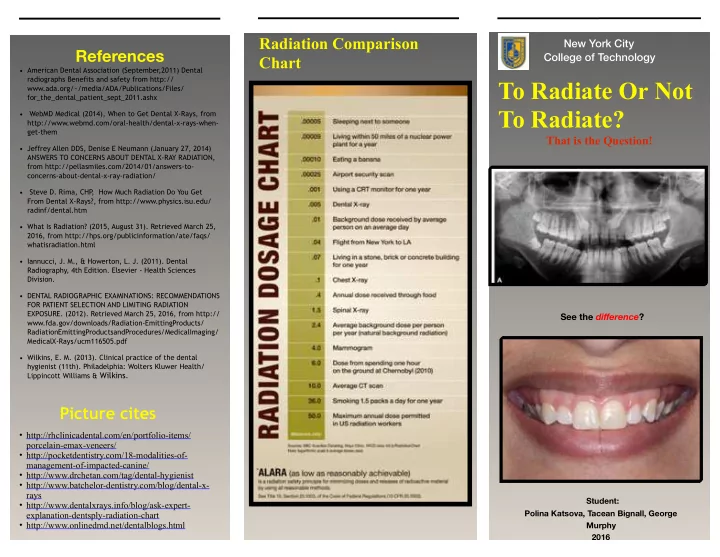
Radiation Comparison New York City References Chart College of Technology American Dental Association (September,2011) Dental radiographs Benefits and safety from http:// To Radiate Or Not www.ada.org/~/media/ADA/Publications/Files/


slide-1
SLIDE 1

References

  • American Dental Association (September,2011) Dental

radiographs Benefits and safety from http:// www.ada.org/~/media/ADA/Publications/Files/ for_the_dental_patient_sept_2011.ashx

  • WebMD Medical (2014), When to Get Dental X-Rays, from

http://www.webmd.com/oral-health/dental-x-rays-when- get-them

  • Jeffrey Allen DDS, Denise E Neumann (January 27, 2014)

ANSWERS TO CONCERNS ABOUT DENTAL X-RAY RADIATION, from http://pellasmiles.com/2014/01/answers-to- concerns-about-dental-x-ray-radiation/

  • Steve D. Rima, CHP

, How Much Radiation Do You Get From Dental X-Rays?, from http://www.physics.isu.edu/ radinf/dental.htm

  • What Is Radiation? (2015, August 31). Retrieved March 25,

2016, from http://hps.org/publicinformation/ate/faqs/ whatisradiation.html

  • Iannucci, J. M., & Howerton, L. J. (2011). Dental

Radiography, 4th Edition. Elsevier - Health Sciences Division.

  • DENTAL RADIOGRAPHIC EXAMINATIONS: RECOMMENDATIONS

FOR PATIENT SELECTION AND LIMITING RADIATION

  • EXPOSURE. (2012). Retrieved March 25, 2016, from http://

www.fda.gov/downloads/Radiation-EmittingProducts/ RadiationEmittingProductsandProcedures/MedicalImaging/ MedicalX-Rays/ucm116505.pdf

  • Wilkins, E. M. (2013). Clinical practice of the dental

hygienist (11th). Philadelphia: Wolters Kluwer Health/ Lippincott Williams & Wilkins.

Picture cites

  • http://rhclinicadental.com/en/portfolio-items/

porcelain-emax-veneers/

  • http://pocketdentistry.com/18-modalities-of-

management-of-impacted-canine/

  • http://www.drchetan.com/tag/dental-hygienist
  • http://www.batchelor-dentistry.com/blog/dental-x-

rays

  • http://www.dentalxrays.info/blog/ask-expert-

explanation-dentsply-radiation-chart

  • http://www.onlinedmd.net/dentalblogs.html

New York City College of Technology

Radiation Comparison Chart

To Radiate Or Not To Radiate?

That is the Question!

See the difference? Student:

Polina Katsova, Tacean Bignall, George Murphy 2016

slide-2
SLIDE 2

slide-3
SLIDE 3

Role of Dental Hygienist

EDUCATION PREVENTION AWARENESS It is the role of the dental professional to educate the patient and help prevent disease with early detection. The dental X-ray is a useful diagnostic tool and key for awareness and prevention. Dental radiographs provide the clinician the ability to examine the areas of the mouth that cannot be seen visually. In order to have a thorough dental examination, radiographs should be included as part of the treatment plan.

What is Radiation?

  • Radiation is a form of energy that travels

through space and is able to penetrate various materials.

  • Just the mention of the word “radiation”

conjures up an unpleasant image for most

  • people. We associate it with bombs, cancer,

and all manner of bad things. But do you know that there are many beneficial uses of radiation.

Who benefits from dental X- rays?

  • Adults with extensive restorative work, such

as fillings, to examine for decay beneath existing fillings, or development of new decay

  • Individuals with Periodontal (gum) disease to

monitor bone loss.

  • Individuals who have dry mouth, which is

called Xerostomia, side effect of many medications or disease. Dry mouth can lead to root surface decay

  • Smokers, to monitor bone loss resulting from

periodontal disease.

  • Children with mixed dentition; to make sure

the jaw is developing properly and there aren’t any missing permanent teeth.


Radiographs are used to:

  • Diagnose and monitor oral diseases that are

not visible to the naked eye.

  • Monitor dentofacial development.
  • Evaluate the progress of dental treatment.
  • Most importantly, for early detection of

infections or tumors.

Why are dental X-rays recommended?

Early detection of hidden problems allow for dental professionals to intervene and correct problems before they become more serious. Routine dental X-rays should be taken based

  • n age, risk of disease, and presence or

symptoms of disease.

How is the patient protected during dental radiation?

The amount of radiation used to obtain dental radiographs is very small. Dentists follow the ALARA principle, which stands for “As Low As Reasonably Achievable,” when exposing

  • radiographs. This radiation safety principle

limits your exposure by incorporating the following techniques: ❖ Lead apron and thyroid collar to protect vital organs. ❖ Using F speed film versus D speed film which requires 60% less radiation during exposure. ❖ Digital exposure using 70% less radiation exposure as compared to traditional film.

Would you believe. . .

You are exposed to more radiation from an airplane flight from New York to California than having a dental X-ray. If you like canned foods, think twice! In order to keep those foods preserved, they must be irradiated to have a long shelf life. What about all you couch potatoes? Watching hours of television means constant exposure to ionizing radiation. Maybe those dental x-rays are not that bad after all!

slide-4
SLIDE 4