
SLIDE 1
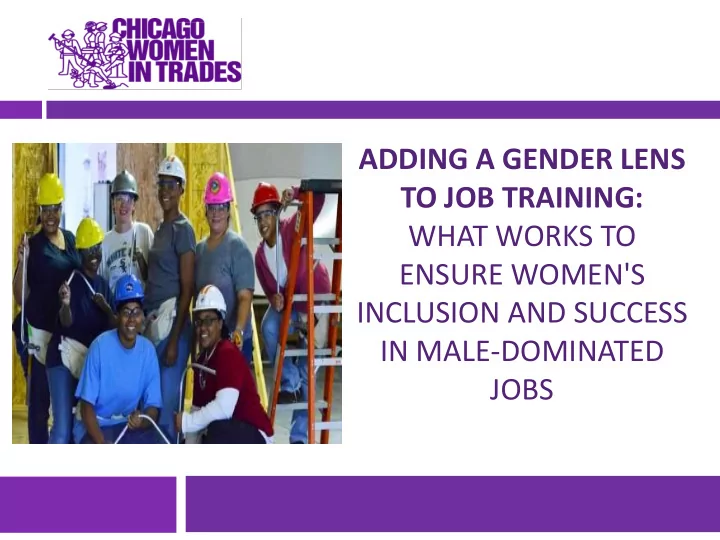
TO JOB TRAINING: WHAT WORKS TO ENSURE WOMEN'S INCLUSION AND - - PowerPoint PPT Presentation
ADDING A GENDER LENS TO JOB TRAINING: WHAT WORKS TO ENSURE WOMEN'S INCLUSION AND SUCCESS IN MALE-DOMINATED JOBS AGENDA: A lot to talk about Outreach and Marketing to Women Putting a Gender Lens on Assessment Practices Effective
Outreach and Marketing to
Putting a Gender Lens on
Effective Education to Prepare
Gender Inclusive Policy and
1)
Women today earn, on average, how much for $1.00 earned by men?
2)
African-American women today earn, on average, how much for $1.00 earned by men?
3)
Latina women today earn, on average, how much for $1.00 earned by men?
4)
42% of all men earn over $50,000. What percent ofwomen do?
5)
Of the 440+ occupations, how many are the majority of women working in?
6)
What is the percentage of women in apprenticeship?
7)
What is the difference between men and women’s wages at placement upon exiting the job traininng system?
8)
What is the lifetime difference in earnings of a woman working in the trades vs. a woman in a job as a nurse assistant?
1) Women on average earn 79% of men’s wages 2) African-American women earn only 69% 3) Latina women earn only 59% 4) 9%—and this was the ceiling, although it is the floor for
male workers.
5) 77% of all women work in just 20 of 440 occupations
6)
The percentage of women in apprenticeship = 7.1%
7) In Illinois we found a $1.48 difference in wage at placements
between men and women exiting WIA. more than a $3,000 difference annually. Some LWIA’s the difference as great as $4.64, a $9500 difference
8)
The lifetime difference in earnings of a woman working in the trades vs. a woman in a job as a nurse assistant -
Occupation % Female
Truck Driver 8.9% $17.72 Mechanic 1.6% $19.07 Firefighter 4.8% $24.25 Elevator Helper/JL <3% $32.31 46.16 Occupation % Female
Secretary 96.1% $15.40 Receptionist 93.6% $12.57 Waitress 73.2% $9.77 Cashier 75.5% $9
Non-Traditional Jobs for Women Traditional Jobs for Women
Apprentice Carpenter $15- 18/hr Journey-level Carpenter $ 37.77 per hour** $ 75,540 per year $ 2,266,200 in 30 years
Earnings Difference: $2,266,200 - $617,430 = $1,648,770 But wait: What about Real Economic Security?!
Lack of outreach and information Stereotypes & sex segregated
Limited training and disparate
Differentiated on-the job training,
Impact of micro-inequities over
Go out of your way! Get women’s attention:
Pair outreach with education Target by who gives the message.
What is a the job/ apprenticeship like? Inform about wages/other benefits that
lead to family economic security
What are working conditions like? What are the entry routes/requirements
and career paths
Inform about barriers and strategies to
Role Models Hands- on activities BE REAL! the good, the bad and the ugly
_________________________________________________
_________________________________________________
_________________________________________________
_________________________________________________
People need to hear/see the message more than
People need to hear/see the
Use Gender
Neutral/Inclusive Assessment Tools
Raise questions about fit
without judging.
Ask probing questions
that go beyond stereotypes.
Minimize yes or no
questions
Allow for applicant to get past the
unknown
Experience aspects of working tasks
and responsibilities.
Identify transferable skills from paid
and unpaid work experiences.
What are some common instincts
about good candidates that might prove to be judgmental or prejudicial female candidates?
Who is conducting the assessment?
Role models and mentors that are gender/race/ culture reflective
A safe and supportive place for:
the foreign
Curriculum to address sex stereotypes, harassment, discrimination
Curriculum that reflects diverse populations’ experiences
Exposure to Work Tool Identification Test-taking Anxiety Reduction Spatial and Mechanical Aptitude Building Physical Fitness: Aerobics,
Self-esteem Balancing work/ family Strategies for surviving and thriving in
Benefits of Diversity in Workforce Expanded Pool of Candidates Public Image Social Justice Equal Employment Opportunity
Women’s Economic
See candidates in action Assist in recruiting and
Building capacity for cultural
Building HR EEO/AA capacity
Take candidates to industry
Link to public works projects
Set goals for women applicants, participants, graduates and placements Assess program and partner's capacity to attract and serve women Build staff understanding of the impact of gender wage inequity and gender segregation of the labor market Design outreach and recruitment materials/plans to target women Program allows for all prospective clients to receive career exploration activities Career counselors are trained to promote nontraditional jobs to women Develop and link to pre-apprenticeship programs that promote women’s inclusion and unique needs
For the public workforce system, job training programs, community agencies
includes presentations, trainings, webinars, curriculum modules, briefs, templates, tip sheets, and planning documents to:
Assist in recruiting and preparing women
for nontraditional occupations;
Develop and add training curriculum and
instructional practices that are gender neutral, inclusive and targeted.
Assist training programs in understanding
and linking to organized labor, apprenticeships, and major employers.
pink-green-toolkit-
Midwest Technical
cultural competency
CONTACT INFORMATION
Lauren Sugerman National Policy Director lsugerman@cwit2.org Chicago Women in Trades 2444 W.16th Street Suite 3E Chicago, IL 60608 312-942-1444 www.cwit2.org
24