To Do Computer Graphics (Fall 2004) Submit HW 3, do well Start - - PDF document

to do
SMART_READER_LITE
LIVE PREVIEW

To Do Computer Graphics (Fall 2004) Submit HW 3, do well Start - - PDF document

To Do Computer Graphics (Fall 2004) Submit HW 3, do well Start early on HW 4 COMS 4160, Lecture 16: Illumination and Shading 2 http://www.cs.columbia.edu/~cs4160 Lecture includes number of slides from other sources: Hence different


slide-1
SLIDE 1

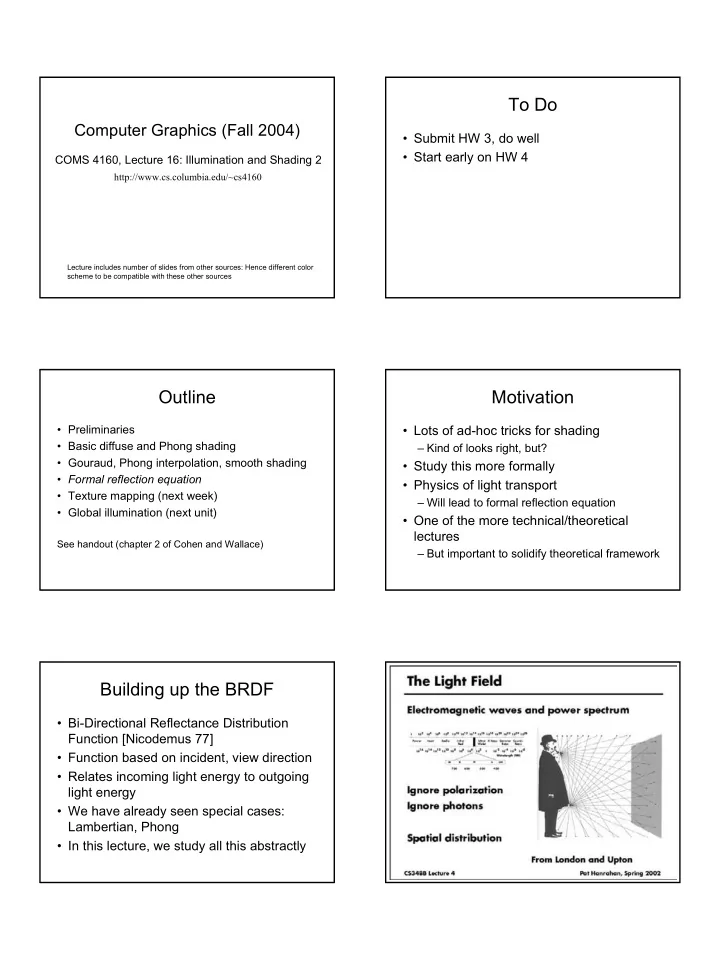
Computer Graphics (Fall 2004)

COMS 4160, Lecture 16: Illumination and Shading 2

http://www.cs.columbia.edu/~cs4160

Lecture includes number of slides from other sources: Hence different color scheme to be compatible with these other sources

To Do

  • Submit HW 3, do well
  • Start early on HW 4

Outline

  • Preliminaries
  • Basic diffuse and Phong shading
  • Gouraud, Phong interpolation, smooth shading
  • Formal reflection equation
  • Texture mapping (next week)
  • Global illumination (next unit)

See handout (chapter 2 of Cohen and Wallace)

Motivation

  • Lots of ad-hoc tricks for shading

– Kind of looks right, but?

  • Study this more formally
  • Physics of light transport

– Will lead to formal reflection equation

  • One of the more technical/theoretical

lectures

– But important to solidify theoretical framework

Building up the BRDF

  • Bi-Directional Reflectance Distribution

Function [Nicodemus 77]

  • Function based on incident, view direction
  • Relates incoming light energy to outgoing

light energy

  • We have already seen special cases:

Lambertian, Phong

  • In this lecture, we study all this abstractly
slide-2
SLIDE 2

Radiometry

  • Physical measurement of electromagnetic

energy

  • We consider light field

– Radiance, Irradiance – Reflection functions: Bi-Directional Reflectance Distribution Function or BRDF – Reflection Equation – Simple BRDF models

Radiance

  • Power per unit projected area perpendicular to

the ray per unit solid angle in the direction of the ray

  • Symbol: L(x,ω) (W/m2 sr)
  • Flux given by

dΦ = L(x,ω) cos θ dω dA

Radiance properties

  • Radiance is constant as it propagates along ray

– Derived from conservation of flux – Fundamental in Light Transport.

1 2

1 1 1 2 2 2

d L d dA L d dA d ω ω Φ = = = Φ

2 2 1 2 2 1

d dA r d dA r ω ω = =

1 2 1 1 2 2 2

dA dA d dA d dA r ω ω = =

1 2

L L ∴ =

slide-3
SLIDE 3

Radiance properties

  • Sensor response proportional to surface

radiance (constant of proportionality is throughput) – Far away surface: See more, but subtends smaller angle – Wall is equally bright across range of viewing distances Consequences – Radiance associated with rays in a ray tracer – All other radiometric quantities derived from radiance

Irradiance, Radiosity

  • Irradiance E is the radiant power per unit area
  • Integrate incoming radiance over hemisphere

– Projected solid angle (cos θ dω)

– Uniform illumination: Irradiance = π [CW 24,25] – Units: W/m2

  • Radiosity

– Power per unit area leaving surface (like irradiance)

BRDF

  • Reflected Radiance proportional to Irradiance
  • Constant proportionality: BRDF [CW pp 28,29]

– Ratio of outgoing light (radiance) to incoming light (irradiance)

– Bidirectional Reflection Distribution Function – (4 Vars) units 1/sr

( ) ( , ) ( )cos

r r i r i i i i

L f L d ω ω ω ω θ ω = ( ) ( ) ( , )cos

r r i i i r i i

L L f d ω ω ω ω θ ω =

slide-4
SLIDE 4

Isotropic vs Anisotropic

  • Isotropic: Most materials (you can rotate

about normal without changing reflections)

  • Anisotropic: brushed metal etc. preferred

tangential direction

Isotropic Anisotropic

Radiometry

  • Physical measurement of electromagnetic

energy

  • We consider light field

– Radiance, Irradiance – Reflection functions: Bi

  • D

irectional Reflectance Distribution Function or BRDF – Reflection Equation – Simple BRDF models

Reflection Equation

i

ω

r

ω

( ) ( ) ( , )( )

r r i i i r i

L L f n ω ω ω ω ω = i

Reflected Radiance (Output Image) Incident radiance (from light source) BRDF Cosine of Incident angle

Reflection Equation

i

ω

r

ω

Sum over all light sources

( ) ( ) ( , )( )

r r i i i r i i

L L f n ω ω ω ω ω =∑ i

Reflected Radiance (Output Image) Incident radiance (from light source) BRDF Cosine of Incident angle

Reflection Equation

i

ω

r

ω

Replace sum with integral i

( ) ( ) ( , )( )

r r i i i r i i

L L f n d ω ω ω ω ω ω

= ∫ i

Reflected Radiance (Output Image) Incident radiance (from light source) BRDF Cosine of Incident angle

slide-5
SLIDE 5

Radiometry

  • Physical measurement of electromagnetic

energy

  • We consider light field

– Radiance, Irradiance – Reflection functions: Bi

  • D

irectional Reflectance Distribution Function or BRDF – Reflection Equation – Simple BRDF models

Brdf Viewer plots

Diffuse

bv written by Szymon Rusinkiewicz

Torrance-Sparrow Anisotropic

slide-6
SLIDE 6

Analytical BRDF: TS example

  • One famous analytically derived BRDF is

the Torrance-Sparrow model.

  • T-S is used to model specular surface, like

the Phong model.

– more accurate than Phong – has more parameters that can be set to match different materials – derived based on assumptions of underlying

  • geometry. (instead of ‘because it works well’)

Torrance-Sparrow

  • Assume the surface is made up grooves at the

microscopic level.

  • Assume the faces of these grooves (called

microfacets) are perfect reflectors.

  • Take into account 3 phenomena

Shadowing Masking Interreflection

Torrance-Sparrow Result

( ) ( , ) ( ) 4cos( )cos( )

i i r h i r

F G D f θ ω ω θ θ θ =

Fresnel term: allows for wavelength dependency Geometric Attenuation: reduces the output based on the amount of shadowing or masking that occurs. Distribution: distribution function determines what percentage of microfacets are

  • riented to reflect in

the viewer direction. How much of the macroscopic surface is visible to the light source How much of the macroscopic surface is visible to the viewer

Other BRDF models

  • Empirical: Measure and build a 4D table
  • Anisotropic models for hair, brushed steel
  • Cartoon shaders, funky BRDFs
  • Capturing spatial variation
  • Very active area of research

Complex Lighting

  • So far we’ve looked at simple, discrete

light sources.

  • Real environments contribute many colors
  • f light from many directions.
  • The complex lighting of a scene can be

captured in an Environment map.

– Just paint the environment on a sphere.

Environment Maps

  • Instead of determining the lighting direction

by knowing what lights exist, determine what light exists by knowing the lighting direction.

Blinn and Newell 1976, Miller and Hoffman, 1984 Later, Greene 86, Cabral et al. 87

slide-7
SLIDE 7

Conclusion

  • All this (OpenGL, physically based) are local

illumination and shading models

  • Good lighting, BRDFs produce convincing

results

– Matrix movies, modern realistic computer graphics

  • Do not consider global effects like shadows,

interreflections (from one surface on another)

– Subject of next unit (global illumination)