To conclude the Meal Service Style Slide 1 Conclusion for Meal - - PDF document

to conclude the meal service style
SMART_READER_LITE
LIVE PREVIEW

To conclude the Meal Service Style Slide 1 Conclusion for Meal - - PDF document

To conclude the Meal Service Style Slide 1 Conclusion for Meal Service Styles Topic Topic, Sponsors must serve all meals and snacks using one of 4 Sponsors must use one of the approved Meal Service Styles: approved Meal Service Styles:


slide-1
SLIDE 1

Slide 1

Conclusion for Meal Service Styles Topic

Sponsors must use one of the approved Meal Service Styles:

 Restaurant  Family  Cafeteria  Combination Restaurant / Family

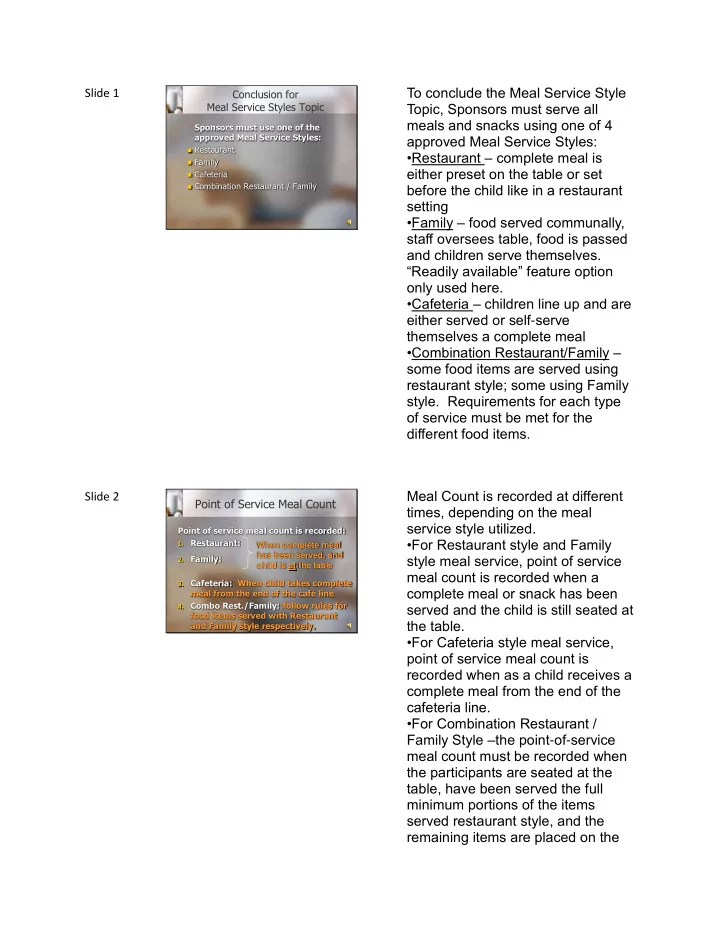
To conclude the Meal Service Style Topic, Sponsors must serve all meals and snacks using one of 4 approved Meal Service Styles:

  • Restaurant – complete meal is

either preset on the table or set before the child like in a restaurant setting

  • Family – food served communally,

staff oversees table, food is passed and children serve themselves. “Readily available” feature option

  • nly used here.
  • Cafeteria – children line up and are

either served or self-serve themselves a complete meal

  • Combination Restaurant/Family –

some food items are served using restaurant style; some using Family

  • style. Requirements for each type
  • f service must be met for the

different food items.

Slide 2

Point of Service Meal Count

Point of service meal count is recorded:

  • 1. Restaurant:
  • 2. Family:
  • 3. Cafeteria: When child takes complete

meal from the end of the café line

  • 4. Combo Rest./Family: follow rules for

food items served with Restaurant and Family style respectively. When complete meal has been served, and child is at the table

Meal Count is recorded at different times, depending on the meal service style utilized.

  • For Restaurant style and Family

style meal service, point of service meal count is recorded when a complete meal or snack has been served and the child is still seated at the table.

  • For Cafeteria style meal service,

point of service meal count is recorded when as a child receives a complete meal from the end of the cafeteria line.

  • For Combination Restaurant /

Family Style –the point-of-service meal count must be recorded when the participants are seated at the table, have been served the full minimum portions of the items served restaurant style, and the remaining items are placed on the

slide-2
SLIDE 2

table.

Slide 3

Actual Count vs. Head Count

Point of Service Meal Count Methods:

 Actual Count – records meals by

participant name

 Head Count – records meals by

counting the number of participants receiving a reimbursable meal.

The point-of-service “actual count” method records the reimbursable meals served to each participant, by name (first and last). Sponsors who serve more than two meals and one snack or two snacks and one meal are required to use the “actual count” method. The Daily Meal Count - Actual Count Method form (Exhibit 23.16 in Big Red) is available to use or Sponsors may develop their own “actual count” form.

  • The point-of-service “head count”

method tallies the meals by counting the number of participants receiving a reimbursable meal and documenting the number on the Daily Meal Count - Head Count Method (Exhibit 23.17 in Big Red) Either actual count or head count meal counting methods may be used with all the approved meal service styles. Refer to chapter 5 in Big red for more information on meal counting requirements.

slide-3
SLIDE 3

Slide 4

Common Errors – Meal Counting

Examples of meal count methods that are NOT acceptable:

 Counting # meals prepared by kitchen  Subtracting # meals leftover from #

meals prepared

 Counting # meals prepared by vendor  Counting server’s memory or

attendance records

 Counting # of plates or trays used

The following are examples of meal count methods that are not acceptable:

  • Counting the number of meals prepared
  • r sent by the kitchen;
  • Determining the meal count by subtracting

the number of entrees left over after the meal service from the number of entrees prepared;

  • Counting the number of meals ordered

from a vendor;

  • Counting meals after the meal is

completed based on teachers’ memory or daily attendance records; and

  • Counting the number of trays or plates on

which food is served. Do not count participants who were not served a creditable meal (for example, a participant who was served tofu as a Meat/Meat Alternate—their meal should not be counted for reimbursement). Have meal count forms readily available in the serving

  • area. Meals served to teachers, helpers,

and non-participant adults are not reimbursable and must not be reported on the monthly reimbursement claim. Keep meal count forms in a notebook or folder, or on a bulletin board or clipboard so they are easy for the meal count staff to find and record meal counts. Sponsors should verify the accuracy of the claim for reimbursement, compared to the meal count records.

Slide 5

Meal service style and Meal Count

Meal service style and point of service meal count are important Program

  • requirements. It’s

important to know what style you use and at what point to record meal count!

Utilizing correct meal service style and recording meal count accurately at the point of service are important Program features and are sometimes findings during administrative reviews. It’s important to know what style your facility uses and at what point to record meal count.