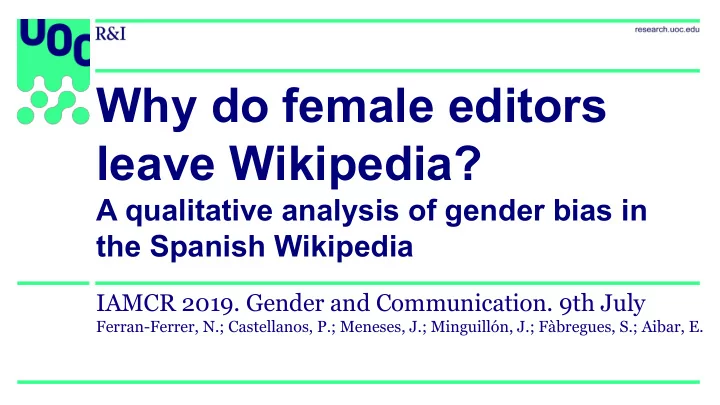
Titular del document Why do female editors Lletra: Arial negreta / - - PowerPoint PPT Presentation

titular del document why do female editors lletra arial
SMART_READER_LITE
LIVE PREVIEW

Titular del document Why do female editors Lletra: Arial negreta / - - PowerPoint PPT Presentation

Titular del document Why do female editors Lletra: Arial negreta / leave Wikipedia? A qualitative analysis of gender bias in 48 pt. / Blanca the Spanish Wikipedia Lletra: Georgia / 24 pt. / Blanca. Si voleu eliminar IAMCR 2019. Gender and


slide-1
SLIDE 1

Titular del document Lletra: Arial negreta / 48 pt. / Blanca

Lletra: Georgia / 24 pt. / Blanca. Si voleu eliminar aquest subtítol, elimineu també les 2 línies anteriors

Why do female editors leave Wikipedia?

A qualitative analysis of gender bias in the Spanish Wikipedia A qualitative analysis of gender bias in the Spanish Wikipedia

IAMCR 2019. Gender and Communication. 9th July

Ferran-Ferrer, N.; Castellanos, P.; Meneses, J.; Minguillón, J.; Fàbregues, S.; Aibar, E.

slide-2
SLIDE 2

50 million articles in more than 300 languages 5th most popular web site and 1st page of results generated by search engines Primary source of information where books are not available & for high school students Spanish Wikipedia 8th according to size (1,5 M pages) and 4th according to registered editors (>18,000)

Wikipedia: community-based sum of all human knowledge

slide-3
SLIDE 3

Wikipedia’s bureaucracy. System of governance: roles and policies

Source: Simonite, T. (2013). “The Decline of Wikipedia”, en: MIT Technology Review, https://www.technologyreview.com/s/520446/the-decline-of-wikipedia/

List of policies and guidelines

  • f Wikipedia

https://en.wikipedia.org/ wiki/Wikipedia:List_of_p

  • licies_and_guidelines
slide-4
SLIDE 4

Poorly representation of the world diversity. Gender bias on Wikipedia: Editor community: primarily male contributors (≈ 90%) Female Editors (≈ 10%) and with higher dropout rate Corresponding gender-oriented disparity in the content

  • f Wikipedia’s articles. Only about 18% of Wikipedia’s

biographical articles are about women Wikipedia Foundation has not achieved the 2015 Goal of increasing up to 25% female editors Though the proportion of female readership to male readership on Wikipedia is roughly equal (47%)

Neutral point of view Policy

Source: Survey on who is editing Wikipedia, Wikimedia Foundation, 2018

slide-5
SLIDE 5

Analyzing Gender Bias in the Spanish Wikipedia: Quantitative Perspective

Research Questions and Methodology:

  • How many editors are female in WP? In disguise? Early dropout?

○ Manual coding of gender or real name: ■

Sample of registered users (Dump 1st Oct 2017). Registered users, User Page, editors during the last 5 years with at least 50 edits: 13,210 ■ Sampling: User page size and number of edits ■ Manual coding instrument using only the User Page content (no username): 4,746

  • coded. (Reliability 2 coders=0,96)

■ Explicit saying gender or real name: 295 women, 2,029 men, 2,422 unknown

○ Automatic gender extraction from Wikipedia API (Spanish: Usuario/Usuaria):

■ 181 women, 1,661 men, 2,904 unspecified

  • When combined: 353 women (7.44%), 2,792 men (58.83%), 1,601 unknown (33.73%)
  • No discrepancies were found between the two coding methods
slide-6
SLIDE 6

Analyzing Gender Bias in the Spanish Wikipedia: Qualitative Perspective

Research Questions and Methods:

  • What are the practices, perceptions, motivations and feelings of female

editors in WP? ○ socio-demographic (education, time spent on care, type of work, etc.) ○ motivation to participate and reasons to abandon ○ experiences as editors ○ gender positioning

  • 353 female users (All contacted, 90 responded and 12 accepted to be

interviewed: 4 current female editors and 8 former editors (4 short-term and 4 long-term)

slide-7
SLIDE 7

Socio-demographic profile of participants

  • Age: 23-63 years old
  • 8 different nationalities across Europe and Latin America

○ Argentine, Basque, Bolivian, Catalan, Mexican, Spanish, Uruguayan and Venezuelan

  • All of them with higher education:

3PhD, 3 higher education, 3 secondary, 2 master, 1 higher education student

  • Domestic chores: 100%-60%-0%
  • Working hours: 50h-30h/per week
slide-8
SLIDE 8

Common features: current and former female editors

  • High personal satisfaction with their contribution to Wikipedia
  • Few feminist: only 2, and 3 feminist activist (explicitly expressed)
  • Most of them stand for Usuaria, although some did not know the possibility
  • Concerns:

little female editor presence ○ low rate of female bio entrances and family/personal issues are more present than professional features in bio female entrances ○ easy nominations for deletions ○ contribute to the equal education of new generations ○ increase the use of non-sexist language

slide-9
SLIDE 9

Main reasons for leaving Wikipedia:

Sue Gardner “9 reasons why women don’t edit Wikipedia” Reasons for leaving (or editing) from our data Women Role

2.Not having enough time

  • Child care and domestic chores.

+But part time job, sick leave, retirement: editing stages

Harsh environment

  • 6. Misogynistic atmosphere
  • 7. Wikipedia culture is sexual, it is off-putting

9.Fewer opportunities than other sites for social relationships and a welcoming tone

  • 8. Being addressed as male is off-putting to women

whose primary language has grammatical gender

  • Non-inclusive language, gender perspective
  • Usuario-Usuaria (User male/female)
  • Unjustified male criticism
  • Insecurity in an environment where you are the minority
  • Tone in communications: "an abrupt environment"/"environment

that generates insecurity"/"gender conflict”

  • Visibility of female bios

+Wikipedia with smaller communities smooth environment

Editing process

  • 4. Aversion to conflict, edit wars
  • 5. Belief that contributions are likely to be deleted

Difficulty justify relevance of female information sources Substancial info sources Need for time to edit discussions / or not willing to

ICT & content competencies

1.Lack of user-friendliness editing interface

  • 3. Lack of self-confidence

Most of them feel competent with ICT and with their expertise Only editors are critics with the platform though it is easy to learn

slide-10
SLIDE 10

Main reasons for editing (or leaving) Wikipedia:

Reason to leave: domestic chores Harsh environment: Off the record, hard male critics, rude manners… inclusive language, gender perspective. Difficulty to

Reasons for editing Reasons for leaving Editathon Main entrance for editing Training Meeting place, social Gender gap task force Main reason to leave when the community or project ends

Source: Kevin Smith Library https://artscimedia.case.edu/wp-content/uploads/sites/63 /2018/02/20141520/artwomen2018.jpg

slide-11
SLIDE 11

Conclusions

  • Difficulties in making female editors concerns visible:

○ Response rate for the interviews quite low (3%. 354 sampled-90 contacted-12 response) ○ Off the record regarding gender issues and situations with male editors

  • Feelings of insecurity in an environment where women are a minority
  • Gender bias

○ Visibility of female bios (all editors and ex-editors) ○ Difficulty to justify the relevance of female information sources. Don’t reach WP quality scores ○ Interpersonal communication is associated with the continuity of women to edit in Wikipedia, through collective experiences of editing; HARSH ENVIRONMENT ○ Non-inclusive language nor gender perspective ○ Usuario-Usuaria (User male/female) ○ Injustify male criticism according to some participants

slide-12
SLIDE 12
  • Editathon’s role

○ Provide more autonomy and security to participants ○ Carry out more stable projects and promote initiatives that facilitate the persistence of female editors into Wikipedia ○ Think about how to facilitate the reentry of female editors into Wikipedia

  • Communication

○ First to thank for the contribution ○ Agreeable tone in communications, discussions, comments on user pages or justification of corrections

  • Need from the public sphere (media/universities, etc.) promotion of equal content

and practices from a gender perspective

Recommendations

slide-13
SLIDE 13

UOCresearch @UOC_research UOCresearch @UOC_research

Thank you for your attention Questions and comments more than welcome! Further information: Núria Ferran Ferrer nferranf@uoc.edu @nferranf Autorship: Ferran-Ferrer, N.; Castellanos, P.; Meneses, J.; Minguillón, J.; Fàbregues, S.; Aibar, E. http://waww.blogs.uoc.edu

Source: T. Morris https://commons.wikimedia.org/wiki/File:We_Can_Edit.jpg