Title: PRESENTATION OF AN E-MODULE FOR DENTAL CONTINUING - - PDF document

title presentation of an e module for dental continuing
SMART_READER_LITE
LIVE PREVIEW

Title: PRESENTATION OF AN E-MODULE FOR DENTAL CONTINUING - - PDF document

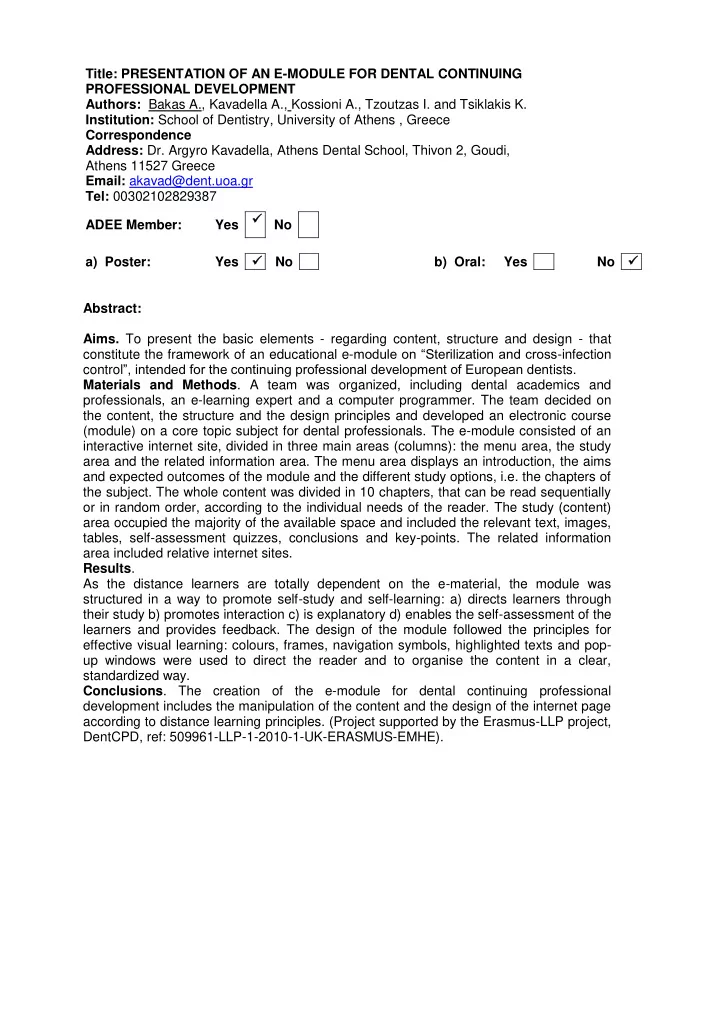
Title: PRESENTATION OF AN E-MODULE FOR DENTAL CONTINUING PROFESSIONAL DEVELOPMENT Authors: Bakas A., Kavadella A., Kossioni A., Tzoutzas I. and Tsiklakis K. Institution: School of Dentistry, University of Athens , Greece Correspondence Address:


slide-1
SLIDE 1

Abstract:

  • Aims. To present the basic elements - regarding content, structure and design - that

constitute the framework of an educational e-module on “Sterilization and cross-infection control”, intended for the continuing professional development of European dentists. Materials and Methods. A team was organized, including dental academics and professionals, an e-learning expert and a computer programmer. The team decided on the content, the structure and the design principles and developed an electronic course (module) on a core topic subject for dental professionals. The e-module consisted of an interactive internet site, divided in three main areas (columns): the menu area, the study area and the related information area. The menu area displays an introduction, the aims and expected outcomes of the module and the different study options, i.e. the chapters of the subject. The whole content was divided in 10 chapters, that can be read sequentially

  • r in random order, according to the individual needs of the reader. The study (content)

area occupied the majority of the available space and included the relevant text, images, tables, self-assessment quizzes, conclusions and key-points. The related information area included relative internet sites. Results. As the distance learners are totally dependent on the e-material, the module was structured in a way to promote self-study and self-learning: a) directs learners through their study b) promotes interaction c) is explanatory d) enables the self-assessment of the learners and provides feedback. The design of the module followed the principles for effective visual learning: colours, frames, navigation symbols, highlighted texts and pop- up windows were used to direct the reader and to organise the content in a clear, standardized way.

  • Conclusions. The creation of the e-module for dental continuing professional

development includes the manipulation of the content and the design of the internet page according to distance learning principles. (Project supported by the Erasmus-LLP project, DentCPD, ref: 509961-LLP-1-2010-1-UK-ERASMUS-EMHE). Title: PRESENTATION OF AN E-MODULE FOR DENTAL CONTINUING PROFESSIONAL DEVELOPMENT Authors: Bakas A., Kavadella A., Kossioni A., Tzoutzas I. and Tsiklakis K. Institution: School of Dentistry, University of Athens , Greece Correspondence Address: Dr. Argyro Kavadella, Athens Dental School, Thivon 2, Goudi, Athens 11527 Greece Email: akavad@dent.uoa.gr Tel: 00302102829387 ADEE Member: Yes  No a) Poster: Yes  No b) Oral: Yes No 

slide-2
SLIDE 2

Abstract:

  • Aims. To present the methodological framework for the development of educational e-

content, including the conversion of conventional text into e-text, suitable for dental e- learning. Materials and Methods. The content of the e-module “Sterilization and cross-infection control in the dental practice” was developed by an expert on the subject and was peer- reviewed by a team of academics and professionals. By following the principles for developing educational material for adult e-learning, the conventional written text was adapted to the electronic environment.

  • Results. Two important parameters were identified while creating the electronic material:

a) the methodology for the development of the material and b) the design of the material. Both parameters depend upon the learning objectives of the course: the formulation of learning objectives is the first step towards the creation of electronic educational material. Into the methodology are included the structural elements of a comprehensive educational material: the main text (the core part of the material), the co-text (aims and

  • utcomes, key-words, tests and activities), the meta-text (conclusions, summaries,

references), the hyper-text (link-texts, glossaries, definitions), the retro-text (text in windows, guides) and the para-text (images, symbols, graphics). The design of the material includes the choice of fonts, colors, spacing, extent of the chapters and sub-

  • chapters. Elements such as the length of the text, the combination of text and

images/video, the time of a text on the computer screen and the need for scrolling should be taken into account. The conversion of the linear, conventional text into electronic content resulted in a multimodal non-linear material, which enables the content-learner interaction and the efficient distance learning.

  • Conclusions. The conversion of conventional educational text into electronic material

requires a) the formulation of learning objectives, b) the relevant methodological framework and c) the suitable e-text design for achieving the learning objectives. (Project supported by the Erasmus-LLP project, DentCPD, ref: 509961-LLP-1-2010-1-UK- ERASMUS-EMHE). Title: A COMPREHENSIVE FRAMEWORK FOR THE DEVELOPMENT OF THE EDUCATIONAL CONTENT OF E-MODULES Authors: Kavadella A., Kossioni A., Tzoutzas I. and Tsiklakis K. Institution: School of Dentistry, University of Athens , Greece Correspondence Address: Dr. Argyro Kavadella, Athens Dental School, Thivon 2, Goudi, Athens 11527 Greece Email: akavad@dent.uoa.gr Tel: 00302102829387 ADEE Member: Yes  No a) Poster: Yes  No b) Oral: Yes No 

slide-3
SLIDE 3

Abstract:

  • Aims. To present the methodology of the implementation of general guidelines into a

specific organizational framework developed to address the local continuing education needs of the dental practitioners. Materials and Methods. The Dental School of Athens University is a provider of continuing education courses for a number of years, yet a comprehensive regulatory and managerial framework did not exist. This regulatory framework was decided to be created during the present academic year and the “Guidelines for the organization of Dental CPD programs” served as guidance. The guidelines were developed under the DentCPD European project, were informed by literature reviews and survey results, and were peer- reviewed and amended. The methodology of adapting the general guidelines into a specific educational and social context is presented here.

  • Results. The new “Regulatory Framework for the organization and management of

Continuing Education activities” of the Athens Dental School aims at encompassing all independent activities under a common framework, which describes and regulates all the relevant parameters: organization, provision, evaluation. The general CPD Guidelines include suggestions on the structure, pedagogy, assessment and quality assurance of the CPD activities offered by dental schools, educators, organizations, etc . Specifically, the topics addressed in the Guidelines are: providers, educators, delivery modes, structure- continuity-learning objectives-learning material, assessment of learning and acquired skills, feedback and credit points. All topics were included in the Regulatory Framework. Each topic was reviewed, analyzed and further specified according to the specific needs

  • f the Greek dentists and the organizational capacity and general educational aims of the

Dental School.

  • Conclusions. The general CPD Guidelines can serve as guidance for the organization of

continuing education activities by dental schools, by adapting them into the local educational and professional environment. (Project supported by the Erasmus-LLP project, DentCPD, ref: 509961-LLP-1-2010-1-UK-ERASMUS-EMHE). Title: IMPLEMENTATION OF THE “GUIDELINES FOR THE ORGANIZATION OF DENTAL CPD PROGRAMS” INTO THE CONTINUING EDUCATION REGULATORY FRAMEWORK OF ATHENS DENTAL SCHOOL Authors: Tsiklakis K.1, Kavadella A.1, Kossioni A.1, Karaharju-Suvanto T.2 and Suomalainen K.2 Institution: 1. School of Dentistry, University of Athens, Greece

  • 2. Institute of Dentistry, University of Helsinki, Finland

Correspondence Address: Dr. Argyro Kavadella, Athens Dental School, Thivon 2, Goudi, Athens 11527 Greece Email: akavad@dent.uoa.gr Tel: 00302102829387 ADEE Member: Yes  No a) Poster: Yes  No b) Oral: Yes No 

slide-4
SLIDE 4

Abstract:

  • Aims. To make a preliminary evaluation of the design of an educational website, which

will be used as an exemplar e-module for the continuing professional development of the European dentists provided by Dental Schools. Materials and Methods. An anonymous electronic questionnaire was developed including close and open-ended questions on the design, colours, fonts, images, self- assessment questions and any technical problems met during navigation. The rating of the quantitative evaluation ranged from 1(very negative) to 10 (very positive). A survey link was e-mailed to 25 faculties of the Athens Dental School and general dentists, members of the Athens Dental Association, with experience in developing and using e- learning material. A reminder e-mail was sent 10 days later addressing to non-

  • respondents. The results were analysed using descriptive statistics and a qualitative

analysis was also performed.

  • Results. 20 dentists responded to the questionnaire. Their general impression on the e-

module was good. They all agreed that they didn’t meet any technical difficulties exploring the website (x=10.0). The mean rating of all items ranged from 6.7 to 10. The highest rate was recorded for the fonts (x=9.0) and the self-assessment questions (x=8.7) and the lowest for the colours being used (x=6.7). The open-text questions provided very useful comments, which could help in improving the e-module (eg. comments on the size of the images, the presentation and type of the self-assessment questions, the colours used, the use of videos on particular topics etc).

  • Conclusions. The preliminary evaluation of the electronic e-module for dental continuing

professional development was positive. The comments recorded provided useful information on further improvements of the design. (Project supported by the Erasmus-LLP project, DentCPD, ref: 509961-LLP-1-2010-1-UK- ERASMUS-EMHE). Title: A PRELIMINARY EVALUATION OF AN E-MODULE FOR DENTAL CONTINUING PROFESSIONAL DEVELOPMENT Authors: Kossioni A., Kavadella A, Tzoutzas I., Bakas A. and Tsiklakis K. Institution: School of Dentistry, University of Athens , Greece Correspondence Address: Assist. Prof. Anastasia Kossioni, Athens Dental School, Thivon 2, Goudi, Athens 11527 Greece Email: akossion@dent.uoa.gr Tel: 00302107461212 ADEE Member: Yes  No a) Poster: Yes  No b) Oral: Yes No 