
SLIDE 1
Tips ‘N’ Tricks
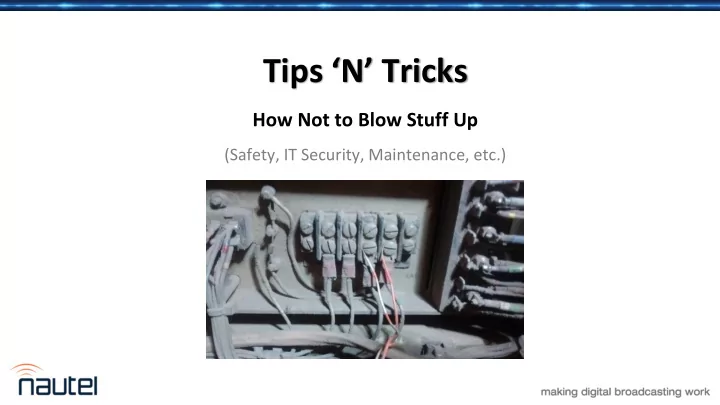
How Not to Blow Stuff Up
(Safety, IT Security, Maintenance, etc.)
Tips N Tricks How Not to Blow Stuff Up (Safety, IT Security, - - PowerPoint PPT Presentation
Tips N Tricks How Not to Blow Stuff Up (Safety, IT Security, Maintenance, etc.) Agenda Overview Safety Fewer resources does not mean taking risks! Useful tools Grounding Protecting equipment and engineers
How Not to Blow Stuff Up
(Safety, IT Security, Maintenance, etc.)
Overview
✓ Safety
⁻ Fewer resources does not mean taking risks! ⁻ Useful tools
✓ Grounding
⁻ Protecting equipment and engineers ⁻ How much is too much?
✓ IT security
⁻ More connected equipment ⁻ Protecting the license
✓ Maintenance
⁻ Sometimes it is easier to stop the fire from starting ⁻ Spending a little to save a lot
Jeff Welton Regional Sales Manager Central U.S.
Agenda
Your questions please?
(if you don’t see the control panel, click on the orange arrow icon to expand it) Please enter your questions in the text box of the webinar control panel (remember to press send)
Remember: The completion of a Nautel webinar qualifies for ½ SBE re-certification credit, identified under Category I of the Re-certification Schedule for SBE Certifications.
Graying Talent
From the paper, The Shortage of Broadcast Engineers – is there, or do we just need to know where to look? by John L. Poray, CAE, Executive Director, Society of Broadcast Engineers, 2012 NAB Broadcast Engineering Conference.
More frequently, engineers are working alone, often after a full day at another job, bringing fatigue into the equation.
Resulting Safety Concerns
Proper Protection is Important
live circuit.
Lockout/tagout – it can save your life
Safety is Key
source, a fast verification is a good idea (breakers can weld closed)
Safety is Key
equipment is mandatory
– Ladders rated for working with electricity (and make sure ladders are used, don’t stand on chairs!) – Equipment should be secured when not in use.
Safety is Key
Photo credit: Guy West, Far East Broadcasting Company
Periodic Safety Checks
Grounding
Bulkhead ground for coax cables
building
reference ground
possible
Single Point
soldered, brazed or CAD welded.
are not ideal, they can loosen over time, or become less effective as materials
Bonding
Make certain your ground is REALLY a ground!
Bonding
AC Power line protectors are a must – and they MUST be connected to your station reference ground.
Surge Protector
Ferrites are good for reducing common mode signals
located AM and FM sites)
noise
Ferrites
tuning unit (ATU)
used
and AC ground go through the same ferrite
pair, shielded cables should be used
Ferrites
Clean up excess wiring
replaced Keep ground connections to a minimum
Ground Loops
IT Security
IT Security
IT Security
A Virtual Private Network (VPN) is a good way to improve security – There are many available, local or remotely hosted, free or subscription based, with various levels of flexibility and support. – One resource for learning about the VPN options is techradar.com
IT Security
ports and port forward through the router
deleted (or at least change the password to something complex)
IT Security
Maintenance
Air Filters should be changed on a schedule, based on site conditions. Metal mesh filters can be washed – make sure they are dry before reinstalling!
Air Filters
AC entry points and circuit breakers) can loosen over time, as wires compress.
should also be checked (fan/blower vibration and heating/cooling cycles can also cause these to loosen)
Hardware
Make sure ground is grounded! Remove unused cables
Groundskeeping
Housekeeping
Online Information
http://www.nautel.com/newsletter/
http://www.nautel.com/webinars/
http://www.youtube.com/user/NautelLtd
www.nautel.com