Time to Vote EHR use for asynchronous and telehealth visits PC - - PDF document

time to vote
SMART_READER_LITE
LIVE PREVIEW

Time to Vote EHR use for asynchronous and telehealth visits PC - - PDF document

Primary Care Medicine: Principles and Practice https://www.nytimes.com/video/business/100000005421 370/iphone-10th-anniversary-destroy.html The Present and Future of Primary Care: Optimizing Joy, Quality, Equity, and Payment Coleen Kivlahan,


slide-1
SLIDE 1

Leading Together in Primary Care: Learning Lab 10/11/17 1

Primary Care Medicine: Principles and Practice

Primary Care Medicine: Principles and Practice 1

The Present and Future of Primary Care: Optimizing Joy, Quality, Equity, and Payment Coleen Kivlahan, MD, MSPH

Primary Care Medicine: Principles and Practice 2

https://www.nytimes.com/video/business/100000005421 370/iphone-10th-anniversary-destroy.html

Primary Care Medicine: Principles and Practice 3

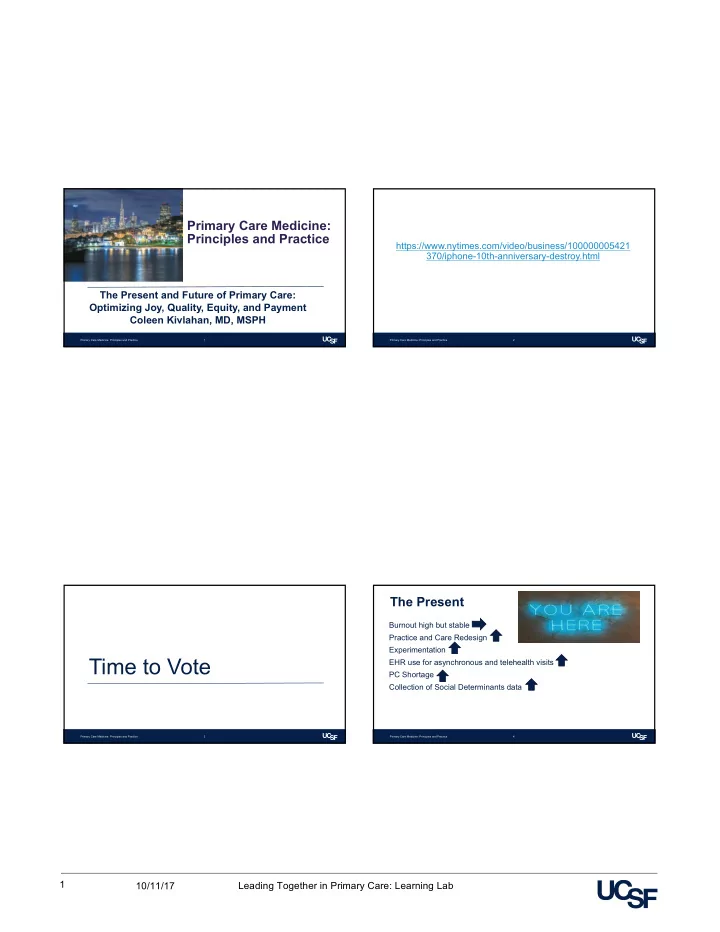
Time to Vote

Primary Care Medicine: Principles and Practice 4

The Present

Burnout high but stable Practice and Care Redesign Experimentation EHR use for asynchronous and telehealth visits PC Shortage Collection of Social Determinants data

slide-2
SLIDE 2

Leading Together in Primary Care: Learning Lab 10/11/17 2

Primary Care Medicine: Principles and Practice 5

What is Burnout?

Exhaustion, depersonalization, low sense of accomplishment Nearly half of all U.S. nurses and physicians Contributes to lower patient satisfaction, worse patient safety, more likely to leave jobs, take sick leave, depression and relationship problems

It’s Not Just Us

Overall prevalence of burnout was 41% Rates of burnout in our teams: physicians (49%), nurse care managers (42%), MAs, LPNs (32%), and admins (36%) Clinicians and staff are more likely to suffer burnout when we are part of under-staffed teams with frequent turnover, and when we have an

  • ver-capacity patient panel.

Burnout prevalence was 30% lower for those working on fully staffed teams with no turnover and caring for an appropriate panel compared

  • ther practices.

Helfrich CD et al, The Association of Team-Specific Workload and Staffing with Odds of Burnout Among VA Primary Care Team Members. JGIM July 2017 32(7): 760-66 Primary Care Medicine: Principles and Practice 6

Germany, U.S., UK, and Swedish primary care doctors report higher-than-average levels of dissatisfaction compared with other countries. The vast majority of primary care doctors in the world are satisfied with their practice and income, but frustrated with administrative burden and insurance hassle. Dissatisfaction is far worse in countries with multipayer private insurance systems

Osbonr, R. Primary Care Physicians In Ten Countries Report Challenges Caring For Patients With Complex Health Needs. Health Aff December 2015 34( 12): 2104-2112.

Is There A Common Denominator?

Primary Care Medicine: Principles and Practice 9 Primary Care Medicine: Principles and Practice 8

System fixes:

Burnout improved with workflow interventions, and with targeted QI projects. Interventions in communication or workflow lead to greater improvements in clinician satisfaction, and with a trend toward lower intention to leave.

Linzer, M. A Cluster Randomized Trial of Interventions to Improve Work Conditions and Clinician Burnout in Primary Care: Results from the Healthy Work Place (HWP) Study. JGIM Aug 2015 30(8): 1105-11

How Do we Fix It?

slide-3
SLIDE 3

Leading Together in Primary Care: Learning Lab 10/11/17 3

Resilience to Burnout

Reasons we practice medicine: patient interaction and the intellectual challenge Deploying curiosity is an opportunity with each patient Curiosity (continuous learning) is sensed by the patient and family, leading to improvements in both patient and physician satisfaction Curiosity, mindfulness and reflection, as daily renewal behaviors, may constitute an effective antidote to burnout.

Schattner, A. Measuring Burnout in Primary Care Staff. JGIM Aug 2015 30(8): 1062 Primary Care Medicine: Principles and Practice 7

JOY HAS TO BE OUR PRIORITY

Addressing burnout is necessary, but not sufficient. We all believe that health is more than the absence of disease. Well, joy in work is more than the absence of burnout. Joy in work is a shared responsibility at all levels of our organizations.

(IHI President and CEO Derek Feeley Aug 2017)

Primary Care Medicine: Principles and Practice 10

QUALITY AND CARE REDESIGN

Proposal for New Quality Measurement in PC

§ Quality goals should use target ranges, not rigid targets § Include metrics that capture avoidance of excessive testing or treatment § Include attributes of primary care associated with better outcomes and lower costs (continuity, comprehensiveness) § Less emphasis on patient satisfaction scores and instead use patient-centered

  • utcomes, such as days of avoidable disability

§ Peer-led qualitative reviews of patterns of care, practice infrastructure, and intrapractice relationships

§ Young, R et al. Ann Fam Med 15: 2(175-182) March/April 2017. The Challenges of Measuring, Improving, and Reporting Quality in Primary Care.

Leading Together in Primary Care: Learning Labs 12

slide-4
SLIDE 4

Leading Together in Primary Care: Learning Lab 10/11/17 4

Primary Care Medicine: Principles and Practice 13

Practice Redesign

Primary Care Medicine: Principles and Practice 13 Primary Care Medicine: Principles and Practice 14 Primary Care Medicine: Principles and Practice 15

slide-5
SLIDE 5

Leading Together in Primary Care: Learning Lab 10/11/17 5

We Spend More Time Online

In a study reviewing over 31M EHR transactions 2011–14 by 500 PCPs on 750,000 patients’ EHRs Doctors logged an ave. of 3.08 hours on F2F office visits and 3.17 hours on desktop medicine daily. Desktop medicine=patient portal messages, prescription refills or medical advice, ordering tests, sending staff messages, and reviewing test results. Over the study years, there was a decline in the time allocated to F2F visits, and an increase in time allocated to desktop medicine. Staffing and scheduling in the physician’s office, as well as provider payment models for primary care practice, must account for this new work.

Tai-Seale, M. Electronic Health Record Logs Indicate That Physicians Split Time Evenly Between Seeing Patients And Desktop Medicine. Health Affairs April 2017 36(4): 655-662. Primary Care Medicine: Principles and Practice 16

Observing Physician Time Use

Another study: 4 specialties (FM, IM, Card, and Ortho) in 4 states (Ill, NH, VA, WA). 57 doctors observed for 430 hours Physicians spent 27% of their days on direct clinical face time with patients and 49% of their time on EHR and desk work. In the exam room: 53% on direct clinical face time and 37% on EHR and desk work. For every hour physicians provide F2F time with patients, nearly 2 additional hours is spent on EHR and desk work within the clinic day. Outside office hours, physicians spend another 1 to 2 hours of personal time doing additional computer and other clerical work.

Sinsky, C. Allocation of Physician Time in Ambulatory Practice: A Time and Motion Study in 4 Specialties. Ann Intern Med Dec 2016 165(11): 753-760. Primary Care Medicine: Principles and Practice 17 19 Primary Care Medicine: Principles and Practice 20

slide-6
SLIDE 6

Leading Together in Primary Care: Learning Lab 10/11/17 6

Wearables

Primary Care Medicine: Principles and Practice 19

Telehealth

Three types of services: store-and-forward (asynchronous communication), real-time video (synchronous conversation), and remote patient monitoring.

Primary Care Medicine: Principles and Practice 20

Do Patients Like Televisits?

Interview study with adult patients following video visits with their primary care clinicians at a single academic medical center. All patients reported overall satisfaction with video visits, with the majority interested in continuing to them as an alternative to in-person visits. Primary benefits were convenience and decreased cost. Some patients felt more comfortable with video visits than office visits and preferred to receive future serious news via video visit, in their own supportive environment.

Powell, RE. Patient Perceptions of Telehealth Primary Care Video Visits. Ann Fam Med May/June 2017 15(3): 225-229. Primary Care Medicine: Principles and Practice 22

Do Video Visits Cost Less?

RAND study: commercial claims data on over 300,000 patients from three years Total annual spending (costs to insurers and out-of-pocket payments by patients) was $45 more/patient for people who used telehealth to treat acute URI than it was for F2F visits for the same condition. WHY? 88% of the telehealth visits represented people who would not have gone to a doctor otherwise (NEW utilization). Only 12% of the telehealth sessions, the researchers concluded, amounted to a substitute for seeing the doctor.

Ashwood, JS. Direct-To-Consumer Telehealth May Increase Access To Care But Does Not Decrease Spending. Health Aff March 2017 36(3): 485-491. Primary Care Medicine: Principles and Practice 21

slide-7
SLIDE 7

Leading Together in Primary Care: Learning Lab 10/11/17 7

What are the Barriers To Adoption?

Payment System: The current visit-based payment system Lack Of Integrated Tools: Some tools are not integrated with electronic records Financial Incentives: Pay for individual online visits, management fees to compensate for time spent in online patient care Chronic Disease Management: Using telehealth to manage obesity, diabetes, high blood pressure, and high cholesterol is emerging

Primary Care Medicine: Principles and Practice 23

Disruptive Innovation

Primary Care Medicine: Principles and Practice 33 Primary Care Medicine: Principles and Practice 35 Primary Care Medicine: Principles and Practice 36

slide-8
SLIDE 8

Leading Together in Primary Care: Learning Lab 10/11/17 8

Primary Care Medicine: Principles and Practice 37 Primary Care Medicine: Principles and Practice 38 Primary Care Medicine: Principles and Practice 27

IOM’s Social Determinants of Health

Primary Care Medicine: Principles and Practice 31

slide-9
SLIDE 9

Leading Together in Primary Care: Learning Lab 10/11/17 9

Primary Care Medicine: Principles and Practice 28

Racial Disparities and Access To Primary Care

Study assessed ratios of adults/PCP to assess variation in primary care access in Philadelphia, PA The average ratio was 1:1,073; the supply of primary care providers varied widely across census tracts, ranging from 1:105 to 1:10,321 Six areas of the city have much lower accessibility to primary care relative to the rest After adjustment for sociodemographic and insurance characteristics, the odds

  • f being in a low-access area were 28 times greater for census tracts with a

high proportion of African Americans

Brown, EJ et al. Racial Disparities In Geographic Access To Primary Care In Philadelphia. Health Aff August 2016 35(8) 1374-1381. Primary Care Medicine: Principles and Practice 29

Our Preparedness for Complex Patients

For complex patients, <70% of PC practices are well prepared For mental health or substance use–related problems, <50% reported their practice to be well prepared; and in the United States, <16% are well prepared. 50% of German, New Zealand, Dutch, US, and Swedish doctors said that their patients use e-mail to contact them about medical questions 60% of US doctors (more than twice as high as the other 9 countries) provide patients with online access to view, download, or transmit information from their medical record

Osborn, R et al. Primary Care Physicians In Ten Countries Report Challenges Caring For Patients With Complex Health Needs. Health Affairs December 2015 34(12); 2104- 2112. Primary Care Medicine: Principles and Practice 30

Integrating Social Determinants

  • f Health into EHRs

Inform clinical decision making (eg, indicate the urgency of screening, medications, or behavioral counseling; augment clinical risk scores) Enable teams to tailor services, facilitate appropriate referrals, and coordinate care across community organizations Facilitate active panel management approaches that identify and prioritize patients for focused outreach

DeVoe, JE et al. Perspectives in Primary Care: A Conceptual Framework and Path for Integrating Social Determinants of Health Into Primary Care Practice. Ann Fam Med March/April 2016 14(2): 104-108. Primary Care Medicine: Principles and Practice 32
slide-10
SLIDE 10

Leading Together in Primary Care: Learning Lab 10/11/17 10

Primary Care Medicine: Principles and Practice 40

New Competencies in Primary Care

A new level of medical generalism demands: Instant access 24/7 to our patients Direct/concierge care Broader use of more team members More use of technology and wearables Provide integrated data that patients value Focus on social determinants of health Attention to our communities

Primary Care Medicine: Principles and Practice 34

Need for a New Vision

In the U.S., financing has focused almost exclusively on transactional care, Fee for Service RVUs for primary care undervalue the work of PC doctors in the health of our communities Primary care faces work life balance, high burnout, workforce shortages and lower salaries And PCMH is not going to fix it all

Russell Phillips MD Center for Primary Care at Harvard 2017 SGIM meeting

Primary Care Medicine: Principles and Practice 41

What is Needed in a New Vision

  • 1. Generalist physicians will increasingly focus on high

acuity/high complexity patients: including end of life care, severe illness and atypical presentations, other team members will manage lower acuity patients.

  • 2. Relationships will be fostered by teams and technology. Task

redistribution is now required in primary care. Workforce shortages will mandate panel size increases.

  • 3. Primary care will address health behaviors and social

determinants of health for their patients.

  • 4. Payment will support primary care and reward non visit-based care

in order to encourage population based care strategies.

Russell Phillips MD Center for Primary Care at Harvard 2017 SGIM meeting Primary Care Medicine: Principles and Practice 42

slide-11
SLIDE 11

Leading Together in Primary Care: Learning Lab 10/11/17 11

Leading Together in Primary Care: Learning Labs 41 Primary Care Medicine: Principles and Practice 42

“I want to thank you for today. Our time with you was open, inspiring and calming. Your approach was spot on with my husband and left him with newfound hope and possibilities. You helped normalize things that have been otherwise elusive. Thank you for taking the time to really get to know us and understand our crazy journey. You are such a breath of fresh air.”

Leading Together in Primary Care: Learning Labs 43