Time Representation of Events Pascal Amsili Introduction (1) a. - - PowerPoint PPT Presentation

time representation
SMART_READER_LITE
LIVE PREVIEW

Time Representation of Events Pascal Amsili Introduction (1) a. - - PowerPoint PPT Presentation

The Negation Time Representation of Events Pascal Amsili Introduction (1) a. Jones loves a woman. Davidson b. x woman( x ) love( j , x ) Initial Problem 1 Initial Problem 2 Reification Discussion Parsons Kamp&Reyle The


slide-1
SLIDE 1

The Negation

  • f Events

Pascal Amsili Introduction

Davidson Initial Problem 1 Initial Problem 2 Reification Discussion Parsons Kamp&Reyle The question

Observations and arguments Complete Proposal Conclusion & Perspectives References

Time Representation

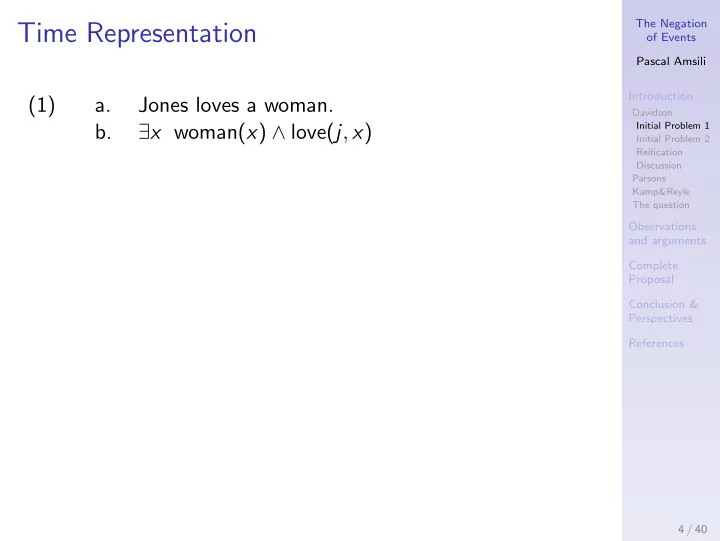
(1) a. Jones loves a woman. b. ∃x woman(x) ∧ love(j, x)

4 / 40

slide-2
SLIDE 2

The Negation

  • f Events

Pascal Amsili Introduction

Davidson Initial Problem 1 Initial Problem 2 Reification Discussion Parsons Kamp&Reyle The question

Observations and arguments Complete Proposal Conclusion & Perspectives References

Time Representation

(1) a. Jones loves a woman. b. ∃x woman(x) ∧ love(j, x) would equally represent (2) a. Jones loved a woman. b. Jones will love a woman.

4 / 40

slide-3
SLIDE 3

The Negation

  • f Events

Pascal Amsili Introduction

Davidson Initial Problem 1 Initial Problem 2 Reification Discussion Parsons Kamp&Reyle The question

Observations and arguments Complete Proposal Conclusion & Perspectives References

Time Representation

(1) a. Jones loves a woman. b. ∃x woman(x) ∧ love(j, x) would equally represent (2) a. Jones loved a woman. b. Jones will love a woman. as well as (3) a. Jones used to love a woman. b. Jones was loving a woman.

4 / 40

slide-4
SLIDE 4

The Negation

  • f Events

Pascal Amsili Introduction

Davidson Initial Problem 1 Initial Problem 2 Reification Discussion Parsons Kamp&Reyle The question

Observations and arguments Complete Proposal Conclusion & Perspectives References

Time Representation

(1) a. Jones loves a woman. b. ∃x woman(x) ∧ love(j, x) would equally represent (2) a. Jones loved a woman. b. Jones will love a woman. as well as (3) a. Jones used to love a woman. b. Jones was loving a woman. Yet we want (4) not to be contradictory. (4) Jones loved a women and he doesn’t love a woman.

4 / 40

slide-5
SLIDE 5

The Negation

  • f Events

Pascal Amsili Introduction

Davidson Initial Problem 1 Initial Problem 2 Reification Discussion Parsons Kamp&Reyle The question

Observations and arguments Complete Proposal Conclusion & Perspectives References

Time Representation: temporal logic

Variant of modal logic: propositional operators & accessibility relation between worlds

5 / 40

slide-6
SLIDE 6

The Negation

  • f Events

Pascal Amsili Introduction

Davidson Initial Problem 1 Initial Problem 2 Reification Discussion Parsons Kamp&Reyle The question

Observations and arguments Complete Proposal Conclusion & Perspectives References

Time Representation: temporal logic

Variant of modal logic: propositional operators & accessibility relation between worlds P[Ψ] = there is a world w in the past s.t. Ψ ∈ w. (5) a. Jones loved a woman. b. P[∃x woman(x) ∧ love(j, x)]

5 / 40

slide-7
SLIDE 7

The Negation

  • f Events

Pascal Amsili Introduction

Davidson Initial Problem 1 Initial Problem 2 Reification Discussion Parsons Kamp&Reyle The question

Observations and arguments Complete Proposal Conclusion & Perspectives References

Time Representation: temporal logic

Variant of modal logic: propositional operators & accessibility relation between worlds P[Ψ] = there is a world w in the past s.t. Ψ ∈ w. (5) a. Jones loved a woman. b. P[∃x woman(x) ∧ love(j, x)] P[Ψ] = there is a world w in the future s.t. Ψ ∈ w. (6) a. Jones will love a woman. b. F[∃x woman(x) ∧ love(j, x)]

5 / 40

slide-8
SLIDE 8

The Negation

  • f Events

Pascal Amsili Introduction

Davidson Initial Problem 1 Initial Problem 2 Reification Discussion Parsons Kamp&Reyle The question

Observations and arguments Complete Proposal Conclusion & Perspectives References

Time Representation: temporal logic

Variant of modal logic: propositional operators & accessibility relation between worlds P[Ψ] = there is a world w in the past s.t. Ψ ∈ w. (5) a. Jones loved a woman. b. P[∃x woman(x) ∧ love(j, x)] P[Ψ] = there is a world w in the future s.t. Ψ ∈ w. (6) a. Jones will love a woman. b. F[∃x woman(x) ∧ love(j, x)] (7) a. PP[Ψ]

5 / 40

slide-9
SLIDE 9

The Negation

  • f Events

Pascal Amsili Introduction

Davidson Initial Problem 1 Initial Problem 2 Reification Discussion Parsons Kamp&Reyle The question

Observations and arguments Complete Proposal Conclusion & Perspectives References

Time Representation: temporal logic

Variant of modal logic: propositional operators & accessibility relation between worlds P[Ψ] = there is a world w in the past s.t. Ψ ∈ w. (5) a. Jones loved a woman. b. P[∃x woman(x) ∧ love(j, x)] P[Ψ] = there is a world w in the future s.t. Ψ ∈ w. (6) a. Jones will love a woman. b. F[∃x woman(x) ∧ love(j, x)] (7) a. PP[Ψ] ≈ pluperfect

5 / 40

slide-10
SLIDE 10

The Negation

  • f Events

Pascal Amsili Introduction

Davidson Initial Problem 1 Initial Problem 2 Reification Discussion Parsons Kamp&Reyle The question

Observations and arguments Complete Proposal Conclusion & Perspectives References

Time Representation: temporal logic

Variant of modal logic: propositional operators & accessibility relation between worlds P[Ψ] = there is a world w in the past s.t. Ψ ∈ w. (5) a. Jones loved a woman. b. P[∃x woman(x) ∧ love(j, x)] P[Ψ] = there is a world w in the future s.t. Ψ ∈ w. (6) a. Jones will love a woman. b. F[∃x woman(x) ∧ love(j, x)] (7) a. PP[Ψ] ≈ pluperfect b. FP[Ψ]

5 / 40

slide-11
SLIDE 11

The Negation

  • f Events

Pascal Amsili Introduction

Davidson Initial Problem 1 Initial Problem 2 Reification Discussion Parsons Kamp&Reyle The question

Observations and arguments Complete Proposal Conclusion & Perspectives References

Time Representation: temporal logic

Variant of modal logic: propositional operators & accessibility relation between worlds P[Ψ] = there is a world w in the past s.t. Ψ ∈ w. (5) a. Jones loved a woman. b. P[∃x woman(x) ∧ love(j, x)] P[Ψ] = there is a world w in the future s.t. Ψ ∈ w. (6) a. Jones will love a woman. b. F[∃x woman(x) ∧ love(j, x)] (7) a. PP[Ψ] ≈ pluperfect b. FP[Ψ] ≈ past in the future

5 / 40

slide-12
SLIDE 12

The Negation

  • f Events

Pascal Amsili Introduction

Davidson Initial Problem 1 Initial Problem 2 Reification Discussion Parsons Kamp&Reyle The question

Observations and arguments Complete Proposal Conclusion & Perspectives References

Time Representation: temporal logic

Variant of modal logic: propositional operators & accessibility relation between worlds P[Ψ] = there is a world w in the past s.t. Ψ ∈ w. (5) a. Jones loved a woman. b. P[∃x woman(x) ∧ love(j, x)] P[Ψ] = there is a world w in the future s.t. Ψ ∈ w. (6) a. Jones will love a woman. b. F[∃x woman(x) ∧ love(j, x)] (7) a. PP[Ψ] ≈ pluperfect b. FP[Ψ] ≈ past in the future c. PFFPPFP[Ψ]

5 / 40

slide-13
SLIDE 13

The Negation

  • f Events

Pascal Amsili Introduction

Davidson Initial Problem 1 Initial Problem 2 Reification Discussion Parsons Kamp&Reyle The question

Observations and arguments Complete Proposal Conclusion & Perspectives References

Time Representation: temporal logic

Variant of modal logic: propositional operators & accessibility relation between worlds P[Ψ] = there is a world w in the past s.t. Ψ ∈ w. (5) a. Jones loved a woman. b. P[∃x woman(x) ∧ love(j, x)] P[Ψ] = there is a world w in the future s.t. Ψ ∈ w. (6) a. Jones will love a woman. b. F[∃x woman(x) ∧ love(j, x)] (7) a. PP[Ψ] ≈ pluperfect b. FP[Ψ] ≈ past in the future c. PFFPPFP[Ψ] ???

5 / 40

slide-14
SLIDE 14

The Negation

  • f Events

Pascal Amsili Introduction

Davidson Initial Problem 1 Initial Problem 2 Reification Discussion Parsons Kamp&Reyle The question

Observations and arguments Complete Proposal Conclusion & Perspectives References

Time Representation: temporal logic

Variant of modal logic: propositional operators & accessibility relation between worlds P[Ψ] = there is a world w in the past s.t. Ψ ∈ w. (5) a. Jones loved a woman. b. P[∃x woman(x) ∧ love(j, x)] P[Ψ] = there is a world w in the future s.t. Ψ ∈ w. (6) a. Jones will love a woman. b. F[∃x woman(x) ∧ love(j, x)] (7) a. PP[Ψ] ≈ pluperfect b. FP[Ψ] ≈ past in the future c. PFFPPFP[Ψ] ??? ⇒ very powerfull what about present tense? aspect? (Kamp, 1979)

5 / 40

slide-15
SLIDE 15

The Negation

  • f Events

Pascal Amsili Introduction

Davidson Initial Problem 1 Initial Problem 2 Reification Discussion Parsons Kamp&Reyle The question

Observations and arguments Complete Proposal Conclusion & Perspectives References

Time Representation: temporalized predicates

(8) a. Jones loved a woman. b. ∃t∃x t < n ∧ woman(x) ∧ love(j, x, t)

I Predicates have one additional place for time I Underspecified role of the time argument

6 / 40

slide-16
SLIDE 16

The Negation

  • f Events

Pascal Amsili Introduction

Davidson Initial Problem 1 Initial Problem 2 Reification Discussion Parsons Kamp&Reyle The question

Observations and arguments Complete Proposal Conclusion & Perspectives References

Time Representation: second order formulae

(9) a. Jones loves a woman. b. ∃t t < n holds at(t, [∃x woman(x) ∧ love(j, x)])

I usual in AI/KR I too powerfull (decidability issues) I many meaning postulates needed

7 / 40

slide-17
SLIDE 17

The Negation

  • f Events

Pascal Amsili Introduction

Davidson Initial Problem 1 Initial Problem 2 Reification Discussion Parsons Kamp&Reyle The question

Observations and arguments Complete Proposal Conclusion & Perspectives References

Polyadicity

(10) a. Jones buttered the toast b. buttered(j, t)

8 / 40

slide-18
SLIDE 18

The Negation

  • f Events

Pascal Amsili Introduction

Davidson Initial Problem 1 Initial Problem 2 Reification Discussion Parsons Kamp&Reyle The question

Observations and arguments Complete Proposal Conclusion & Perspectives References

Polyadicity

(10) a. Jones buttered the toast b. buttered(j, t) (11) a. Jones buttered the toast in the bathroom with a knife at midnight b. ???

8 / 40

slide-19
SLIDE 19

The Negation

  • f Events

Pascal Amsili Introduction

Davidson Initial Problem 1 Initial Problem 2 Reification Discussion Parsons Kamp&Reyle The question

Observations and arguments Complete Proposal Conclusion & Perspectives References

Polyadicity

(10) a. Jones buttered the toast b. buttered(j, t) (11) a. Jones buttered the toast in the bathroom with a knife at midnight b. ??? Kenny (1963) : buttered(j, t, b, k, m).

8 / 40

slide-20
SLIDE 20

The Negation

  • f Events

Pascal Amsili Introduction

Davidson Initial Problem 1 Initial Problem 2 Reification Discussion Parsons Kamp&Reyle The question

Observations and arguments Complete Proposal Conclusion & Perspectives References

Polyadicity

(10) a. Jones buttered the toast b. buttered(j, t) (11) a. Jones buttered the toast in the bathroom with a knife at midnight b. ??? Kenny (1963) : buttered(j, t, b, k, m). But we want to have (11-a) ⇒ (10-a)

8 / 40

slide-21
SLIDE 21

The Negation

  • f Events

Pascal Amsili Introduction

Davidson Initial Problem 1 Initial Problem 2 Reification Discussion Parsons Kamp&Reyle The question

Observations and arguments Complete Proposal Conclusion & Perspectives References

Polyadicity

(10) a. Jones buttered the toast b. buttered(j, t) (11) a. Jones buttered the toast in the bathroom with a knife at midnight b. ??? Kenny (1963) : buttered(j, t, b, k, m). But we want to have (11-a) ⇒ (10-a) as well as (11-a) ⇒ (12)

(12) a. Jones buttered the toast in the bathroom buttered(j, t, b) b. Jones buttered the toast with a knife buttered(j, t, k) c. Jones buttered the toast in the bathroom with a knife buttered(j, t, b, k)

8 / 40

slide-22
SLIDE 22

The Negation

  • f Events

Pascal Amsili Introduction

Davidson Initial Problem 1 Initial Problem 2 Reification Discussion Parsons Kamp&Reyle The question

Observations and arguments Complete Proposal Conclusion & Perspectives References

Polyadicity II

Proposal (Kenny, 1963) : (10-a) shall be represented as a 5-ary predicate. In other words, (10-a) is seen as an elliptic/underspecified version of (13). (13) Jones buttered the toast somewhere with something at sometime.

9 / 40

slide-23
SLIDE 23

The Negation

  • f Events

Pascal Amsili Introduction

Davidson Initial Problem 1 Initial Problem 2 Reification Discussion Parsons Kamp&Reyle The question

Observations and arguments Complete Proposal Conclusion & Perspectives References

Polyadicity II

Proposal (Kenny, 1963) : (10-a) shall be represented as a 5-ary predicate. In other words, (10-a) is seen as an elliptic/underspecified version of (13). (13) Jones buttered the toast somewhere with something at sometime. Then the wanted inferences come through.

9 / 40

slide-24
SLIDE 24

The Negation

  • f Events

Pascal Amsili Introduction

Davidson Initial Problem 1 Initial Problem 2 Reification Discussion Parsons Kamp&Reyle The question

Observations and arguments Complete Proposal Conclusion & Perspectives References

Polyadicity II

Proposal (Kenny, 1963) : (10-a) shall be represented as a 5-ary predicate. In other words, (10-a) is seen as an elliptic/underspecified version of (13). (13) Jones buttered the toast somewhere with something at sometime. Then the wanted inferences come through. But what do we do with (14)? (Davidson, 1967) (14) Jones buttered the toast in the bathroom with a knife at midnight by holding it between the toes of his left foot

9 / 40

slide-25
SLIDE 25

The Negation

  • f Events

Pascal Amsili Introduction

Davidson Initial Problem 1 Initial Problem 2 Reification Discussion Parsons Kamp&Reyle The question

Observations and arguments Complete Proposal Conclusion & Perspectives References

Davidson’s intuition

  • Individuals

(15) a. I bought a house b. ∃x house(x)

10 / 40

slide-26
SLIDE 26

The Negation

  • f Events

Pascal Amsili Introduction

Davidson Initial Problem 1 Initial Problem 2 Reification Discussion Parsons Kamp&Reyle The question

Observations and arguments Complete Proposal Conclusion & Perspectives References

Davidson’s intuition

  • Individuals

(15) a. I bought a house, it has three rooms b. ∃x house(x) ∧ 3 room(x)

10 / 40

slide-27
SLIDE 27

The Negation

  • f Events

Pascal Amsili Introduction

Davidson Initial Problem 1 Initial Problem 2 Reification Discussion Parsons Kamp&Reyle The question

Observations and arguments Complete Proposal Conclusion & Perspectives References

Davidson’s intuition

  • Individuals

(15) a. I bought a house, it has three rooms, it is well-heated b. ∃x house(x) ∧ 3 room(x) ∧ well heated(x)

10 / 40

slide-28
SLIDE 28

The Negation

  • f Events

Pascal Amsili Introduction

Davidson Initial Problem 1 Initial Problem 2 Reification Discussion Parsons Kamp&Reyle The question

Observations and arguments Complete Proposal Conclusion & Perspectives References

Davidson’s intuition

  • Individuals

(15) a. I bought a house, it has three rooms, it is well-heated , and has 2 storeys b. ∃x house(x) ∧ 3 room(x) ∧ well heated(x) ∧ 2 storey(x)

10 / 40

slide-29
SLIDE 29

The Negation

  • f Events

Pascal Amsili Introduction

Davidson Initial Problem 1 Initial Problem 2 Reification Discussion Parsons Kamp&Reyle The question

Observations and arguments Complete Proposal Conclusion & Perspectives References

Davidson’s intuition

  • Individuals

(15) a. I bought a house, it has three rooms, it is well-heated , and has 2 storeys b. ∃x house(x) ∧ 3 room(x) ∧ well heated(x) ∧ 2 storey(x)

I (re)descriptions I pronouns

10 / 40

slide-30
SLIDE 30

The Negation

  • f Events

Pascal Amsili Introduction

Davidson Initial Problem 1 Initial Problem 2 Reification Discussion Parsons Kamp&Reyle The question

Observations and arguments Complete Proposal Conclusion & Perspectives References

Davidson’s intuition

  • Individuals

(15) a. I bought a house, it has three rooms, it is well-heated , and has 2 storeys b. ∃x house(x) ∧ 3 room(x) ∧ well heated(x) ∧ 2 storey(x)

I (re)descriptions I pronouns

  • Events

(16) John did it slowly, deliberatly, in the bathroom, with a knife, at midnight. What he did was butter a piece of toast.

10 / 40

slide-31
SLIDE 31

The Negation

  • f Events

Pascal Amsili Introduction

Davidson Initial Problem 1 Initial Problem 2 Reification Discussion Parsons Kamp&Reyle The question

Observations and arguments Complete Proposal Conclusion & Perspectives References

Reification of events

  • 1. Action predicates have an additional, event, place (17).
  • 2. Action sentences “have an existential quantifier binding

the action[event] variable” (18). (Reichenbach, 1947) (17) a. Kim kicked Sam. b. kick(k, s, e) (18) a. Kim kicked Sam. b. ∃xe kick(k, s, xe)

11 / 40

slide-32
SLIDE 32

The Negation

  • f Events

Pascal Amsili Introduction

Davidson Initial Problem 1 Initial Problem 2 Reification Discussion Parsons Kamp&Reyle The question

Observations and arguments Complete Proposal Conclusion & Perspectives References

Reification of events

  • 1. Action predicates have an additional, event, place (17).
  • 2. Action sentences “have an existential quantifier binding

the action[event] variable” (18). (Reichenbach, 1947) (17) a. Kim kicked Sam. b. kick(k, s, e) (18) a. Kim kicked Sam. b. ∃xe kick(k, s, xe) (19) a. A man found a coin. b. ∃x∃y∃e man(x) ∧ coin(y) ∧ find(x, y, e)

11 / 40

slide-33
SLIDE 33

The Negation

  • f Events

Pascal Amsili Introduction

Davidson Initial Problem 1 Initial Problem 2 Reification Discussion Parsons Kamp&Reyle The question

Observations and arguments Complete Proposal Conclusion & Perspectives References

Discussion

I Which predicates have an event-place ?

12 / 40

slide-34
SLIDE 34

The Negation

  • f Events

Pascal Amsili Introduction

Davidson Initial Problem 1 Initial Problem 2 Reification Discussion Parsons Kamp&Reyle The question

Observations and arguments Complete Proposal Conclusion & Perspectives References

Discussion

I Which predicates have an event-place ?

many

12 / 40

slide-35
SLIDE 35

The Negation

  • f Events

Pascal Amsili Introduction

Davidson Initial Problem 1 Initial Problem 2 Reification Discussion Parsons Kamp&Reyle The question

Observations and arguments Complete Proposal Conclusion & Perspectives References

Discussion

I Which predicates have an event-place ?

many

I What’s a sentence denotation ?

12 / 40

slide-36
SLIDE 36

The Negation

  • f Events

Pascal Amsili Introduction

Davidson Initial Problem 1 Initial Problem 2 Reification Discussion Parsons Kamp&Reyle The question

Observations and arguments Complete Proposal Conclusion & Perspectives References

Discussion

I Which predicates have an event-place ?

many

I What’s a sentence denotation ?

t —no change

12 / 40

slide-37
SLIDE 37

The Negation

  • f Events

Pascal Amsili Introduction

Davidson Initial Problem 1 Initial Problem 2 Reification Discussion Parsons Kamp&Reyle The question

Observations and arguments Complete Proposal Conclusion & Perspectives References

Discussion

I Which predicates have an event-place ?

many

I What’s a sentence denotation ?

t —no change

I Who denotes an event ?

12 / 40

slide-38
SLIDE 38

The Negation

  • f Events

Pascal Amsili Introduction

Davidson Initial Problem 1 Initial Problem 2 Reification Discussion Parsons Kamp&Reyle The question

Observations and arguments Complete Proposal Conclusion & Perspectives References

Discussion

I Which predicates have an event-place ?

many

I What’s a sentence denotation ?

t —no change

I Who denotes an event ?

nominals (20) (20) a. [ [Caesar’s death] ] = ιx dead(x, c) b. Caesar is dead : ∃x dead(x, c)

12 / 40

slide-39
SLIDE 39

The Negation

  • f Events

Pascal Amsili Introduction

Davidson Initial Problem 1 Initial Problem 2 Reification Discussion Parsons Kamp&Reyle The question

Observations and arguments Complete Proposal Conclusion & Perspectives References

Discussion

I Which predicates have an event-place ?

many

I What’s a sentence denotation ?

t —no change

I Who denotes an event ?

nominals (20) (20) a. [ [Caesar’s death] ] = ιx dead(x, c) b. Caesar is dead : ∃x dead(x, c) ⇒ Syntax-semantics interface to be worked out.

12 / 40

slide-40
SLIDE 40

The Negation

  • f Events

Pascal Amsili Introduction

Davidson Initial Problem 1 Initial Problem 2 Reification Discussion Parsons Kamp&Reyle The question

Observations and arguments Complete Proposal Conclusion & Perspectives References

Discussion: individuation of events

Individuation at its best requires sorts or kinds that give a principle for counting. But here again, events come out well enough: rings of the bell, major wars, eclipses of the moon, and performances of Lulu can be counted as easily as pencils, pots, and people. Problems can arise in either

  • domain. The conclusion to be drawn, I think, is that the

individuation of events poses no problems worse in principle than the problems posed by individuation of material objects; and there is as good reason to believe events exist.

(Davidson, 1985, p. 180)

13 / 40

slide-41
SLIDE 41

The Negation

  • f Events

Pascal Amsili Introduction

Davidson Initial Problem 1 Initial Problem 2 Reification Discussion Parsons Kamp&Reyle The question

Observations and arguments Complete Proposal Conclusion & Perspectives References

Parsons’ generalisation

(21) ∃xe kick(k, s, xe)

14 / 40

slide-42
SLIDE 42

The Negation

  • f Events

Pascal Amsili Introduction

Davidson Initial Problem 1 Initial Problem 2 Reification Discussion Parsons Kamp&Reyle The question

Observations and arguments Complete Proposal Conclusion & Perspectives References

Parsons’ generalisation

(21) ∃xe kick(k, s, xe) (22) ∃xe kick(xe) ∧ agent(xe, k) ∧ patient(xe, s) (Parsons, 1990)

14 / 40

slide-43
SLIDE 43

The Negation

  • f Events

Pascal Amsili Introduction

Davidson Initial Problem 1 Initial Problem 2 Reification Discussion Parsons Kamp&Reyle The question

Observations and arguments Complete Proposal Conclusion & Perspectives References

Parsons’ generalisation

(21) ∃xe kick(k, s, xe) (22) ∃xe kick(xe) ∧ agent(xe, k) ∧ patient(xe, s) (Parsons, 1990)

I requires a richer lexicon, and an appropriate management

  • f the syntax-semantics interface

I solves radically the polyadicity problems, I and puts on a par arguments and adjuncts.

14 / 40

slide-44
SLIDE 44

The Negation

  • f Events

Pascal Amsili Introduction

Davidson Initial Problem 1 Initial Problem 2 Reification Discussion Parsons Kamp&Reyle The question

Observations and arguments Complete Proposal Conclusion & Perspectives References

Parsons’ generalisation

(21) ∃xe kick(k, s, xe) (22) ∃xe kick(xe) ∧ agent(xe, k) ∧ patient(xe, s) (Parsons, 1990)

I requires a richer lexicon, and an appropriate management

  • f the syntax-semantics interface

I solves radically the polyadicity problems, I and puts on a par arguments and adjuncts.

(23) ∃xe kick(xe) ∧ agent(xe, k)

14 / 40

slide-45
SLIDE 45

The Negation

  • f Events

Pascal Amsili Introduction

Davidson Initial Problem 1 Initial Problem 2 Reification Discussion Parsons Kamp&Reyle The question

Observations and arguments Complete Proposal Conclusion & Perspectives References

Parsons’ generalisation

(21) ∃xe kick(k, s, xe) (22) ∃xe kick(xe) ∧ agent(xe, k) ∧ patient(xe, s) (Parsons, 1990)

I requires a richer lexicon, and an appropriate management

  • f the syntax-semantics interface

I solves radically the polyadicity problems, I and puts on a par arguments and adjuncts.

(23) ∃xe kick(xe) ∧ agent(xe, k) ∧ patient(xe, s)

14 / 40

slide-46
SLIDE 46

The Negation

  • f Events

Pascal Amsili Introduction

Davidson Initial Problem 1 Initial Problem 2 Reification Discussion Parsons Kamp&Reyle The question

Observations and arguments Complete Proposal Conclusion & Perspectives References

Parsons’ generalisation

(21) ∃xe kick(k, s, xe) (22) ∃xe kick(xe) ∧ agent(xe, k) ∧ patient(xe, s) (Parsons, 1990)

I requires a richer lexicon, and an appropriate management

  • f the syntax-semantics interface

I solves radically the polyadicity problems, I and puts on a par arguments and adjuncts.

(23) ∃xe kick(xe) ∧ agent(xe, k) ∧ patient(xe, s) ∧ at(xe, 8h)

14 / 40

slide-47
SLIDE 47

The Negation

  • f Events

Pascal Amsili Introduction

Davidson Initial Problem 1 Initial Problem 2 Reification Discussion Parsons Kamp&Reyle The question

Observations and arguments Complete Proposal Conclusion & Perspectives References

Parsons’ generalisation

(21) ∃xe kick(k, s, xe) (22) ∃xe kick(xe) ∧ agent(xe, k) ∧ patient(xe, s) (Parsons, 1990)

I requires a richer lexicon, and an appropriate management

  • f the syntax-semantics interface

I solves radically the polyadicity problems, I and puts on a par arguments and adjuncts.

(23) ∃xe kick(xe) ∧ agent(xe, k) ∧ patient(xe, s) ∧ at(xe, 8h) ∧ loc(xe, in front of the house)

14 / 40