www.rocksdistrict.com Milton Freewater, Oregon
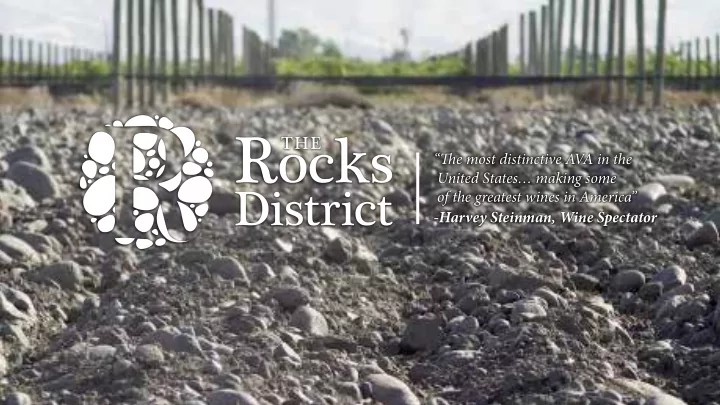
“Tie most distinctive AVA in the United States… making some
- f the greatest wines in America”
- Harvey Steinman, Wine Spectator
Tie most distinctive AVA in the United States making some of the - - PowerPoint PPT Presentation
Tie most distinctive AVA in the United States making some of the greatest wines in America -Harvey Steinman, Wine Spectator www.rocksdistrict.com Milton Freewater, Oregon What is Tie
Tie Rocks District of Milton-Freewater is an American Viticultural Area (AVA) approved by the TTB on February 9, 2015.
Tie Rocks District is known for producing a unique fmavor profjle that is recognized by wine afjcionados around the world. Tie wines from Tie Rocks District are of the highest quality, and have a track record of receiving some of the highest scores on average of any wine region in the new world. Tie Rocks District is also the only wine region in Oregon to produce a wine to received a perfect 100 point score from one of the three major wine publications (Wine Spectator, Wine Enthusiast, Wine Advocate). Tie Rocks District AVA resides on the Oregon side of the larger, cross-state, Walla Walla Valley AVA. Tie Rocks District is the only AVA in the United States whose boundaries (96%) have been fjxed by virtue of a single soil series (Freewater Series) and a single land form (alluvial fan).
Tie singular Freewater soil series found within Tie Rocks District is unlike any winegrowing region in the new world. Difgerent from the compacted sand, silt and ash of the surrounding Valley, Tie Rocks District is easily identifjed by its composition
at the surface. Derived from the Blue Mountains this cobblestone-rich soil type was deposited by the Walla Walla River. Specialized farming practices and training forms are being developed to support growing vines in this distinctive soil focusing on capturing and radiating the sun’s energy by virtue of exposed cobbles, assuring phenolic ripeness/ fmavor development. Tie additional heat provides protection from extreme temperature fmuctuation and facilitates aromatic wines with savory complexities and umami character.
Tie cobble/gravel layers extend many feet below the surface, making for extremely well-drained soils, encouraging deep root penetration in pursuit of water.
1 Million BC to 100,000 BC: Continental shifu forms the basalt base
100,000 BC to 15,000 BC: Volcanic activity prior to the last ice age leaves layers of compacted volcanic ash. 13,000 BC to 10,000 BC: Tie receding ice shelf causes the Missoula Floods, which remove layers of topsoil and deposit massive amounts of silt loam throughout the Valley. 10,000 BC to Present: Erosion causes volcanic basalt to break ofg of the surrounding Blue Mountains and fjnd its way into the wild Walla Walla River, eventually being deposited, hundreds of feet deep, within Tie Rocks District as an alluvial fan. 7,000 BC: People of the First Nations, the ancestors of the modern day Umatilla and Nez Perce tribes, arrive in Southeastern Washington and Northeastern Oregon. 1805 & 1806: Lewis and Clark become the fjrst eastern explorers to travel through the Walla Walla Valley, then part of the English territory known as the “Columbia District”. 1818: Tie Canada-based Northwest Company establishes Fort Nez Perce as a fur trading outpost. Tiis is the fjrst permanent, non-tribal, settlement in the Walla Walla Valley. 1856: Fort Walla Walla is built and the city of Walla Walla is founded. 1868 & 1873: Tie independent cities of Milton and Freewater are formed in the Walla Walla Valley as processing towns for lumber and local agriculture.
1859: A.B. Roberts establishes a nursery and brings in the fjrst recorded vinifera to the Walla Walla Valley. 1859-1883: Walla Walla develops as a wine region. Settlers produce wines for consumption and to sell to travelers
gold fjelds of Idaho. 1883: Severe frost kills most of the vinifera in the Walla Walla Valley, and other crops are planted in their place. 1917: Prohibition ends any remaining commercial production of wine. 1974: Gary Figgins plants Leonetti Vineyard, beginning the modern wine era in Walla Walla Valley. 1981-1985: Woodward Canyon, L’Ecole, Waterbrook and Seven Hills are founded, forming a fjrm foundation for the Walla Walla wine industry. 1984: Tie Walla Walla Valley appellation is approved by the TTB.
1997: Cayuse Vineyards plants the fjrst modern day vineyard in what is now known as “Tie Rocks District of Milton-Freewater”. 1998 & 1999: Tom Waliser plants Waliser and Eidolon Vineyards; making Rocks District fruit available to the larger marketplace. 2005: A Rocks District wine is rewarded a perfect 100 point score from the Wine Advocate. Wine Enthusiast follows with another perfect 100 point score in 2008...many more 95+ scores follow. 2006: Plantings increase and for the fjrst time orchards are removed to make way for vinifera wine grapes. 2011: Work begins on the AVA formation; spearheaded by Steve
Ph.D is hired to provide the technical petition requirements, and to delinieate the boundaries of Tie Rocks District, predicated upon the Freewater soil series. 2015: Tie TTB grants formal AVA designation status to “Tie Rocks District of Milton-Freewater”. 2018: Tie Rocks District Winegrowers (non-profjt) is formed, marking the fjrst time a member efgort has been made to promote the region.
Tie Rocks District is a nested AVA, residing entirely in Oregon and within the WA/OR, cross-state Walla Walla Valley AVA.
Tie 3767 acre (5.9 square mile) AVA was defjned by the wild Walla Walla River; which formed an alluvial fan when it found the Valley’s fmoor, depositing basalt cobbles and gravels hundreds of feet deep from its Blue Mountain headwaters. Located in the rain shadow of the Cascade mountains, the Walla Walla Valley receives an average of 12 inches of rain and nearly 300 days of sunshine annually. While the dry and sunny conditions make for excellent growing conditions, Tie Rocks District lies in close proximity to the foothills of the Blue Mountains, making it more temperate then other winegrowing areas in the Columbia and Yakima Valleys. In addition to grapes, Tie Rocks District is also a major producer of tree fruit.
At present there are only 338 acres of wine grapes spread across 37 planted vineyards with another 175+ acres in development.
Tiis makes Tie Rocks District one of the smallest AVAs in the United States. Tiis AVA’s Rhone varieties are capturing the wine world’s attention with wines that are capable of showcasing “place” . Of the total 3,767 AVA acres, approximately 3,400 acres are
grape production there is tremendous potential for growth.
A & K Estates Ancient Stones Ansbah Vineyard Arthur Estate Barrett Station Vineyard Cougar Hills Vineyard Eidolon Freewater Rocks Funk Estate Vineyard Hooker Vineyard Maison Bleue Estate Noble Rock Proper Estate Vineyard Rasa Estate River Rock Vineyard Riviere Galets Rockgarden Estate Rotie Rocks SJR Vineyard Stone Valley Stones Speak Vineyard Tie Walls Vineyards Waliser Vineyard Watermill Estate Vineyard Waterstone Vineyard Winesap Road Vineyard Yellow Jacket Vineyard
More than 35 producers utilize Rocks District AVA fruit in their wine.
Currently, there are three production facilities and no tasting rooms
located in Walla Walla.) Additionally, there are three new wineries in various stages of construction within the AVA. Estimated maximum production for the region is currently around 55,000 cases. In comparison, the Walla Walla Valley is upwards of 500,000 cases, Red Mountain about 425,000 cases, and the Dundee Hills about 125,000 cases.
Beresan Winery Betz Family Winery Brook & Bull Buty Winery Canvasback Cougar Crest Winery Delmas Doubleback Ducleaux Cellars Force Majeure Maison Bleue Proper Winery Rasa Vineyards Rotie Cellars Rulo Winery Saviah Cellars Seven Hills Winery Siren Song Vineyard Tertulia Cellars Tie Walls Vineyards Two Vintners Valdemar Estates Watermill Winery Zerba Cellars
▶ 3,767 and 5.9 - acres and square miles (respectively) of Rocks District land surface ▶ 3,400 - plantable acres ▶ 2015 - Tie Rocks District of Milton-Freewater is approved by the TTB ▶ 1997 - Cayuse Vineyards plants the fjrst (modern day) vineyard in these soils. ▶ 338 - acres currently producing wine grapes within the AVA ▶ 175 - acres in development within the AVA ▶ 45.4 - percent of vines that are Syrah, the most common variety in the AVA ▶ 37 - number of vineyards in Tie Rocks District ▶ 35 - number of wineries currently producing wine with Rocks District fruit ▶ 12 and 2,935 - annual rainfall inches and average GDD ‘s (Growing Degree Days) of the AVA ▶ 4 - number of perfect 100 point scores which have been awarded to wines from the AVA by Wine Enthusiast, Wine Spectator, and Wine Advocate ▶ 3 - current number of production facilities within AVA boundaries
Tie Rocks District will continue to focus on winegrowing; producing world- class wines that showcase the typicity of terroir found in this unique region.
Winegrowers will work to promote cooperative partnerships within the Walla Walla Valley, as well as the northwest region; increasing the AVA’s recognition within the wine industry and with consumers worldwide. Tie standard of quality and limited availability of wines will keep demand high and increase investment interest in Tie Rocks District. Many new vineyard acres will be developed within the AVA, supported with new destination facilities. Increased production will allow those wineries making wines from Rocks District fruit to reach new consumers in new markets, further spreading the message that Tie Rocks District produces some of the most distinctive wines in the world!