these requirements have been removed w e f 6 april 2016

These requirements have been removed w.e.f. 6 April 2016. - PDF document

FINANCE ACT 2016 PRACTICAL ASPECTS Robert Jamieson MA FCA CTA (Fellow) TEP 4 October 2016 PERSONAL SAVINGS ALLOWANCE Hitherto banks, building societies and other financial institutions have had to deduct 20% tax from interest which


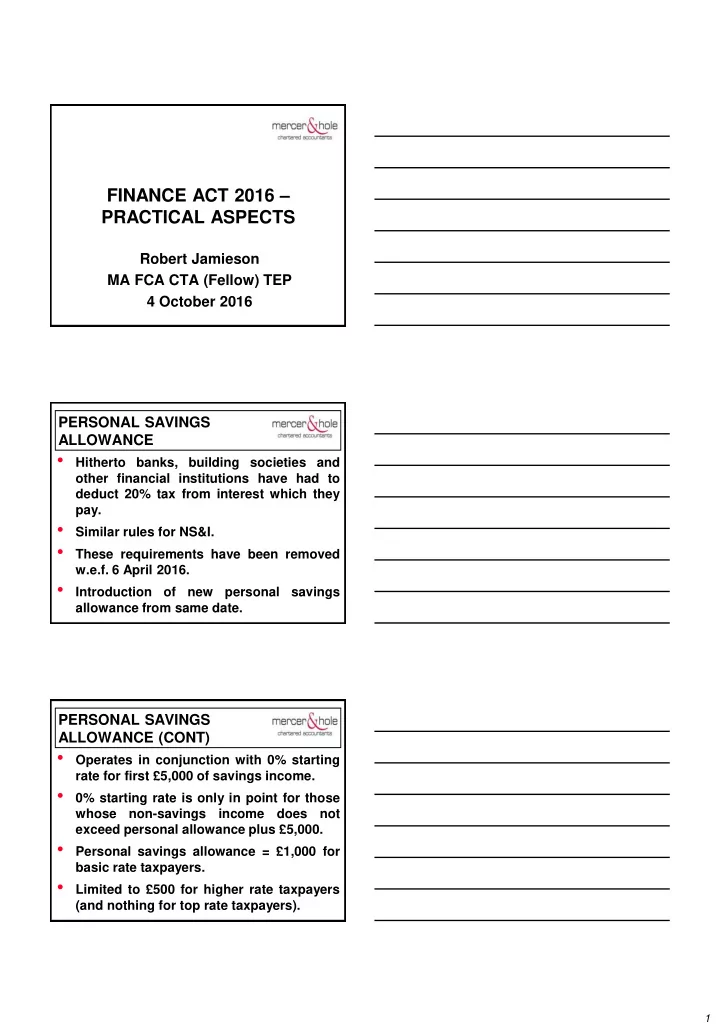
  1. FINANCE ACT 2016 – PRACTICAL ASPECTS Robert Jamieson MA FCA CTA (Fellow) TEP 4 October 2016 PERSONAL SAVINGS ALLOWANCE • Hitherto banks, building societies and other financial institutions have had to deduct 20% tax from interest which they pay. • Similar rules for NS&I. • These requirements have been removed w.e.f. 6 April 2016. • Introduction of new personal savings allowance from same date. PERSONAL SAVINGS ALLOWANCE (CONT) • Operates in conjunction with 0% starting rate for first £5,000 of savings income. • 0% starting rate is only in point for those whose non-savings income does not exceed personal allowance plus £5,000. • Personal savings allowance = £1,000 for basic rate taxpayers. • Limited to £500 for higher rate taxpayers (and nothing for top rate taxpayers). 1

  2. PERSONAL SAVINGS ALLOWANCE (CONT) • Interest within ISA will continue to be tax- free – it does not need to be covered by personal savings allowance. • director’s Interest credited to loan account = savings income (but company must still pay this under deduction of tax). • Dividend income falling under £5,000 nil rate band has to be taken into account in determining marginal rate of tax. PERSONAL SAVINGS ALLOWANCE (CONT) • Personal savings allowance operates like dividend nil rate band – savings income covered by allowance attracts zero rate of tax. • Unfortunate cliff-edge effect. DIVIDENDS – END OF ERA • Imputation system to end on 5 April 2016. • W.e.f. 6 April 2016: • dividend received = gross amount; • no 1/9th tax credit; and • £5,000 dividend allowance. • This new dividend allowance is separate from £1,000 allowance for savings income referred to earlier. 2

  3. DIVIDENDS – END OF ERA (CONT) • Table of rates for 2016/17: • BR – 7.5% (Nil for 2015/16); • HR – 32.5% (25.0% for 2015/16); and • AR – 38.1% (30.6% for 2015/16). • Important to make inter-spouse transfers to ensure full use of £5,000 allowance. • Breakeven points for higher and additional rate taxpayers. DIVIDENDS – END OF ERA (CONT) • Problem for owner managers following “low salary high dividend” regime – overall tax rate is 6% higher in 2016/17. • Dividends to non-working spouses are still advantageous. • With fall in corporation tax rates to 19% in 2017 and to 17% in 2020, will some owner managers seek to retain profits rather than pay them out? DIVIDENDS – END OF ERA (CONT) • More own share purchases on retirement. • Bonus v dividend for 2016/17. • HMRC factsheet dated 17 August 2015. • This confirmed that £5,000 dividend allowance was not exemption. • Dividends within £5,000 allowance still use up relevant part of BR or HR band (even though they are taxed at 0%). 3

  4. DIVIDENDS – END OF ERA (CONT) • Impact on restriction of personal allowances. • Impact on incorporations – tax-motivated incorporations are being targeted. CLOSE COMPANY LOAN WRITE-OFFS • Income tax charge under S416 ITTOIA 2005 on amount written off. • Still classified as “dividend income” . • Therefore, use dividend rates (including £5,000 nil rate band). • S416 ITTOIA 2005 takes precedence over S188 ITEPA 2003. DIVIDENDS AND GIFT AID IN 2016/17 • Revised dividend regime took effect on 6 April 2016. • Trap for individuals who have previously used tax credits to frank basic rate tax deducted from Gift Aid payments. • But tax credits have been abolished for 2016/17 onwards. • Problem is for donors whose main source of taxable income is from dividends. 4

  5. DIVIDENDS AND GIFT AID IN 2016/17 (CONT) • If BR tax which is deemed to be deducted from Gift Aid payments cannot be covered by dividend tax credits, it must be paid over to HMRC. • Illustration of wealthy benefactor. • For 2016/17, problem may be able to be resolved by carry-back election under S426 ITA 2007. • Important caveat. DIVIDENDS AND GIFT AID IN 2016/17 (CONT) • This election can only be made on or before filing of individual’s 2015/16 tax return. • See Cameron v HMRC (2010). • Therefore, it may make sense to delay filing affected donors’ tax returns until January 2017. TRUST DIVIDEND INCOME • For IIP trusts, trustees pay BR tax on all trust income. • Thus, in respect of their share of trust income, beneficiaries may: • obtain refund; • suffer no further tax; or • be liable for higher and additional rates. 5

  6. TRUST DIVIDEND INCOME (CONT) • Position to date has been that, with dividend income, tax credit covered trustees’ BR income tax liability. • W.e.f. 6 April 2016, trustees have to pay 7.5% on all dividend income – they are not entitled to £5,000 dividend allowance. • “transparent” – But IIP trusts are therefore, 7.5% dividend tax charge will be credited to life tenant. TRUST DIVIDEND INCOME (CONT) • Life tenant may be entitled to tax refund if payment falls within his £5,000 dividend nil rate band. • Possibility of mandating such income to beneficiary. • Rules for discretionary and accumulation trusts are rather different. • W.e.f. 6 April 2016, such trusts are also unable to utilise £5,000 allowance. TRUST DIVIDEND INCOME (CONT) • Discretionary and accumulation trusts will suffer tax of 38.1% (7.5% where standard rate band applies) on dividend income. • This is credited to trust’s tax pool and will be available to frank income distributions. • But discretionary and accumulation trusts are not “transparent” – trust distribution counts as annual payment in hands of beneficiary. 6

  7. TRUST DIVIDEND INCOME (CONT) • This will not attract £5,000 allowance – it does not represent dividend income. • When making income payment to beneficiary, trustees will have to deduct 45% tax and so they are likely to end up having to pay further tax to HMRC. • Will it now be preferable to appoint IIPs to many discretionary beneficiaries, given that there should be no CGT or IHT? IS IT “FAIR BARGAIN”? • Normally, where employee reimburses his employer for any benefit in kind, cash equivalent is reduced on £-for-£ basis. • However, if employee receives goods or services at same cost and on same terms as member of public, he will have struck “fair bargain” with employer. • No benefit will have arisen – this follows from decision in Mairs v Haughey (1993). IS IT “FAIR BARGAIN”? (CONT) • But employers have been using these rules to override standard benefit tax charges – see Apollo Fuels case in 2016. • Therefore, for 2016/17 onwards, no “fair bargain” let-out for: • living accommodation; • cars (but note exception); and • loans. 7

  8. DIESEL CAR BENEFITS • 3% diesel supplement was not after all abolished on 6 April 2016. • Retained for further 5 years. • But what about employers who have already ordered cars (on assumption that there would be no diesel supplement)? ZERO-EMISSION VANS • Nil rate charge for zero-emission vans came to end on 5 April 2015. • For 2015/16, benefit in kind charge was 20% of normal van benefit (£3,150). • Planned that rate would then rise on tapered basis. • This will now take place more slowly, with 20% remaining in place for 2016/17 and 2017/18. ZERO-EMISSION VANS (CONT) • Standard van benefit charge for 2016/17 = £3,170. • But any van driver who meets restricted private use condition in S155(4) ITEPA 2003 will still have van benefit of nil. 8

  9. TRIVIAL BENEFITS • – OTS recommendation statutory exemption for “trivial” benefits in kind provided for employees. • Replace previous concessionary practice. • New S323A ITEPA 2003 to apply w.e.f. 6 April 2016. • No income tax or NIC charge where 4 conditions are satisfied – they are: TRIVIAL BENEFITS (CONT) • benefit must not be cash or cash voucher; • cost of providing benefit must not exceed £50 per person (if necessary, simple average can be used); • benefit must not be provided as part of salary sacrifice arrangement (or similar); and TRIVIAL BENEFITS (CONT) • benefit must not be provided in recognition of services performed (or to be performed). • No limit to number of “trivial” benefits for most employees in any 1 tax year. • However, if company is close and if recipient is director, there is annual cap of £300. 9

  10. PENSIONS – LIFETIME ALLOWANCE • Lifetime allowance reduced from £1,250,000 to £1,000,000 for 2016/17 and 2017/18. • Thereafter, index-linked by reference to CPI for 12 months to previous September. • Problem where pension pot is greater than lifetime allowance. • Is there already protection? PENSIONS – LIFETIME ALLOWANCE (CONT) • If not, what about FP16 and/or IP16? • FP16 allows taxpayer to retain old limit, but no further contributions can be made. • Under IP16, taxpayer has limit equal to value of pension savings on 5 April 2016 (up to £1,250,000), but can continue to make payments. • Both forms of protection can be held, but FP16 has precedence. PENSIONS – LIFETIME ALLOWANCE (CONT) • In order to obtain protection, taxpayer must apply for reference number from HMRC before he takes his benefits. 10

Recommend


More recommend


Explore More Topics

Stay informed with curated content and fresh updates.