Thermo Gravimetric Analysis Environmental Geomechanics - - PowerPoint PPT Presentation

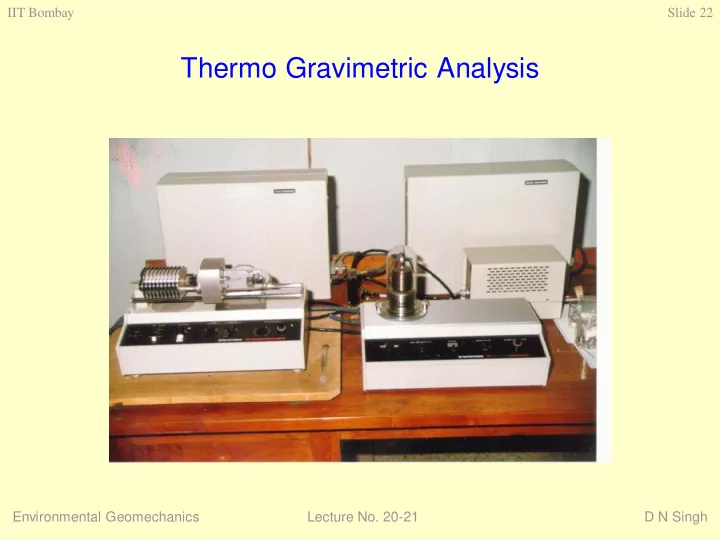
thermo gravimetric analysis
SMART_READER_LITE
LIVE PREVIEW

Thermo Gravimetric Analysis Environmental Geomechanics - - PowerPoint PPT Presentation

IIT Bombay Slide 22 Thermo Gravimetric Analysis Environmental Geomechanics Lecture No. 20-21 D N Singh IIT Bombay Slide 23 0 TGA Exo. 20 Weight loss (%)


slide-1
SLIDE 1

Thermo Gravimetric Analysis

IIT Bombay Environmental Geomechanics Lecture No. 20-21 D N Singh Slide 22
slide-2
SLIDE 2

TGA and DTA curve for OLA and ALA6 samples (Inert atmosphere) (Dry air atmosphere)

600 200 400 800

DTA TGA

  • Temp. difference ( T)

Endo. Exo. OLA ALA6

Weight loss (%)

20 40 60 80 20 40 60 80 100 100

IIT Bombay Environmental Geomechanics Lecture No. 20-21 D N Singh Slide 23

slide-3
SLIDE 3

100 200 300 400 500 600

  • 5.0
  • 4.8
  • 4.6
  • 4.4
  • 4.2
  • 4.0
  • 3.8
  • 3.6
  • 3.4
  • 3.2
  • 3.0

Heat flow (mW)

FA-3

Temperature (

0C)

DSC

200 400 600 800 100 80 60 40 20 Temperature difference(,

0C)

Temperature (

0C)

Weight loss (%) FA-3 DTA TGA

Endo. Exo.

IIT Bombay Environmental Geomechanics Lecture No. 20-21 D N Singh Slide 24

slide-4
SLIDE 4

CHEMICAL CHARACTERIZATION

  • X-Ray Fluorescence (XRF)
  • Inductively Coupled Plasma (ICP)
  • pH value
  • Cation Exchange Capacity (CEC)
  • Pore solution analysis

IIT Bombay Environmental Geomechanics Lecture No. 20-21 D N Singh Slide 25

slide-5
SLIDE 5

IIT Bombay Environmental Geomechanics Lecture No. 20-21 D N Singh Slide 26

XRF Pallets

slide-6
SLIDE 6

Inductively Coupled Plasma Unit AAS

IIT Bombay Environmental Geomechanics Lecture No. 20-21 D N Singh Slide 27

slide-7
SLIDE 7

Elemental Composition (% by weight) of Materials

Material Element CS WC IC RSS BSS FA-I FA-II C-I C-II GGBFS Si 15.78 20.32 11.52 39.21 40.71 25.53 28.30 24.65 23.62 15.56 Al 5.75 17.77 1.67 2.65 3.29 15.95 15.92 20.70 21.92 8.59 Fe 8.23 1.09 1.19 0.50 0.94 2.51 2.31 1.38 1.81 0.25 Ti 1.53 2.88 0.03 0.22 0.14 2.12 1.45 1.15 1.02 0.37 S

  • 0.1
  • 0.01

0.23 0.11 0.03 0.39 Ca 4.58 0.27 38.9 001 0.01 3.20 0.11 0.06 0.10 26.50 K 0.54 0.06 0.13 2.42 1.49 0.77 0.55 1.07 1.14 0.19 Mg 0.99 0.45 0.48 0.09 0.19 0.33 0.24 0.41 0.24 5.52 P 0.07 0.02 5.0 0.01 0.02 0.18 0.25 0.12 0.06 0.02 Sr 0.02 0.00 0.14

  • 0.06

0.07 0.08 0.05 0.08 Ba

  • 0.66

0.07 0.11 0.12 0.06 Na 1.49 0.13

  • 0.04
  • 0.09

0.04 0.08 0.02 0.05 Mn 0.12 0.04 0.01

  • 0.04

0.03 0.01 0.01 0.01 0.01 Si +Al+Fe 29.76 39.18 14.39 42.35 44.94 43.98 46.54 46.74 47.35 24.41

XRF Studies

Calibration of XRF- Setup

  • Physical Calibartion
  • Chemical Calibration

IIT Bombay Environmental Geomechanics Lecture No. 20-21 D N Singh Slide 28

slide-8
SLIDE 8

5 10 15 20 25 30 7.0 7.2 7.4 7.6 7.8 8.0

L/S

5 10 20 30 40

pH

Time (days)

pH variation of the OLA sample

IIT Bombay Environmental Geomechanics Lecture No. 20-21 D N Singh Slide 29

slide-9
SLIDE 9

Material CEC(meq./100g) CS 18.6 WC 5.0 IC 12.6 RSS 3.5 BSS 3.4 FA-I 4.5 FA-II 5.2 C-I 3.9 C-II 4.1 GGBFS Not applicable

Cation-exchange Capacity

            

(g) sample

  • f

wt. 1000 cation the

  • f

weight Equivalent (ml) extract

  • f

Vol. 100 g/ml) ( Ca

  • f

ion Concentrat CEC

2

IS:2720

IIT Bombay Environmental Geomechanics Lecture No. 20-21 D N Singh Slide 30

slide-10
SLIDE 10

23.10.2015 Lecture No. 22 Lecture Name: Geomaterial Characterization

Sub-topics

  • Specific Surface Area determination
  • Chemical characterization

Pore-solution sampling Corrosion potential Sorption-Desorption

  • Thermal Characterization
  • Electrical Characterization

IIT Bombay Slide 1 Environmental Geomechanics Lecture No. 22 D N Singh

slide-11
SLIDE 11

Specific-surface Area (SSA)

Environmental Geomechanics Lecture No. 22 D N Singh IIT Bombay Slide 2

Soil-water-contaminant interaction is strongly dependent on SSA SSA is indicative of activity (reactivity) of fine-grained soils A classification scheme based on SSA would help to establish:

  • Swelling and shrinkage characteristics
  • Frost heave
  • Collapse and compressibility
  • Cation-exchange capacity
  • Water retention characteristics
  • Sorption and desorption characteristics

These characteristics mainly depend on the grain-size distribution of the soil (i.e., the clay-size fraction) and its mineralogical composition. SSA can capture the combined effect of these factors and hence, can be used for predicting engineering behavior of fine-grained soils.

slide-12
SLIDE 12

IIT Bombay

Determination of SSA of fine-grained soils

A. gas or vapor adsorption techniques BET nitrogen adsorption water-vapor adsorption

  • B. absorption of the polar liquids and dyes on the soil surface

Ethylene glycol (EG) method Ethylene Glycol Monoethyle Ether (EGME) method p-Nitrophenol method Methylene blue (MB) dye method

  • C. application of the state-of-the-art instruments

Mercury intrusion porosimetry (MIP) Internal reflectance spectroscopy X-ray diffraction Gas pycnometer

Environmental Geomechanics Lecture No. 22 D N Singh Slide 3

slide-13
SLIDE 13

10 100 1000 1 2 3 4

Activity SSA (m2/g)

Shah and Singh (2005) and CS & WC Cerato and Lutenegger (2004)

200 400 600 800 1000 40 80 120 160 Shah and Singh (2005), and CS & WC Low (1980) Cerato and Lutenegger (2004) Farrar and Coleman (1967)

  • - - 95% confidence limit

CEC (meq./100g) SSA (m2/g)

1 10 100 1000 150 300 450 600

LL (%) SSA (m

2/g)

Shah and Singh (2005), and CS & WC Cerato and Lutenegger (2004) Dolinar and Trauner (2004)

Some Relationships

Arnepalli, D.N., Shanthakumar, S., Rao, H.B. and Singh, D.N., “Comparison of Methods for Determining Specific Surface Area of Fine-grained Soils", Geotechnical and Geological Engineering, 2008, 26(2), 121-137.

Environmental Geomechanics Lecture No. 22 D N Singh IIT Bombay Slide 4

slide-14
SLIDE 14

IIT Bombay

200 400 600 2 4 6 8 10 12 20 40 60 80

Hedley et al.(2000) Banin and Amiel (1969) Dirksen and Dasberg (1993) Combine data (CD)

SSA (m

2/g)

CEC (meq/100 g)

whygroscopic (%)

SSA=0.0012·(h/dry )+16.6 SSA=1.88kdiff +9.4

SSA (in m2/g) Shah, Paresh H. and Singh, D. N., "Methodology for Determination of Hygroscopic Moisture Content of Soils”, Journal of ASTM International. 3(2), (2006), 14 Pages.

h, dry : Hygroscopic and dry soil electrical conductivity, respectively kdiff (=kh-kdry)

Slide 5 Environmental Geomechanics Lecture No. 22 D N Singh

slide-15
SLIDE 15

pH determination

Glass calomel electrode is used Soil solutions with different Liquid to solid ratios pH Temperature Total Dissolved Solids Electrical Conductivity Chemical Oxygen demand Biological Oxygen Demand

Environmental Geomechanics Lecture No. 22 D N Singh Slide 6 IIT Bombay

slide-16
SLIDE 16

IIT Bombay

The chloride and sulphite contents of the soils can be obtained

  • n an extract of 2:1 Liquid to solid ratio.

Indion Easy test kit (Ion Exchange, India Ltd.), an ion exchange resin, is employed A sort of a titration Change in color of the solution due to addition of chemicals

Chloride and Sulphite contents determination

Environmental Geomechanics Lecture No. 10 D N Singh Slide 7

slide-17
SLIDE 17

IIT Bombay Determination of Cation exchange capacity (CEC)

Is the amount of cations a soil can hold. Summation of exchangeable cations (Na+, K+, Ca+2 and Fe+3) Factors affecting CEC are: charge carrying capacity of the soil, pH, ionic strength of the pore-solution and presence of salts. Guidelines presented by IS 2720 (part XXIV, 1976) and (EPA SW-846) are followed for the determination of CEC of the soil sample. IS 2720 (Part XXIV 1976): The sample is first treated with hydrogen peroxide (H2O2), and boiled thoroughly for 1 h to remove organic contents. The treated sample is oven-dried and its 5 g is mixed with 50 ml 1N Sodium acetate (CH3COONa) solution with pH=5. This mixture is digested in a boiling water bath for 30 min., with intermittent stirring, and later centrifuged at a speed of 5000 to 6000 rpm, for 15 min. The supernatant liquid is discarded and the sample, settled at the bottom of the centrifuge tube is again treated with 50 ml of 1N CH3COONa solution (pH=5) and centrifuged. Repeat this process thrice, so as to ensure exchange

  • f Ca2+ in the soil by Na+, completely.

Environmental Geomechanics Lecture No. 22 D N Singh Slide 8

slide-18
SLIDE 18

IIT Bombay

This sample is treated with 1N Calcium chloride (CaCl2) solution and is again digested and centrifuged. This process is repeated thrice, so as to ensure exchange of Na+ by Ca2+. The sample is treated again with 50 ml 1N CH3COONa solution (pH=7) and again digested and centrifuged. This operation is performed thrice. The resulting supernatant from the last three steps is collected in a 250 ml volumetric flask, and the concentration of Ca2+ present in the solution is determined using the Atomic Absorption Spectrometer, AAS.

             

 

(g) soil

  • f

wt. 1000 cation the

  • f

weight Equivalent dilution (ml) extract

  • f

Vol. 100 g/ml) (

  • rNa

Ca

  • f

ion Concentrat ) (meq./100g CEC

2

Minerals Present in soils(XRD) CEC (meq./100g) Montmorillonite 18.6 Kaolinite, Illite 4.989

Environmental Geomechanics Lecture No. 22 D N Singh Slide 9

slide-19
SLIDE 19

A Prerequisite to Soil-Water-Contaminant Interaction Studies To predict transport/fate of contaminants in the soil mass Design of suitable containment/Barrier system Assessment of safe waste disposal limits: Quantity & Concentration Leaching/Attenuation characteristics of soils Intrusion of pollutants in ground water resources Prediction of the loss of nutrients from the root zone Detection of the microbial activity in soils Validation of solute transport models

Slide 10

Pore-solution Sampling

The pore-solution sampling is identical to blood sampling

Environmental Geomechanics Lecture No. 22 D N Singh IIT Bombay

slide-20
SLIDE 20

In-situ (Field)

  • Lysimeter
  • Zero-tension Lysimeter
  • Tension Lysimeter
  • Soil Salinity Sensors
  • Absorption Techniques

Laboratory

  • Centrifugation
  • Pressure-membrane extractor (PME)

Sampling Techniques

Environmental Geomechanics Lecture No. 22 D N Singh Slide 11 IIT Bombay

slide-21
SLIDE 21

In-situ studies

Objective: To simulate disposal facility in a Control Volume based on moisture movement concentration of contaminant(s)

Using a Lysimeter

A device which collects and senses percolating water through soil mass and helps in determining the Concentration of water soluble contaminant(s) As a function of time and space

Environmental Geomechanics Lecture No. 22 D N Singh Slide 12 IIT Bombay

slide-22
SLIDE 22

Lysimeter Studies

  • Simulate

the effect

  • f

percolating rainfall

  • n

the release

  • f

contaminants from waste froms

  • Provide insight in understanding the site as well as validating water

balance studies and radionuclide migration in the unsaturated zone

  • Data obtained from the study provide a link between the laboratory and

field conditions and thus aid in predicting radionuclide migration from shallow land disposal facility

Environmental Geomechanics Lecture No. 22 D N Singh Slide 13 IIT Bombay

slide-23
SLIDE 23

Lysimeter (Pore Solution Collection Device)

Collection device to Collection bottle Pervious fill Percolating water Soil Control volume

Environmental Geomechanics Lecture No. 22 D N Singh Slide 14

Zero Tension Lysimeter Collects Pore Solution From Saturated Soils

IIT Bombay

slide-24
SLIDE 24
  • Performance assessment of solidified radioactive waste
  • Attenuation properties of soils

Upper compartment with fill material, sensors and moisture extraction cups Lower compartment for leachate collection

Environmental Geomechanics Lecture No. 22 D N Singh Slide 15

Validation of theoretical model by fitting Mathematical model to Lysimeter data

Basic Philosophy

Rain water Leachate

IIT Bombay

slide-25
SLIDE 25

Tension Lysimeter

Collects pore-solution from “Unsaturated Soils”

Environmental Geomechanics Lecture No. 22 D N Singh Slide 16

To Vacuum pump To sample bottle Ground Porous ceramic cup

PVC pipe

I I I – Inflow of pore solution under vacuum applied

IIT Bombay

slide-26
SLIDE 26

Soil Salinity Sensors

Used for in situ measurement of soil salinity Soil salinity is an indication of soil contamination

Environmental Geomechanics Lecture No. 22 D N Singh Slide 16

Absorption techniques

Sponge material as absorbent for sampling pore solution

  • Large surface area of the sponge improves sampling efficiency
  • Not a fully harnessed method

IIT Bombay

slide-27
SLIDE 27

R is the soil spiked (with Cs, Co & Tritium)

Environmental Geomechanics Lecture No. 22 D N Singh Slide 19 IIT Bombay

slide-28
SLIDE 28

Slurry of native soil

Environmental Geomechanics Lecture No. 22 D N Singh Slide 20 IIT Bombay

slide-29
SLIDE 29

Vial for pore-solution collection

Environmental Geomechanics Lecture No. 22 D N Singh Slide 21 IIT Bombay

slide-30
SLIDE 30

Details of the suction sampler

Stopper Sample Collector Flexible rubber tube To the vacuum Pump Ceramic thimble Perspex tube Soil slurry

Screw cap Environmental Geomechanics Lecture No. 22 D N Singh Slide 22 IIT Bombay

slide-31
SLIDE 31

Activities at a Glance

Environmental Geomechanics Lecture No. 22 D N Singh Slide 23 IIT Bombay

slide-32
SLIDE 32

TDR studies

200 180 160 140 120 100 80 60 40 20 0.0 0.1 0.2 0.3 0.4 0.5

 Depth(cm)

15/06/05 20/06/05 05/07/05 14/07/05 18/07/05 26/7 flash floods 26/08/05 27/09/05

GSL

Hanumantha Rao, B, Sridhar, V., Rakesh, R.R., Singh, D.N., Narayan, P.K. and Wattal, P.K., “Application of In-situ Lysimetric Studies for Determining Soil Hydraulic Conductivity”, Geotechnical and Geological Engineering, 2009, DOI 10.1007/ s10706-009-9260-5. Published Online: 13 May 2009.

Environmental Geomechanics Lecture No. 22 D N Singh Slide 24 IIT Bombay

slide-33
SLIDE 33

Variation of 3H activity concentration with time in pore solutions in different Lysimeters at approx. 40 cm depth

  • 20

20 40 60 80 100 120 140 160 180 200

  • 100

100 200 200 300 400 400 500 600 600 700 800 800 900 1000 1000 1100 1200 1200 1300

3H Activity (Bq/ml)

Time (days) Lysimeter 1 Lysimeter 2

Environmental Geomechanics Lecture No. 22 D N Singh Slide 25 IIT Bombay

slide-34
SLIDE 34

Variation of 137Cs and 60Co activity concentration with depth in dry soils after a period of 500 days

Environmental Geomechanics Lecture No. 22 D N Singh Slide 26 IIT Bombay

slide-35
SLIDE 35

Pressure Membrane Extractor

S PG PME A P PG C R RU B Air inlet Pressure gauge Drain Expelled water to the sampling bottle Air pressure

Environmental Geomechanics Lecture No. 22 D N Singh Slide 27 IIT Bombay