Theres Dataand Then Theres Data : Telling Your Institution's Story - - PowerPoint PPT Presentation

there s data and then there s data telling your
SMART_READER_LITE
LIVE PREVIEW

Theres Dataand Then Theres Data : Telling Your Institution's Story - - PowerPoint PPT Presentation

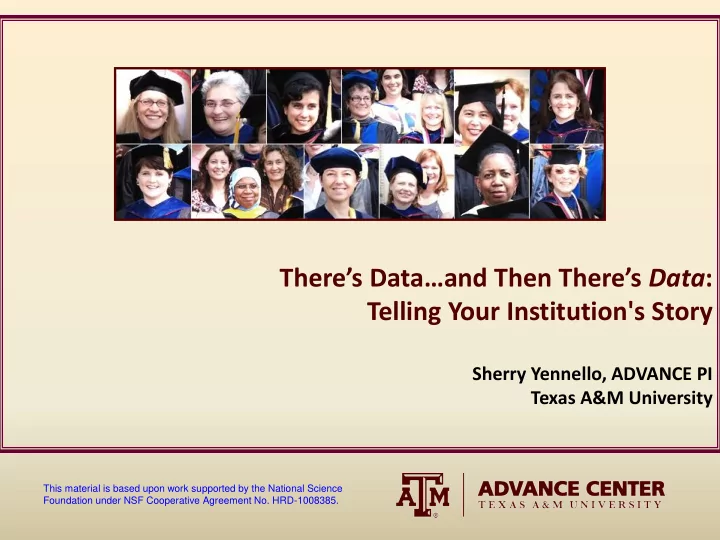
Theres Dataand Then Theres Data : Telling Your Institution's Story Sherry Yennello, ADVANCE PI Texas A&M University This material is based upon work supported by the National Science Foundation under NSF Cooperative Agreement No.


slide-1
SLIDE 1

There’s Data…and Then There’s Data: Telling Your Institution's Story

Sherry Yennello, ADVANCE PI Texas A&M University

This material is based upon work supported by the National Science Foundation under NSF Cooperative Agreement No. HRD-1008385.

slide-2
SLIDE 2

2

Important questions

How do we increase the number of women? Are women recruited at the same rate as men?

Are women tenured at the same rate as men? Are women retained at the same rate as men?

slide-3
SLIDE 3

3

2 Broad Requirements:

  • 1. Annually report data related to progress

toward the goals of your program

  • 2. Use Toolkit Guidelines
  • a. NSF Indicators
  • b. Salary

c. Space

  • d. Start-up Packages

NSF Reporting Requirements

slide-4
SLIDE 4

4

1. Standardized cross-sectional data for cross-institutional comparison 2. Relatively straightforward and quick (once you have the data) 3. Snap-shot, a single point in time 4. Best for descriptive studies 5. No causality or trend analysis

Toolkit includes guidelines for what NSF requires

slide-5
SLIDE 5

5

NSF Indicators – Table 3

  • No problem with promotion
slide-6
SLIDE 6

6

NSF Indicators – Table 6

  • No problem with attrition
slide-7
SLIDE 7

7

What we knew…

  • r thought we knew

What We Thought We Knew

Female faculty are not being denied tenure at a higher rate than male faculty. Retention is not a problem at TAMU. On average, 95% of tenured or tenure-track faculty are retained from one year to the next.

slide-8
SLIDE 8

9

  • Your university’s story is complex, unique, and needs to be fully

understood to bring about institutional transformation

  • Survival Analysis
  • Say what?
  • Time to event (Public Health)
  • Duration Analysis (Economics)
  • Event History Analysis (Sociology)
  • Two common statistical methods
  • Kaplan-Meier analysis (non-parametric)
  • Cox proportional hazards regression model (semi-parametric)
  • Answers the question:
  • What proportion of a population will “survive” to an event?

Going Beyond the Toolkit to Tell the Story

slide-9
SLIDE 9

10

Baseline Survival Rates for Tenure- Track Faculty in Engineering

slide-10
SLIDE 10

Probabilities of Promotion and Separation for STEM Associate Professors

11

.05 .1 .15 .2 2 4 6 8 10 Years as TAMU Associate Professor Female Probability of Promotion Male Probability of Promotion Female Probability of Separation Male Probability of Separation

All STEM

Probabilities of Promotion and Separation

slide-11
SLIDE 11

12

What We Know Now

What We Thought We Knew What We Know Now

Female faculty are not being denied tenure at a higher rate than male faculty. As we explored the data on a deeper level, we realized that some faculty are counseled-out along the path to tenure. Retention is not a problem at TAMU. On average, 95% of tenured or tenure-track faculty are retained from one year to the next. Survivability has been significantly lower for female faculty than for male faculty in our College of Engineering. Female faculty are leaving right after tenure Female faculty do not leave after getting tenure disproportionate to their male counterparts

slide-12
SLIDE 12

14

Take Home Message

  • You must meet NSF reporting

requirements

  • Higher level statistical analysis can help

you understand the data (and tell your institution’s story)

slide-13
SLIDE 13

advance.tamu.edu

Sherry Yennello, PI yennello@comp.tamu.edu 979.845.1141 Lori Taylor, Evaluation Team Leader lltaylor@tamu.edu 979.458.3015