Theory of Computer Science May 9, 2016 D7. Halting Problem and - - PowerPoint PPT Presentation

theory of computer science
SMART_READER_LITE
LIVE PREVIEW

Theory of Computer Science May 9, 2016 D7. Halting Problem and - - PowerPoint PPT Presentation

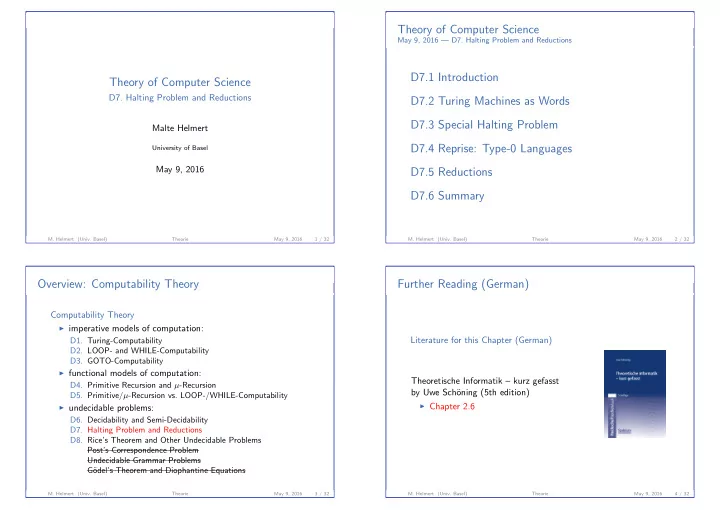
Theory of Computer Science May 9, 2016 D7. Halting Problem and Reductions D7.1 Introduction Theory of Computer Science D7. Halting Problem and Reductions D7.2 Turing Machines as Words D7.3 Special Halting Problem Malte Helmert D7.4


slide-1
SLIDE 1

Theory of Computer Science

  • D7. Halting Problem and Reductions

Malte Helmert

University of Basel

May 9, 2016

  • M. Helmert (Univ. Basel)

Theorie May 9, 2016 1 / 32

Theory of Computer Science

May 9, 2016 — D7. Halting Problem and Reductions

D7.1 Introduction D7.2 Turing Machines as Words D7.3 Special Halting Problem D7.4 Reprise: Type-0 Languages D7.5 Reductions D7.6 Summary

  • M. Helmert (Univ. Basel)

Theorie May 9, 2016 2 / 32

Overview: Computability Theory

Computability Theory

◮ imperative models of computation:

  • D1. Turing-Computability
  • D2. LOOP- and WHILE-Computability
  • D3. GOTO-Computability

◮ functional models of computation:

  • D4. Primitive Recursion and µ-Recursion
  • D5. Primitive/µ-Recursion vs. LOOP-/WHILE-Computability

◮ undecidable problems:

  • D6. Decidability and Semi-Decidability
  • D7. Halting Problem and Reductions
  • D8. Rice’s Theorem and Other Undecidable Problems

Post’s Correspondence Problem Undecidable Grammar Problems G¨

  • del’s Theorem and Diophantine Equations
  • M. Helmert (Univ. Basel)

Theorie May 9, 2016 3 / 32

Further Reading (German)

Literature for this Chapter (German) Theoretische Informatik – kurz gefasst by Uwe Sch¨

  • ning (5th edition)

◮ Chapter 2.6

  • M. Helmert (Univ. Basel)

Theorie May 9, 2016 4 / 32

slide-2
SLIDE 2

Further Reading (English)

Literature for this Chapter (English) Introduction to the Theory of Computation by Michael Sipser (3rd edition)

◮ Chapters 4.2 and 5.1

Notes:

◮ Sipser does not cover all topics we do. ◮ His definitions differ from ours.

  • M. Helmert (Univ. Basel)

Theorie May 9, 2016 5 / 32

  • D7. Halting Problem and Reductions

Introduction

D7.1 Introduction

  • M. Helmert (Univ. Basel)

Theorie May 9, 2016 6 / 32

  • D7. Halting Problem and Reductions

Introduction

Undecidable Problems

◮ We now know many characterizations

  • f semi-decidability and decidability.

◮ What’s missing is a concrete example

for an undecidable (= not decidable) problem.

◮ Do undecidable problems even exist? ◮ Yes! Counting argument: there are (for a fixed Σ)

as many decision algorithms (e. g., Turing machines) as numbers in N0 but as many languages as numbers in R. Since N0 cannot be surjectively mapped to R, languages with no decision algorithm exist.

◮ But this argument does not give us a concrete undecidable

  • problem. main goal of this chapter
  • M. Helmert (Univ. Basel)

Theorie May 9, 2016 7 / 32

  • D7. Halting Problem and Reductions

Turing Machines as Words

D7.2 Turing Machines as Words

  • M. Helmert (Univ. Basel)

Theorie May 9, 2016 8 / 32

slide-3
SLIDE 3
  • D7. Halting Problem and Reductions

Turing Machines as Words

Turing Machines as Inputs

◮ The first undecidable problems that we will get to know

have Turing machines as their input. “programs that have programs as input”:

  • cf. compilers, interpreters, virtual machines, etc.

◮ We have to think about how we can encode

arbitrary Turing machines as words over a fixed alphabet.

◮ We use the binary alphabet Σ = {0, 1}. ◮ As an intermediate step we first encode over the alphabet

Σ′ = {0, 1, #}.

  • M. Helmert (Univ. Basel)

Theorie May 9, 2016 9 / 32

  • D7. Halting Problem and Reductions

Turing Machines as Words

Encoding a Turing Machine as a Word (1)

Step 1: encode a Turing machine as a word over {0, 1, #} Reminder: Turing machine M = Q, Σ, Γ, δ, q0, , E Idea:

◮ input alphabet Σ should always be {0, 1} ◮ enumerate states in Q and symbols in Γ

and consider them as numbers 0, 1, 2, . . .

◮ blank symbol always receives number 2 ◮ start state always receives number 0

Then it is sufficient to only encode δ explicitly:

◮ Q: all states mentioned in the encoding of δ ◮ E: all states that never occur on a left-hand side of a δ-rule ◮ Γ = {0, 1, , a3, a4, . . . , ak}, where k is the largest symbol

number mentioned in the δ-rules

  • M. Helmert (Univ. Basel)

Theorie May 9, 2016 10 / 32

  • D7. Halting Problem and Reductions

Turing Machines as Words

Encoding a Turing Machine as a Word (2)

encode the rules:

◮ Let δ(qi, aj) = qi′, aj′, y be a rule in δ,

where the indices i, i′, j, j′ correspond to the enumeration of states/symbols and y ∈ {L, R, N}.

◮ encode this rule as

wi,j,i′,j′,y = ##bin(i)#bin(j)#bin(i′)#bin(j′)#bin(m), where m =      if y = L 1 if y = R 2 if y = N

◮ For every rule in δ, we obtain one such word. ◮ All of these words in sequence (in arbitrary order)

encode the Turing machine.

  • M. Helmert (Univ. Basel)

Theorie May 9, 2016 11 / 32

  • D7. Halting Problem and Reductions

Turing Machines as Words

Encoding a Turing Machine as a Word (3)

Step 2: transform into word over {0, 1} with mapping 0 → 00 1 → 01 # → 11 Turing machine can be reconstructed from its encoding. How?

  • M. Helmert (Univ. Basel)

Theorie May 9, 2016 12 / 32

slide-4
SLIDE 4
  • D7. Halting Problem and Reductions

Turing Machines as Words

Encoding a Turing Machine as a Word (4)

Example (step 1) δ(q2, a3) = q0, a2, N becomes ##10#11#0#10#10 δ(q1, a1) = q3, a0, L becomes ##1#1#11#0#0 Example (step 2) ##10#11#0#10#10##1#1#11#0#0 111101001101011100110100110100111101110111010111001100 Note: We can also consider the encoded word (uniquely; why?) as a number that enumerates this TM. This is not important for the halting problem but in other contexts where we operate on numbers instead of words.

  • M. Helmert (Univ. Basel)

Theorie May 9, 2016 13 / 32

  • D7. Halting Problem and Reductions

Turing Machines as Words

Turing Machine Encoded by a Word

goal: function that maps any word in {0, 1}∗ to a Turing machine problem: not all words in {0, 1}∗ are encodings of a Turing machine solution: Let M be an arbitrary fixed deterministic Turing machine (for example one that always immediately stops). Then: Definition (Turing Machine Encoded by a Word) For all w ∈ {0, 1}∗: Mw =

  • M′

if w is the encoding of some DTM M′

  • M
  • therwise
  • M. Helmert (Univ. Basel)

Theorie May 9, 2016 14 / 32

  • D7. Halting Problem and Reductions

Special Halting Problem

D7.3 Special Halting Problem

  • M. Helmert (Univ. Basel)

Theorie May 9, 2016 15 / 32

  • D7. Halting Problem and Reductions

Special Halting Problem

Special Halting Problem

Our preparations are now done and we can define: Definition (Special Halting Problem) The special halting problem or self-application problem is the language K = {w ∈ {0, 1}∗ | Mw started on w terminates}. German: spezielles Halteproblem, Selbstanwendbarkeitsproblem Note: word w plays two roles as encoding of the TM and as input for encoded machine

  • M. Helmert (Univ. Basel)

Theorie May 9, 2016 16 / 32

slide-5
SLIDE 5
  • D7. Halting Problem and Reductions

Special Halting Problem

Semi-Decidability of the Special Halting Problem

Theorem (Semi-Decidability of the Special Halting Problem) The special halting problem is semi-decidable. Proof. We construct an “interpreter” for DTMs that receives the encoding of a DTM as input w and simulates its computation on input w. If the simulated DTM stops, the interpreter returns 1. Otherwise it does not return. This interpreter computes χ′

K.

Note: TMs simulating arbitrary TMs are called universal TMs. German: universelle Turingmaschine

  • M. Helmert (Univ. Basel)

Theorie May 9, 2016 17 / 32

  • D7. Halting Problem and Reductions

Special Halting Problem

Undecidability of the Special Halting Problem (1)

Theorem (Undecidability of the Special Halting Problem) The special halting problem is undecidable. Proof. Proof by contradiction: we assume that the special halting problem K were decidable and derive a contradiction. So assume K is decidable. Then χK is computable (why?). Let M be a Turing machine that computes χK, i. e., given a word w writes 1 or 0 onto the tape (depending on whether w ∈ K) and then stops. . . .

  • M. Helmert (Univ. Basel)

Theorie May 9, 2016 18 / 32

  • D7. Halting Problem and Reductions

Special Halting Problem

Undecidability of the Special Halting Problem (2)

Proof (continued). Construct a new machine M′ as follows:

1 Execute M on the input w. 2 If the tape content is 0: stop. 3 Otherwise: enter an endless loop.

Let w′ be the encoding of M′. How will M′ behave on input w′? M′ run on w′ stops iff M run on w′ outputs 0 iff χK(w′) = 0 iff w′ / ∈ K iff Mw′ run on w′ does not stop iff M′ run on w′ does not stop Contradiction! This proves the theorem.

  • M. Helmert (Univ. Basel)

Theorie May 9, 2016 19 / 32

  • D7. Halting Problem and Reductions

Reprise: Type-0 Languages

D7.4 Reprise: Type-0 Languages

  • M. Helmert (Univ. Basel)

Theorie May 9, 2016 20 / 32

slide-6
SLIDE 6
  • D7. Halting Problem and Reductions

Reprise: Type-0 Languages

Back to Chapter C7: Closure Properties

Intersection Union Complement Product Star Type 3 Yes Yes Yes Yes Yes Type 2 No Yes No Yes Yes Type 1 Yes(1) Yes Yes(1) Yes Yes Type 0 Yes(1) Yes No(2) Yes Yes Proofs? (1) without proof (2) proofs in later chapters (part D)

  • M. Helmert (Univ. Basel)

Theorie May 9, 2016 21 / 32

  • D7. Halting Problem and Reductions

Reprise: Type-0 Languages

Back to Chapter C7: Decidability

Word problem Emptiness problem Equivalence problem Intersection problem Type 3 Yes Yes Yes Yes Type 2 Yes Yes No No Type 1 Yes No(1) No No Type 0 No(2) No(2) No(2) No(2) (1) without proof (2) proof in later chapters (part D)

  • M. Helmert (Univ. Basel)

Theorie May 9, 2016 22 / 32

  • D7. Halting Problem and Reductions

Reprise: Type-0 Languages

Answers to Old Questions

Closure properties:

◮ K is semi-decidable (and thus type 0) but not decidable.

¯ K is not semi-decidable, thus not type 0. Type-0 languages are not closed under complement. Decidability:

◮ K is type 0 but not decidable.

word problem for type-0 languages not decidable emptiness, equivalence, intersection problem: later in exercises (We are still missing some important results for this.)

  • M. Helmert (Univ. Basel)

Theorie May 9, 2016 23 / 32

  • D7. Halting Problem and Reductions

Reductions

D7.5 Reductions

  • M. Helmert (Univ. Basel)

Theorie May 9, 2016 24 / 32

slide-7
SLIDE 7
  • D7. Halting Problem and Reductions

Reductions

What We Achieved So Far: Discussion

◮ We now know a concrete undecidable problem. ◮ But the problem is rather artificial:

how often do we want to apply a program to itself?

◮ We will see that we can derive further (more useful)

undecidability results from the undecidability

  • f the special halting problem.

◮ The central notion for this is reducing

a new problem to an already known problem.

  • M. Helmert (Univ. Basel)

Theorie May 9, 2016 25 / 32

  • D7. Halting Problem and Reductions

Reductions

Reductions: Definition

Definition (Reduction) Let A ⊆ Σ∗ and B ⊆ Γ∗ be languages, and let f : Σ∗ → Γ∗ be a total and computable function such that for all x ∈ Σ∗: x ∈ A if and only if f (x) ∈ B. Then we say that A can be reduced to B (in symbols: A ≤ B), and f is called reduction from A to B. German: A ist auf B reduzierbar, Reduktion von A auf B

  • M. Helmert (Univ. Basel)

Theorie May 9, 2016 26 / 32

  • D7. Halting Problem and Reductions

Reductions

Reduction Property

Theorem (Reductions vs. Semi-Decidability/Decidability) Let A and B be languages with A ≤ B. Then:

1 If B is decidable, then A is decidable. 2 If B is semi-decidable, then A is semi-decidable. 3 If A is not decidable, then B is not decidable. 4 If A is not semi-decidable, then B is not semi-decidable.

In the following, we use 3. to show undecidability for further problems.

  • M. Helmert (Univ. Basel)

Theorie May 9, 2016 27 / 32

  • D7. Halting Problem and Reductions

Reductions

Reduction Property: Proof

Proof. for 1.: The following algorithm computes χA(x) given input x: y := f (x) result := χB(y) RETURN result for 2.: identical to (1), but use χ′

B (instead of χB)

to compute χ′

A (instead of χA)

for 3./4.: contrapositions of 1./2. logically equivalent

  • M. Helmert (Univ. Basel)

Theorie May 9, 2016 28 / 32

slide-8
SLIDE 8
  • D7. Halting Problem and Reductions

Reductions

Reductions are Preorders

Theorem (Reductions are Preorders) The relation “≤” is a preorder:

1 For all languages A:

A ≤ A (reflexivity)

2 For all languages A, B, C:

If A ≤ B and B ≤ C, then A ≤ C (transitivity) German: schwache Halbordnung/Quasiordnung, Reflexivit¨ at, Transitivit¨ at

  • M. Helmert (Univ. Basel)

Theorie May 9, 2016 29 / 32

  • D7. Halting Problem and Reductions

Reductions

Reductions are Preorders: Proof

Proof. for 1.: The function f (x) = x is a reduction from A to A because it is total and computable and x ∈ A iff f (x) ∈ A. for 2.: exercises

  • M. Helmert (Univ. Basel)

Theorie May 9, 2016 30 / 32

  • D7. Halting Problem and Reductions

Summary

D7.6 Summary

  • M. Helmert (Univ. Basel)

Theorie May 9, 2016 31 / 32

  • D7. Halting Problem and Reductions

Summary

Summary

◮ The special halting problem (self-application problem)

is undecidable.

◮ However, it is semi-decidable. ◮ important concept in this chapter:

Turing machines represented as words Turing machines taking Turing machines as their input

◮ reductions: “embedding” a problem as a special case

  • f another problem

◮ important method for proving undecidability:

reduce from a known undecidable problem to a new problem

  • M. Helmert (Univ. Basel)

Theorie May 9, 2016 32 / 32