Thematic Assessment Report Enter presentation title here. 1 - - PowerPoint PPT Presentation

thematic assessment report
SMART_READER_LITE
LIVE PREVIEW

Thematic Assessment Report Enter presentation title here. 1 - - PowerPoint PPT Presentation

Access to Housing and Tensions in Jordanian Communities Hosting Syrian Refugees Thematic Assessment Report Enter presentation title here. 1 18/09/2014 Introduction Supported by the British Embassy in Amman . Data collection took


slide-1
SLIDE 1

18/09/2014

Enter presentation title here…. 1

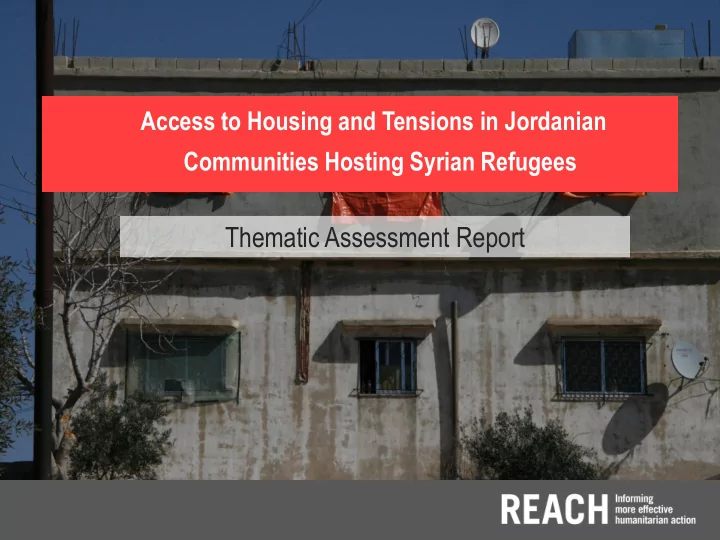
Access to Housing and Tensions in Jordanian Communities Hosting Syrian Refugees

Thematic Assessment Report

slide-2
SLIDE 2

Introduction

  • Supported by the British Embassy in Amman.
  • Data collection took place between December 2013 and March 2014 across

the six northern Jordanian governorates of Ajloun, Balqa, Irbid, Jarash, Al Mafraq and Zarqa.

  • Exploring refugee-host community relations > specifically factors influencing

tension and destabilization relating to Education, Employment, External Support, Health, Shelter and Water.

  • Housing was the most commonly cited sector linked to community

tensions by respondents, with a total of 81%.

  • The thematic assessment report focuses on perceptions of access to housing,

and tensions in accessing housing.

slide-3
SLIDE 3

Methodology

  • Mixed-methods approach using focus group discussions (FGDs) and

individual questionnaires using Open Data Kit (ODK) uploaded onto smart phones.

  • FGDs were held with the following demographic groups: Jordanian women,

Jordanian men, young Jordanian women, young Jordanian men, Syrian women, Syrian men, young Syrian women, and young Syrian men.

  • Findings from a key informant assessment were used to identify the 160 host

communities estimated to be most at risk of high tension and low levels of social cohesion and resilience.

  • A purposive sampling approach did not allow for generalisible findings but

provided a more nuanced understanding of Syrian and Jordanian perceptions of the sectors assessed.

slide-4
SLIDE 4

Assessment Coverage Map

slide-5
SLIDE 5

Perceptions of access to housing

0% 10% 20% 30% 40% 50% 60% 70% 80% 90% 100% Jordanians Syrians More than 2 years 1-2 years 6-12 months 1-6 months Less than 1 month 2% 22% 47% 3% 22% 4% 4% 13% 38% 3% 38% 4% 0% 5% 10% 15% 20% 25% 30% 35% 40% 45% 50% I don't know Strongly Disagree Disagree Neutral Agree Strongly Agree Jordanians Syrians

How long have you been living in this community? There is adequate access to housing in your community (by nationality)

  • The vast majority of Jordanian respondents indicated a longer

period of residency than their Syrian counterparts. 96% of Jordanians had lived in their community for more than two years, as opposed to a mere 3% of Syrians.

  • Only 1% of Syrians and 0% of Jordanians had been living in their

community for less than one month, indicating that a minority of respondents were new arrivals.

  • 69% of Jordanian respondents considered access to housing

in their community to be inadequate, as did 51% of Syrians.

  • One narrative arising in FGDs maintains that some Syrians

have displaced Jordanians in the housing market due to their willingness to pay higher rents.

  • Jordanian respondents who have lived in their community for

longer may base their perceptions of access to housing on the steady decline in housing availability subsequent to the influx of Syrian refugees.

slide-6
SLIDE 6

Perceptions of access to housing

There is adequate access to housing in this community (by sex)

2% 22% 41% 4% 25% 6% 4% 13% 43% 2% 35% 2% 0% 5% 10% 15% 20% 25% 30% 35% 40% 45% 50% I don't know Strongly Disagree Disagree Neutral Agree Strongly Agree Male Female

  • There was a notable difference in reported access to housing between male and female respondents.
  • When disaggregated by sex the findings showed that more male (63%) than female (56%) respondents perceived there to be

inadequate access to shelter in their community.

  • In Jordanian host communities a limited capacity to secure housing arrangements and concerns over rising rental costs

may have contributed to more acutely negative male perceptions of access to housing in the community.

slide-7
SLIDE 7

Perceptions of tensions in accessing housing

Access to housing causes tension in your community (by nationality)

  • 83% of Jordanians and 77% Syrians identified access to housing as a cause of tension in their

community (81% overall).

  • FGDs in Ajloun, Jarash, Al Mafraq and Zarqa revealed a narrative of Jordanians being displaced by

Syrian tenants in the housing market.

  • An equal proportion of Jordanians and Syrians (44%) rated challenges to housing in their community as

‘very urgent’, ¡with ¡a ¡further ¡36% of Jordanians and 32% of ¡Syrians ¡considering ¡these ¡‘extremely urgent’. ¡

Rate challenges to housing in your community (all respondents)

0% 10% 20% 30% 40% 50% Not Important At All Less Important Urgent Very Urgent Extremely Urgent Jordanians Syrians 2% 3% 9% 4% 53% 30% 0% 3% 4% 14% 2% 56% 21% 0% 0% 10% 20% 30% 40% 50% 60% I don't know Strongly Disagree Disagree Neutral Agree Strongly Agree I prefer not to answer Jordanians Syrians

slide-8
SLIDE 8

18/09/2014

Enter presentation title here…. 8

slide-9
SLIDE 9

Reasons behind housing-related tensions

Perceived reasons why access to housing causes tension (by nationality)

0% 1% 1% 1% 30% 66% 0% 1% 0% 2% 51% 45% 0% 10% 20% 30% 40% 50% 60% 70% No space for tent Discrimination in accessing shelter Housing

  • vercrowded

Housing inadequate Too expensive Insufficient housing Jordanians Syrians

  • When asked to indicate key reasons behind housing-related tension, the majority of Jordanian respondents (66%) cited

a lack of housing.

  • FGD outcomes provided evidence to support this finding. Example: In Downtown, Ajloun Jordanian and Syrian families

reported coping with the increase in population and lack of available housing by living in shared accommodation.

  • Syrians most commonly cited the high cost of housing as a reason behind tension, with 51% selecting this response,

compared to 30% of Jordanians.

  • This finding is corroborated by evidence that Jordanians in host communities spend considerably less on rent and

utilities than Syrians, on average JOD 107 per month compared to JOD 193. Furthermore, in FGDs Syrian participants expressed acute concerns that they were unable to afford housing prices.

slide-10
SLIDE 10

Conclusion

  • Findings indicate that a lack of adequate housing and high rental costs represented the two

most discernible reasons for housing-related tension perceived by both Jordanian and Syrian respondents.

  • According to anecdotal evidence some Jordanians and Syrians face near insurmountable
  • bstacles in securing housing that is both adequate and affordable. Challenging circumstances

have reportedly led many to resort to a range of negative coping strategies, which many entail harmful effects.

  • FGD findings suggest that access to housing not only represents a basic need but also a

social issue, which may have a direct influence on social norms by impeding the ability of young people to marry, and encouraging more communal living.

  • While some Jordanians have profited from charging Syrian refugees lucrative rents, others

are purportedly being replaced by Syrians in the rental market leading to a decline in social cohesion between the two groups.

slide-11
SLIDE 11

Thank you

For more information please contact REACH Coordination: Elisabeth.Vikman@reach-initiative.org Assessment Officer: Erin.Carey@reach-initiative.org General Enquiries: jordan@reach-initiative.org