Spikes and mass ratios : emission line diagnostics in AM CVns Danny - - PowerPoint PPT Presentation

spikes and mass ratios emission line diagnostics in am
SMART_READER_LITE
LIVE PREVIEW

Spikes and mass ratios : emission line diagnostics in AM CVns Danny - - PowerPoint PPT Presentation

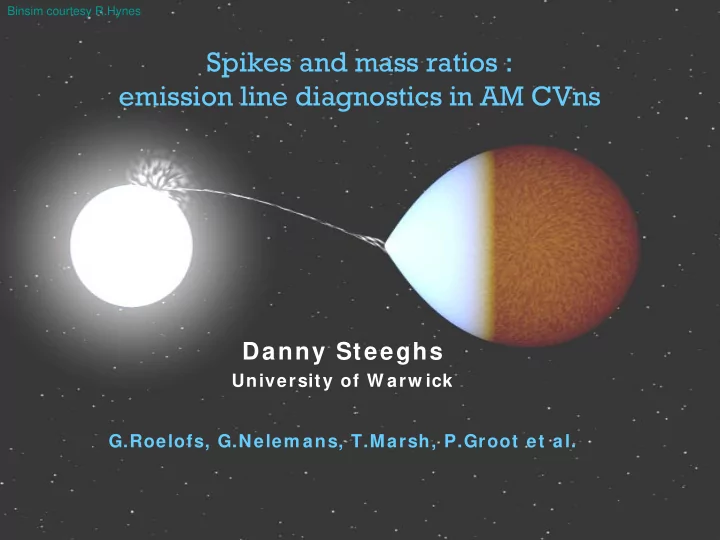
Binsim courtesy R.Hynes Spikes and mass ratios : emission line diagnostics in AM CVns Danny Steeghs University of W arw ick G.Roelofs, G.Nelem ans, T.Marsh, P.Groot et al. Danny Steeghs Emission line spectra facilitate their discovery/


slide-1
SLIDE 1

Danny Steeghs

Spikes and mass ratios : emission line diagnostics in AM CVns

Danny Steeghs

University of W arw ick G.Roelofs, G.Nelem ans, T.Marsh, P.Groot et al.

Binsim courtesy R.Hynes
slide-2
SLIDE 2

Danny Steeghs

Emission line spectra

  • facilitate their discovery/ identification (see P

.Groot)

  • sample the abundances of the donor star
  • provide a detailed dynamical probe of the emission line regions
slide-3
SLIDE 3

Danny Steeghs

Emission lines from a disk

slide-4
SLIDE 4

Danny Steeghs

Key locations

Donor star with velocity K2 Accretor with velocity K1 (Ballistic) accretion stream Accretion disk Stream-disk interaction Stream-accretor interaction (direct impact)

slide-5
SLIDE 5

Danny Steeghs

Spectroscopic periods

  • Complex photometric

behaviour of AM CVn stars makes a solid identification

  • f the binary period difficult
  • The stream-disk impact

localisation provides a common beacon in the binary frame

  • Kicked off by fast

spectroscopy of AM CVn itself

Accretion disc + bright spot emission (Nelemans, Steeghs & Groot 2001)

slide-6
SLIDE 6

Danny Steeghs

Period distribution of current AM CVn systems

slide-7
SLIDE 7

Danny Steeghs

The (almost) twins GP Com & V396 Hya

CII 4267 OII 4659 GP Com V3 9 6 Hya

slide-8
SLIDE 8

Danny Steeghs

The (almost) twins GP Com & V396 Hya

N blends GP Com V3 9 6 Hya

slide-9
SLIDE 9

Danny Steeghs

GP Com & V396 Hya

slide-10
SLIDE 10

Danny Steeghs

Central spike from the accreting WD

K1 = 11.7 km/ s

  • rbital phase

0 1 2

slide-11
SLIDE 11

Danny Steeghs

  • Spikes all move in phase and with

the same amplitude = > near WD (Marsh 1999)

  • However, spike mean velocity

changes significantly from line to line (~ 0-50 km/ s )

  • Some lines show double spikes, each

moving together

  • Both GP Com and V396 Hya show

the same pattern, other AM CVn systems show spikes as well (Roelofs et al.)

  • Spikes are narrow, though non-

Gaussian

  • Stark effect in high-density line

formation region? (Morales-Rueda et al. 2003)

Emission spikes from the white dwarf

appears not to be consistent w ith DB/ EHe m odels for Stark-shift and split ( Beaucham p et al. 1 9 9 7 )

slide-12
SLIDE 12

Danny Steeghs

Beauchamp et al. (1997) Stark profiles

velocity

+100 km/s

  • 100 km/s

velocity

+100 km/s

  • 100 km/s

Both velocity of peak and overall profile shape depends on ne ne=1015 cm-3 1016 cm-3

slide-13
SLIDE 13

Danny Steeghs

Observed split spike profiles

slide-14
SLIDE 14

Danny Steeghs

Spike velocity shifts

Decent match to the family of spike profiles (both shift and shape) for ne = 3 1015 cm -3

slide-15
SLIDE 15

Danny Steeghs

Spikes at the accreting WD

  • Single density Stark profiles describe the spike properties in both

GP Com and V396 Hya

  • Kinematics and density conditions of the spike match an

emission line region tied to the accreting white dwarf

  • Provide us with the orbital velocity K1, the absolute binary phase

and the (Stark corrected) systemic velocity

  • Unknown binary space velocity prevents us from converting the
  • verall velocity offset (+ 16-17 km/ s) into a gravitational red-shift
slide-16
SLIDE 16

Danny Steeghs

Rotation

  • Spikes are relatively narrow, and shapes are dominated by the

Stark broadening profile

  • Need very little rotational broadening !
  • From HeII 4686 :

vsini = 60 – 85 km/ s

  • White dwarfs appear to be rotating

slowly, unless the spike photosphere does not co-rotate with the white dwarf

slide-17
SLIDE 17

Danny Steeghs

Doppler maps

GP Com HeI 3888 V396 HeI 5015

slide-18
SLIDE 18

Danny Steeghs

Mass ratio from disk-stream impact : ballistic

GP Com V396 Hya q q

slide-19
SLIDE 19

Danny Steeghs

Mass ratio from disk-stream impact : disk velocities

ballistic mix disk velocities

slide-20
SLIDE 20

Danny Steeghs

Mass ratios from spike + impact spot

  • GP Com

q = 0.019 ± 0.002

  • V396 Hya

q = 0.013 ± 0.002

  • SDSS J1240 (Roelofs et al. 2005)

q = 0.039 ± 0.010

  • AM CVn (Roelofs et al. 2006)

q = 0.18 ± 0.01

  • (SDSS J1552)
slide-21
SLIDE 21

Danny Steeghs

Double hot-spots ; stream overflow ?

not sensitive to q ? Roelofs et al. 2005 V396 Hya SDSS J1240 + sn2003aw

slide-22
SLIDE 22

Danny Steeghs

The (almost) twins GP Com & V396 Hya

GP Com V3 9 6 Hya

slide-23
SLIDE 23

Danny Steeghs

Non-moving absorption lines ; circum-binary ?

V3 9 6 Hya GP Com

slide-24
SLIDE 24

Danny Steeghs

ES Ceti with Magellan

slide-25
SLIDE 25

Danny Steeghs

ES Cet at 10.3 mins

HeII 4686 HeII 5411 No measurable polarisation (< 0.1% ) argues against a magnetically channeled flow

slide-26
SLIDE 26

Danny Steeghs

The accretion geometry

constant variable

A disk is present, though containing a strong asymmetry, most likely the stream-disk interaction No classic direct-impact, but how far does the stream penetrate? Strong orbital modulations in the UV (HST/ XMM)

slide-27
SLIDE 27

Danny Steeghs

Conclusions and outlook

  • Jan-Erik’s Question : What do AM CVns look like?

emission lines can tell us what the accretion flow looks like

  • Disk-stream hot spots are beacons for reliable orbital periods

through fast spectroscopy

  • Disk dynamics ; precession , direct-impact, double spots
  • Spikes from the accretor

– Kinematics of the white dwarf (K1), Stark effect – Spike + hot-spot provides a mass ratio – Slow rotation ?

  • No sign of the donor stars so far
  • Abundances could use some effort
  • Comparison with atmosphere & SPH codes