The Worlds Competitive Supply Source World Trade Expo, October - - PowerPoint PPT Presentation

the world s competitive supply source
SMART_READER_LITE
LIVE PREVIEW

The Worlds Competitive Supply Source World Trade Expo, October - - PowerPoint PPT Presentation

Bangladesh The Worlds Competitive Supply Source World Trade Expo, October 29-30, 2018 World Trade Centre, Mumbai 2 Geographical Location of Bangladesh Bangladesh : The Peoples Republic of Bangladesh Name Capital : Dhaka : South Asia


slide-1
SLIDE 1

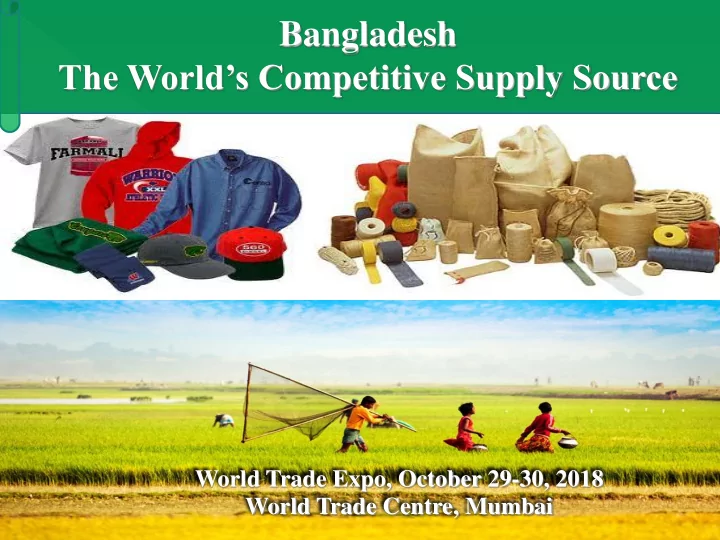
World Trade Expo, October 29-30, 2018 World Trade Centre, Mumbai

Bangladesh The World’s Competitive Supply Source

slide-2
SLIDE 2

2

slide-3
SLIDE 3

Geographical Location of Bangladesh

Bangladesh

slide-4
SLIDE 4

Name : The People’s Republic of Bangladesh Capital : Dhaka Location : South Asia (20º34‘ - 26º38‘) N La. 88º01'- 92º42‘ E Long Boarders : India on the east, west and north ; on the south side covered by the Bay of Bengal and a small border strip with Myanmar on the south-east. Area/Land : 147,570 square km. Population : 163 million GDP : US$ 246.00 billion (Nominal,2017) GDP per capita : US$ 1602.00 (May,2017) Annual Export : US$ 34.19 billion (2016-2017)(excluding service sector) Annual Import : US$ 43.49 billion (2016-2017)

4

slide-5
SLIDE 5

 Bangladesh has been cited as one of the next eleven countries that are

likely to follow the BRICS ;

 Bangladesh, the 77th largest trading nation in the world, has now

emerged as a trading hub with prosperous and sustainable growth ;

 73% of our population are at the age of 40 or below 40 years;  Bangladesh has a young population compared to regional countries;  Homogeneous population;  Homogeneous language; English is widely spoken;  Strategically located;  Eight Export Processing Zones already in operation;  10 Special zones are being established;  2 private Export Processing Zones are under process of development;  Bangladesh has principally developed labor-intensive industries but she

is now going for labour-cum- capital intensive industries.

5

slide-6
SLIDE 6

Bangladesh and India are the members of WTO SARRC, BIMSTEC and other important bilateral and multilateral trade

  • rganization.

The two way trade between two countries stood at US$ 6834.00 ;

Bangladesh’s export to India is US$ 672.40 mn.

Bangladesh’s import from India is US$ 6162.20 mn.

The major export items of Bangladesh to India are Raw jute, Jute manufactures, Jute yarn and twine,Sacks and Bags ,Cut flower,Rice bran oil,Copper wire,Agro processed food, Soap and Toiletries , Cement , betel nuts ,Jamdani Sharee, Cane molasses, Woven garments, Knitwear, Leather, Footwear, Frozen fish,, Engineering goods, Mosquito net, Furnace oil, accumulator Battery etc.

Bangladesh imports from India are Live Animal, Prepared food stuffs, vegetables, mineral products, products of the chemical or allied industries ,plastic and article thereof ,textile and textile articles, Articles of stone, base metals ,vehicles and transport equipment etc.

BD export to India US$ 672.40 mn and import from India US$ 6162.20 mn) in the fiscal year 2016-17

slide-7
SLIDE 7

7

 RMG (Knit & Woven Garments);  Pharmaceuticals;  Ship Building;  Light Engineering;  Environment friendly Jute Goods;  Frozen foods (Fish & Shrimps);  Furniture;  Footwear;  Ceramic.

slide-8
SLIDE 8

Products Name 2013- 2014 2014-2015 2015-2016 All products 30186.62 31208.94 34257.18 RMG (Knit & Woven) 24491.88 25491.4 28094.16 Pharmaceuticals 69.24 72.64 82.11 Ship Building 0.44 15.92 19.89 Light Engineering 366.63 447.04 510.08 Jute & Jute Goods 824.49 868.53 919.58 Frozen foods (Fish & Shrimps) 638.19 568.03 535.77 Furniture 42.58 38.94 46.26 Footwear 550.11 523.65 468.77 Ceramic 47.58 42.92 37.69 Vegetables 147.55 103.24 104.34

8

Million US$

slide-9
SLIDE 9

9

slide-10
SLIDE 10

01. RMG 28094.16

Six Items constitute 93.21% of the total export figure .

02. Frozen Foods 535.77 03. Jute & Jute Goods 919.58 04. Home textiles 753.01 05. Footwear 468.77

  • 06. Leather

1160.95 Total: 31932.24

10

Shares of major exportables of Bangladesh:

slide-11
SLIDE 11

11

slide-12
SLIDE 12

12

Regional Export Market Share

 Bangladesh exports to 198 countries on the Globe. Region–wise shares

are:

  • European Region

55.54 %

  • American Region

21.07%

  • Asian Region

11.95 %

  • Middle-east region

2.02 %

  • African region

0.93%

  • East European Region

3.25 %

  • Oceania Region

2.11 %

  • Other Region

3.13 %

slide-13
SLIDE 13

13

 Where we were ?  Where we are now ?

Trend in Export Trade

slide-14
SLIDE 14

14

1972-73 2015-16

  • No. of Products

25 744 (H.S. Code 4 digit)

  • No. of Markets

68 198 Export value 348.00 Mln. 34,257.18 Mln US$

(Product & market wise)

slide-15
SLIDE 15

15

5000 10000 15000 20000 25000 30000 35000 40000

Mn.US$

Export From Bangladesh During 1972-73 to 2015-2016

slide-16
SLIDE 16

16

Export as a percentage of Import

(2007-2008 to 2015-2016 )

FY Exports Imports Contribution 2007-2008 14,111 21,630 65.23% 2008-2009 15,565 22,507 69.16% 2009-2010 16204.65 23738.00 68.26% 2010-2011 22928.22 33657.40 68.12% 2011-2012 24301.90 35516.30 68.42% 2012-2013 27027.36 33969.00 79.56% 2013-2014 30186.62 40692.90 74.18% 2014-2015 31208.94 40638.50 76.80% 2015-2016 34257.18 40097.40 85.43%

(Value in million US$)

slide-17
SLIDE 17

Limited Products (1) only six products dominate the export;

Limited Market :

(1) EU – 54.55% (2) U.S.A – 18.16% (3) Other countries – 27.29%

17

slide-18
SLIDE 18

 Largest cotton t-shirt exporter in the world;  Second largest knitwear exporter of the world;  Third largest Apparel exporter in the world;  6,500 garment factories in Bangladesh;  4.50 million workers are employed in Apparel sector;  80% of the workers are women;  Workers are loyal, adaptible, trainable & committed  GSP facilities for the Apparel sector to EU, Japan, Australia, New Zealand,

Canada;

 Duty Free Market Access to China, S. Korea, India.  US$ 28.29 billion worth of Apparel export from Bangladesh;

18

slide-19
SLIDE 19

19

Continued…..

 Available backward linkage Industry in the apparel sector;  Composite Textile Mills on the rise;  Japanese Importers are planning to source 10% of their Apparel

requirements from Bangladesh;

 Reputed world chain stores like Wal-Mart, C&A,H&M, Marks & Spencer,

Zara, Mango, Matalon, GAP , Tesco, Puma are sourcing from Bangladesh;

 High value Apparel Production on the rise ;  Fashion University has been in operation ;  Own brands are developing in Bangladesh;  Apparel export will rise to 45 billion US$ as predicted by Mcenzie Report;  Positive growth in Knit & Woven Sector.

slide-20
SLIDE 20

 246 companies registered with food & drug administration of Bangladesh;  US$ 82.11 million worth of medicine export from Bangladesh;  Export to 156 countries in the world;  Quality & Price Competitive products;  Maintain GMP (Good Manufacturing Practice);  Second largest contributors to the National Exchequer ;  Only LDC in the world to produce generic medicine;  License to produce patent medicine;  Good number of products registered with EU, Latin America & African Countries;  97% total domestic demand met from local production;  3% imported for domestic consumption;  Multinational companies exist;  Bangladesh successfully exporting APIs (Active Pharmaceutical Ingredients) and a

wide range of products covering all major therapeutic classes and doses ;

 Besides regular dosage forms like Tablets, Capsules & Syrups, Bangladesh is also

exporting high-tech specialized products like HFA Inhalers, CFC Inhalers, Suppositories, Nasal Sprays , Injectables, IV Infusions etc.

20

slide-21
SLIDE 21

 Ship building emerged as an important export sector in

Bangladesh;

 Bangladesh has the potential to earn US$2.0 billion by

exporting ships and vessels in the next five years;

 Shipyards of Bangladesh are capable to make ships of about

10,000 DWT as per international standard, and performance of three of those has been highly appreciated;

 Bangladesh has been exporting new ships to European Union

market, especially to Denmark, Finland, Germany and Pakistan, Mozambique;

 The Government of Bangladesh has declared shipping industry

as one of the driving forces of our economy.

21

slide-22
SLIDE 22

 Light Engineering Products include Spare Parts of paper &

cement mills, Bicycle, Motor cycles, Automotive maintenance free sealed batteries, Fancy light fittings, Construction equipments, Battery, Voltage stabilizer, Carbon rod, Automobile spares, Electronic items, etc;

 Bangladesh exports Light Engineering Products to E.U, USA,

Middle East, Japan and India;

 About 0.60 million workers are employed in this sector.

22

slide-23
SLIDE 23

 Jute is an environment friendly product whose use as a good

alternative to the use of synthetic fibers such as carbon or ceramic fibers which are subject to environmental concerns;

 Bangladesh is one of the largest jute goods exporters of the

world;

 Demand for Jute goods has been growing in developed market

such as USA, Canada, Japan, Australia where consumer groups are conscious about carbon footprint of consumer

  • goods. Jute is a natural fiber and biodegradable. Bangladesh is

in a unique position to take advantage of this growing consumer concern.

23

slide-24
SLIDE 24

 Supplier of world’s reputed tasty salted & fresh water Shrimps

& Fishes;

 Strictly maintain quality following HACCP & Traceability;  Exporter of Consumer packets and value added products;  Approved processing plants by the EU are 74.

24

slide-25
SLIDE 25

 Bangladesh declared furniture as priority sector for

expanding export ;

 Exporting furniture to Japan, Singapore, Australia, USA and

  • ther markets;

 Furniture factories are committed to developing design and

quality;

 Supplier to Shipbuilding Industry.

25

slide-26
SLIDE 26

 Bangladesh is in the spotlight now for shoe due to western

importers are looking for new sourcing destinations;

 Due to quick domestic market expansion in the EU, USA &

  • Japan. They are becoming worried over future supply from

china;

 US$ 494.83 million worth of shoe exported from

Bangladesh.

26

slide-27
SLIDE 27

There are 36 industries in Bangladesh which are as follows:

a)

Ceramic Tableware – 12

b)

Ceramic Tiles – 16

c)

Sanitary Ware – 8

Bangladesh exports Ceramic & Porcelain tableware Bone China tableware and Stone tableware, Ceramic Tiles, Ceramic Sanitary Ware;

Available Sulphur free Gas;

Skilled Workers, Artisans, Designers are available;

Export to Europe, U.S.A, Canada, Japan, S.Korea, China, India, Singapore, Middle East, Russia, Turkey & other countries.

27

slide-28
SLIDE 28

 Bangladesh is gifted with a fertile land;  Favorable climate for the production of

various agricultural products;

 Huge supply of raw materials;  Cheap labour force;  Demand of local and

export market;

 Strong supply chain;  Eco-friendly production

process;

Export earning stood at US$ 596.05 million;

slide-29
SLIDE 29

 Bangladesh has been recognized as the 26th

best destination for IT

  • ut-sourcing

globally by leading US companies;

 500 software companies with more than

75,000 knowledgeable workers are

  • perating in the country;

 100 companies exporting software and

  • utsourcing jobs to more than 30 countries;

 Export earning already crossed

151.83

million US$;

 More than 30 thousand employments are

generated from this sector;

 Many developed countries are conducting

their business in joint venture with Bangladeshi firms;

More than 200 IT firms are directly and 800 IT firms are indirectly involved in this sector;

slide-30
SLIDE 30

 Product diversification  Market Development

30

slide-31
SLIDE 31

31

Export Policy (2015-2018) has identified three categories of products for product diversification:

 Highest priority sector  Special development sector  Special Development Service sector

slide-32
SLIDE 32

High end readymade garments and garments accessories; Software & IT enable Services, ICT products; Pharmaceutical Products; Ocean going Ship & fishing trawlers building; Shoes & Leather Products; Jute goods; Plastic products; Agro-products & and Agro-processing products; Furniture Industry; Home textiles & Terry Towel; Terry Towel; and Luggage.

32

Highest priority sector

slide-33
SLIDE 33

 Jute diversified products;  Electric and Electronic products;  Ceramic products;  Light engineering products including auto-parts & bicycles;  Value added Frozen fish;  Papadum;  Printing & Packaging;  Rough Diamond & Jewellery;  Paper & paper products;  Rubber;  Silk products;  Handicrafts;  Handloom products including Lungi; and  Coconut coir.

33

Special development sector

Potential sectors with strong production & supply base

slide-34
SLIDE 34

Tourism;

Architecture, Engineering and Consultancy Services.

34

Special Development Service sectors are:

slide-35
SLIDE 35

 Bangladesh offers the most lucrative incentives both in the

form of fiscal & non fiscal. These are-

Availability of very competitive, adaptive & peaceful labour force;

Access to credit facility;

Availability of utility & power;

Availability of special economic zone;

Low cost based production.

35

slide-36
SLIDE 36

Remittance of royalty;

Repatriation facilities of dividend & capital;

Tax Holidays;

Depreciation allowances;

Cash & added incentives to exporting industries;

Investment is protected by law.

36

slide-37
SLIDE 37

 10 years tax holiday for the Industries to be established before

1st January, 2012 and Industries to set up after 31st December, 2011 tax holiday period will be, Duty free import of construction materials

 Duty free import of machineries, office equipment & spare parts etc.  Duty free import and export of raw materials and finished goods  Relief from double taxation 6. Exemption from divident tax  GSP facility available  Accelerated depreciation on machinery or plant allowed  Remittance of royalty, technical and consultancy fees allowed  Duty & quota free access to EU, Canada, Norway, Australia etc.

slide-38
SLIDE 38

 28 countries of European Union, Australia, New Zealand, Norway,

Switzerland and Liechtenstein are giving GSP facilities for all products except Arms & Ammunition (EBA Scheme);

 Japan (except Arms & Ammunition including hand gloves)  Turkey (except RMG and Arms & Ammunition)  Canada (except Poultry, Diary, Egg, Arms & Ammunition)  Russia (71 products)  Belarus (71 products)  Armenia (71 products)  Kirgizstan (71 products)  Kazakhstan (71 products)

38

Duty Free and Quota Free Country for Bangladesh

slide-39
SLIDE 39

 South korea is giving us duty free market access on 4802

products;

 China is giving us duty free market access on 5054 products;  India is giving us duty free market access on all products under

SAFTA (except Tobacco & Drugs);

 Other SAARC countries are giving us duty free market access

  • n some products under SAFTA/SAPTA;

 Thailand is giving us duty free market access on 6998 products;  Malaysia is giving us duty free market access on 525 products;  Chile is giving us duty free market access on all Bangladeshi

products.

39

Continued…..

slide-40
SLIDE 40

40

slide-41
SLIDE 41

41