The West Transformed (1860-1896) slides by Mr. Zindman 1 A - - PowerPoint PPT Presentation

the west transformed
SMART_READER_LITE
LIVE PREVIEW

The West Transformed (1860-1896) slides by Mr. Zindman 1 A - - PowerPoint PPT Presentation

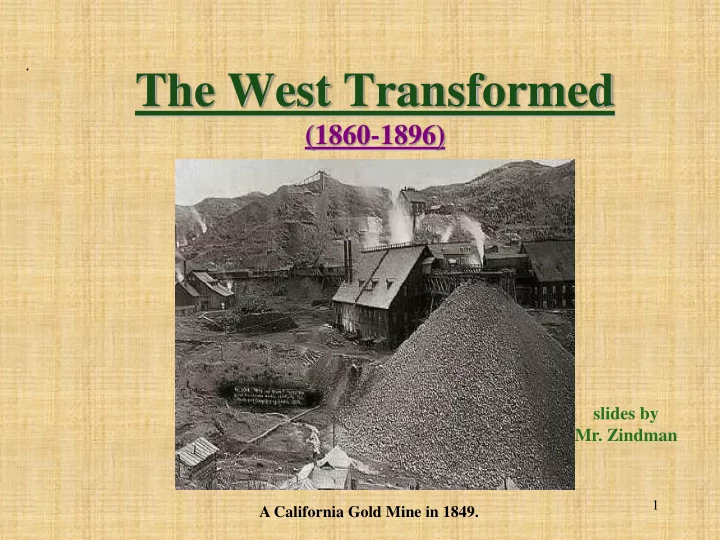
. The West Transformed (1860-1896) slides by Mr. Zindman 1 A California Gold Mine in 1849. NEW YORK STATE STANDARD A CHANGING SOCIETY: 8.3 EXPANSION AND IMPERIALISM: Beginning in the second half of the 19th century, economic, political,


slide-1
SLIDE 1

1

.

The West Transformed

(1860-1896)

slides by

  • Mr. Zindman

A California Gold Mine in 1849.
slide-2
SLIDE 2

2

NEW YORK STATE STANDARD A CHANGING SOCIETY:

8.3 EXPANSION AND IMPERIALISM: Beginning in the second half of the 19th century, economic, political, and cultural factors contributed to a push for westward expansion and more aggressive United States foreign policy. (Standards: 1, 2, 3, 5; Themes: GEO, GOV, CIV, ECO

8.3a Continued westward expansion contributed to increased conflicts with Native Americans

➢ Students will examine the effects of the transcontinental railroad on the movement toward westward expansion. ➢ Students will examine examples of Native American resistance to the western encroachment, including the Sioux Wars and the flight and surrender of Chief Joseph and the Nez Perce. ➢ Students will examine United States and New York State policies toward Native Americans, such as the displacement of Native Americans from traditional lands, creation of reservations, efforts to assimilate Native Americans through the creation of boarding schools, the Dawes Act, and the Indian Reorganization Act and the Native Americans’ various responses to these policies

Technological developments changed the modes of production, and access to natural resources facilitated increased industrialization.

slide-3
SLIDE 3

3

ESSENTIAL QUESTIONS:

  • 1. What impact did railroading and mining have on the development of the West?

2.How did a boom town develop into a ghost town? What bearing did this have on the West?

  • 3. Why were Native Americans put on reservations? Why has America failed to keep

their promises to Native Americans?

  • 4. What attempts did Native Americans take to preserve their tribal lands?
  • 2. ENDURING UNDERSTANDINGS:
  • 1. The cycle of wealth for southern whites continued to perpetuate racism.
  • 2. American greed has contributed to the movement west and poverty of Native

Americans. I CAN STATEMENTS: I can explain how the Transcontinental Railroad and the Gold Rush effected the West. I can why America failed to keep their promises to Native Americans. I can explain why the cattle kingdom failed in the West. I can explain how homesteaders survived in the western plains. LANGUAGE OBJECTIVE: 1.To determine the central idea from an informational text 2.To determine the topic and supporting details from an informational text.

slide-4
SLIDE 4

4

  • 1. How the Transcontinental Railroad and the gold rush effect the West.

Explain your answer. _________________________________________________________ _________________________________________________________ _________________________________________________________

  • 2. Why did America fail to keep their promises to Native Americans?

_________________________________________________________ _________________________________________________________ _________________________________________________________

  • 3. Why did the cattle kingdom failed in the West.

_________________________________________________________ _________________________________________________________ _________________________________________________________

  • 4. How did homesteaders survive in the West.

_________________________________________________________ _________________________________________________________ _________________________________________________________

slide-5
SLIDE 5

5

Many Americans were lured to the West by the chance to strike it rich by mining gold and silver. The Western Mining boom had begun with the California Gold Rush of 1849. gold

  • 1. Mining and Railroading

Boom Towns

What was a strike of gold? How did mining and railroading draw people into the West?

When someone finds land that is loaded with gold.

In California, miners searched for new strikes of gold and silver.

I can explain how the Transcontinental Railroad and the Gold Rush effected the West. I can why America failed to keep their promises to Native Americans. I can explain why the cattle kingdom failed in the West. I can explain how homesteaders survived in the western plains.

slide-6
SLIDE 6

6

In 1859, two young prospectors struck gold in the Sierra Nevada lands. The Comstock Lode attracted thousands of prospectors. Miners came across the United States, as well as from France, Germany, Ireland, Mexico, and China. One of every three miners was Chinese. Henry Comstock discovered a vein of gold called a lode.

I can explain how the Transcontinental Railroad and the Gold Rush effected the West. I can why America failed to keep their promises to Native Americans. I can explain why the cattle kingdom failed in the West. I can explain how homesteaders survived in the western plains.

slide-7
SLIDE 7

7

Thousands of people came West to supply the minors with materials such as tools, food, and clothing. People opened restaurants, boarding houses, laundries, etc. These tents later became towns and cities. The cities of Denver and Colorado Springs grew very quickly as a result other miner’s discovery of gold. With the boom in mining tent cities formed. A tent city was a town of people settling in tents.

I can explain how the Transcontinental Railroad and the Gold Rush effected the West. I can why America failed to keep their promises to Native Americans. I can explain why the cattle kingdom failed in the West. I can explain how homesteaders survived in the western plains.

slide-8
SLIDE 8

8

When the gold was gone the city’s turned into ghost towns. A ghost town was an abandoned town.

I can explain how the Transcontinental Railroad and the Gold Rush effected the West. I can why America failed to keep their promises to Native Americans. I can explain why the cattle kingdom failed in the West. I can explain how homesteaders survived in the western plains.

slide-9
SLIDE 9

9

6

I can explain how the Transcontinental Railroad and the Gold Rush effected the West. I can why America failed to keep their promises to Native Americans. I can explain why the cattle kingdom failed in the West. I can explain how homesteaders survived in the western plains.

slide-10
SLIDE 10

10

To the Indians, the railroad was a terrifying monster, an “iron horse” letting out black smoke and moving at stunning speeds.

The Railroads

A railroad train was called an “iron horse.”

I can explain how the Transcontinental Railroad and the Gold Rush effected the West. I can why America failed to keep their promises to Native Americans. I can explain why the cattle kingdom failed in the West. I can explain how homesteaders survived in the western plains.

slide-11
SLIDE 11

11

As cities grew the Federal Government encouraged railroad building in the West. During the Civil War, Congress loaned money to the railroad

  • companies. The railroad

companies built railroads to connect the East and the West.

I can explain how the Transcontinental Railroad and the Gold Rush effected the West. I can why America failed to keep their promises to Native Americans. I can explain why the cattle kingdom failed in the West. I can explain how homesteaders survived in the western plains.

slide-12
SLIDE 12

12

In 1863, two companies began the race to build the first transcontinental railroad. They were called the Central Pacific and Union Pacific Railroad. The Transcontinental Railroad was a railroad that stretched across the from the east coast to west coast.

I can explain how the Transcontinental Railroad and the Gold Rush effected the West. I can why America failed to keep their promises to Native Americans. I can explain why the cattle kingdom failed in the West. I can explain how homesteaders survived in the western plains.

slide-13
SLIDE 13

13

Both companies building the railroad had trouble getting workers. Labor was scarce, backbreaking, and

  • dangerous. The pay was also very low. Many of the

railroad companies used immigrant workers to build the railroad.

The railroad used thousands of workers from China, Ireland, Mexico, and Africa. The immigrants worked for less pay. This created many conflicts with American workers. Many workers were killed by snow storms and avalanches.

I can explain how the Transcontinental Railroad and the Gold Rush effected the West. I can why America failed to keep their promises to Native Americans. I can explain why the cattle kingdom failed in the West. I can explain how homesteaders survived in the western plains.

slide-14
SLIDE 14

14

People in the country celebrated the goals achieved by the two

  • railroads. Before long other major railroad lines will link to

the West and East. Soon wherever rail lines went, towns and cities spring up all along the tracks.

The Transcontinental Railroad. The golden spike

The Central Pacific and Union Pacific Railroad met at Promontory Point on May 10, 1869. They hammered a golden spike into the rail that joined the two tracks.

I can explain how the Transcontinental Railroad and the Gold Rush effected the West. I can why America failed to keep their promises to Native Americans. I can explain why the cattle kingdom failed in the West. I can explain how homesteaders survived in the western plains.

slide-15
SLIDE 15

15

Many Native Americans lived on the Great Plains for hundreds of years.

People of the Plains

  • 2. Native Americans Struggle to Survive

What were the consequences of the conflict between Native Americans and white settlers? A number of them, such as the Sioux and Cheyenne, had lived on the Plains for hundreds of years.

I can explain how the Transcontinental Railroad and the Gold Rush effected the West. I can why America failed to keep their promises to Native Americans. I can explain why the cattle kingdom failed in the West. I can explain how homesteaders survived in the western plains.

slide-16
SLIDE 16

16

Many different Native American nations lived on the Great Plains. Plains Indians had rich and varied cultures.They had well

  • rganized religions, made fine and crafts,

and created much poetry. The Plains Indians lived in villages.

I can explain how the Transcontinental Railroad and the Gold Rush effected the West. I can why America failed to keep their promises to Native Americans. I can explain why the cattle kingdom failed in the West. I can explain how homesteaders survived in the western plains.

slide-17
SLIDE 17

17

After the Pueblo Indians revolted against the Spaniards in 1680, they were left with thousands of horses. They traded the horses with neighboring tribes and learned to ride them

The Indians captured and tamed wild

  • horses. By the 1700’s, hunting replaced

farming as the basis of life for many plains people. Horses changed the Indians’ way of life. The Spanish brought horses in the late 1400’s. At first Indians could not own horses. Agriculture, or the science of farming, was their main source of food.

I can explain how the Transcontinental Railroad and the Gold Rush effected the West. I can why America failed to keep their promises to Native Americans. I can explain why the cattle kingdom failed in the West. I can explain how homesteaders survived in the western plains.

slide-18
SLIDE 18

18

The Indians moved very often, following the Buffalo that roamed the plains.

What do we mean when we say the buffalo was a living grocery store for the Native Americans?

They sent out hunting parties that pursued Buffalo and

  • ther animals.

corrals

The buffalo served as a living grocery store for the Plains Indians. After acquiring horses, they followed huge herds of buffalo.

The buffalo provided every thing the Native Americans needed to live on.

They hunted them by driving them into large corrals,

  • r enclosures.

I can explain how the Transcontinental Railroad and the Gold Rush effected the West. I can why America failed to keep their promises to Native Americans. I can explain why the cattle kingdom failed in the West. I can explain how homesteaders survived in the western plains.

slide-19
SLIDE 19

19

Buffalo meat, rich in protein was the main item in the Indians diet.

Many Americans still eat beef jerky today.

The Plains Indians were dependent on the Buffalo for food, clothing, and shelter. The Indians lived in tepees, or shelters made from wooden sticks and Buffalo skins They carried their belongings on travois or small sleds. They usually dried the meat on racks. They dried meat called jerky.

I can explain how the Transcontinental Railroad and the Gold Rush effected the West. I can why America failed to keep their promises to Native Americans. I can explain why the cattle kingdom failed in the West. I can explain how homesteaders survived in the western plains.

slide-20
SLIDE 20

20

In the summer many groups played together, hunted together and staged horse and foot races. In the Sundance, dancers circled around a tree and asked the Great Spirit to give them good fortune during the coming year. The most important event for the Plains Indians was a religious ceremony known as the Sundance.

I can explain how the Transcontinental Railroad and the Gold Rush effected the West. I can why America failed to keep their promises to Native Americans. I can explain why the cattle kingdom failed in the West. I can explain how homesteaders survived in the western plains.

slide-21
SLIDE 21

21

Women were skilled in many crafts. They made baskets and blankets.

The Roles of Plains Indian Women and Men

The woman’s artistic ability established their rank in society. Plains Indian women tanned Buffalo hides to make leather. They made clothing, tepees and tools. They made everything but weapons. They took care of the children.

I can explain how the Transcontinental Railroad and the Gold Rush effected the West. I can why America failed to keep their promises to Native Americans. I can explain why the cattle kingdom failed in the West. I can explain how homesteaders survived in the western plains.

slide-22
SLIDE 22

22

They provided military leadership and waged war to fight or extend a territory. The most successful warriors gained great respect from the members of their nation. They passed their valuable skills to the boys. Plains Indian men protected the women, children and elders. They supervised the spiritual life of the community by leading religious ceremonies.

I can explain how the Transcontinental Railroad and the Gold Rush effected the

  • West. I can why America failed to keep their promises to Native Americans. I

can explain why the cattle kingdom failed in the West. I can explain how homesteaders survived in the western plains.

slide-23
SLIDE 23

23

As the settlers moved for the West the United States promised to protect the Indians hunting grounds. The United States Government broke promise after promise. This made the Indians very angry. Indian wars spread across the Great Plains for this reason.

I can explain how the Transcontinental Railroad and the Gold Rush effected the West. I can why America failed to keep their promises to Native Americans. I can explain why the cattle kingdom failed in the West. I can explain how homesteaders survived in the western plains.

slide-24
SLIDE 24

24

In 1851, the Federal Government met with the Indian nations near Fort Laramie in Wyoming.

Yet settlers continued to trespass on Indian lands and break the agreement. The Native American leaders agreed to the government’s terms.

This treaty was called the Fort Laramie Treaty. The Government asked the Indians to stay in a limited area. In return, they promised money, domestic animals, agricultural tools, and other goods.

The Sioux Wars broke out against settlers and the army when their treaties with the United States was broken.

I can explain how the Transcontinental Railroad and the Gold Rush effected the West. I can why America failed to keep their promises to Native Americans. I can explain why the cattle kingdom failed in the West. I can explain how homesteaders survived in the western plains.

slide-25
SLIDE 25

25

In 1858, gold was struck at Pikes Peak in

  • Colorado. The gold strike brought

miners onto the land the government promised to the Indians.

Native Americans refused to give up their land. They attacked trains, burned, and killed many soldiers and common people. Colonel John Chivington, of the United States Army, attacked the Indians. When the Indians surrendered he ordered his men to destroy the village and take no prisoners. He slaughtered about 150 Indian men, women, and children. This was called the Chivington Massacre.

In 1860, the Indians were forced to give up the land around Pikes Peak.

I can explain how the Transcontinental Railroad and the Gold Rush effected the West. I can why America failed to keep their promises to Native Americans. I can explain why the cattle kingdom failed in the West. I can explain how homesteaders survived in the western plains.

slide-26
SLIDE 26

26

The Indians in the Northern Plains also signed a treaty. They agreed to live on reservations that included all

  • f South Dakota west of the Missouri

River.

In 1867, the Southern Plains Indians signed a new agreement with the United States Government. The Indians were promised the land in the territory called present-day Oklahoma. The Indians were unhappy with the new treaty. They had no choice but to move.

A reservation is land set aside for Native Americans to live on.

I can explain how the Transcontinental Railroad and the Gold Rush effected the West. I can why America failed to keep their promises to Native Americans. I can explain why the cattle kingdom failed in the West. I can explain how homesteaders survived in the western plains.

slide-27
SLIDE 27

27

Indians were being forced to live on reservations set up by the United States

  • government. The

traditional Indian way of life has ended for the Native American Indians.

I can explain how the Transcontinental Railroad and the Gold Rush effected the West. I can why America failed to keep their promises to Native Americans. I can explain why the cattle kingdom failed in the West. I can explain how homesteaders survived in the western plains.

slide-28
SLIDE 28

28

The Plains Indians suffered from for lost battles and broken treaties. The Buffalo were being destroyed. The two reasons Buffalo were being destroyed were:

Buffalo hunting became a fashionable sport and commercial hunters shot Buffalo to make hide blankets.

End of the Buffalo

Hired Hunters killed thousands of buffalo to provide food for the railroad crews laying tracks across the prairie.

I can explain how the Transcontinental Railroad and the Gold Rush effected the

  • West. I can why America failed to keep

their promises to Native Americans. I can explain why the cattle kingdom failed in the

  • West. I can explain how homesteaders

survived in the western plains.

slide-29
SLIDE 29

29

With 2 to 3 million Buffalo hides its being taken every year, the number of Buffalo on the plain dropped from 13 million in 1862 to a few hundred the in 1900‘s.

Please do not hunt me!

I can explain how the Transcontinental Railroad and the Gold Rush effected the West. I can why America failed to keep their promises to Native Americans. I can explain why the cattle kingdom failed in the

  • West. I can explain how homesteaders survived in the western plains.
slide-30
SLIDE 30

30

Many Americans forced the Indians off their lands by force. In 1876, Sitting Bull, an Indian chief wrote the to the United States Army troops when they drove him off his land. “ I want to know what you are doing to the

  • land. You scare the Buffalo way. I want to

hunt in this place. I want you to return back from of this place. If you don’t, I will fight you!”

Sitting Bull

Indian People in Retreat

What was Sitting Bull trying to tell the American people? If the Americans do not leave our lands we will fight you.

I can explain how the Transcontinental Railroad and the Gold Rush effected the West. I can why America failed to keep their promises to Native Americans. I can explain why the cattle kingdom failed in the West. I can explain how homesteaders survived in the western plains.

slide-31
SLIDE 31

31

This war between the settlers and Indians was called the Sioux War. Colonel George Custer led his soldiers against the Indians. George Custer attacked the Indians was only 225 men. Chief Sitting Bull and George Custer

Last Stand for Custer and the Sioux

Even on reservations, the Indians were not left in peace. In 1874 gold was found on a plains Indian Reservation in the Black Hills region. Chief Sitting Bull and Crazy Horse fought back against the Americans invading their lands in 1876. Custer lost the battle. This battle was called the Battle of Little Bighorn.

I can explain how the Transcontinental Railroad and the Gold Rush effected the West. I can why America failed to keep their promises to Native Americans. I can explain why the cattle kingdom failed in the West. I can explain how homesteaders survived in the western plains.

slide-32
SLIDE 32

32

Apache Indians fiercely resisted the loss of their lands by the settlers setting up ranches. An Apache leader, Geronimo, led the Apache Indians against the settlers.

I can explain how the Transcontinental Railroad and the Gold Rush effected the West. I can why America failed to keep their promises to Native Americans. I can explain why the cattle kingdom failed in the West. I can explain how homesteaders survived in the western plains.

slide-33
SLIDE 33

33

Many Native Americans performed the Ghost Dance. In this dance they believed the buffalo would return and the white settlers would leave.

I can explain how the Transcontinental Railroad and the Gold Rush effected the West. I can why America failed to keep their promises to Native Americans. I can explain why the cattle kingdom failed in the West. I can explain how homesteaders survived in the western plains.

slide-34
SLIDE 34

34

Chief Joseph was a Nez Perce chief who, faced with settlement by whites of tribal lands in Oregon, led his followers in a dramatic effort to escape to Canada. Over the course of four long months, Chief Joseph and his 700 followers, a group that included just 200 actual warriors, embarked on a 1,400-mile march toward Canada. The journey included several impressive victories against a U.S. force that numbered more than 2,000 soldiers.

Over the course of four long months, Chief Joseph and his 700 followers, a group that included just 200 actual warriors, embarked on a 1,400-mile march toward Canada. The journey included several impressive victories against a U.S. force that numbered more than 2,000 soldiers. But the retreat took its toll on the group. By the fall of 1877 Chief Joseph and his people were exhausted. They had come within 40 miles of the Canadian border, reaching the Bear Paw Mountains of Montana, but were too beaten and starving to continue to fight. Having seen his warriors reduced to just 87 fighting men, having weathered the loss of his own brother, Olikut, and having seen many of the women and children near starvation, Chief Joseph surrendered to his enemy, delivering one of the great speeches in American history.

I can explain how the Transcontinental Railroad and the Gold Rush effected the West. I can why America failed to keep their promises to Native Americans. I can explain why the cattle kingdom failed in the West. I can explain how homesteaders survived in the western plains.

slide-35
SLIDE 35

35

Chief Joseph surrendered to his enemy, delivering one of the great speeches in American history.

"I am tired of fighting," he said. "Our chiefs are killed. Looking Glass is dead. Toohoolhoolzote is dead. The old men are all

  • dead. It is the young men who say, 'Yes' or

'No.' He who led the young men [Olikut] is

  • dead. It is cold, and we have no blankets.

The little children are freezing to death. My people, some of them, have run away to the hills, and have no blankets, no food. No one knows where they are—perhaps freezing to

  • death. I want to have time to look for my

children, and see how many of them I can

  • find. Maybe I shall find them among the
  • dead. Hear me, my chiefs! I am tired. My

heart is sick and sad. From where the sun now

stands, I will fight no more forever."

What does Chief Joseph's speech tell you about the Native American's predicament?

I can explain how the Transcontinental Railroad and the Gold Rush effected the West. I can why America failed to keep their promises to Native Americans. I can explain why the cattle kingdom failed in the West. I can explain how homesteaders survived in the western plains.

slide-36
SLIDE 36

36

Those Indians that accepted allotments and lived separately from the tribe would be granted United States citizenship. By dividing the tribal lands to and making Indians individual land owners, the Federal government tied to assimilate the Native Americans as American citizens. Many tribal leaders were angry because it broke up the tribal unity which was held for hundreds of years. This led to the Sioux and other tribal wars against the United States. The Dawes Act of 1887 authorized the President of the United States to survey American Indian tribal land and divide it into allotments for individual Indians.

I can explain how the Transcontinental Railroad and the Gold Rush effected the West. I can why America failed to keep their promises to Native Americans. I can explain why the cattle kingdom failed in the West. I can explain how homesteaders survived in the western plains.

slide-37
SLIDE 37

37

The Act also restored to Indians the management of their assets—land and mineral rights—and included provisions intended to create a sound economic foundation for the inhabitants of Indian reservations. The Indian Reorganization Act of June 18, 1934, was U.S. federal legislation that dealt with the status of Native

  • Americans. It was the centerpiece of what has been
  • ften called the "Indian New Deal".

The major goal of the Indian Reorganization Act was to reverse the traditional goal of assimilation of Indians into American society and to strengthen, encourage and perpetuate the tribes and their historic traditions and culture.

I can explain how the Transcontinental Railroad and the Gold Rush effected the West. I can why America failed to keep their promises to Native Americans. I can explain why the cattle kingdom failed in the West. I can explain how homesteaders survived in the western plains.

slide-38
SLIDE 38

38

Before the arrival of the settlers the Spanish and Mexicans set up cattle ranches in the Southwest. Over the years the strays from these ranches grew into large herds of wild cattle.

3.The Cattle Kingdom

What factors to the boom and bust in the cattle industry?

They roamed across the grassy plains of Texas. As the demand for beef increased the growing cities needed meat. The Texas longhorns were perfect for the market. These cattle were known as longhorns because they had long horns on their head.

I can explain how the Transcontinental Railroad and the Gold Rush effected the West. I can why America failed to keep their promises to Native Americans. I can explain why the cattle kingdom failed in the West. I can explain how homesteaders survived in the western plains.

slide-39
SLIDE 39

39

The Chisholm Trail became the most famous cattle trail. Ranchers employed cowhands to tend the cattle and drive the herds to the

  • market. Their job was to keep the cattle moving and round of strays.

Most of these cow hands were Spanish. They were called Vaqueros ,

  • r skilled riders who herded cattle on ranches in Mexico.

In response to the need for meat, ranchers began rounding up the herds of longhorns. They drove the herds hundreds

  • f miles called cattle drives.

I can explain how the Transcontinental Railroad and the Gold Rush effected the West. I can why America failed to keep their promises to Native Americans. I can explain why the cattle kingdom failed in the West. I can explain how homesteaders survived in the western plains.

slide-40
SLIDE 40

40

Ranching spread north from Texas across the plains. A rancher could buy a young calf for five dollars and sell a mature steer for sixty dollars. Soon cattle grazed on the grassy plains from Kansas to the present day Montana.

The cattle industry lasted from the 1860’s to the 1880’s. The region dominated by the cattle industry and it’s ranches, trails, and cow towns came to be called the cattle kingdom.

I can explain how the Transcontinental Railroad and the Gold Rush effected the West. I can why America failed to keep their promises to Native Americans. I can explain why the cattle kingdom failed in the West. I can explain how homesteaders survived in the western plains.

slide-41
SLIDE 41

41

Bad weather ended the cattle kingdom herds. The winter

  • f 1885 was terrible and that summer was hot and dry.

The Boom Ends

By 1900, half a million farmers had arrived. They put up fences in their fields with barbed wire. As more farmers strung barbed wire, the open range began to disappear.

The bitter cold of the next winter killed millions of

  • cattle. By the spring of 1887, nine out of ten cattle

have frozen to death.

I can explain how the Transcontinental Railroad and the Gold Rush effected the West. I can why America failed to keep their promises to Native Americans. I can explain why the cattle kingdom failed in the West. I can explain how homesteaders survived in the western plains.

slide-42
SLIDE 42

42

Cow towns attracted settlers that wanted to build stable communities where families could strive. Each town had a main street where people conducted business. Every town had a general store that sold tools groceries and clothing.

The Wild West-Cow Towns

Cattle drives ended in cow towns. In cow towns the cows were held in large pens until they could be loaded on large trains and shipped to markets in the East. Towns such as Abilene, Kansas and Dodge City sprang up.

I can explain how the Transcontinental Railroad and the Gold Rush effected the

  • West. I can why America failed to keep

their promises to Native Americans. I can explain why the cattle kingdom failed in the

  • West. I can explain how homesteaders

survived in the western plains.

slide-43
SLIDE 43

43

Many conflicts developed between the sheep herders and the cattle herders that ended in destroying many cattle and sheep. The bitter winter of 1886-1887 killed entire herds of cattle. In the summer, severe heat and drought dried up the water holes. Cattle ranchers began buying land, fencing it in and setting up ranches. The days of the cattle kingdom were over. The church in society played and important role in cow towns. Each town had a church. As towns grew in size the church and worship played an important role by providing spiritual leadership. By the 1870’s the cattle boom ended. One reason for this was there was not enough grass for the cattle to feed on.

I can explain how the Transcontinental Railroad and the Gold Rush effected the West. I can why America failed to keep their promises to Native

  • Americans. I can explain why the cattle

kingdom failed in the West. I can explain how homesteaders survived in the western plains.

slide-44
SLIDE 44

44

The government wanted to encourage farmers to settle in the West. They also wanted to give poor people in the East a chance to own their own farm.

  • 5. Farming in the West

Homesteading

How did the farmers on the plains struggle to make a living? In 1862, Congress passed the Homestead Act. Under the act, the government gave 160 acres of land to anyone who farmed for 5 years.

I can explain how the Transcontinental Railroad and the Gold Rush effected the West. I can why America failed to keep their promises to Native Americans. I can explain why the cattle kingdom failed in the

  • West. I can explain how homesteaders survived in the western

plains.

slide-45
SLIDE 45

45

By 1900, half a million farmers have settled on the Great Plains under the Homestead Act. Many Easterners rushed to accept this offer for free land. These people who accepted acquired free land from the government were called homesteaders.

I can explain how the Transcontinental Railroad and the Gold Rush effected the West. I can why America failed to keep their promises to Native Americans. I can explain why the cattle kingdom failed in the West. I can explain how homesteaders survived in the western plains.

slide-46
SLIDE 46

46

They took their name from the Bible. White Southerners did not want to lose a cheaper labor supplied by the African

  • Americans. To prevent the African Americans from leaving,

whites stopped the boats carrying the African Americans up the Mississippi. The Homestead Act had its problems. Only about 20% of the homestead land originally went to small farmers. Big land

  • wning companies took large areas of land illegally. They

divided the land and then resold it to farmer’s high price. African Americans joined in the rush for land. In 1879, a group of African Americans decided to move to

  • Kansas. They called themselves the Exodusters.

Despite the danger, between 40,000 and 70,000 African Americans moved to Kansas in 1881.

I can explain how the Transcontinental Railroad and the Gold Rush effected the West. I can why America failed to keep their promises to Native Americans. I can explain why the cattle kingdom failed in the West. I can explain how homesteaders survived in the western plains.

slide-47
SLIDE 47

47

Plows made of steel enabled farmers to break up the ground for planting.

Many farmers made their homes from soil because wood was rarely found on the plains. They called these homes sod homes.

A Hard Life on the Plains- New Farming Methods

It enabled sodbusters, or the plains farmers, to cut through the sod and reach the soil below.

I can explain how the Transcontinental Railroad and the Gold Rush effected the West. I can why America failed to keep their promises to Native Americans. I can explain why the cattle kingdom failed in the West. I can explain how homesteaders survived in the western plains.

slide-48
SLIDE 48

48

Last Rush For Land

In 1889, 100,000 people formed a line in Oklahoma City to claim 2 million acres of for land that once belonged to the Native Americans. Fights broke out

  • ver the land.

A few people known as Sooners, had already sneaked

  • n the land and claimed it as their own land.

One year later the U.S. government said no more land was available.

I can explain how the Transcontinental Railroad and the Gold Rush effected the West. I can why America failed to keep their promises to Native Americans. I can explain why the cattle kingdom failed in the West. I can explain how homesteaders survived in the western plains.

slide-49
SLIDE 49

49

50-Wholesale means buying or selling things in large quantities at lower prices.

Farmers Organize

In the 1860’s farmers began to work together. They believed if they worked together they could improve their farming conditions through economic cooperation and political

  • action. They formed an organization called the

National Grange. Granges were groups of farmers that met for lectures, sewing , and other events. The grange helped farmers set up cooperatives. In a cooperative, farmers pooled their money together to make large purchases of tools, seed, and other supplies at a discount.

I can explain how the Transcontinental Railroad and the Gold Rush effected the West. I can why America failed to keep their promises to Native Americans. I can explain why the cattle kingdom failed in the West. I can explain how homesteaders survived in the western plains.

slide-50
SLIDE 50

50

They had to educate the children. They also treated the sick and injured because there were no doctor’s nearby. People lived miles apart so they enjoyed the chance to get together with other

  • families. Picnics, dances, and

weddings were special events.

Women and the Plains

People to be strong to survive the hardships of life on the Great Plains. Women made clothing, quilts, soap, candles, and other goods by hand. They also have to cook and preserve all food needed through the long winter.

I can explain how the Transcontinental Railroad and the Gold Rush effected the West. I can why America failed to keep their promises to Native Americans. I can explain why the cattle kingdom failed in the West. I can explain how homesteaders survived in the western plains.

slide-51
SLIDE 51

51

  • 1. How the Transcontinental Railroad and the Gold Rush effect the
  • West. Explain your answer.

_________________________________________________________ _________________________________________________________ _________________________________________________________

  • 2. Why did America fail to keep their promises to Native Americans?

_________________________________________________________ _________________________________________________________ _________________________________________________________

  • 3. Why did the cattle kingdom failed in the West.

_________________________________________________________ _________________________________________________________ _________________________________________________________

  • 4. How did homesteaders survive in the West.

_________________________________________________________ _________________________________________________________ _________________________________________________________

slide-52
SLIDE 52

52 I can explain how the Transcontinental Railroad and the Gold Rush effected the West. I can why America failed to keep their promises to Native Americans. I can explain why the cattle kingdom failed in the West. I can explain how homesteaders survived in the western plains.