
SLIDE 1
6 November 2015
The Use of Graphic Media in Teaching Animal Law
Animal Law Teaching Workshop | Monash University | Aaron Timoshanko
The Use of Graphic Media in Teaching Animal Law Animal Law Teaching - - PowerPoint PPT Presentation
The Use of Graphic Media in Teaching Animal Law Animal Law Teaching Workshop | Monash University | Aaron Timoshanko 6 November 2015 Growth of Animal Law Since 2005 there has been a steady increase in the number of universities offering
6 November 2015
Animal Law Teaching Workshop | Monash University | Aaron Timoshanko
✤ Since 2005 there has been a
✤ Many academics teaching
✤ This was me earlier this year
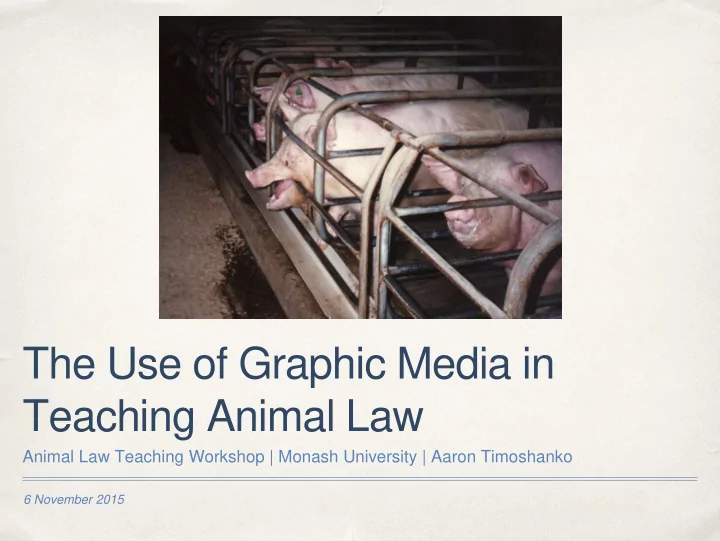
✤ One of the key questions for me was whether to use graphic media ✤ ‘Graphic media’ is film or still images that most students will find confronting and/or distressing ✤ Very broad: from the extreme (gory) to the routine ✤ Subjective phenomena ✤ e.g. lawful confinement of sows or layer hens ✤ The key question: does graphic media promote student learning and engagement? ✤ Not a lot out there offering guidance ✤ Probably due to the ethical dimension ✤ Although I advocate for the use of graphic media I am not suggesting that all academics should
use graphic media or that courses without graphic media are somehow deficient
✤ Relying upon research and literature on: ✤ The teaching of sensitive topics (e.g. rape law,
✤ Non-graphic media (audio-visual tools for learning) ✤ There are some obvious points of distinction but there
✤ Student engagement is ‘a crucial cornerstone of quality teaching and learning’. ✤ Perform better academically ✤ More likely to complete their studies ✤ 4 types of engagement: cognitive, affective, conative and relational ✤ Focus here is on affective engagement: based on students’ reporting ✤ Positive vs negative affective engagement ✤ Some negative affective engagement may promote agency but others may
hinder or detract from students learning experience.
✤ As an ‘affective strategy’ graphic media can promote
✤ Links abstract concepts to reality (e.g. animal welfare)
✤ Provides an authentic learning experience ✤ Film and images can stimulate interest ✤ Promotes empathy and compassion
✤ Produces mature and
✤ Emotionally taxing - especially in prep phase (cutting out the gore) ✤ Even employing self-care strategies, harm is a risk (PTSD) due
to repeated exposure (9/11 footage)
✤ Students (and academic) may experience ‘content fatigue’ or
apathy
✤ Time consuming - high degree of ‘commitment and critical
intelligence’
✤ Final section provides some guidance ‘critical intelligence’
✤ Students will disengage/ withdraw from the topic due to negative emotional states. Risk is more
apparent when one of the following considerations are out of balance:
✤ Direct relationship between these factors ✤ There is a limit to this equation. Excessively graphic (lurid) media should never be shown,
even if pedagogically justifiable:
✤ Social pressure to remain during screening - risk of negative emotional state too high. ✤ Exposure to criticism that the educator is attempting to convert students to veganism or animals
rights activists!!
✤ But see: Francione
✤ 1st consideration: student and academic wellbeing. 2nd: pedagogical value of
the media.
✤ Keep it as short as possible - lengthy videos not required to improve student
engagement.
descriptions?
✤ Blunt force trauma to the
✤ Satisfies questions 1, 2, 3 ✤ However, extremely graphic
✤ 4 evaluative criteria:
✤ Aussiepigs.org ✤ Complies with law and
✤ Satisfies the 4 merit-
✤ Especially question 4
✤ 4 evaluative criteria:
✤ Not prescriptive → start the conversation ✤ Graphic media can have a positive effect on student engagement providing it does not evoke a negative
affective response → disengagement
✤ To avoid the risks of disengagement: ✤ Keep it short ✤ Apply ‘critical intelligence’ to every scene or image → what is its pedagogical value? ✤ Consider the four evaluative criteria: