The Supports Paradigm: Why understanding people with disabilities - - PDF document

the supports paradigm why understanding people with
SMART_READER_LITE
LIVE PREVIEW

The Supports Paradigm: Why understanding people with disabilities - - PDF document

7/7/16 The Supports Paradigm: Why understanding people with disabilities by their support needs changes everything James R. Thompson, PhD. Reykjavik, Iceland June 30, 2016 Premise: Advances in any scientific field proceed via paradigmatic

slide-1
SLIDE 1

7/7/16 1

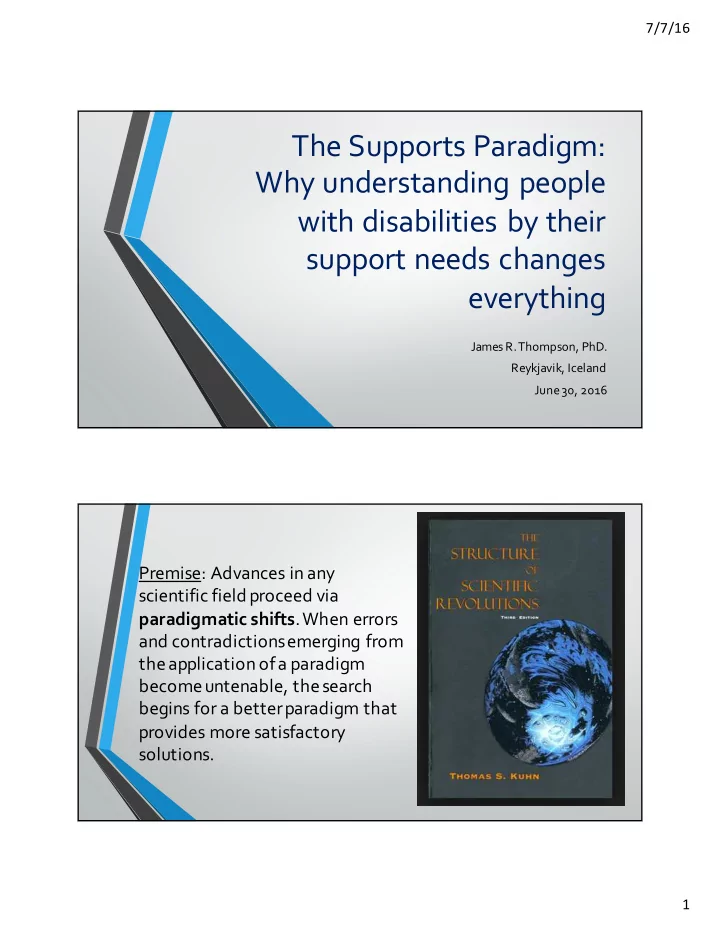
The Supports Paradigm: Why understanding people with disabilities by their support needs changes everything

James R. Thompson, PhD. Reykjavik, Iceland June 30, 2016

Premise: Advances in any scientific field proceed via paradigmatic shifts. When errors and contradictions emerging from the application of a paradigm become untenable, the search begins for a better paradigm that provides more satisfactory solutions.

slide-2
SLIDE 2

7/7/16 2

Paradigmatic Shift: An example

Ptolemaic Astronomy Heliocentric Astronomy

Joshua 10:13 - And the sun stood still, and the moon stayed, until the people had avenged themselves upon their enemies. Is not this written in the book of Jasher? So the sun stood still in the midst of heaven, and hasted not to go down about a whole day.

Paradigms in an applied field … the widely accepted truths, assumptions, and viewpoints that guide people’s work

Describe the paradigm associated with the applied field

  • f human services to people with

developmental disabilities.

slide-3
SLIDE 3

7/7/16 3

Prior Paradigms in services to people with developmental disabilities

  • The Medical-Institutional Paradigm
  • disability is a deficit within the individual, a condition that

prevents functioning or participation in activities (Pledger, 2003)

  • the goal of professional services should be to remove the

pathology (i.e., fix or cure the person) in settings where expertise can be gathered and treatment and care can be most efficiently delivered

  • the interests of people disabilities can be addressed by

consolidating services in hospital type settings and sending people to these settings to receive remediation services

The Medical-Institutional Paradigm

  • Had some successes
  • Disability caused by PKU has been eradicated in much of the world
  • Prenatal Vitamins (Folic acid) significantly reduces the risk of a mother

giving birth to a child with spina bifida

  • The debilitating effects of alcohol on a developing fetus are well known
  • Remains relevant to the work of professionals in the field who are involved

in prevention and medical treatment – but that is a relatively small number

  • Had tragic shortcomings
  • Being understood as a person lacking a desirable trait (i.e., human

intelligence) resulted in people being marginalized and devalued by the larger society

  • Institutions became “hospitals”; people had to earn their way out of the

institution by demonstrating improved competencies – most never did, and spent their lives in segregated settings where few others in society would choose to live

slide-4
SLIDE 4

7/7/16 4

The Normalization-Community Services Paradigm

  • Enter Bengt Nirjeand the Nordic

Countries!

  • “The normalization principle means

making available to the mentally retarded patterns and conditions of everyday life which are as close as possible to the norms and patterns of the mainstream of society” (Nirje, 1969, p. 181).

Some very good questions:

  • Why wouldn’t people with disabilities want the same types of life conditions and

experiences that are valued by the vast majority of others from the general population?

  • Wouldn’t it make sense that denying people access to culturally valued settings and

experiences harms their learning and development, and therefore exacerbates their limitations and problems?

  • Why are people wasting their lives away in institutions, when they could be contributing

members of society? To which the old Medical-Institutional Paradigm did not provide good answers

The Normalization- Community Services Paradigm

Nirje’s (1969) Normalization Guidelines Perske’s (2004) Reflections

  • n Institutional Life

Normalization means a normal rhythm of the day (e.g., getting out of bed and getting dressed in the morning; eating meals and snacks as the day proceeded; having things to do, people to see, and places to go) “The rhythm of the day at the institution where I worked was remarkably

  • abnormal. All of our

residents were dressed and fed before the 7 a.m. shift

  • change. They were in bed by

8:30 in the evening.” Normalization means living in a world with bothsexes (e.g.,

  • pportunities to date, marry,

and engage in intimate and loving relationships) “Periodically, the recreation department scheduled a Saturday night dance, but many staff members were pressed into action, too - watching the residents like hawks.”

Deinstitutionalization (moving people out of and preventing new admission into institutions) - achieved through developing Community-Based Services

slide-5
SLIDE 5

7/7/16 5

The Normalization-Community Services Paradigm

  • Had tremendous successes
  • Institutional populations have been reduced throughout the world
  • People living in community homes on their own or with just a few (5 or less) housemates has

dramatically increased; There are community vocational and recreational services in most communities

  • Overwhelming evidence that people who moved from institutions to community benefited
  • But, shortcomings were noted – the paradigm needed to change!
  • Provider organizations exert much control over people’s lives - people don’t have choices other

than what the provider organization is offering; it is a “system centered” world of community services

  • Many people with disabilities feel socially isolated within their communities; they are physically

included but not socially included

  • People continued to be understood by their deficits - deficits limit opportunities

Personal Competence Personal Competence Influenced by factors such as Health, Intelligence, Adaptive Behavior Skills, Challenging Behavior, & Motivation h Disability is the MISMATCH between personal competency and environmental demands. This mismatch creates extraordinary support needs. Demands of Environment Environmental Demands Influenced by complexities that are inherent to active engagement in community activities and Settings

S U P P O R T S

Some supports improve the competency of the person Some supports improve both the competency of the person a well as the accessibility of the environment Some supports change the demands of settings and activities so that the environment is more accessible

  • A social-ecological

understanding of disability is different than a medical understanding

The Supports Paradigm

  • Is based on a social-

ecological understanding

  • f disability
slide-6
SLIDE 6

7/7/16 6

11

Component 4: Monitor Progress Component 3: Develop the Individualized Support Plan Component 1: Identify desired life experiences and goals Component 2: Determine Support Needs Component 5: Evaluation

AAIDD 12

Planning Supports

Mismatch of competency and demands People with disabilities experience a mismatch between their personal competency and environmental demands Improved personal

  • utcomes

Greater independence, better personal relationships, enhanced

  • pportunities to

contribute to society Individualized Supports Thoughtful planning & application of individualized Supports Creates support needs Results in supports leading to

slide-7
SLIDE 7

7/7/16 7

Meet Beth Meet Beth

slide-8
SLIDE 8

7/7/16 8

Meet Beth

slide-9
SLIDE 9

7/7/16 9

Paradigms in an applied field … the widely accepted truths, assumptions, and viewpoints that guide people’s work

Describe the paradigm associated with the applied field

  • f human services to people with

developmental disabilities. Description of the Supports Paradigm

  • Person-Centered – the needs and aspirations of the

person with the disability and their family members direct the provision of human services and development of personalized supports

  • Focus is on understanding people by their support

needs, and identifying, arranging, and delivering supports

  • Supports are anything that enhances opportunities for

success in settings and activities in which the person is engaged

slide-10
SLIDE 10

7/7/16 10

Description of the Supports Paradigm

  • Supports function to bridge the person-environment gap
  • Assure basic needs are met – food, safety, shelter
  • Promote inclusion, participation, empowerment &

meaningfulness

  • Activate the seabed of dormant possible selves
  • Finding and arranging supports drives the work of the

planning team & professional efforts

  • requires problem solving & prioritizing
  • Is a never-ending quest, not a destination

The Supports Paradigm: Why understanding people with disabilities by their support needs changes everything

James R. Thompson, PhD. Reykjavik, Iceland June 30, 2016