THE STRIKING MOVEMENT: How do percussionists control timing and - - PowerPoint PPT Presentation

the striking movement
SMART_READER_LITE
LIVE PREVIEW

THE STRIKING MOVEMENT: How do percussionists control timing and - - PowerPoint PPT Presentation

Sofia Dahl THE STRIKING MOVEMENT: How do percussionists control timing and dynamic level when drumming? Sofia Dahl sof@imi.aau.dk Stick movements for accented and unaccented drumstrokes Sofia Dahl sof@imi.aau.dk Whole limb motion trajectory


slide-1
SLIDE 1

Sofia Dahl sof@imi.aau.dk
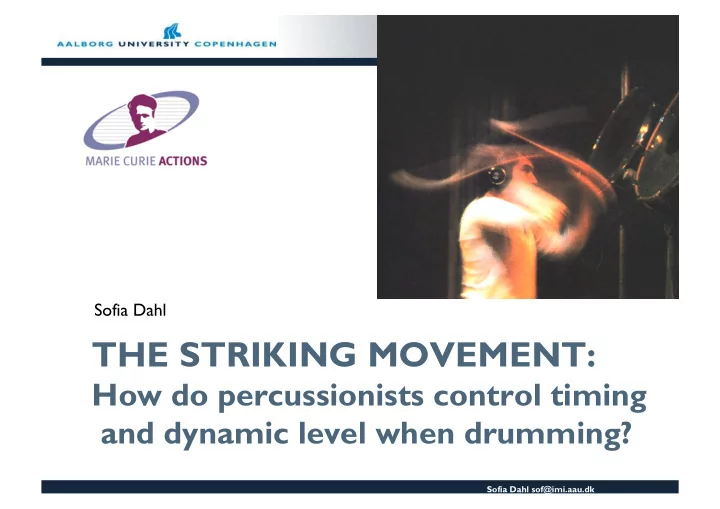
THE STRIKING MOVEMENT:

How do percussionists control timing and dynamic level when drumming?

Sofia Dahl

slide-2
SLIDE 2

Sofia Dahl sof@imi.aau.dk

Stick movements for accented and unaccented drumstrokes

slide-3
SLIDE 3

Sofia Dahl sof@imi.aau.dk

Whole limb motion trajectory

Dahl, 2004

slide-4
SLIDE 4

Sofia Dahl sof@imi.aau.dk

Producing force from acceleration

slide-5
SLIDE 5

Sofia Dahl sof@imi.aau.dk

Dealing with the rebound

  • The rebound from the surface can be incorporated in,

and be an aid for, the preparation for the nextcoming stroke.

  • Necessary in order to play some fast patterns (e.g.

rolls)

  • Strategies like the “Moeller stroke” also utilizes the

rebound

  • Accelerating the stick over a longer runway makes

louder playing possible.

  • ...but if the next stroke is to be softly played the

rebound may need to be controlled

slide-6
SLIDE 6

Sofia Dahl sof@imi.aau.dk

Measuring movement and sound in drumming

audio

motion capture

muscle activity contact force and duration

slide-7
SLIDE 7

Sofia Dahl sof@imi.aau.dk

Motion capture data for a single mf stroke

shoulder elbow wrist knuckle stick

slide-8
SLIDE 8

Sofia Dahl sof@imi.aau.dk

Single, isolated stroke at mf

Dahl et al, 2009

slide-9
SLIDE 9

Sofia Dahl sof@imi.aau.dk

How does controlling the rebound affect the sound?

  • Separated single mf strokes
  • allowed to ring out
  • “Normal”
  • play as normal, relaxed, stick free to rebound
  • “Controlled”
  • stop stick as close as possible to the drumhead directly after stroke
slide-10
SLIDE 10

Sofia Dahl sof@imi.aau.dk

“Normal” and “Controlled” strokes

controlled normal

stick knuckle wrist

Dahl & Altenmüller, 2008

slide-11
SLIDE 11

Sofia Dahl sof@imi.aau.dk

Vertical displacement of stick marker

controlled normal

Dahl & Altenmüller, 2008

slide-12
SLIDE 12

Sofia Dahl sof@imi.aau.dk

Contact force and duration

Dahl & Altenmüller, 2008

slide-13
SLIDE 13

Sofia Dahl sof@imi.aau.dk

Hz

Spectral centroid (considering 16-1000 Hz)‏

Dahl & Altenmüller, 2008

slide-14
SLIDE 14

Sofia Dahl sof@imi.aau.dk

Ratings for timbre and attack: results

full hard soft flat

slide-15
SLIDE 15

Sofia Dahl sof@imi.aau.dk

An “appropriate” strategy?

Player 1 Player 2

slide-16
SLIDE 16

Sofia Dahl sof@imi.aau.dk

Musicians’ focal dystonia

Defined as (painless) loss of voluntary motor control in highly trained movements (e.g. curling in/ over

  • extension of fingers).

Neurological disorder Task-specific

(Altenmüller, Hand Clin., 2003)

slide-17
SLIDE 17

Sofia Dahl sof@imi.aau.dk

General movement patterns: healthy player

Part1: Left, 120 bpm, mf

slide-18
SLIDE 18

Sofia Dahl sof@imi.aau.dk

General movement patterns: dystonic patient

Pat5: Left, 120 bpm, mf

slide-19
SLIDE 19

Sofia Dahl sof@imi.aau.dk

Comparing left and right – phase plots

dystonic 50 bpm mf healthy 50 bpm mf

vertical velocity (m/s) vertical velocity (m/s) Vertical displacement (mm)

slide-20
SLIDE 20

Sofia Dahl sof@imi.aau.dk

Comparing left and right – phase plots

dystonic 120 bpm mf healthy 120 bpm mf

vertical velocity (m/s) vertical velocity (m/s) Vertical displacement (mm)

slide-21
SLIDE 21

Sofia Dahl sof@imi.aau.dk

dystonic 300 bpm mf healthy 300 bpm mf

Comparing left and right – phase plots

vertical velocity (m/s) vertical velocity (m/s) Vertical displacement (mm)

slide-22
SLIDE 22

Sofia Dahl sof@imi.aau.dk

dystonic 300 bpm mf healthy 300 bpm mf

Comparing left and right – phase plots

slide-23
SLIDE 23

Sofia Dahl sof@imi.aau.dk

IOI (ms) patient 1

Comparing left – right

(120 and 300 bpm )

slide-24
SLIDE 24

Sofia Dahl sof@imi.aau.dk

Patient 1, left arm, f, 300 bpm

front view top view

slide-25
SLIDE 25

Sofia Dahl sof@imi.aau.dk

Learning to play

Playing for fun Drop out professional Professional beginner

slide-26
SLIDE 26

Sofia Dahl sof@imi.aau.dk

Acknowledgements

Project funded by European Commission Collaborators Eckart Altenmüller, Michael Grossbach, and colleagues at Institute for Musicians’ Physiology and Musicians’ medicine, Hanover Thanks to all our participants playing and participating in the listening tests.