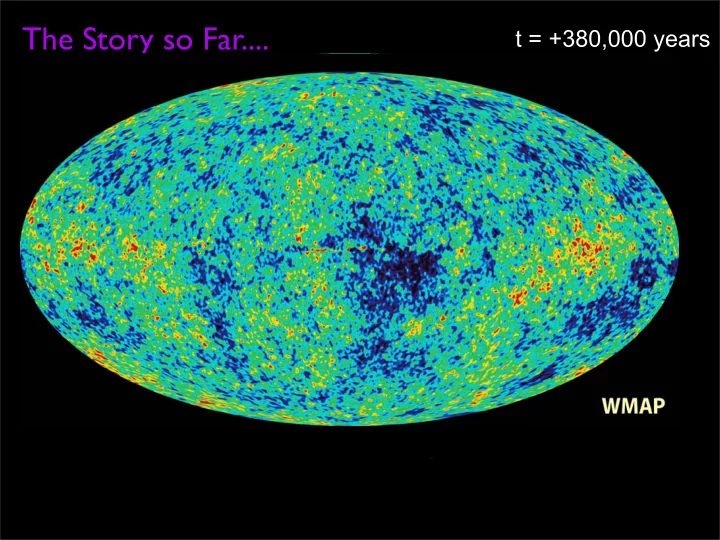
SLIDE 1
1964
The Story so Far....
t = +380,000 years
SLIDE 2
1964 WMAP
The Story so Far....
t = +600 million years
?
udfy-38135539 z=8.6 Galaxy Detected!
SLIDE 3
1964 WMAP
The Story so Far....
t = ~1 billion years Large Scale Structure
?
SLIDE 4
1964 WMAP
The Story so Far....
t = +13.73 billion years
?
SLIDE 5 1964 WMAP
The Story so Far....
t = +13.73 billion years
?
SLIDE 6 1964
The Story so Far....
Structure in Early Universe:
- Matter concentrated (WMAP)
- Formed protogalactic clouds
- Clouds collapsed & fragmented
to form stars & galaxies
STARS are the basic units
- f structure in the Universe!!
SLIDE 7
Galactic Recycling
ALL HEAVY ELEMENTS ARE FORMED DEEP INSIDE STARS!
SLIDE 8
Star Formation:
The Great Battle Between....
GRAVITY PRESSURE
SLIDE 9
GRAVITY
(Newton’s Law of Gravity)
SLIDE 10
PRESSURE
Thermal Pressure: Depends on Density and Temperature Temperature: Measures AVERAGE Kinetic Energy of Particles Thermal Energy: Kinetic Energy of Particles
SLIDE 11
The Interstellar Medium (ISM)
Current Composition: 70% H, 28% He, 2% Heavy Elements Stars form in DENSE regions of the ISM.... Gas (99%) and dust (1%) in between stars
SLIDE 12
The Interstellar Medium (ISM)
Gas (99%) and dust (1%) in between stars Early Composition: 75% H, 25% He, 0% Heavy Elements Stars form in DENSE regions of the ISM....
SLIDE 13 GMCs are dense RELATIVE to ISM GIANT MOLECULAR CLOUDS (GMCs) Large, Dense, & Cold regions of ISM
ISM: 1 atom/cc GMC: 100-1000 atoms/cc (Air: 30 billion billion molecules/cc)
Made of Molecular Gas & Dust
SLIDE 14
GIANT MOLECULAR CLOUDS (GMCs) Large, Dense, & Cold regions of ISM
GMCs are the LARGEST structures in Galaxy
0.1-10 million solar masses
Why so big???
SLIDE 15 GRAVITY
- Cloud Core Collapses due to GRAVITY
Density Gas Particle Energies Temperature
SLIDE 16 GRAVITY PRESSURE
- Stellar Nucleosynthesis, Phase 1: H-Burning
- (H into He, MAIN SEQUENCE)
- Generates Energy & Provides Pressure!
FUSION!!
SLIDE 17 Fusion in Stars
- Only process capable of producing required energies
to hold up the star against gravity!
Mass of 4 H Atoms = 6.693 × 10⁻²⁷ kg Mass of 1 He Atom = 6.645 × 10⁻²⁷ kg Difference = 0.048 × 10⁻²⁷ kg
Mass “lost” (0.7%) is converted to Energy!
Lighter Nuclei combine to produce Heavier Nuclei:
How much energy?
Annual output of Sun = Annual energy used by Vegas every second since the Big Bang!
SLIDE 18 STAR IS NOW STABLE -- Hydrostatic Equilibrium
gravity & pressure
GRAVITY PRESSURE
SLIDE 19
The Sun is a Mass of Incandescent Gas...
Incandescence: Heat-driven light emission... ...random energies for particle collisions leads to CONTINUOUS SPECTRUM
SLIDE 20 Solar Structure - 4 (+) parts
- 1. Core
- 2. Radiative Zone
- 3. Convection Zone
- 4. Photosphere
Outer layers (Atmosphere)
Radiative zone T~2-7 Million Convection zone T~1 Million K and less Photosphere+
Keep spectra in mind - Continuous, Absorption, Emission
T=13.6 Million K
SLIDE 21
The Sun is HOT...
(The Sun Is So Hot That Everything On It Is A Gas)
The Sun is a Mass of Incandescent Gas...
PLASMA - ions & free electrons miasma of plasma!!
X X
core is 13,600,000 K
SLIDE 22
Solar Structure - CORE
...a Gigantic Nuclear Furnace
(where Hydrogen Is Built Into Helium at a Temperature Of Millions Of Degrees)
Energy is Generated in the CORE
4 H He
The Proton-Proton Chain core is > 10,000,000 K
9.2 x 1037
reactions per second!
SLIDE 23 Mass of 4 H Atoms = 6.693 × 10⁻²⁴ g Mass of 1 He Atom = 6.645 × 10⁻²⁴ g Difference = 0.048 × 10⁻²⁴ g
Mass “lost” (0.7%) is converted to Energy!
Albert Einstein 1905
(you don’t need to know numbers, just the idea below)
...a Gigantic Nuclear Furnace
(where Hydrogen Is Built Into Helium at a Temperature Of Millions Of Degrees)
Solar Structure - CORE
E = m c 2
A little mass yields A LOT of energy:
1 gram of matter ⇒ 1014 Joules (J) of energy (powers a 100 Watt light bulb for ~32,000 years!)
Sun: 90 billion Megatons TNT/second !!
9.2 x 1037 reactions per second!
SLIDE 24 ENERGY TRANSPORT BY RADIATION
⇒ions & free electrons ⇒ photons carry energy, interacting on the way out
Radiative zone T~2-7 Million Convection zone T~1 Million K and less
t ~ 1 million Years! “RANDOM WALK”
T=13.6 Million K
Solar Structure - Radiative Zone
SLIDE 25 Radiative zone T~2-7 Million Convection zone T~1 Million K and less
COOLER than Radiative Zone
⇒ electrons bound ⇒ photons absorbed (heat the gas) ⇒ “bubbles” carry energy
T=13.6 Million K
Solar Structure - Convection Zone
SLIDE 26 Radiative zone T~2-7 Million Convection zone T~1 Million K and less
Photosphere: Visible “Surface” of the Sun MUCH COOLER
Teff ~ 5800 K (Effective Temperature)
T=13.6 Million K
BASE: CONTINUOUS SPECTRUM
SLIDE 27
Sun is a Typical Main Sequence G Star
Sun: G2 V T(surface) = 5800K (yellow) L = 3.85 x 1026 W H-R Diagram: Luminosity vs. Temperature for all stars