
SLIDE 1
Presentation to:
The Standing Committee
- n Communities, Land and
Environment
by:
The Standing Committee on Communities, Land and Environment by: - - PDF document
Presentation to: The Standing Committee on Communities, Land and Environment by: The Federation of Prince Edward Island Municipalities November 8, 2016 On behalf of the Federation of Prince Edward Island Municipalities, thank you for
by:
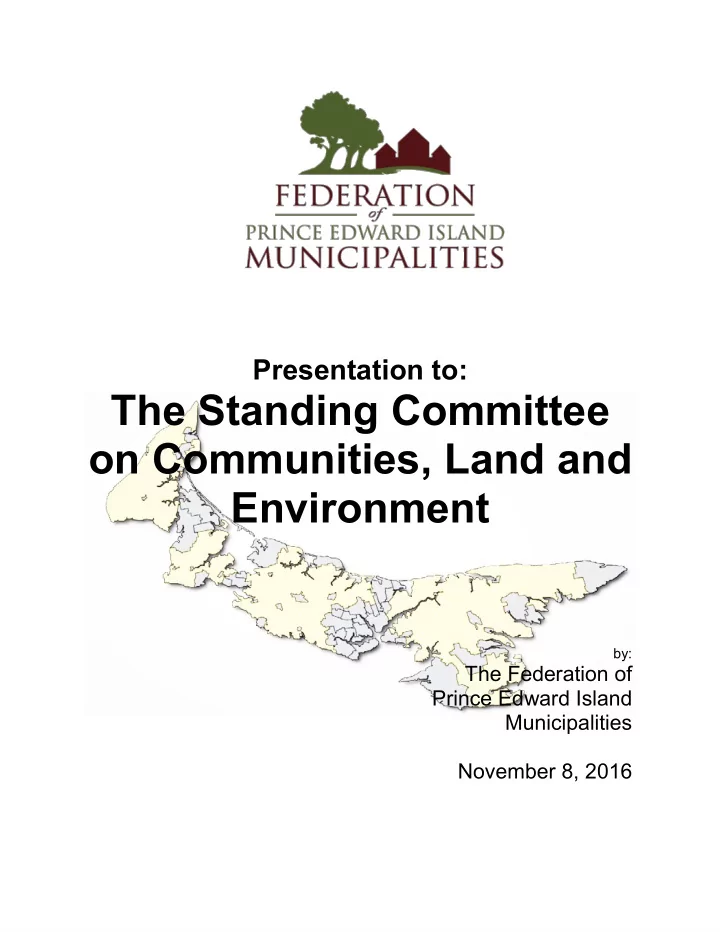
1 On behalf of the Federation of Prince Edward Island Municipalities, thank you for initiating a dialogue on annexation and amalgamation and for inviting the Federation to present its views on this important topic. In Canada, and in developed countries around the world, it is increasingly understood that there is an important link between the strength of local governments, and regional and national prosperity. Citizens rely on municipalities to deliver local services that make cities, towns and communities attractive places to live, work and play. Through long-term comprehensive planning, modern infrastructure and amenities, and the delivery of a broad range of services, municipal governments play a fundamental role in creating conditions for economic growth. Unfortunately, Prince Edward Island cannot reach its potential without transformative changes to address outdated municipal boundaries. Municipal leaders have known this for a long time and, through the Federation, have been calling for change. The announcement by the provincial government, in 2008, that a Commissioner on Land and Local Governance would be appointed was welcomed by municipal leaders across the province and created optimism that municipalities had reached an important turning point. At the FPEIM semi- annual meeting that year, the Federation organized round-table discussions and asked each group the following question: “If you were appointed Commissioner on Land and Local Governance what would you recommend?" There was an overwhelming response recommending Island-wide municipal incorporation. Prince Edward Island is the most densely populated province in the country, yet municipalities only cover 30 percent of its area. There are 73 municipalities which are shown in grey on the above
2
percent of the provincial population. The remaining thirty percent of Islanders live in unincorporated areas. The 69 predominantly rural municipalities have a combined population of fewer than 35,000
The boundaries of several municipalities are based on old school districts that were created in the 1800s at a time when children would have to walk to school. It is not surprising that one-third of Island municipalities are smaller than five square kilometres, including seven of the 10 towns. Municipal boundaries have not grown over time, and no longer reflect the service area. Limited capacity prevents many rural municipalities from providing services that are often taken for granted elsewhere. In 2014, twenty-eight rural municipalities had budgeted expenditures of less than $50,000. Many municipalities do not have bylaws, emergency preparedness plans, recreational programs, land use plans or regular office hours; in fact, many do not have a municipal
Island have fallen well behind those in other Canadian jurisdictions and the gap is growing. In other parts of Canada, unincorporated area tends to be vast uninhabited or sparsely populated areas where it would not be practical or feasible to establish a municipality. Very few Canadians live in areas that are not within a local and/or regional municipality, except in PEI, where municipal boundaries are stuck in a bygone era. As Land and Local Governance Commissioner Ralph Thompson explained in his report: “What has emerged is a system that is almost unique in Canada . . . the provincial government acts as the local government in unincorporated areas. Where local governments do exist, because of small populations and tax bases, they are often ill-equipped to make or administer land use plans, or to
Changing municipal boundaries to cover all areas of the province is vital to the viability of municipal governments in rural areas and to the future success of Prince Edward Island as a whole. Many rural municipalities are poorly positioned to address a growing list of challenges, including rural depopulation, an ageing population, climate change, a declining base of volunteers, higher public expectations, and increasing standards.
1 Government of Prince Edward Island, New Foundations – Report of the Commission on Land and Local Governance, December
2009, page 2.
What has emerged is a system that is almost unique in Canada . . . the provincial government acts as the local government in unincorporated
exist, because of small populations and tax bases, they are often ill- equipped to make or administer land use plans, or to offer their residents a reasonable level of services. - New
Foundations – Report of the Commission on Land and Local Governance
3 As a small province that depends heavily on the land, province-wide municipal land use planning is extremely important. Fortunately, Commissioner Thompson made several recommendations to improve land use planning. The Commissioner’s recommendations led to the appointment of the Task Force on Land Use Policy, which provided more detailed policy direction. The Report of the Task Force also drew attention to another challenge created by the absence of province-wide municipal coverage. The report stated: “In an ideal system, planning should be managed at the local municipal level. Since Prince Edward Island does not have full municipal coverage, a system of land use planning administration is needed for areas without a municipal official plan.”2 The Federation is optimistic that a modern planning framework is on the horizon. As the province continues its work to modernize land use planning, it needs to recognize that province-wide municipal incorporation is essential for successful implementation. The 32 municipalities that have adopted an official plan and bylaws are shown in red on the above
under provincial responsibility, but the provincial subdivision and development requirements are
2 Government of Prince Edward Island, Report of the Task Force and Land Use Policy, January 2014, page 35.
In an ideal system, planning should be managed at the local municipal level. Since Prince Edward Island does not have full municipal coverage, a system
needed for areas without a municipal
Land Use Policy
4
that could decrease the value of their largest investment. The above map depicts development across the province. The red on the map represents developed land. Although the map does not display roads, they are easily identified due to the ribbon development that has been permitted to occur. Sprawl is a clearly a serious problem. Rural sprawl is partly fueled by an inequitable provincial property tax system that results in lower property taxes on properties situated in unincorporated areas. Sprawl is expensive. When homes and businesses are spread out it is more expensive to provide services such as building and maintaining roads, transporting children to school, collecting garbage, and installing and operating water and wastewater systems, to name a few. Instead of using land use planning as a tool to control costs, Islanders are often sharing the burden of higher servicing costs due to sprawl. Islanders cannot afford to allow haphazard development to drive up costs and threaten the quality and availability of services that are vital to rural areas. Sprawl is consuming agricultural and other resource land, and increasing land use conflicts. Our lack of planning compromises fragile areas, is harmful to the environment, does not preserve green spaces for public benefit, and makes watershed protection measures more difficult to implement. The Island is losing wildlife habitat, and ribbon development is altering the landscape. Agriculture
5 and tourism are vital to Prince Edward Island. The absence of land use planning in much of rural Prince Edward Island undermines these industries. Inadequate planning in much of the province has created car dependent communities where residences are further from workplaces, shopping, and services. Modern land use planning reduces greenhouse gas emissions. Prince Edward Island will be impacted by the changing climate. Municipal land use plans covering the entire province must be used as an effective tool to help us plan for and adapt to the negative impacts of climate change, including damage to public infrastructure and private property. Unfortunately, permits continue to be issued for construction in areas that are vulnerable to sea level rise and storm surges. The sprawl occurring outside municipal boundaries goes against modern planning principles, and impedes efforts to strengthen the rural economy. As Commissioner Ralph Thompson said in his report: “Our land, our water, our natural areas, our viewscapes, and our architectural heritage, both inside and outside municipalities will not look after
know them, forever.”3 The map to the right provides a close-up view of what sprawl looks like in the O'Leary area. The Town of O’Leary is the area outlined in black. It is easy to see the ribbon development along the roads
the boundaries of the Town.
3 Government of Prince Edward Island, New Foundations – Report of the Commission on Land and Local Governance, December
2009, page 1.
Our land, our water, our natural areas,
viewscapes, and
architectural heritage, both inside and
after themselves. If we do not provide responsible stewardship now, we run the risk of losing them as we know them, forever. - New Foundations – Report
Governance
6 This photo provides an aerial view
the ribbon development between O'Leary and West Cape. The Government of Prince Edward Island has been well aware of problems related to land use and municipal boundaries for a very long time. Reports dating back to the 1970s have made recommendations related to land and local governance. Many of the problems identified in these reports are getting worse. As the document Land Use and Development in Prince Edward Island: Issues, Choices, and Policy, states: "By slow incremental steps, the land is being transformed in a way which will eventually undo its ability to support us collectively."4 A brighter future for rural areas depends on strong municipalities. Major changes are needed to build the critical mass of existing towns and communities by encouraging planned growth. All areas
The population of many rural towns and former villages has been declining or stagnant. Those municipalities act as service centres for rural areas. If this trend continues, as it is expected to, there will be fewer people in those small municipalities to pay for services and amenities that benefit a much larger area. This is not sustainable. The need to change municipal boundaries has been well documented, but public resistance, or perceived resistance, has stalled progress for decades. Fear of losing community identity is often cited as a reason for maintaining the present system. The Federation is convinced that creating larger municipalities would strengthen individual
Nova Scotia, there are 51 municipalities covering the entire province. Many commonly recognized community names in Nova Scotia are part of a large municipality made up of several communities. Resistance also arises in relation to property taxes. The provincial property tax rate within municipalities is the same as the rate in unincorporated areas, but by building outside a municipality, property owners avoid municipal taxes. This negatively impacts services in rural areas and makes municipalities more costly places to live and do business.
4 Government of Prince Edward Island, Land Use Development in Prince Edward Island: Issues, Choices, and Policy, July 1991,
pages 9-10.
7 In 1991, the Municipal Study Report highlighted the inequity of charging the same property tax to ratepayers in unincorporated areas, noting that they are provided with the necessary local services by the province, while ratepayers in municipalities must pay for some or all of those same services through municipal property taxes.5 The report went on to say “Not only should there not be any property tax advantage for settlement in an unincorporated area, but there should be definite tax disadvantages.” 6 From time to time, individuals have suggested that the residents of unincorporated areas pay their fair share through user fees. That argument fails to recognize that, in addition to any user fees,
residents of the municipality, as well as those living in unincorporated areas. Expanding boundaries into areas that are not incorporated would increase municipal viability and lead to a more equitable sharing of the cost of local services. As boundaries change, tiered tax rates can be applied to different areas within a municipality, based
currently unincorporated areas. It is also important to note that there have been indirect costs to Islanders as a result of outdated municipal boundaries. As mentioned, sprawl has resulted in higher infrastructure and servicing
addition, our failure to concentrate much of the development in rural areas around service centres has undermined rural economic development and job creation. Prince Edward Island will benefit in many ways from healthy, vibrant municipal governments throughout the province. Stronger municipal governments can foster economic development, curb youth out- migration, retain and attract medical and
municipality must have the capacity to develop and work toward a collective long-term vision for their community, based on economic, environmental, social and cultural needs and priorities. Island-wide incorporation would address the democratic deficit in unincorporated areas by providing new opportunities for citizen engagement and local decision-making. It would also generate a larger pool of candidates for elections. In many municipalities, residents of areas that are presently not incorporated would hold the majority of seats on council through a ward system. As Commissioner Ralph Thompson said in his report on land and local governance: “We cannot maintain the status quo in a world that is changing all around us.”7
5 Smith Green & Associates, in association with ARA Consulting Group and Kell Antoft, Municipal Study Report, May 1991,
Successive provincial
pages 60-61.
6 Ibid, page 60. 7 Government of Prince Edward Island, New Foundations – Report of the Commission on Land and Local Governance, December
2009, page 83.
We cannot maintain the status quo in a world that is changing all around us.
Foundations – Report
the Commission on Land and Local Governance
8 governments have tried to do just that – maintain the status quo. The outdated municipal structure in PEI really has been an elephant in the room. Instead of addressing the problem, provincial governments avoided it, and often looked for alternative ways of delivering local services instead of addressing the need for province-wide incorporation. This problem cannot be attributed to any one government or any one political party. It is a problem that has evolved over many decades and now all parties need to work together to fix it. Commissioner Thompson concluded that larger self-sustaining municipalities are achievable across the province. He reported that a sufficient tax base and population are key requirements for a municipality to be viable and referred to minimum thresholds of 4,000 residents and an assessed value of $200 million. Today, only four municipalities meet those requirements. Some people might argue that rural Prince Edward Island cannot afford larger municipalities covering areas that are presently not incorporated. The Federation is convinced that the opposite is
municipal governments. Stronger municipal governments will strengthen rural Prince Edward Island, and the province as a whole. Creating larger municipalities that reflect the community of interest would increase capacity to develop and implement long-term plans that reflect local needs and priorities. Municipalities can play a meaningful role in rural economic and social development, but major changes are required. As those changes occur, Prince Edward Island municipalities will be better positioned to take advantage of opportunities as they emerge, and prepare for future challenges through strategic decision-making. Expanding boundaries to take in unincorporated areas will not resolve all the issues in rural Prince Edward Island or eliminate all the problems that are undermining municipal governments, but it definitely is an essential part of the solution. The time has come to embrace a move to Island-wide municipal incorporation. We cannot change the past, but we can build strong municipalities to help shape a better future. As Commissioner Ralph Thompson said, “the best time to plant a tree was 20 years ago. The next best time is now.” Thank you The best time to plant a tree was 20 years ago. The next best time is now.
Land and Local Governance