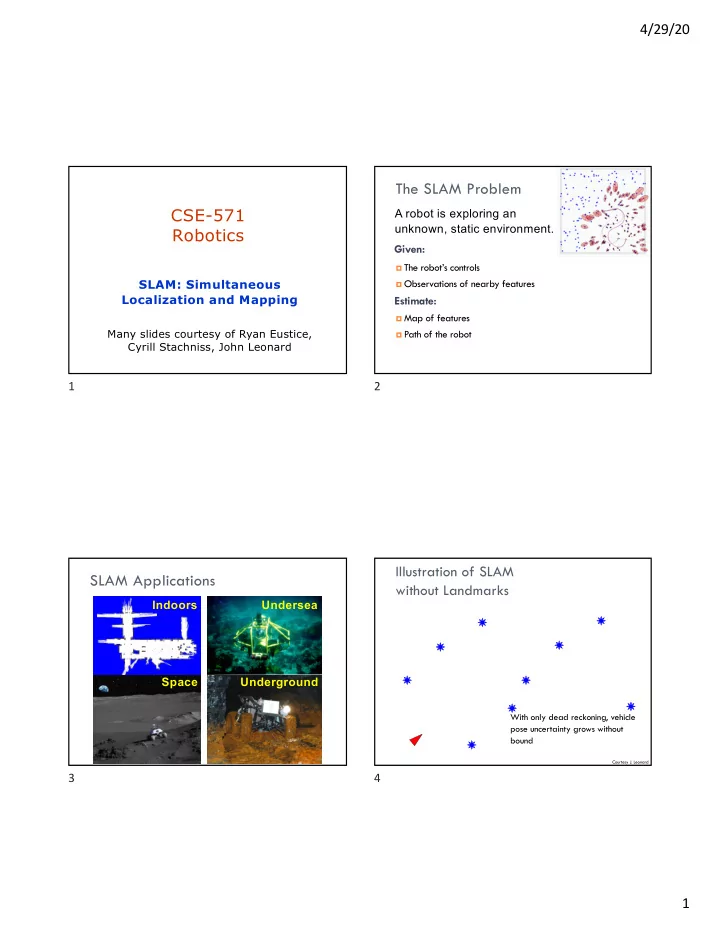
The SLAM Problem CSE-571 2 A robot is exploring an unknown, - - PDF document

the slam problem
SMART_READER_LITE
LIVE PREVIEW

The SLAM Problem CSE-571 2 A robot is exploring an unknown, - - PDF document

4/29/20 The SLAM Problem CSE-571 2 A robot is exploring an unknown, static environment. Robotics Given: The robots controls SLAM: Simultaneous Observations of nearby features Localization and Mapping Estimate: Map of features


slide-1
SLIDE 1

4/29/20 1

CSE-571 Robotics

SLAM: Simultaneous Localization and Mapping

Many slides courtesy of Ryan Eustice, Cyrill Stachniss, John Leonard

1

2

Given:

¤ The robot’s controls ¤ Observations of nearby features

Estimate:

¤ Map of features ¤ Path of the robot

The SLAM Problem

A robot is exploring an unknown, static environment.

2

3

SLAM Applications

Indoors Space Undersea Underground

3

Illustration of SLAM without Landmarks

Courtesy J. Leonard

With only dead reckoning, vehicle pose uncertainty grows without bound

4

slide-2
SLIDE 2

4/29/20 2 Illustration of SLAM without Landmarks

With only dead reckoning, vehicle pose uncertainty grows without bound

Courtesy J. Leonard

5

Illustration of SLAM without Landmarks

With only dead reckoning, vehicle pose uncertainty grows without bound

Courtesy J. Leonard

6

Illustration of SLAM without Landmarks

With only dead reckoning, vehicle pose uncertainty grows without bound

Courtesy J. Leonard

7

Illustration of SLAM without Landmarks

With only dead reckoning, vehicle pose uncertainty grows without bound

Courtesy J. Leonard

8

slide-3
SLIDE 3

4/29/20 3 Illustration of SLAM without Landmarks

With only dead reckoning, vehicle pose uncertainty grows without bound

Courtesy J. Leonard

9

Mapping with Raw Odometry

10

Repeat, with Measurements of Landmarks

¨ First position: two features observed

Courtesy J. Leonard

11

Illustration of SLAM with Landmarks

¨ Second position: two new features

  • bserved

Courtesy J. Leonard

12

slide-4
SLIDE 4

4/29/20 4

Illustration of SLAM with Landmarks

¨ Re-observation of first two features

results in improved estimates for both vehicle and feature

Courtesy J. Leonard

13

Illustration of SLAM with Landmarks

¨ Third position: two additional

features added to map

Courtesy J. Leonard

14

Illustration of SLAM with Landmarks

¨ Re-observation of first four features

results in improved location estimates for vehicle and all features

Courtesy J. Leonard

15

Illustration of SLAM with Landmarks

¨ Process continues as the vehicle moves

through the environment

Courtesy J. Leonard

16

slide-5
SLIDE 5

4/29/20 5

SLAM Using Landmarks

MIT Indoor Track

Courtesy J. Leonard

17

Test Environment (Point Landmarks)

Courtesy J. Leonard

18

View from Vehicle

Courtesy J. Leonard

19

  • 1. Move
  • 2. Sense
  • 3. Associate measurements with known features
  • 4. Update state estimates for robot and previously mapped features
  • 5. Find new features from unassociated measurements
  • 6. Initialize new features
  • 7. Repeat

SLAM Using Landmarks

MIT Indoor Track

20

slide-6
SLIDE 6

4/29/20 6 Comparison with Ground Truth

  • dometry

Courtesy J. Leonard

SLAM result

21

Simultaneous Localization and Mapping (SLAM)

¨ Building a map and locating the robot in the map at

the same time

¨ Chicken-and-egg problem map localize

Courtesy: Cyrill Stachniss

22

Definition of the SLAM Problem

Given

¤ The robot’s controls ¤ Observations

Wanted

¤ Map of the environment ¤ Path of the robot

Courtesy: Cyrill Stachniss

23

Three Main Paradigms

Kalman filter Particle filter Graph- based

Courtesy: Cyrill Stachniss

24

slide-7
SLIDE 7

4/29/20 7

Bayes Filter

¨ Recursive filter with prediction and correction step ¨ Prediction ¨ Correction

Courtesy: Cyrill Stachniss

25

EKF for Online SLAM

¨ We consider here the Kalman filter as a solution to

the online SLAM problem

Courtesy: Thrun, Burgard, Fox

26

EKF SLAM

¨ Application of the EKF to SLAM ¨ Estimate robot’s pose and locations of landmarks in

the environment

¨ Assumption: known correspondences ¨ State space (for the 2D plane) is

Courtesy: Cyrill Stachniss

27

EKF SLAM: State Representation

¨ Map with n landmarks: (3+2n)-dimensional

Gaussian

¨ Belief is represented by

Courtesy: Cyrill Stachniss

28

slide-8
SLIDE 8

4/29/20 8

EKF SLAM: State Representation

¨ More compactly

Courtesy: Cyrill Stachniss

29

EKF SLAM: State Representation

¨ Even more compactly (note: )

Courtesy: Cyrill Stachniss

30

EKF SLAM: Filter Cycle

  • 1. State prediction
  • 2. Measurement prediction
  • 3. Measurement
  • 4. Data association
  • 5. Update

Courtesy: Cyrill Stachniss

31

EKF SLAM: State Prediction

Courtesy: Cyrill Stachniss

32

slide-9
SLIDE 9

4/29/20 9 EKF SLAM: Measurement Prediction

Courtesy: Cyrill Stachniss

33

EKF SLAM: Obtained Measurement

Courtesy: Cyrill Stachniss

34

EKF SLAM: Data Association and Difference Between h(x) and z

Courtesy: Cyrill Stachniss

35

EKF SLAM: Update Step

Courtesy: Cyrill Stachniss

36

slide-10
SLIDE 10

4/29/20 10

EKF SLAM: Concrete Example

Setup

¨ Robot moves in the 2D plane ¨ Velocity-based motion model ¨ Robot observes point landmarks ¨ Range-bearing sensor ¨ Known data association ¨ Known number of landmarks

Courtesy: Cyrill Stachniss

37

Initialization

¨ Robot starts in its own reference frame (all

landmarks unknown)

¨ 2N+3 dimensions

Courtesy: Cyrill Stachniss

38

Extended Kalman Filter Algorithm

Courtesy: Cyrill Stachniss

39

Prediction Step (Motion)

¨ Goal: Update state space based on the robot’s

motion

¨ Robot motion in the plane ¨ How to map that to the 2N+3 dim space?

Courtesy: Cyrill Stachniss

40

slide-11
SLIDE 11

4/29/20 11

Update the State Space

¨ From the motion in the plane ¨ to the 2N+3 dimensional space

Courtesy: Cyrill Stachniss

41

Extended Kalman Filter Algorithm

DONE

Courtesy: Cyrill Stachniss

42

Update Covariance

¨ The function only affects the robot’s motion and not

the landmarks

Jacobian of the motion (3x3) Identity (2N x 2N)

Courtesy: Cyrill Stachniss

43

This Leads to the Time Propagation

Apply & DONE

Courtesy: Cyrill Stachniss

48

slide-12
SLIDE 12

4/29/20 12

Extended Kalman Filter Algorithm

DONE DONE

Courtesy: Cyrill Stachniss

51

EKF SLAM: Correction Step

¨ Known data association ¨

: i-th measurement at time t observes the landmark with index j

¨ Initialize landmark if unobserved ¨ Compute the expected observation ¨ Compute the Jacobian of ¨ Proceed with computing the Kalman gain

Courtesy: Cyrill Stachniss

52

Range-Bearing Observation

¨ Range-Bearing observation ¨ If landmark has not been observed

  • bserved

location of landmark j estimated robot’s location relative measurement

Courtesy: Cyrill Stachniss

53

Jacobian for the Observation

¨ Based on ¨ Compute the Jacobian

Courtesy: Cyrill Stachniss

58

slide-13
SLIDE 13

4/29/20 13

Jacobian for the Observation

¨ Use the computed Jacobian ¨ map it to the high dimensional space

Courtesy: Cyrill Stachniss

59

Next Steps as Specified…

DONE DONE

Courtesy: Cyrill Stachniss

61

Extended Kalman Filter Algorithm

DONE DONE Apply & DONE Apply & DONE Apply & DONE

Courtesy: Cyrill Stachniss

62

EKF SLAM – Correction (1/2)

Courtesy: Cyrill Stachniss

63

slide-14
SLIDE 14

4/29/20 14 EKF SLAM – Correction (2/2)

Courtesy: Cyrill Stachniss

64

EKF SLAM Complexity

¨ Cubic complexity depends only on the measurement

dimensionality

¨ Cost per step: dominated by the number of

landmarks:

¨ Memory consumption: ¨ The EKF becomes computationally intractable for

large maps!

Courtesy: Cyrill Stachniss

65

Online SLAM Example

69

69

EKF SLAM Correlations

¨ In the limit, the landmark estimates

become fully correlated

Courtesy: Dissanayake

70

slide-15
SLIDE 15

4/29/20 15

71

EKF SLAM Correlations

¨ Approximate the SLAM posterior with a high-dimensional

Gaussian [Smith & Cheesman, 1986] …

¨ Single hypothesis data association Blue path = true path Red path = estimated path Black path = odometry

Courtesy: M. Montemerlo

71

72

Data Association in SLAM

¨ In the real world, the mapping between observations and

landmarks is unknown

¨ Picking wrong data associations can have catastrophic

consequences

¤ EKF SLAM is brittle in this regard ¨ Pose error correlates data associations

Robot pose uncertainty

72

Loop-Closing

¨ Loop-closing means recognizing an already

mapped area

¨ Data association under ¤ high ambiguity ¤ possible environment symmetries ¨ Uncertainties collapse after a loop-closure (whether

the closure was correct or not)

Courtesy: Cyrill Stachniss

73

Before the Loop-Closure

Courtesy: K. Arras

74

slide-16
SLIDE 16

4/29/20 16

After the Loop-Closure

Courtesy: K. Arras

75

Example: Victoria Park Dataset

Courtesy: E. Nebot

76

Victoria Park: Data Acquisition

Courtesy: E. Nebot

77

78

Victoria Park: EKF Estimate

Courtesy: E. Nebot

78

slide-17
SLIDE 17

4/29/20 17 Victoria Park: EKF Estimate

Courtesy: E. Nebot

79

Victoria Park: Landmarks

Courtesy: E. Nebot

80

81

Victoria Park: Landmark Covariance

Courtesy: E. Nebot

81

Andrew Davison: MonoSLAM

82

slide-18
SLIDE 18

4/29/20 18 Sub-maps for EKF SLAM

[Leonard et al 1998]

83

84

EKF SLAM Summary

¨ Quadratic in the number of landmarks: O(n2) ¨ Convergence results for the linear case. ¨ Can diverge if nonlinearities are large! ¨ Have been applied successfully in large-scale

environments.

¨ Approximations reduce the computational complexity.

84

Literature

EKF SLAM

¨ “Probabilistic Robotics”, Chapter 10 ¨ Smith, Self, & Cheeseman: “Estimating Uncertain

Spatial Relationships in Robotics”

¨ Dissanayake et al.: “A Solution to the Simultaneous

Localization and Map Building (SLAM) Problem”

¨ Durrant-Whyte & Bailey: “SLAM Part 1” and “SLAM

Part 2” tutorials

Courtesy: Cyrill Stachniss

85

Graph-SLAM

  • Full SLAM technique
  • Generates probabilistic links
  • Computes map only occasionally
  • Based on Information Filter form

86

slide-19
SLIDE 19

4/29/20 19

Graph-SLAM Idea

87

Information Form

  • Represent posterior in canonical form
  • One-to-one transform between

canonical and moment representation n vector Informatio matrix n Informatio

1 1

µ x

  • S

= S = W

1 1

x µ

  • W

= W = S

88

Information vs. Moment Form

Correlation matrix Information matrix

89

Graph-SLAM Idea (1)

90

slide-20
SLIDE 20

4/29/20 20

Graph-SLAM Idea (2)

91

Graph-SLAM Idea (3)

92

Graph-SLAM Inference (1)

93

Graph-SLAM Inference (2)

94

slide-21
SLIDE 21

4/29/20 21

Graph-SLAM Inference (3)

95

Mine Mapping

96

Mine Mapping: Data Associations

97

Efficient Map Recovery

  • Information matrix inversion can be

avoided if only best map estimate is required

  • Minimize constraint function JGraphSLAM

using standard optimization techniques (gradient descent, Levenberg

Marquardt, conjugate gradient)

98

slide-22
SLIDE 22

4/29/20 22

Robot Poses and Scans [Lu and Milios

1997]

  • Successive robot poses

connected by

  • dometry
  • Sensor readings yield

constraints between poses

  • Constraints

represented by Gaussians

  • Globally optimal

estimate

ij ij ij

Q D D + =

ij ij ij

Q D D + =

[ ]

) | ( max arg

ij ij X

D D P

i

99

Loop Closure

Before loop closure After loop closure

  • Use scan patches to detect loop closure
  • Add new position constraints
  • Deform the network based on covariances of

matches

100

Mapping the Allen Center

101

3D Outdoor Mapping

108 features, 105 poses, only few secs using cg.

102

slide-23
SLIDE 23

4/29/20 23

Map Before Optimization

103

Map After Optimization

104

Graph-SLAM Summary

  • Adresses full SLAM problem
  • Constructs link graph between poses and

poses/landmarks

  • Graph is sparse: number of edges linear in number
  • f nodes
  • Inference performed by building information

matrix and vector (linearized form)

  • Map recovered by reduction to robot poses,

followed by conversion to moment representation, followed by estimation of landmark positions

  • ML estimate by minimization of JGraphSLAM
  • Data association by iterative greedy search

105