
SLIDE 1
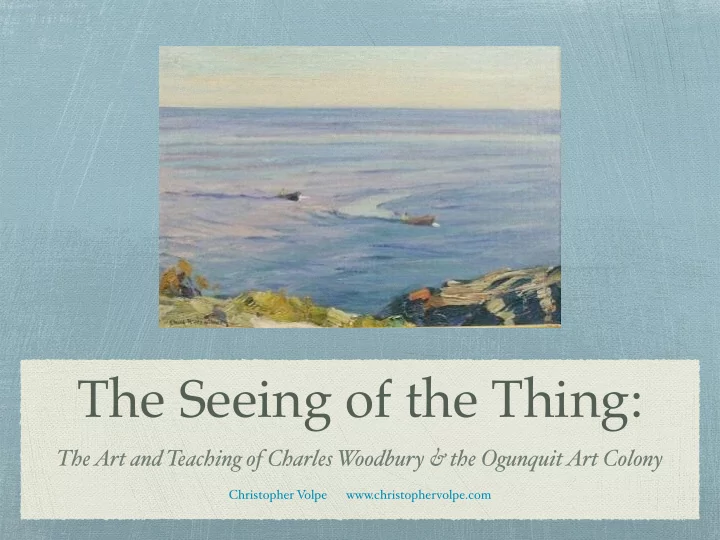
The Seeing of the Thing:
The Art and Teaching of Charles W
- odbury & the Ogunquit Art Colony
- Christopher V
- lpe www.christophervolpe.com
The Seeing of the Thing: The Art and Teaching of Charles W oodbury - - PowerPoint PPT Presentation
The Seeing of the Thing: The Art and Teaching of Charles W oodbury & the Ogunquit Art Colony Christopher V olpe www.christophervolpe.com Charles Herbert Woodbury (1864-1940) Christopher V olpe www.christophervolpe.com
The Art and Teaching of Charles W
Charles Herbert Woodbury (1864-1940)
Christopher V
Charles Herbert Woodbury (1864-1940)
Christopher V
The Last Drift, 1909, 29” x 36”
“It was live wires for him, nothing less.”
Woodbury’s MIT graduation photographs, class of 1886
Christopher V
The Lynn Beach Painters
Charles Woodbury, Saugus River, c. 1887, oil on canvas, 16 x 26 inches, Lynn Historical Society
In the wake of “The Mandatory Drawing Act”
Drawing School
seven united “Regional Impressionists” ~ 1887 ~
C.E.L. Green
Christopher V
Roots in Realism
Above: Paintings by Charles Woodbury, c. 1887 Below: Paintings by Antoine Vollon, c. 1870 Christopher V
Woodbury’s “Lynn Beach” Phase
Charles Woodbury North Shore scenery, c. 1888
Christopher V
Ogunquit in 1887
Maine Historical Society
Dories at Wharf Lane, off Shore Rd.
Perkins Cove by Woodbury, 1887
Christopher V
A fresh perspective: Charles H. Woodbury & Alfred T. Bricher (1837-1908)
Ogunquit, Maine by A. T. Bricher c. 1850
A fresh perspective: Charles H. Woodbury & Alfred T. Bricher (1837-1908)
A fresh perspective: Charles H. Woodbury & Alfred T. Bricher (1837-1908)
Woodbury’s first view of Perkins Cove, 1887
Christopher V
“Miss Oakes, I simply cannot teach you to paint.... But will you mind - mind if I ask you to marry me?” (1890)
M a r c i a O a k e s W o o d b u r y (1865 -1913) Moeder en Dochter: Het G e h e e l e L e v e n (Mother and D a u g h t e r : The Whole
Marcia and Charles Woodbury with son David, 1897
Christopher V
Mid-Ocean, 1893-94
“.... the truth of nature intelligently and feelingly stated ... a fine hint of a fine thing, the vastness, power, beauty, and majesty of the ocean .... with such a green as no lapidary could ever match, and shading off into a blue and purple so deep and intense that it astonishes and enchants the observer.” - The Boston Transcript, Jan. 23, 1895 Christopher V
1898: Woodbury founds his summer “Course of Instruction in Observation, Drawing & Painting” Later renamed The Art of Seeing
Christopher V
Christopher V
“Paint it the way it seems, not the way it looks.”
Christopher V
“Paint it the way it seems, not the way it looks.”
Christopher V
“Get the great things first.”
Christopher V
“Paint in verbs, not in nouns.”
Left: Phlox, 1903. Woodbury believed he had the best view on all of Maine’s coast. Panels of the Sea #4, Porpoises
Christopher V
“I enjoy anything which has the flavor
air in it.”
Christopher V
Liberating the seascape & “Suspending the viewer in mid-air above the waves...”
Christopher V
Christopher V
Assimilating traditional painting with the new discoveries of modern art
Christopher V
Christopher V
Christopher V
“Woodbury developed a unique blend of Impressionism, oriental compositional motifs, and the sensuous lines and jewel-like colors of the Art Nouveau.”
Christopher V
Christopher V
Christopher V
Other Lights: Robert Henri
Christopher V
Above: Dories, Perkins Cove, c. 1910
Other Lights: George Bellows
Christopher V
Woodbury
Christopher V
Bellows Henri Bellows
Other Lights: Soren Emil Carlsen
Above: Bald Head Cliff, Ogunquit, c. 1910-1915 Left: The Meeting of the Two Seas, 1919
Christopher V
Other Lights: Edward Hopper
Above: The Dories, Ogunquit, 1914; Top right: Sun at Ogunquit, 1914 Bottom right: Square Rock, Ogunquit, 1914
Christopher V
Christopher V
Christopher V
Addison Gallery of American Art, MA Art Institute of Chicago, IL Bowdoin College Museum of Art, ME Chrysler Museum of Art, VA Cleveland Museum of Art, OH Currier Gallery of Art, NH El Paso Museum of Art, TX Farnsworth Art Museum, ME Fine Arts Museum of San Francisco, CA Harvard University Art Museums, MA Isabella Stewart Gardner Museum, MA Maier Museum of Art at Randolph College, VA Metropolitan Museum of Art, NY Museum of Fine Arts, Boston, MA Portland Museum of Art, ME Rhode Island School of Design – Museum of Art, RI San Diego Museum of Art, CA Smithsonian American Art Museum, Washington, DC
Boston Art Club Guild of Boston Artists National Academy of Design Ogunquit Art Association Salmagundi Club Society of American Artists Watercolor Club of Boston 1887 J. Eastman Chase Gallery, MA 1902 Art Institute of Chicago, IL 1910 Cincinnati Art Museum, OH 1910 City Art Museum of St. Louis, MO 1912 Buffalo Fine Arts Academy, NY 1913 Detroit Museum of Art, MI 1925 Frederick Keppel & Co., NY 1939 Winchester Public Library, MA 1940 Cleveland Museum of Art, OH 1945 Museum of Fine Arts, Boston, MA 1968 Adelson Galleries Inc., MA 1978 Vose Galleries of Boston, MA 1988 MIT, Boston, MA
Memberships 100+ solo shows Major Collections:
Woodbury painted “personally” (He painted the way nature felt, not just what it looked like)
A picture is a personal reaction. We are seeing according as we are, and our facts vary with our perceptions.”
Woodbury was trained as a mechanical engineer (He saw & painted the world in motion, in terms of “the conditions of force and resistance”)
facts, is in Mr. Woodbury’s blood.”
Woodbury was (rigorously) self-trained (Free from the strictures of academic dogma, he put painting at the service of his perceptions rather than the other way around)
Christopher V
Christopher V
“A picture is a thought or feeling expressed in terms of nature.”
“We see according as we are, and our facts vary with our perceptions…. all visual impressions are a result, partly of the physical conditions of Nature and partly of your own mentality.”
see and feel them. Realism is after all only what you think the thing may be.”
must know what you see, why you see, and what is worth seeing.”
Christopher V
What is a Work of Art?
“A work of art is not a copy of things. It is inspired by nature but must not be a copying of the surface. Therefore what is commonly called “finish” may not be finish at all. You have to make your statement of what is is essential to you - an innate reality, not a surface reality. You handle surface appearances as compositional factors to express a reality that is beyond superficial appearances. you choose things seen and use them to phrase your statement... Painting is the study of our lives, our environment; it is the giving of evidence.”
Christopher V
“It is the Seeing of the Thing”
“Anything under the sun is beautiful if you have the vision - it is the seeing of the thing that makes it so....
say in trees or houses, coming together, that inspires you. We do well the things we see already painted in our mind’s eye - don’t do it until you see it or you are defeated before you begin.”
Paint it as it looked then.” - Robert Henri
Bibliography
A Century of Color, Ogunquit, Maine’s Art Colony, 1886-1986
Louise Traggard, Patricia E. Hart, W.L. Copithone, The Barn Gallery Associates, 1986
Earth, Sea and Sky, Charles H. Woodbury, Artist and Teacher
Joan Loria and Warren A. Seamans, MIT, 1988
Force Through Delicacy, The Life and Art of Charles H. Woodbury, N.A.
George M. Young, Peter Randall Publishing, Portsmouth, NH, 1998
The Art of Seeing
Charles H. Woodbury & Elizabeth Ward Perkins, Scribners, 1925
Charles H. Woodbury, Houghton Mifflin, 1919 Christopher V
The Art Spirit
Robert Henri, Philadelphia, 1923 (1984 reprint)
1864 Born in Lynn, MA on July 14. 1881 At 17, becomes the youngest honoree of the Boston Art Club. 1882 Begins studies at MIT. 1886 Graduates from MIT with a degree in mechanical engineering. 1887 Takes a studio in Boston and teaches drawing. 1887 First recorded visit to Ogunquit, ME. 1890 Marries former student, Marcia Oakes. They travel together to Europe. 1891 Studies at the Académie Julian under Boulanger and Lefebvre. 1896 Moves to Ogunquit with Marcia after the birth of their son, David. 1897 Takes Second Prize for Mid-Ocean painting at the Tennessee Centennial Exposition 1898 Founds his Ogunquit School. 1906 Elected an associate of the National Academy of Design. 1907 Elected full member of the National Academy of Design. 1913 Death of wife, Marcia Oakes. 1940 Dies in Jamaica Plain, MA on January 21. (source: Wikipedia)
Timeline
Ogunquit, Edward Henry Pothast, another of the colony’s “painter of verbs”
Christopher V
What is painting?
paintings as much as it relies on interesting and compelling forms and light. It has to do with mixing observation and study with discovery and imagination.” - Eric Aho
rendering toward the more thrilling realm of composing and closer to the excitement of reality.” - Ken Kewley
humanity.