The Rules of Change Management Doug Barker Principal Barker & - - PowerPoint PPT Presentation

the rules of change management
SMART_READER_LITE
LIVE PREVIEW

The Rules of Change Management Doug Barker Principal Barker & - - PowerPoint PPT Presentation

The Rules of Change Management Doug Barker Principal Barker & Scott Consulting Banafsheh Ghassemi VP, Marketing ECRM & Customer Experience American Red Cross Vinay Bhagat Founder & Chief Strategy Officer Convio The What


slide-1
SLIDE 1

The Rules of Change Management

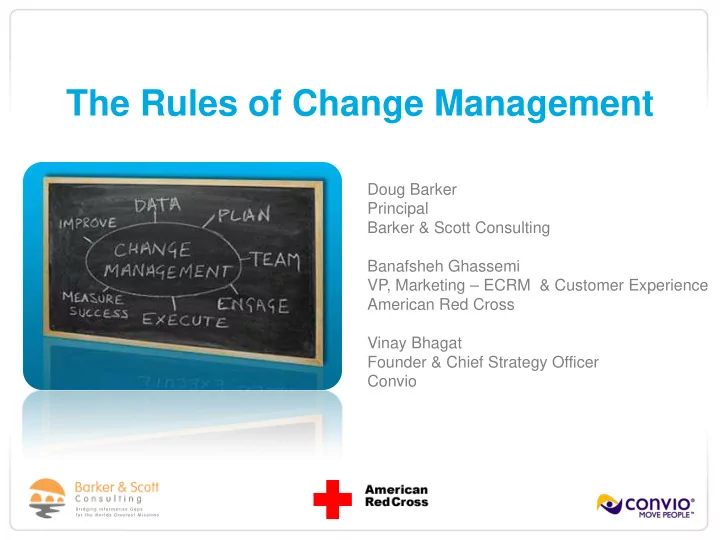
Doug Barker Principal Barker & Scott Consulting Banafsheh Ghassemi VP, Marketing – ECRM & Customer Experience American Red Cross Vinay Bhagat Founder & Chief Strategy Officer Convio
slide-2
SLIDE 2
  • Why CRM

Rich constituent relationships that generate lasting bonds are increasingly critical to organizational survival and success. Undeniably, it is a constituent-driven marketplace. And now more than ever, organizations must be able to flexibly adapt to the unique needs of the individuals they serve in order to sustain healthy growth.

  • What CRM Is

CRM is a strategy used to: 1) learn more about constituent’s needs and behaviours in order to develop stronger relationships with them and 2) maximize the value of those constituent relationships through the intelligent and responsible use of relevant data. If done right, organizations should be able to: provide better constituent service, make service delivery more efficient, support multi-channel outreach and marketing, increase revenue, and generate trust and loyalty.

The What and Why of CRM

slide-3
SLIDE 3

What is CRM?

CRM is more than just…

  • A database
  • Personalized email
  • Sophisticated “segmentation”
  • Good service
  • Contact management
  • A large expense
  • It is a holistic approach that takes into account

people, process, and technology

  • It is recognizing a constituent as that unique

constituent through any medium, at any time

  • It is treating different constituents differently
  • It is “remembering” things for and about

constituents

  • It is using information about each constituent to

make each constituent more valuable to the Movement and the Movement more valuable to each constituent

  • It is leveraging information about each

constituent to decrease the cost of service AND increase the lifetime value of each constituent

“It’s a mindset, not a thing."

slide-4
SLIDE 4

“Change management is a structured approach to shifting/transitioning individuals, teams, and

  • rganizations from a current state to a desired

future state. It is an organizational process aimed at empowering employees to accept and embrace changes in their current business environment.”

– Jeff Hiatt, author of The Employee's Survival Guide to Change

What is Change Management?

Change = Stress = Resistance

slide-5
SLIDE 5

Business Strategy

People Process Data

Components of a CRM Project

Technology

slide-6
SLIDE 6
  • Constituent-centric

transformation

  • Collaborative fundraising /

integrated marketing

Strategy

“It’s not about your organization."

slide-7
SLIDE 7
  • Perceived need for change
  • Leadership commitment
  • Organizational structure
  • Performance metrics
  • Communication effectiveness

People

Lack of Information = Anger + Fear = Resistance

slide-8
SLIDE 8
  • Organization-wide business rules
  • Cross-functional design
  • Workflow management
  • Ongoing process ownership

Process

New Systems + Old Processes = Sore Feet (aka bad fit) = Pain/Discomfort

slide-9
SLIDE 9
  • Enterprise solutions
  • “Open” architecture
  • Cloud computing
  • Mobile technologies

Technology

“How IT-smart is your organization?”

slide-10
SLIDE 10
  • 360º view
  • Approach to “data” sharing
  • Common data definitions
  • Business intelligence / actionable insight

Data

“I’m all for CRM, as long as no one else can see my donors.”

slide-11
SLIDE 11

Some CRM Change Management Maxims And How To Face Them!

slide-12
SLIDE 12

70% Of CRM Initiatives Fail

  • Cap Gemini

75% Fail To Impact The Customer Experience

  • Gartner

Maxim: CRM Initiatives Have An Abysmal Track Record, But You Don’t Have To Be A Part Of That Trend

slide-13
SLIDE 13

Customer Relationship Management Strategy Customer Experience Management Strategy

Why Very tactical. Get the house in order

  • perationally. Scripts day-to-day

interactions with the donor. More comprehensive strategic planning to ensure results & ROI. Glues together fragmented view of customers to develop and sustain the long term relationship. View Focuses on internal objectives (in-side

  • ut) with an eye on operational

efficiencies and priorities Focuses on delivering according to donors expectations (outside-in) with an eye on customer life-time value and long-term relationship What Captures and distributes what you know about a customer with an interest on the value of the donor to the enterprise Captures and distributes what a customer thinks about you and the value you bring to she, he or it. When Relationship refined after there is a record of a customer interaction Relationship refined before or at points

  • f customer interaction

Expand Your CRM Mindset To A Customer Experience Management (CEM) Strategy Mindset: #1 Driver Of Success In CRM Deployments

slide-14
SLIDE 14

Maxim: In The Absence Of A CEM Strategy, Even The Best CRM Technology Can Make Life More (Not Less) Difficult

slide-15
SLIDE 15

Postpone Until You Have a Strategy

CRM technology will facilitate a business strategy designed to learn about, select, optimize and manage the most valuable customer relationships.

The selected tech is only a tool… …and it’s

  • ne of many

It facilitates a strategy… …so there needs to be a strategy for it to facilitate The strategy has to be customer centric… …they all have expectations, needs & wants…they each have diff life-time values But our customers are not the same… …do our data, internal processes, orgs, policies, rules of engagement support the consistency expectations? Are their expectations aligned with their life-time value? …whatever the needs, they need them to be met consistently across the touch- points.

slide-16
SLIDE 16

Developing Strategy: An Approach

CEM Vision Wants, Needs, and Expectations Capabilities Enablers Initiatives Business Strategy Voice of the Customer People, Process, Policy & System

 Stakeholder Interviews  Inside-Out Workshops  Donor Focus Groups  Primary Research  Best Practices

  • Business Requirements for

CRM Platform

CRM

  • Moves Management

Framework

Moves Management

  • Donor Communications
  • Cross / Up-sell

Other Initiatives

Define CE Vision and Strategy Statement Develop guidelines for operational direction Prioritize Top Donor Wants / Needs Show prioritized list of initiatives against goals Align with Enterprise and Brand Strategies Determine key loyalty and touch-point metrics

Voice of the Customer Initiatives CRM/CEM Strategy & Roadmap

slide-17
SLIDE 17

Maxim: This Is Not About You, The Management Team, And Your Insatiable Appetite For “Their” Data!

slide-18
SLIDE 18
  • More Successful Fundraisers & Front-Line

Customer-Facing Personnel

– Train Better Customer Engagement Not How To Use The System

  • Communicating Effectively
  • Identifying Opportunities
  • Building Relationships
  • More Engaged & Loyal Constituents Who

Will Also Be Your Advocates

Make It Clear From The Onset Why You Are Doing This…

slide-19
SLIDE 19
  • Make Customer-Centricity Central To How You

Operate, In Every Function

  • Be 100% Present & Engaged
  • Lead By Example
  • Engage The End-Users From The Beginning

– Pilot, Examine, Refine, Launch – Steering Committee, To Include – Trusted/Respected Decision Makers On Behalf Of The Whole Community – Both Trailblazers & Naysayers

…And Mean It!

slide-20
SLIDE 20

Maxim: Your CEM Strategy Must Span The Entire Customer Lifecycle And High-Value Touchpoints To Be Effective

Aware/ Learn Donate Confirm/ Appreciate Seek Help Renew

Learning how donation was used (Stewardship) Ease of donation process (esp. @ time of disaster Acknowledgement and appreciation of donation Request information regarding specific issue

slide-21
SLIDE 21
  • Customer Life-Cycle Per Segment, If

Appropriate

  • Moments Of Truth To Focus On
  • Key Interactions

…And There Must Be Consensus

slide-22
SLIDE 22

Maxim: CRM Investments Are Not Cheap & Cutting Corners Can Lead To Costly Write-Offs…

slide-23
SLIDE 23
  • Voice Of The Customer

– Continuously Assess Customer Sentiment, Needs & Wants And Refine Organizational Capabilities And Enablers To Satisfy The Ever Changing Landscape – Requires Investment In Structures That Are Focused On VOC

  • Deployments Are High-Touch Endeavours

– Configuration/Testing – Training – Onsite Project Management – Communications

Don’t Skimp on Necessary Steps

Ongoing Customer Feedback Methods

Customer Feedback *Welcome Calls *Transactional Surveys *Customer Panels *Relationship Surveys *Call/Inquiries Into Frontline Orgs *Social Media Employee Feedback *Employee Panels *Front-line Surveys *Rep Quality Monitoring *Executive Immersion *Employee Engagement Survey

slide-24
SLIDE 24
  • Virtually Impossible To Prove That You Will Collect X

Additional Dollars in Donations Or Sell Y Units of A Product If You Bought Technology X

  • The ROI Is In Your New Way Of Doing Business

(Customer Centric Initiatives) And Measured In

– Customer Satisfaction – Customer Retention/Churn (Loyalty) – Net Promoter Score

  • Tech Is Cost Of Doing Business

– How Many Additional Dollars Do You Have To Have In Order to Pay For The Tech? Is It Achievable?

Maxim: CRM Can’t Be Justified Through Conventional ROI Measures...But What You Can Measure Is More Meaningful

slide-25
SLIDE 25

“People underestimate their capacity for

  • change. There is never a right time to do a

difficult thing. A leader’s job is to help people have vision of their potential.”

– John Porter

Open Discussion