The Role of Atmospheric Circulation in the Seasonal Melt of Snow - - PowerPoint PPT Presentation

the role of atmospheric circulation in the seasonal melt
SMART_READER_LITE
LIVE PREVIEW

The Role of Atmospheric Circulation in the Seasonal Melt of Snow - - PowerPoint PPT Presentation

The Role of Atmospheric Circulation in the Seasonal Melt of Snow and Sea Ice in the Pacific Arctic Christopher J. Cox 1,2 , Robert S. Stone 3 , Diane Stanitski 4 , David C. Douglas 5 1 Cooperative Institute for Research in Environmental Sciences


slide-1
SLIDE 1

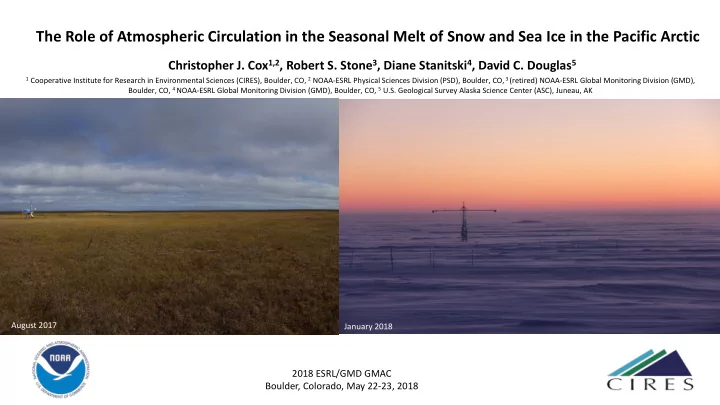
The Role of Atmospheric Circulation in the Seasonal Melt of Snow and Sea Ice in the Pacific Arctic

Christopher J. Cox1,2, Robert S. Stone3, Diane Stanitski4, David C. Douglas5

2018 ESRL/GMD GMAC Boulder, Colorado, May 22-23, 2018

January 2018 August 2017

1 Cooperative Institute for Research in Environmental Sciences (CIRES), Boulder, CO, 2 NOAA-ESRL Physical Sciences Division (PSD), Boulder, CO, 3 (retired) NOAA-ESRL Global Monitoring Division (GMD),

Boulder, CO, 4 NOAA-ESRL Global Monitoring Division (GMD), Boulder, CO, 5 U.S. Geological Survey Alaska Science Center (ASC), Juneau, AK

slide-2
SLIDE 2

Date of snowmelt at Barrow, 1901-2016

2015: 4th earliest on record 2016: 1st earliest on record 2015 2016 Cox et al. (2017, BAMS)

slide-3
SLIDE 3

Date of snowmelt at Barrow, 1901-2016

2015: 4th earliest on record 2016: 1st earliest on record 2015 2016 2017 2017: latest since 1988 Cox et al. (2017, BAMS)

slide-4
SLIDE 4

~294 MJ more in 2016 than 2017 ~969 MJ avg for positive net-rad period

Impact on the surface radiation budget

slide-5
SLIDE 5

Why does this matter?

  • Vegetation Phenology
slide-6
SLIDE 6

Why does this matter?

  • Vegetation Phenology
  • Biogeochemical Cycles
slide-7
SLIDE 7

Why does this matter?

  • Vegetation Phenology
  • Biogeochemical Cycles
  • Soil Temperature and Active

Layer Depth

slide-8
SLIDE 8

Why does this matter?

  • Vegetation Phenology
  • Biogeochemical Cycles
  • Soil Temperature and Active

Layer Depth

  • Ecology

[days]

slide-9
SLIDE 9

May Average

slide-10
SLIDE 10

Years >= 5 Days late Years <= 5 Days early

slide-11
SLIDE 11

N E W S N E W S

slide-12
SLIDE 12

N E W S N E W S

ALBSA = [E-W] – [N-S]

Aleutian Low Beaufort Sea Anticyclone

slide-13
SLIDE 13

Thanks to Michael Gallagher and Matt Shupe for the SOM

Mapping May-average ALBSA to a Self Organizing Map

These are the main early melt patterns These are the some late melt patterns

slide-14
SLIDE 14

May 2002

slide-15
SLIDE 15

Spatial Distribution

  • f Anomalies

Correlation maps (r) between ALBSA in May 1979-2017 and a combination of satellite observations; the date of snow melt derived from the Northern Hemisphere Snow Cover Extent (NH-SCE) data set (terrestrial regions) and the first date of initiation of surface melt over sea ice derived from SSM/I passive microwave data (sea ice regions).

Correlation [r]

slide-16
SLIDE 16

ALBSA Mean over 30 days prior to melt Melt Date

slide-17
SLIDE 17

Date of snowmelt at Barrow, 1901-2016

2015: 4th earliest on record 2016: 1st earliest on record 2015 2016 2017 2017: latest since 1988 Cox et al. (2017, BAMS) 2018 2018: Experimental projection does not indicate circulation patterns associated with early melt. Regressive model suggests “average” melt date

  • verall, but late compared to many

recent years.

slide-18
SLIDE 18

Utqiaġvik Snowmelt Record 20th Century Reanalysis BRW Met Observations BRW Radiation Thanks to Gil Compo for help with 20CR Time Lengths of Relevant Data Sets Dots are years when |ALBSA| > 0 (p<0.01)

Long Term ALBSA Record – 20th C. Reanalysis

slide-19
SLIDE 19

Conclusions

  • Long term records of the date of snowmelt at Utqiaġvik supported by NOAA-NWS/NOAA-GMD reveal a modern

trend towards earlier arrival of spring with extraordinary interannual variability in recent years.

  • The environment is sensitive to this variability.
  • The timing of snowmelt on Alaska’s north coast and melt onset over sea ice in the Beaufort and Chukchi Seas are

linked to advection facilitated by the juxtaposition of the Aleutian Low and the Beaufort High.

  • We developed a 4-pt climate index, “ALBSA”, that represents the variability in Pacific-Arctic atmospheric circulation.
  • We are currently working to assess subseasonal-to-seasonal scale (S2S) predictability of ALBSA.