The risky behaviour of young drivers in ArRyadh (Saudi Arabia) Ralf - - PDF document

the risky behaviour of young drivers in arryadh saudi
SMART_READER_LITE
LIVE PREVIEW

The risky behaviour of young drivers in ArRyadh (Saudi Arabia) Ralf - - PDF document

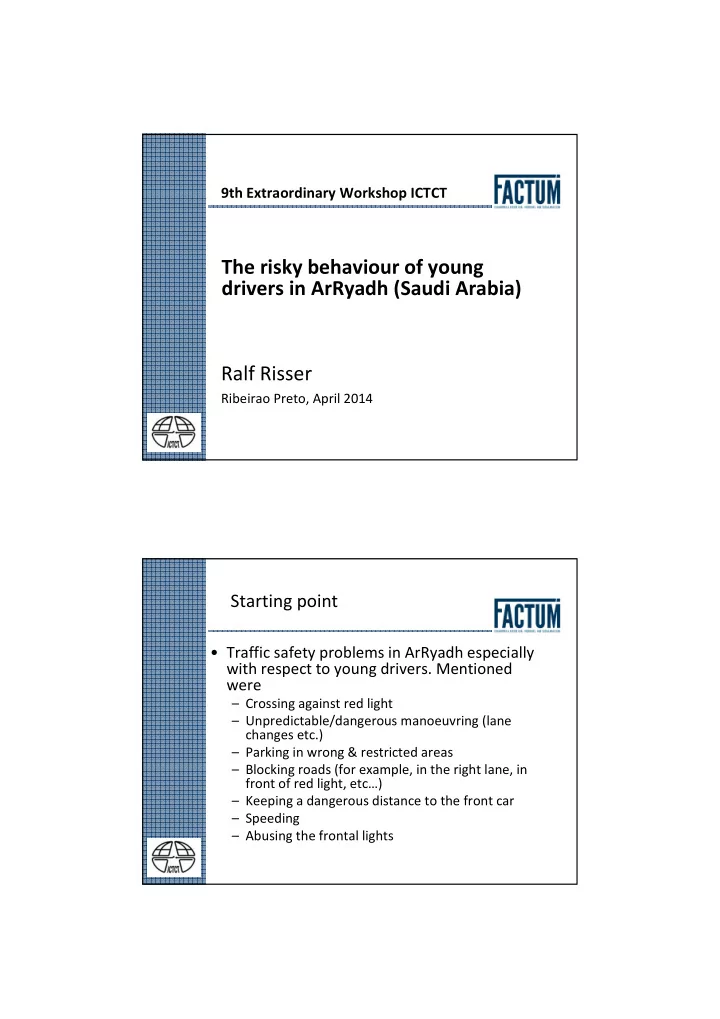
9th Extraordinary Workshop ICTCT The risky behaviour of young drivers in ArRyadh (Saudi Arabia) Ralf Risser Ribeirao Preto, April 2014 Starting point Traffic safety problems in ArRyadh especially with respect to young drivers. Mentioned


slide-1
SLIDE 1

Ralf Risser

Ribeirao Preto, April 2014

The risky behaviour of young drivers in ArRyadh (Saudi Arabia)

9th Extraordinary Workshop ICTCT

Starting point

  • Traffic safety problems in ArRyadh especially

with respect to young drivers. Mentioned were

– Crossing against red light – Unpredictable/dangerous manoeuvring (lane changes etc.) – Parking in wrong & restricted areas – Blocking roads (for example, in the right lane, in front of red light, etc…) – Keeping a dangerous distance to the front car – Speeding – Abusing the frontal lights

slide-2
SLIDE 2

Theory: Broad look at acting

Culture & social environment

Influencing factors

Individual Individual Communication Behaviour of

  • ther road users

Communication Behaviour of

  • ther road users

Transport mode, „vehicle“ Transport mode, „vehicle“

How does society treat traffic, is traffic safety taken seriously (enforcement etc.) How does society treat traffic, is traffic safety taken seriously (enforcement etc.)

Infrastructure Infrastructure

slide-3
SLIDE 3

How to look at areas

  • Focus groups: Reflect behaviour on higher

levels, reflect dimensions of the diamond

  • In-car observation: lower level behaviour

& communication

  • On-site observations: Reflect behaviour of

the general public (lower levels)

  • Workshops: How do responsible persons &

institutions look at traffic safety

Data collection – FGIs & WS

What? Focus groups and workshops How? 3 workshops were carried out on the first three days with 8 to 15 participants in each (N=28). 5 Focus groups with 7 or 8 participants were conducted, one on each morning of the working days (N=37) Participants? Workshops: experts (policemen, researchers, administrators, traffic planners, etc.) Focus groups: ~10 persons from each of the age groups 17/18, 19/20, 21/and 25 to 30 from Center, East, North, South and West Riad Who? Workshops: Daniel Bell & 4 local assistants Focus-group interviews: Carried out by local moderators, supervised by one junior researcher

slide-4
SLIDE 4

Data collection – Driving Test

What? Vienna driving test How? 20 driving observations along a standardised route (established during visit 1); on this route 4 driving

  • bservations per day were carried out

Participants? Young drivers aged 18 or 19 years (8 test persons), middle aged drivers from 20 to 25 years (8 test persons) and older drivers aged 26 years or older (4 test persons) distributed over East, North, South and West Riyadh Who? 4 local observers carried out the observations according to a provided scheme supervised by one junior

Data collection – Traffic Conflicts

What? Traffic conflicts registration How? 4 intersections were selected, they should cover several regions of ArRiyadh, and at the same time easy accessibility was a criterion. On these inter-sections one-day traffic-conflict

  • bservations were carried out

Participants? Normal traffic was observed, covering an average working day, from Saturday to Wednesday Who? 4 observers registered traffic phenomena on 4 days on 4 intersections sequentially, supervised by one senior researcher

slide-5
SLIDE 5

Identified errors/problems by method

In-car

  • bservation

On-site

  • bservation

FGI Workshops

Speed behaviour Speed behaviour Speed behaviour Speed behaviour Lane keeping behaviour Lane keeping behaviour Lane keeping behaviour Lane keeping behaviour Lane changing & lane choosing Lane changing and lane choosing Lane changing and lane choosing Lane changing and lane choosing Rule obedience (red light crossing etc.) Rule obedience (red light crossing etc.) Rule obedience (red light crossing etc.) Rule obedience (red light crossing etc.) Ruthless to pedestrians Ruthless to pedestrians Ruthless to pedestrians Anticipation Anticipation Anticipation Communication (indicating etc.) Communication (indicating etc.) Communication (indicating etc.)

Results – FGIs

Numerous forms of dangerous driving behaviour and safety risks were identified Traffic and driving education & public awareness are major factors for a change on a societal level Improved infrastructure that is adapted to the rising number of road users Enhanced traffic control and traffic laws to motivate changes and maintain them – specific forms of behaviour (speeding, using phone, etc.) – traffic situation & current infrastructure – vehicle (maintenance, type of car,

  • wnership)

– age & personal background – Schools, Universities, Mosques, Media – Role models and social environment – Maintenance – Expand and develop – Provide alternatives (i.e.: public transport)

– Resources relevant for education and scale of police force

– Utilize and improve efficient technological innovations – Establish specia- lized traffic courts and coordinate branches – Specify punishment and strictly apply it

slide-6
SLIDE 6

Results In-car behaviour observation

Sum Mean StD Variance Use of the indicator - Not at all 1083 54,2 14,1 199,0 Lane - Driving on two lanes 164 8,2 6,3 39,9 Lane - Extremely on the right side of the lane 88 4,4 2,4 5,8 Adaptation of speed before/in intersection or before obstacles - Bad 66 3,3 3,1 9,8 Distance to the road user ahead - Dangerous 61 3,1 2,5 6,5 Lane - Extremely on the left side of the lane 51 2,6 1,9 3,5 Too fast according to the situation 47 2,4 2,5 6,1 Use of the indicator - Inappropriate 39 2,0 2,4 5,6 Lane - Dangerous 29 1,5 1,6 2,7 Lane - Incorrect lane choice before intersection 19 1,0 1,1 1,2

In total 1684 errors observed – 85 errors per person

Results Traffic Conflict Observation

Type of conflict

total rear end right angle head on lane change mingling pedestria n

Intersection

Olaya & Thalia (camera) number 11 2 24 3 40 % of Type

  • f conflict

45,8% 4,2% ,0% 27,0% 21,4% 22,5% Tahlia & Salman Al Hamsah (camera) number 6 29 4 39 % of Type

  • f conflict

25,0% ,0% ,0% 32,6% 28,6% 21,9% Hamsah & Al Madinah number 2 11 2 23 2 40 % of Type

  • f conflict

8,3% 22,9% 66,7% 25,8% 14,3% 22,5% Al Zubeir & Imam Shafei number 5 35 1 13 5 59 % of Type

  • f conflict

20,8% 72,9% 33,3% 14,6% 35,7% 33,1% total number 24 48 3 89 14 178 % of Type

  • f conflict

100,0% 13,5% 100,0% 27,0% 100,0% 1,7% 100,0% 50,0% 100,0% 7,8% 100,0 100,0
slide-7
SLIDE 7

Conflicts: Situations where road users are

  • n a collision course and only a last-second

evasive action avoids a crash

3 hours of observation each intersections

  • Lane change on 89 mainly left/right turn &

approach

  • Right angle 48 11 (23%) against red light
  • Rear end

24 late braking before red light

  • Pedestrian 14 mainly right turning lane
  • Head on 3 all in dense traffic

Total N: 178 Driving against red and high speeds are correlated

General observation

  • When numbers of road users lower speeds very high &

late braking, crossing several lanes & crossing against red; under these conditions few conflicts but high risk

  • Right turn lanes used for better position for going on

straight blocking lane for right turners. At two intersections no cameras: many from far right lane move ahead, across the pedestrian crossing into the intersection area, in front of two or three other lanes and then go straight on or left or even make U-turn when light turns green frustration for others

  • Pedestrian facilities not useable safely; green light does

not provide safety why should pedestrian respect rules, as these rules do not protect them? Logical consequence: pedestrians cross where they have shortest walking distance

slide-8
SLIDE 8

Main conclusions

  • Behaviour of youngsters problematic: speed, lane keeping,

intersection behaviour, rule obedience in general

  • Young persons and experts are conscious of same problems
  • Paradox: youngsters are conscious of problems, they want

control (reluctant to improve control necessary)

  • General public behaviour does not support better behaviour
  • f youngsters, rather on the contrary
  • Traffic safety work (education, enforcement etc.) not carried
  • ut seriously & youngsters perceive this
  • Infrastructure: lack of space experts criticise lack of public

transport, bad pedestrian infrastructure

  • Big cars enhance dynamic and ruthless behaviour, intimidate

road users with smaller cars

Recommendations

  • Education & especially awareness raising
  • Enforcement police & ITS
  • New technology for traffic management
  • Families, schools, media & religious events to

create awareness & motivation for change

  • Introduce facts/know how, e.g. concerning

– relation between capacity and speed – road space and capacitiy problems – speed & travelling time – car size and safety

slide-9
SLIDE 9

Muito obrigado Muchas gracias Vielen Dank Thank you very much