The reverse mathematics of Ekelands variational principle Paul - - PowerPoint PPT Presentation

the reverse mathematics of ekeland s variational principle
SMART_READER_LITE
LIVE PREVIEW

The reverse mathematics of Ekelands variational principle Paul - - PowerPoint PPT Presentation

The reverse mathematics of Ekelands variational principle Paul Shafer University of Leeds p.e.shafer@leeds.ac.uk http://www1.maths.leeds.ac.uk/~matpsh/ Workshop on Proof Theory, Modal Logic, and Reflection Principles Moscow, Russia


slide-1
SLIDE 1

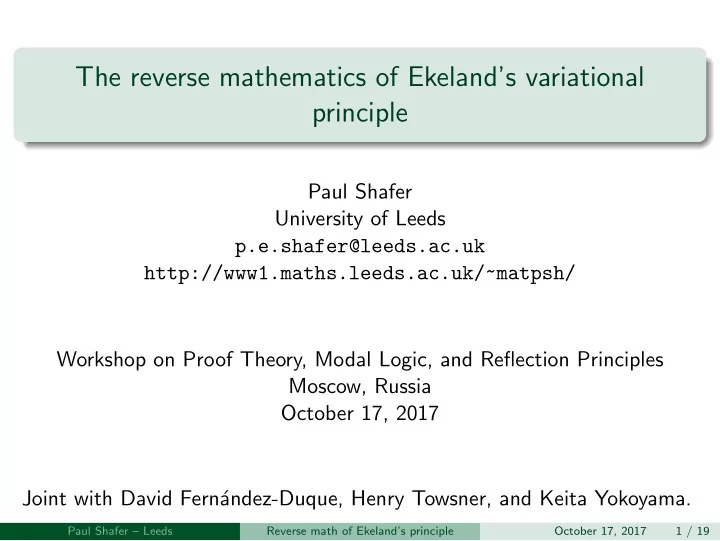
The reverse mathematics of Ekeland’s variational principle

Paul Shafer University of Leeds p.e.shafer@leeds.ac.uk http://www1.maths.leeds.ac.uk/~matpsh/ Workshop on Proof Theory, Modal Logic, and Reflection Principles Moscow, Russia October 17, 2017 Joint with David Fern´ andez-Duque, Henry Towsner, and Keita Yokoyama.

Paul Shafer – Leeds Reverse math of Ekeland’s principle October 17, 2017 1 / 19

slide-2
SLIDE 2

The original Ekeland’s variational principle

Theorem (Ekeland; J. Mathematical Analysis and Applications, 1974)

Let

  • X be a complete metric space;
  • V : X → R≥0 be a continuous function;
  • ε > 0 and y ∈ X be such that

inf(V ) ≤ V (y) ≤ inf(V ) + ε;

  • λ > 0.

Then there is an x∗ ∈ X such that

  • V (x∗) ≤ V (y);
  • d(x∗, y) ≤ λ;
  • for all w = x∗,

V (x∗) < V (w) + ε λd(x∗, w).

Paul Shafer – Leeds Reverse math of Ekeland’s principle October 17, 2017 2 / 19

slide-3
SLIDE 3

Digestible Ekeland’s variational principle (plus terminology)

Terminology:

  • Henceforth, a metric space is a complete, separable metric space.
  • For a metric space X, we call a continuous V : X → R≥0 a potential.

Definition

Let X be a metric space, and let V : X → R≥0 be a potential. A critical point of V is a point x∗ ∈ X such that, for all y = x∗, V (x∗) < V (y) + d(x∗, y)

Theorem (Critical point theorem / digestible Ekeland’s principle)

If X is a metric space and V : X → R≥0 is a potential, then V has a critical point.

Paul Shafer – Leeds Reverse math of Ekeland’s principle October 17, 2017 3 / 19

slide-4
SLIDE 4

What does Ekeland’s variational principle do?

From Ekeland’s own abstract, there are applications to:

  • Plateau’s problem (of finding a minimal surface with a given

boundary),

  • partial differential equations,
  • nonlinear eigenvalues,
  • geodesics on infinite-dimensional manifolds, and
  • control theory.

Basically, Ekeland’s variational principle is used to find approximate solutions to various optimization problems. We care about using Ekeland’s variational principle to find fixed points! In particular, Ekeland’s variational principle implies Caristi’s fixed point theorem.

Paul Shafer – Leeds Reverse math of Ekeland’s principle October 17, 2017 4 / 19

slide-5
SLIDE 5

Caristi’s fixed point theorem

Definition

A Caristi system is a triple (X, V, f), where

  • X is a metric space,
  • V : X → R≥0 is a potential, and
  • f : X → X is an arbitrary function

such that (∀x ∈ X)[d(x, f(x)) ≤ V (x) − V (f(x))].

Theorem (Caristi; TAMS 1976)

If (X, V, f) is a Caristi system, then f has a fixed point. A critical point x∗ of V is a fixed point of f: If f(x∗) = x∗, then V (x∗) − V (f(x∗)) < d(x∗, f(x∗)), contradiction!

Paul Shafer – Leeds Reverse math of Ekeland’s principle October 17, 2017 5 / 19

slide-6
SLIDE 6

Lower semi-continuous functions

In Ekeland’s variational principle, the potential V : X → R≥0 is in fact allowed to be lower semi-continuous.

Definition

Let X be a metric space. V : X → R is lower semi-continuous if (∀x ∈ X)(∀ǫ > 0)(∃δ > 0)(∀y ∈ X)[d(x, y) < δ → f(y) ≥ f(x) − ǫ]. Lower semi-continuous functions can be complicated. Let X be a metric space, and let C ⊆ X be closed. Then V (x) =

  • if x ∈ C

1 if x / ∈ C is lower semi-continuous.

Paul Shafer – Leeds Reverse math of Ekeland’s principle October 17, 2017 6 / 19

slide-7
SLIDE 7

Ekeland’s principle, Caristi’s theorem, and reverse math

We want to analyze the strengths of Ekeland’s variational principle, Caristi’s theorem, and related statements in the style of reverse mathematics. But why?

  • These theorems seem important, and their proofs are interesting.
  • It’s nice to study theorems that are not quite so old as the theorems

that people (or at least I) usually study in reverse mathematics.

  • The strengths of these theorems vary a lot depending on exactly what

statement you care about.

Paul Shafer – Leeds Reverse math of Ekeland’s principle October 17, 2017 7 / 19

slide-8
SLIDE 8

A one-slide-introduction to reverse mathematics

Q: How strong is my theorem? A: What do you mean? . . . thinking . . . thinking . . . Q: How strong is my sentence in the language of second-order arithmetic relative to a pre-specified base theory? A: We can work with that. The typical situation in reverse mathematics is:

  • Consider two sentences ϕ and ψ in the language of second-order

arithmetic (often expressing two well-known theorems).

  • Does RCA0 ⊢ ϕ → ψ?

Paul Shafer – Leeds Reverse math of Ekeland’s principle October 17, 2017 8 / 19

slide-9
SLIDE 9

The Big Five subsystems of second-order arithmetic

We have two sorts: natural numbers and sets of natural numbers. Ignore induction and focus on set-existence axioms. RCA0 says that sets computable from existing sets exist. Formally, ∆0

1

comprehension. WKL0 adds the statement “every infinite subtree of 2<N has an infinite path” to RCA0. ACA0 says that every arithmetical formula defines a set. Formally, arithmetical comprehension.

(Intuition: ACA0 can earn an undergraduate degree in mathematics.)

ATR0 says that arithmetical comprehension can be iterated along a well-order. Π1

1-CA0 says that every Π1 1 formula defines a set. Formally, Π1 1

comprehension.

Paul Shafer – Leeds Reverse math of Ekeland’s principle October 17, 2017 9 / 19

slide-10
SLIDE 10

0x430x6f0x640x690x6e0x670x21

I said that we can only talk about natural numbers and sets of natural numbers. But I want to talk about:

  • trees
  • real numbers
  • metric spaces
  • open and closed subsets of metric spaces
  • continuous and lower semi-continuous functions
  • and more!

This takes a lot of coding. I’ll only say a few things about it.

Paul Shafer – Leeds Reverse math of Ekeland’s principle October 17, 2017 10 / 19

slide-11
SLIDE 11

0x430x6f0x640x690x6e0x670x210x210x21

A real number is a rapidly converging Cauchy sequence of rationals. A point in a metric space is a rapidly converging Cauchy sequence of points in a pre-specified countable dense set. An open set is an enumeration of rational open balls. A continuous function f : X → Y is an enumeration of pairs of rational

  • pen balls Bp(a), Bq(b) indicating that f(Bp(a)) ⊆ Bq(b).

A lower semi-continuous function f : X → R is an enumeration of pairs Bp(a), q indicating that f(Bp(a)) ⊆ [q, ∞).

Paul Shafer – Leeds Reverse math of Ekeland’s principle October 17, 2017 11 / 19

slide-12
SLIDE 12

Remember what we’re talking about?

Remember that we have

  • X, a metric space, and
  • V : X → R≥0, a potential (i.e., a (lower semi-)continuous function).

A critical point of V is a point x∗ ∈ X such that, for all y = x∗, V (x∗) < V (y) + d(x∗, y). Ekeland’s principle: V has a critical point. Equivalently, “x∗ is a critical point of V ” as means that, for all y, [d(x∗, y) ≤ V (x∗) − V (y)] → y = x∗.

Paul Shafer – Leeds Reverse math of Ekeland’s principle October 17, 2017 12 / 19

slide-13
SLIDE 13

Sketching a proof of Ekeland’s principle (continuous V )

Theorem (Critical point theorem / Ekeland’s principle)

If X is a metric space and V : X → R≥0 is a potential, then V has a critical point (i.e., an x∗ s.t. ∀y[d(x∗, y) ≤ V (x∗) − V (y) ⇒ y = x∗]). Build a sequence (xn : n < ω) of points in X:

  • Choose any x0 ∈ X.
  • Let Sxn = {y ∈ X : d(xn, y) ≤ V (xn) − V (y)}.
  • Choose xn+1 ∈ Sxn so that V (xn+1) ≤
  • infy∈Sxn V (y)
  • + 2−n.
  • Notice V (x0) ≥ V (x1) ≥ V (x2) ≥ . . . , so let c = limn→∞ V (xn).
  • Show that d(xm, xn) ≤ n−1

i=m d(xi, xi+1) ≤ V (xm) − c.

  • This means that (xn : n < ω) is Cauchy. Let x∗ be the limit.
  • Show that x∗ is a critical point.

Paul Shafer – Leeds Reverse math of Ekeland’s principle October 17, 2017 13 / 19

slide-14
SLIDE 14

Reverse math of Ekeland’s principle (continuous V)

Theorem (F-D S T Y)

The following are equivalent over RCA0. (i) ACA0. (ii) Ekeland’s principle for arbitrary metric spaces X and continuous potentials V . A proof similar to the previous sketch is possible in ACA0.

Theorem (F-D S T Y)

The following are equivalent over RCA0. (i) WKL0. (ii) Ekeland’s principle for compact metric spaces X and continuous potentials V . If X is compact, then extreme value theorem ⇒ Ekeland’s principle. In both theorems, the reversals follow from reversals of Caristi’s theorem.

Paul Shafer – Leeds Reverse math of Ekeland’s principle October 17, 2017 14 / 19

slide-15
SLIDE 15

Dealing with lower semi-continuous potentials

Let X be a metric space. Let V : X → R≥0 be lower semi-continuous. Idea: Replace V with its 2-envelope: V2(x) = inf

y∈X(V (y) + 2d(x, y))

Then

  • V2 is continuous;
  • if x∗ is a critical point of V2, then V2(x∗) = V (x∗);
  • if x∗ is a critical point of V2, then x∗ is a critical point of V .

However, to define V2, we need the set {a, r, q : (∀x ∈ Br(a))(V (x) ≥ q)}.

  • If X is compact, ACA0 suffices.
  • If X is not compact, then we need Π1

1-CA0.

Paul Shafer – Leeds Reverse math of Ekeland’s principle October 17, 2017 15 / 19

slide-16
SLIDE 16

Ekeland’s principle in compact spaces with l.s.c. potentials

Theorem (F-D S T Y)

The following are equivalent over RCA0. (i) ACA0. (ii) Ekeland’s principle for compact metric spaces X and l.s.c. potentials V . For the reversal, use that the monotone convergence theorem is equivalent to ACA0 over RCA0.

  • Let q0 < q1 < q2 < · · · be an increasing sequence of rationals in [0, 1].
  • Define V : [0, 1] → R≥0 by

V (x) =

  • 2

if x < qn for some n x

  • therwise.
  • Check that if x∗ is a critical point of V , then x∗ = sup{qn : n ∈ N}.

Paul Shafer – Leeds Reverse math of Ekeland’s principle October 17, 2017 16 / 19

slide-17
SLIDE 17

In general, Ekeland’s principle is equivalent to Π1

1-CA0

(Because lower semi-continuous functions are bad.)

Theorem (F-D S T Y)

The following are equivalent over RCA0. (i) Π1

1-CA0.

(ii) Ekeland’s principle for arbitrary metric spaces X and l.s.c. potentials V . The reversal takes advantage of the following fact.

Fact (see Simpson’s SoSOA)

The following are equivalent over RCA0. (i) Π1

1-CA0.

(ii) For every sequence (Ti : i ∈ N) of subtrees of N<N, there is a set X such that ∀i(i ∈ X ↔ Ti is ill-founded).

Paul Shafer – Leeds Reverse math of Ekeland’s principle October 17, 2017 17 / 19

slide-18
SLIDE 18

Ekeland’s principle is equivalent to Π1

1-CA0

Fact (see Simpson’s SoSOA)

Π1

1-CA0 is equivalent to the statement “for every sequence (Ti : i ∈ N) of

subtrees of N<N, there is a set X such that ∀i(i ∈ X ↔ Ti is ill-founded).” Work over ACA0 (because the critical point theorem implies ACA0).

  • Let (Ti : i ∈ N) be a sequence of subtrees of N<N.
  • Let X = NN.
  • (For an f ∈ NN, let (f)i denote (f)i(n) = f(i, n).)
  • Let V : NN → R≥0 be

V (f) =

  • {2−i : (f)i /

∈ [Ti]}.

  • V is lower semi-continuous, and ACA0 can make sense of this.
  • Let f∗ be a critical point, and let X = {i : (f∗)i ∈ [Ti]}.
  • Show that i ∈ X if and only if Ti is ill-founded.

Paul Shafer – Leeds Reverse math of Ekeland’s principle October 17, 2017 18 / 19

slide-19
SLIDE 19

Thank you!

Thank you for coming to my talk! Do you have a question about it?

Paul Shafer – Leeds Reverse math of Ekeland’s principle October 17, 2017 19 / 19