THE RESTORATION OF SLINDON BOTTOM GRAVEL PIT Community Consultation - - PowerPoint PPT Presentation

the restoration of slindon bottom gravel pit
SMART_READER_LITE
LIVE PREVIEW

THE RESTORATION OF SLINDON BOTTOM GRAVEL PIT Community Consultation - - PowerPoint PPT Presentation

THE RESTORATION OF SLINDON BOTTOM GRAVEL PIT Community Consultation February 2020 Mick Balch Managing Director (L&S) Steve Harman General Manager (L&S) Stuart Austin Planning Consultant Introduction Site freehold owned by


slide-1
SLIDE 1

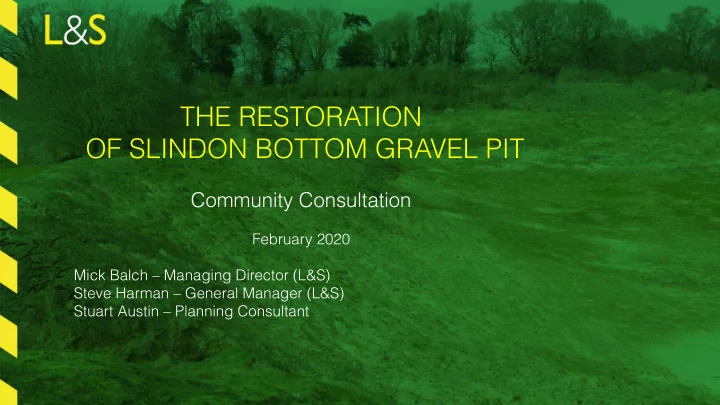
THE RESTORATION OF SLINDON BOTTOM GRAVEL PIT

Community Consultation

February 2020 Mick Balch – Managing Director (L&S) Steve Harman – General Manager (L&S) Stuart Austin – Planning Consultant
slide-2
SLIDE 2

Introduction

  • Site freehold owned by Slindon Bottom

Farm Ltd since 2008.

  • L&S Waste Management operate from

bases in Southampton, Fareham, and Portsmouth.

  • Employ over 150 staff and run a fleet of

75 vehicles providing a range of waste services across Hampshire, Surrey and West Sussex and surrounding counties.

  • Successful L&S in the Community Project

to help and support the wider community, including local people and charitable

  • rganisations.
slide-3
SLIDE 3

Land Management

  • Vulnerable to trespass and unauthorised activity.
  • Site subject to regular fly tipping.
  • Criminal damage including theft of weighbridge

plates.

  • Used to store stolen property.
  • Landform attractive for unauthorised motor

sports.

  • Measures in place to deter unauthorised entry

and use but difficult to police.

slide-4
SLIDE 4
  • Historic use for mineral extraction, waste disposal and

restoration which pre-dates the introduction of planning controls.

  • Formal consents relating to these activities date back to

1954, with subsequent permissions in 1960s, 70s, 80s and 90s.

  • The older mineral workings, in the southern part of the

site, were backfilled by the local authority using household and general wastes prior to 1974.

  • Later consents allowed for backfilling and restoration of

the northern workings with the use of inert material, with ancillary recycling.

  • Principal activities ceased in late 1990s with the last

planning permission requiring the site to be restored in full by September 2006.

Site History

Slindon Bottom Gravel Pit circa. 1940

slide-5
SLIDE 5

Site History

Lower level unrestored land to North Backfilled land to South with historic restoration profile markers

slide-6
SLIDE 6

Recent History

  • After acquiring site in 2008 L&S sought permission to deliver previously

uncompleted backfilling and restoration scheme, with separate application to re-start onsite recycling operation.

  • Site would have been restored to originally approved levels, with land

returned to agricultural use, with some boundary tree and hedgerow planting.

  • No agreement reached with South Downs National Park Authority who had

preference for minimal ‘low-level’ restoration scheme. SDNPA written advice provided October 2012.

  • In September 2016 old planning permission lapsed for all purposes.
  • In July 2019 South Downs Local Plan (2014 – 2033) formally adopted.
slide-7
SLIDE 7

Restoration Solution

  • Seeking to develop a new restoration

solution.

  • Key Objectives:
  • Fit with Vision and Policies of new

South Downs Local Plan.

  • Engage Community in Design.
  • Be Deliverable.
slide-8
SLIDE 8

Initial Concept

  • South Downs Local Plan:
  • Landscape-Led Design
  • Enhance Natural Capital
  • Meet Policy Tests
  • Local Community:
  • Discussions held with nearest neighbours to site
  • Consultation with Local Parish Councils
  • Maintain engagement through all stages of Project
  • Delivery:
  • Requires viable engineering solution
  • Obtainable Environmental Permit
  • Be achievable within short timeframe
slide-9
SLIDE 9

Design – Landscape Led

  • Restoration of historic landscape

features.

  • Reduction in height of final restoration

levels and contour to fit within wider landscape.

  • Create inter-visibility and connection

in the landscape with Public Right of Way Network.

  • Provision of land for pasture

consistent with landscape character.

slide-10
SLIDE 10

Design – Ecosystem Services

  • Woodland Planting – connectivity to off-site

Ancient Woodland.

  • Reinstatement of Hedgerow Network to

reflect historic alignment.

  • Creation of wetland habitat with species

rich meadow and scrub.

  • Retained sand faces.
  • Provision of land for grazing.
slide-11
SLIDE 11

Design – Community

  • Effective use of onsite material to deliver early restoration

benefits and reduce volume of imported soils.

  • Restrict principal restoration operations to central part of the

site – furthest away from residential properties and Public Right of Way.

  • Provision of long-term access via Permissive Paths.
  • Use of Interpretation Boards – detail on site history /

biodiversity / landscape setting etc.

slide-12
SLIDE 12

Design – Operational Delivery

  • Creation of single engineered

restoration area centrally within site.

  • Maintains separation from historically

tipped material.

  • Required volume for importation likely

to be achieved in two year period.

  • HGVs to adhere to historic routeing

agreement – via Britten’s Lane and Slindon Road.

slide-13
SLIDE 13

What do we want to Achieve?

  • “…a former part-restored mineral working that, to my mind, would benefit from being finished…

there must be a policy framework to allow a proposal to come forward…” Brian Cook, Planning Inspector (2014)

  • Remove uncertainty for community, landowner, and planning authority.
  • Create a community asset with a long term beneficial use.
  • Provide a positive use for the land and bring an end to unauthorised uses.
  • Deliver long-term benefits that clearly outweigh any short-term disturbance from site operations.
  • Ensure scheme is designed and site is operated to ensure any short-term disturbance is minimised.
slide-14
SLIDE 14

Community Input

  • In principle support from nearest neighbours.
  • Seeking wider community input and support to shape final

restoration scheme design.

  • Maximise value of resource to community – e.g. end uses / access.
  • Long term management.
slide-15
SLIDE 15

Next Steps

  • Evaluate initial restoration concept design to incorporate first stage of

community feedback.

  • Engage technical specialists i.e. ecologists and landscape architects to

further influence final design to ensure natural capital benefits are fully maximised.

  • Undertake formal pre-application discussions with the South Downs

NPA.

  • If in-principle support obtained move forward through planning process

and re-consult with the local community before final submission.

slide-16
SLIDE 16