The Rationale 2 The Bragg Peak Characteristics of a Proton Beam - - PDF document

the rationale
SMART_READER_LITE
LIVE PREVIEW

The Rationale 2 The Bragg Peak Characteristics of a Proton Beam - - PDF document

8/2/2012 Will the High Cost of Proton Therapy Facilities Limit the Availability of Proton Therapy Treatment? Richard L. Maughan University of Pennsylvania Disclaimer: University of Pennsylvania has a Proton Therapy Facility 1 The Rationale


slide-1
SLIDE 1

8/2/2012 1

Will the High Cost of Proton Therapy Facilities Limit the Availability of Proton Therapy Treatment?

Richard L. Maughan University of Pennsylvania

1

Disclaimer: University of Pennsylvania has a Proton Therapy Facility

The Rationale

2 3

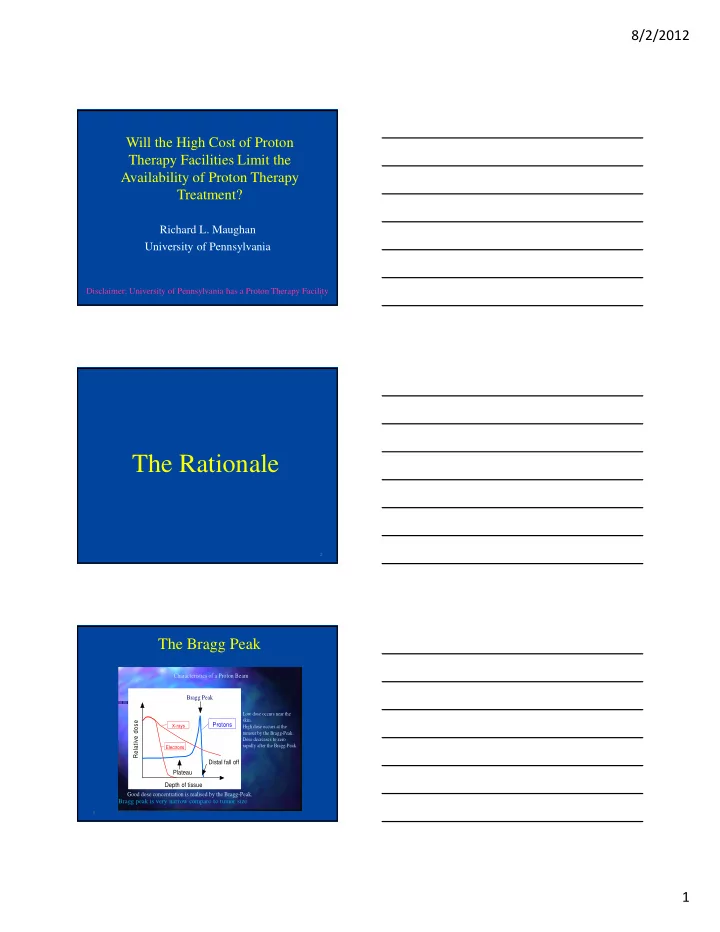
The Bragg Peak

Bragg Peak Depth of tissue Relative dose Distal fall off Plateau Protons

Electrons X-rays

Good dose concentration is realised by the Bragg-Peak. Characteristics of a Proton Beam

Low dose occurs near the skin. High dose occurs at the tumour by the Bragg-Peak. Dose decreases to zero rapidly after the Bragg-Peak.

Bragg peak is very narrow compare to tumor size

slide-2
SLIDE 2

8/2/2012 2

4 0.0 0.5 1.0 1.5 2.0 2.5 3.0 50 100 150 200 250

Depth (mm) Relative Dose

Spread-Out Bragg Peak

Adding together Bragg peaks from multiple beam energies with independent weights can generate a flat region at the tumor at the expense of increasing the entrance dose

The Proton Beam Delivery System

5 6

Scattered or Scanned Beam?

To use the proton beam for treatments it must be spread-out in the lateral and depth directions. There are several ways to do this: Depth Passive using Modulator wheels or Ridge filters Active by bringing in different energy protons Transverse Passive using double scatterers Active by magnetically steering the protons across the target

0.0 0.5 1.0 1.5 2.0 2.5 3.0 50 100 150 200 250

Depth (mm) Relative Dose

Spread-out Bragg peak

slide-3
SLIDE 3

8/2/2012 3

7

Double-Scattering

A set of scatterers and modulators spread the beam in the transverse and depth directions and field specific apertures and compensators are used to conform to the target.

http://radmed.webntry/scan/n_scattering.html.psi.ch/asm/ga

Proton Beam Delivery Options

Uniform Scanning (aka Wobbling)

Large spot (~ 5 cm diameter FWHM) Lateral Field Shaping – Aperture or MLC SOBP – Modulator wheel Distal Edge Shaping – Patient Specific Compensator Allows for much larger field sizes – up to 30 cm x 40 cm

8

Modulator Wheel, Apertures and Compensators

9

slide-4
SLIDE 4

8/2/2012 4

10

MLC for Double Scattering

11

Proton Beam Delivery Options

Modulated Scanning (aka Pencil Beam Scanning)

Energy selection outside treatment room – selects depth of penetration of beam spot. X and Y magnet scanning to provide lateral beam shaping Beam spot Gaussian determines beam penumbra characteristics.

12

slide-5
SLIDE 5

8/2/2012 5

13

A proton pencil beam (spot)…... A few pencil beams together…. Some more…

A full set, with a homogenous dose conformed distally and proximally

Spot Scanning - The Principle

The dynamic application of scanned and modulated proton pencil beams

Images courtesy of E Pedroni and T Lomax, PSI

New Technology for Capital Cost Reductions

14

Reducing Capital Costs Of Proton Therapy System

  • To date all operational systems have multiple

treatment rooms with beams supplied by a single accelerator, with high patient throughput to recover the large capital costs.

  • As the accelerator and beam transport systems

are expensive items, one room solutions combined with less expensive compact accelerator solutions have been advocated.

15

slide-6
SLIDE 6

8/2/2012 6

Compact Accelerators

  • 1. A gantry mounted Superconducting
  • Synchrocyclotron. Built by Mevion originally

installed at Washington University, St Louis.

  • 2. A gantry mounted Dielectric Wall Accelerator

(DWA). Under development by Compact Particle Accelerator Corporation (CPAC).

  • 3. A gantry mounted Laser Accelerator. Basic

research in many laboratories around the world.

16

Superconducting Synchrocyclotron

Blosser, NIM 1989, 41, 1326 “Compact Superconducting Synchrocyclotron Systems for Proton Therapy.”

17

Mevion Superconducting Synchrocyclotron

18

slide-7
SLIDE 7

8/2/2012 7

Mevion Superconducting Synchrocyclotron

19

CPAC Dielectric Wall Accelerator

20 21

slide-8
SLIDE 8

8/2/2012 8

22

Laser Acceleration

23

The Business Plan

24

slide-9
SLIDE 9

8/2/2012 9

Profitable

Paying Back Investment Losing Money

2000 Patients Per Year

Source:The National Accociation for Proton Therapy, Proton News, Catching the Proton Wave,Charlotte Huff

Average Revenue (in $Millions)

500-1000 Patients ~18-20K Fractions 1000- 2000 Patients ~36-40K Fractions 750-1500 Patients ~27-30K Fractions

~$25M ~$12M $50M ~$38M Operating Cost Target

Time

~552 Patients (22-24K Fractions) 25

The Financial Challenge of PT

“according to the Advisory Board analysis. M.D. Anderson’s Latinkic, predicts that it could be as long as 10 years before investors start turning a profit” * It can be quicker if you plan for it.

*Source:The National Accociation for Proton Therapy, Proton News, Catching the Proton Wave,Charlotte Huff

26

Role of Single Room Systems

  • Reduced capital costs, start-up, training and staffing costs

make the technology accessible to many smaller institutions.

  • Business plan may not be as attractive.
  • Cost per room relative to large facility – is it lower?
  • The established vendors are offering one accelerator, one

gantry system on a limited foot print to compete

27

slide-10
SLIDE 10

8/2/2012 10

One Room Solution Based on Established Technology

28

The Business Plan

  • Currently in the USA high capital costs

are compensated by high reimbursement.

  • Therefore, business plans remain

attractive.

29

Professional Symposium, Thursday 1:00 pm – 1:55 pm “Economics of Light Ion Therapy” Michael Moyers

Project Plan

30

slide-11
SLIDE 11

8/2/2012 11

31

Formal Project Plan

  • Major milestones established with vendor
  • Timeline established for installation,

acceptance, commissioning and first treatment

  • Financial incentives to vendors for “on time

delivery”

  • Biweekly formalized review of progress at

Proton Steering Committee Meetings

  • Ramp up plan
  • Annual budget for personnel, travel, software

development/IT infrastructure, ramp up plan

31 31

Formal Project Plan Challenges

  • Must be prepared to be flexible; highly

probable that revision will be needed.

  • For a large multi-room system, time sharing

for continuing system validation, acceptance, commissioning and patient treatment is a particularly challenging as the program ramps- up.

32

Project Implementation and Ramp-Up

33

slide-12
SLIDE 12

8/2/2012 12

Form a Core Team

  • 3 Medical Physicists - preferably one with

accelerator expertise and all with extensive clinical experience

  • 3 Physicians - active clinicians who understand

the clinic/work flow

  • Departmental Chief Operating Officer
  • 1 Senior level Health System Administrator
  • 1 Project Manager

34

Implementation Challenges

  • Vendor cooperation & collaboration
  • Identify and recruit required human

resources

  • Constant attention to the project plan
  • Focus on the goals & principles – with

flexibility

35

Credentialing & Training

  • Hire physicists and technical staff with proton

experience

  • Send physicists & physicians to other proton

therapy centers for training

  • Use existing Training Centers
  • Formal educational program for staff with

associated assessment of competencies

  • Proton planning is different need to have/gain

in depth understnding of range uncrtainty.

36

slide-13
SLIDE 13

8/2/2012 13

Project Implementation and Ramp-up Involves Time and Money

  • Project Management (Physicians, Physicists

and Administration)

  • Start-up/Ramp-up Staffing
  • Training (Physicians, Physicists, Dosimetrists

and Therapists).

  • The time and expense involved is much greater

than for starting-up a new conventional therapy facility.

37

Beyond Implementation: On-going Challenges

38

Ongoing Challenges

  • Operational Efficiency
  • people and processes: a local issue
  • equipment and option choices
  • Continuing Credentialing & Training
  • Maximizing system relaability/up-time:

generally the Vendor’s responsibility

  • External Forces: such as reimbursement

39

slide-14
SLIDE 14

8/2/2012 14

Team in Proton Therapy at Full Capacity Operation

40

Personnel 1 Room Multi-Room 2 5

Physicians 2-3 4-5 10-12 Physicists 2-3 4-5 10-12 Dosimetrists 2-3 4-6 10-15 Therapists 7-8 12-14 35 Nurses 2 4 10

  • Admin. Support

1-2 2-3 5-7

Summary Slides

41

What Are the Cost?

ITEM 1 Room Multi-Room 2 5 Equipment + Building $30 M $60 M $140 M Start-up/Ramp-up period Personnel Maintenance (start-up) 1 year $3-4M $0.3M 2 years $6-8M $0.5 M 3 years $15-20M $1.5 M TOTAL (thro’ start-up) $3.3-4.3M $6.5-8.5M $16.5-21.5M Annual Running Costs Personnel Maintenance $3-4M $1 M $6-8M $2 M $15-20M $4 M TOTAL (Annual running) $4-5M $8-10M $19-24M

42

slide-15
SLIDE 15

8/2/2012 15

How Can Costs be Minimized?

  • Reduce costs by limiting scope:

– less rooms saves capital costs on equipment and

building – less running costs for maintenance and personnel

  • Reduce costs by limiting available modality
  • ptions – modulated scanning only (PBS)
  • Less capital cost on treatment nozzle
  • TPS costs reduced for less treatment planning options.
  • Planning less time consuming, fewer dosimetrists

43

Critical Success Factors for Proton Therapy in the USA

  • Successful deployment of one room systems.
  • Reimbursement rates remain higher than for photon

therapy – Key issue.

  • This requires more evidence that proton therapy is

superior to photon across a range of disease sites. Cost-benefit evidence.

  • Capital costs and start-up costs are not an issue

provided reimbursement is maintained, since current business plans are feasible.

44

Conclusion

The Conclusion is yours

  • time to vote!

45

slide-16
SLIDE 16

8/2/2012 16

Will the High Cost of Proton Therapy Facilities Limit the Availability of Proton Therapy Treatment?

46

47% 30% 23%

  • 1. Yes
  • 2. No
  • 3. Don’t Know