The programme has evolved its approach to engagement and evidence - - PowerPoint PPT Presentation

the programme has evolved its approach to engagement and
SMART_READER_LITE
LIVE PREVIEW

The programme has evolved its approach to engagement and evidence - - PowerPoint PPT Presentation

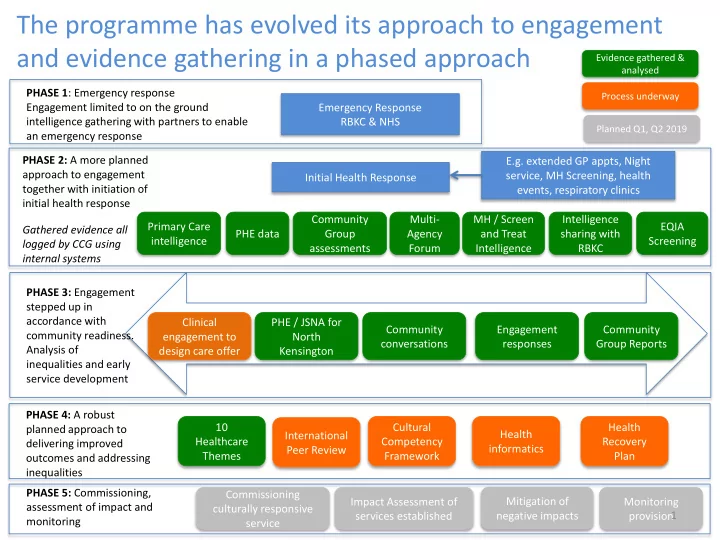
The programme has evolved its approach to engagement and evidence gathering in a phased approach Evidence gathered & analysed PHASE 1 : Emergency response Process underway Engagement limited to on the ground Emergency Response


slide-1
SLIDE 1

The programme has evolved its approach to engagement and evidence gathering in a phased approach

Emergency Response RBKC & NHS PHASE 1: Emergency response Engagement limited to on the ground intelligence gathering with partners to enable an emergency response PHASE 3: Engagement stepped up in accordance with community readiness. Analysis of inequalities and early service development Clinical engagement to design care offer PHE / JSNA for North Kensington Community conversations Engagement responses Community Group Reports Initial Health Response PHE data Community Group assessments EQIA Screening Primary Care intelligence MH / Screen and Treat Intelligence Intelligence sharing with RBKC PHASE 2: A more planned approach to engagement together with initiation of initial health response Gathered evidence all logged by CCG using internal systems E.g. extended GP appts, Night service, MH Screening, health events, respiratory clinics PHASE 4: A robust planned approach to delivering improved

  • utcomes and addressing

inequalities 10 Healthcare Themes Health informatics Health Recovery Plan PHASE 5: Commissioning, assessment of impact and monitoring Impact Assessment of services established Commissioning culturally responsive service Monitoring provision Cultural Competency Framework International Peer Review Multi- Agency Forum

Evidence gathered & analysed Process underway Planned Q1, Q2 2019

Mitigation of negative impacts 1

slide-2
SLIDE 2

Our approach

  • Developing the Evidence

base – Health Informatics

  • International Review of

PTSD

  • Community conversations
  • Patient conversations- GPs
  • Health Recovery Strategy
  • Cultural Competence

Framework

  • Literature Review - 622
  • Whole system change
  • Asset based approach to

health care

  • Social Value Act
  • Outcomes Framework
  • Commissioning Process
  • NK Health Recovery

Partnership

  • Accountability
slide-3
SLIDE 3

Social Determinants Community /Health Behaviours Engagement/Health Literacy NHSE Commissioners Providers

CULTURAL COMPETENCY CONNECTORS

slide-4
SLIDE 4

Theory of change

  • What is the populations

understanding of the healthcare available to them

  • Essential to a positive response

to healthcare and self care

  • Ability for people to engage

with professionals

Health literacy

  • How does the population

respond to their medical need

  • What are the influencers on

their response

  • What are the health

behaviours that we need to change

Health Insights

  • How patients and professionals

interact to begin to solve challenges

  • Shared decision making
  • Shared understanding of ‘What

matters to the patient’

Patient engagement

Getting the Theory of Change right enables:

  • Better Decision making for commissioners and providers on what and how

services and delivered

  • Health behaviour change in communities through better mutual understanding
  • f needs
  • Improved chronic disease management
  • Enable identification of the inputs that support desired change – and in turn

drive better outcomes / reduced inequalities

4

slide-5
SLIDE 5
  • Engagement approach
  • Health Insights
  • Health Literacy
  • Decision making
  • Cultural Influences
  • Health Behaviours/Information
  • Role of Commissioner/Provider
  • Role of Communities, patients, VCS/Faith Groups
  • Outcomes to measure success – NK specific

CCF COMPRISE OF