The Prison To College Pipeline: Supporting Justice-Involved Students - - PowerPoint PPT Presentation

the prison to college pipeline
SMART_READER_LITE
LIVE PREVIEW

The Prison To College Pipeline: Supporting Justice-Involved Students - - PowerPoint PPT Presentation

The Prison To College Pipeline: Supporting Justice-Involved Students P r e s e n t e d b y : A n n e - M a r i e B e c k & D e b r a A r v i s o Current U.S. Prison Population = over 2 million Source: World Prison Brief Compared to the


slide-1
SLIDE 1

The Prison To College Pipeline:

P r e s e n t e d b y : A n n e - M a r i e B e c k & D e b r a A r v i s o
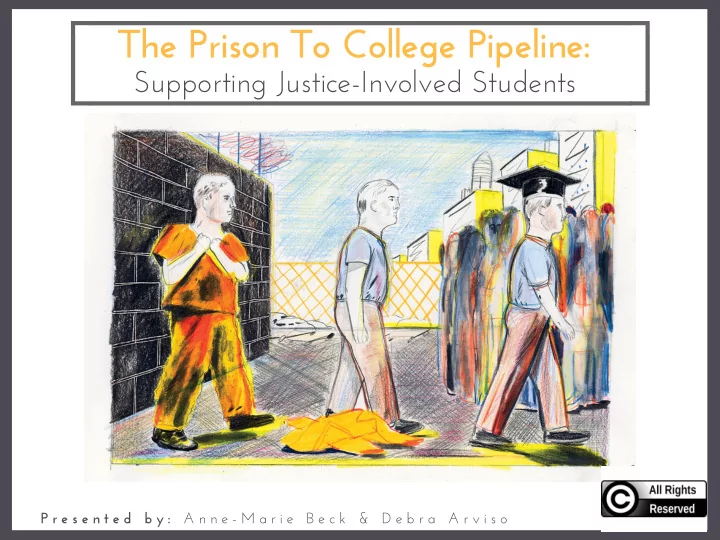
Supporting Justice-Involved Students

slide-2
SLIDE 2

Current U.S. Prison Population =

  • ver 2 million

Source: World Prison Brief

slide-3
SLIDE 3

Compared to the rest of the world..

slide-4
SLIDE 4

Population of inmates in California: 83,000 Several million Californians currently living with criminal convictions Approximately 400,000 Californians living under supervision / parole per year Nearly 90% of people under supervision are within 15 miles of public college campus

Sources: World Prison Brief & Degrees of Freedom: Expanding Opportunities for Currently and Formerly Incarcerated Californians

slide-5
SLIDE 5

Recidivism: a tendency to relapse into a previous condition or mode of behavior; especially: relapse into criminal behavior California's rate of recidivism =

  • ne of the highest in the country: 58%

Source: Merriam-Webster Dictionary & Pew Charitable Trust: "State of Recidivism The Revolving Door of America's Prisons" 2011

slide-6
SLIDE 6

The Power of an Education

Meta-Analysis by the RAND Corp: Individuals who participate in college programs while in custody = 51% lower odds of recidivating

Source: Davis LM, Bozick R, Steele JL, Saunders, J., Miles, J. (2013)

slide-7
SLIDE 7

...and the Power of Employment

Employment = major predictor of recidivism (regardless of criminal classification)

Source: Nally, M., Lockwood, S., Ho, T., & Knutson, K. (2009)

slide-8
SLIDE 8

Trauma & The Incarcerated Population 2009 Study of 4,000 inmates: 56% of men 54% of women Reported physical abuse in childhood

Source: Wolff, N., Shi, J., & Siegel, J.A. (2009)

slide-9
SLIDE 9

Definition of Trauma

An event that is experienced as physically or emotionally harmful or life threatening and that has lasting adverse effects on the individual’s functioning and well-being.

Source: Substance Abuse and Mental Health Service Administration (SAMSHA)

slide-10
SLIDE 10

Trauma During Incarceration

Individuals can be traumatized while incarcerated as well.

Source: Wooldridge, J. D. (1998)

1998 study: 1/10 (of 581 inmates) reported being physically assaulted within 6 months of interview

slide-11
SLIDE 11

Other Groups At Risk For Trauma

  • Foster Youth
  • Refugee students
  • LGBTQ students
  • Veterans
  • American Indian/Alaska Native students
slide-12
SLIDE 12

Trauma In College Students

What you might see:

  • Difficulty focusing and recalling
  • Withdrawal and isolation
  • Missing a lot of classes
  • Fear of taking risks

Source: Hoch, A., Stewart, D., Webb, K., & Wyandt-Hiebert, M. A. (2015, May).

slide-13
SLIDE 13

Trauma Informed Approach: 3 Rs

Goal: Resist Retraumatization

Source: Hoch, A., Stewart, D., Webb, K., & Wyandt-Hiebert, M. A. (2015, May).

A program, organization, or system that is trauma-informed:

  • Realizes the impact of trauma and understands paths for recovery
  • Recognizes the signs of trauma in students, staff, and others

involved with the system

  • Responds by integrating knowledge about trauma into
  • Policies
  • Procedures
  • Practices
slide-14
SLIDE 14

Safety & Trustworthiness

  • Are first contacts welcoming, respectful, and engaging?
  • How safe is the building or environment?
  • Is information about tasks and procedures clear?
  • Are roles and professional boundaries defined?

Source: Hoch, A., Stewart, D., Webb, K., & Wyandt-Hiebert, M. A. (2015, May).

slide-15
SLIDE 15

Collaboration & Empowerment

  • Are trauma survivors on an advisory board that evaluates

services?

  • Are opportunities to work with faculty advertised?
  • Are each student’s strengths and skills recognized?
  • Are students encouraged to advocate for themselves

Source: Hoch, A., Stewart, D., Webb, K., & Wyandt-Hiebert, M. A. (2015, May).

slide-16
SLIDE 16

Working With Trauma-Affected Individuals

  • Normalize and validate their feelings and experiences
  • Empower them to better manage their current lives
  • Check in & express concern for emotional safety

Source: Source: Knight, C . (2015); Carello, J., & Butler, L. D. (2014); Downey, L. (2013); Health Federation of Philadelphia (2010); Wolpow, R., Johnson, M. M., Hertel, R., & Kincaid, S. O. (2009)

slide-17
SLIDE 17

Connecting the Dots: Warm Hand-Off

  • Identify trauma informed allies on campus
  • Identify allies at off campus service providers:

* Probation * Department of Mental Health * Workforce Development * Department of Rehabilitation * CSU & UC programs * Housing Getting the run-around, encountering unfriendly staff, or getting unreliable information can be re-traumatizing

slide-18
SLIDE 18

Possible Career Development Challenges

Lack of qualifications / low employment prior to and after incarceration Low educational attainment Housing, food, and transportation Limited awareness of skills, interests, values Criminal background serves as barrier to employment

Sources: Shivy et. al, 2007; Lebel, 2012; Unruh, Gau, & Waintrup, 2009

slide-19
SLIDE 19

Possible Career Development Challenges

Interpersonal difficulties Re-working identity Substance abuse disorder Mental or physical disability

Negative thinking / Dysfunctional career thoughts

Sources: Laux et. al, 2011; Lynch & Sabol, 2001; Haney, 2006; Travis et. al, 2001; Shivy et. al, 2007

slide-20
SLIDE 20

Root & Rebound: Reentry Advocates

Provide several different guides (also: My Education, My Freedom & Employers' Fair Chance Hiring Toolkit) Provide trainings on how to use their resources Have a free legal hotline: 510-279-4662

slide-21
SLIDE 21

Career Theories to Consider

Positive Psychology / Strengths-Based Psychology Narrative / Storied Approach Planned Happenstance Cognitive Therapy

slide-22
SLIDE 22

"It is never too late to be what you might have been."

  • George Elliot