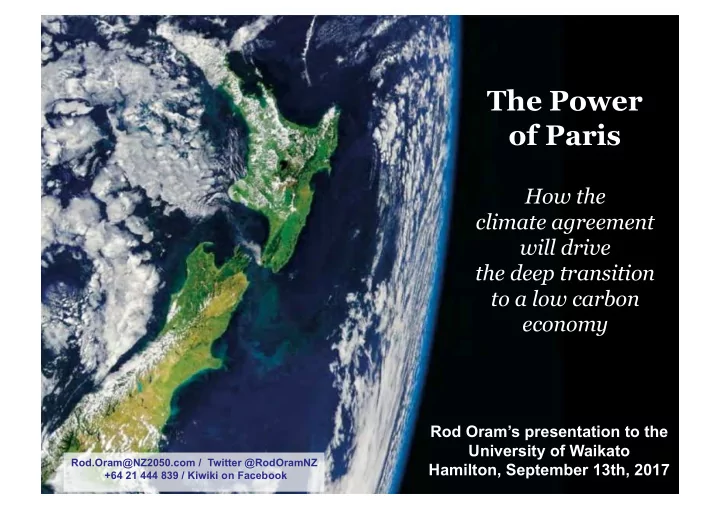
SLIDE 1 The Power
How the climate agreement will drive the deep transition to a low carbon economy
Rod Oram’s presentation to the University of Waikato Hamilton, September 13th, 2017
Rod.Oram@NZ2050.com / Twitter @RodOramNZ +64 21 444 839 / Kiwiki on Facebook
SLIDE 2 Agenda
- Paris
- New Zealand
- Response
SLIDE 3
SLIDE 4 Our time!
in Cape Town
International Geological Congress
the Anthropocene
start date at 1950…
from nuclear tests went global
precise time stamp for human impact
SLIDE 5
... 4.5 billion years in the making
SLIDE 6
SLIDE 7
t
The 6th Great Extinction of species has begun
…the first caused by humans
SLIDE 8 NZ species loss is accelerating ...and a rising number of species are threatened e.g. only 12 breeding pairs of Fairy Terns and only 65 or so Maui Dolphins
SLIDE 9
- https://www.youtube.com/watch?v=fvgG-pxlobk
SLIDE 10 http://www.anthropocene.info/
SLIDE 11
SLIDE 12
Biggest risks
SLIDE 13 www.stockholmresilience.org/21/research/research-programmes/planetary-boundaries.html
The Nine Planetary Boundaries
SLIDE 14 2 4 3 5 6 1 Global Temperature (°C)
IPCC Projections 2100 AD
Earth System moves to a new state? Severe challenge to contemporary civilisation. Possible collapse?
Summerhayes 2015
Committed
SLIDE 15
SLIDE 16 NZ’s crucial contribution to Paris…
- …we proposed the concept of each country determining its own contribution to
reducing carbon – this broke the years-long deadlock in global climate negotations
- We are very useful in such global forums...as we were e.g. at founding of the UN
in San Francisco in 1945
- ...but we have to live up to the standards we expect of others
SLIDE 17 Monumental global challenges
- Are there technological and
economic pathways for big cuts in global emissions in next 20 years?
and business investment?
- Electricity? Yes!
- Transport? Yes!
- Industry & buildings? Yes!
- Agriculture? No!
- …but NZ should be a global
leader to turn this around...and we aren’t yet
SLIDE 18 Rethinking transport
- https://static1.squarespace.com/static/585c3439be65942f022bbf9b/t/591a2e4
be6f2e1c13df930c5/1494888038959/RethinkX+Report_051517.pdf
SLIDE 19
SLIDE 20
SLIDE 21 Airbus E-Fan
- Electric planes?
- Unthinkable a few
years ago
are flying…
Boeing have potential technology pathways to commercial passenger aircraft
SLIDE 22
Electric planes by 2030?
SLIDE 23 Boeing’s research on hybrid and electric planes
- http://tec.ieee.org/aeronautical/boeing-sugar-volt-hybrid-airplane/
SLIDE 24 Transportation Electrification Community
- http://tec.ieee.org/ US Institute of Electrical and Electronics Engineers
SLIDE 25
SLIDE 26
SLIDE 27
Carbon Disclosure Project
SLIDE 28 Carbon Disclosure Project
- https://www.cdp.net/en/research/global-reports/tracking-climate-progress-2016
SLIDE 29
SLIDE 30
- http://www.dpdhl.com/en/responsibility/environmental-protection.html
SLIDE 31
Circular economy
SLIDE 32 Peter Bakker CEO, World Business Council for
Sustainable Development
SLIDE 33 Revolution
- Led by John Elkington and others
- www.breakthroughcapitalism.com/
SLIDE 34
SLIDE 35 Breakthrough Criteria
- Future Ready
- Ecological foot printing – Global Footprint Network
- Planetary Boundaries – Stockholm Resilience Institute
- Stranded Assets - Carbon Tracker
- Ambitious
- Environmental Profit & Loss – Puma with PricewaterhouseCoopers
- Zero emissions – Interface Zero Mission
SLIDE 36 Breakthrough Criteria
- Fair
- Sustainable Living – Unilever
- Social innovation & entrepreneurship – Skoll Centre for Social Entrepreneurship
- Fair Trade
- Disruptive
- Biomimicry – Janine Benyus & Associates
- Circular Economy – Ellen Macarthur Foundation
- Cradle-to-Cradle – McDonough Braungart Design Chemistry
- Collaborative / sharing economy – Uber, Airbnb, Yerdle
SLIDE 37
SLIDE 38 Our competition
zero environmental impact
SLIDE 39 Vertical farming
- ...an example in New Jersey:
AeroFarms, http://aerofarms.com
2017 http://www.newyorker.com/mag azine/2017/01/09/the-vertical- farm
SLIDE 40 Cities will have to change fundamentally
back into cities
largely sufficient for energy, food and other resources
inspiring places to live and work
relationship with the ecosystem
SLIDE 41 Smart cities
- nz2050.com/McKinseySmartCities
SLIDE 42
SLIDE 43 Agenda
- Paris
- New Zealand
- Response
SLIDE 44 Our Paris commitment
- NZ’s current target is to reduce our greenhouse gas emissions by 30%
below 2005 levels by 2030.
- This target is equivalent to 11% below 1990 levels by 2030
- Yet, California's bi-partisan, mandated goal is a 40% cut from 1990 levels by 2030
SLIDE 45 “…the shift...will be profound and widespread”
- “…the shift from the old economy
to a new, low-emissions economy will be profound and widespread, transforming land use, the energy system, production methods and technology, regulatory frameworks and institutions, and business and political culture.”
- New Zealand Productivity Commission
Low carbon economy, August 2017
- http://www.productivity.govt.nz/inquiry-
content/3254?stage=2
- Final report, with recommendations due June 30, 2018
SLIDE 46 What we say…is not what we do
- We’re missing our Paris commitments by miles
SLIDE 47
NZ: poor GHG performance per capita
SLIDE 48
SLIDE 49
NZ’s Paris pledge – where we rank
SLIDE 50
NZ: Emissions rising; current policies won’t cut them
SLIDE 51 “New Zealand is doing its fair share”- John Key
- “New Zealand’s climate target shows it’s far from doing its ‘fair share,’
and is anything but ambitious,”
- Bill Hare, CEO and Senior Scientist at Climate Analytics
(one of the science partners in Climate Action Tracker)
- “If most other countries were to follow New Zealand’s approach,
global warming would exceed 3-4C, a world that would see oceans acidify, coral reefs dissolving, sea levels rising rapidly, and more than 40% species extinction.”
SLIDE 52 OECD’s verdict
- “New Zealand’s growth model...has started to show
its environmental limits, with increased GHG emissions, freshwater contamination and threats to biodiversity.
- “Addressing GHG emissions from agriculture, and
especially dairy farming, should remain a priority...
- “...the need to further explore the economic
- pportunities that more sustainable uses could yield.
- “Developing a long-term vision for a transition
towards a low-carbon, greener economy would help New Zealand defend the “green” reputation it has acquired at an international level.”
SLIDE 53
SLIDE 54
SLIDE 55 Net Zero New Zealand
- Very encouraging NZ roadmap to a low carbon economy
- ...and the dangers of sticking where we are
- Commissioned by GLOBE-NZ (all-party group of MPs),
business and others
- Report produced by Vivid Economics of the UK
- Report and slides from Beehive launch:
- http://www.vivideconomics.com/publications/net-
zero-in-new-zealand
SLIDE 56 Civil and constructive debate...
- ...in Parliament?
- Yes!
- ...the debate:
https://www.parliament.nz/en/watch- parliament/ondemand?keyword=&from=2017-04-13&to=2017-04- 13&subject=&person=&stage
SLIDE 57 Lots we can do on agricultural GHG
- http://www.pce.parliament.nz/publications/climate-change-and-agriculture-understanding-
the-biological-greenhouse-gases
SLIDE 58
NZ’s greenhouse gas emissions
SLIDE 59
e.g. NZ’s transport emissions keep growing
SLIDE 60
Road transport is the big issue
SLIDE 61 Stranded assets
change strands assets
by the rapid transition to a low carbon economy
SLIDE 62 Agenda
- Paris
- New Zealand
- Response
SLIDE 63 The response by National-led government
- Three-pronged:
- Reductions in emissions
- Increase in forestry to sequester carbon
- Buy credits from overseas
- …very roughly, each contributing one-third to our Paris reduction
- The government was promising policies mid-year, or at least before the election, on:
- Revamping the ETS so it sets a higher, more predicatble price on carbon
- Some sector policies e.g. on forestry and agriculture informed by working parties
- Some clarity on carbon credits
- However:
- Todate the work has been slow and superficial
- e.g. not grappling with lack of international credits
- Agriculture looks certain to remain outside the ETS
- despite Parl. Commissioner of Environment & others identifying positive actions
- Still great policy uncertinaty for business and other stakeholders
- Meanwhile:
- Our emissions are going up not down...with land transport going up the most
SLIDE 64 The cost of buying carbon credits abroad
- $14.2bn over 10 years
- Treasury’s estimate in a briefing to Judith Collins on her first day
as Energy Minister…and carbon prices have risen since
- “This represents a significant transfer of wealth overseas", officials wrote
- “An over reliance on overseas purchasing at the expense of domestic reductions
could also leave New Zealand exposed in the face of increasing global carbon prices beyond 2030".
- What officials didn’t say:
- Investing in helping other countries meet their Paris commitments…
- ...means we invest less money in our transition to a modern, low carbon economy
- ...leaving us with older technology
- ...which impairs our productivity, environment and brand
SLIDE 65 ETS reform
work/environment-and- resources/emission- mitigation/emissions- trading/an-effective-nz- ets-clear-price-signals- to-guide-low-emission- investment/
work on how to make the ETS fit-for-purpose…
very few, if any, international credits available for NZ to buy
SLIDE 66 Pure Advantage
big transition to a low carbon economy
- Business-backed advocates of
- ...clean technology
- ...low carbon
- ...deep sustainability
- http://pureadvantage.org/
SLIDE 67 The response from business
- There are some leaders:
- …e.g Z Energy, Sanford, Mercury
- ...and Air NZ, Vector, Inftratil (e.g. its NZ Bus), Tourism Holdings,
Waste Management and some others
- ...e.g. some car companies are bringing in some clean technology
- But they aren’t on the leading edge internationally
- Meanwhile, a large majority of businesses are not engaged strategically
- ...’tho some are doing some tactical things
- NZ is well behind on new international norms
- e.g. mandatory carbon reporting for stock market listed companies
- e.g. on the climate-related investment disciplines NZ Super Fund uses
SLIDE 68 Smart grid – the future of electricity
- Distributed generation, storage, trading, two-way flows, and EVs are key components
SLIDE 69
Vector – 1MW batteries in Auckland, October 2016
SLIDE 70
Vector – 5MW batteries in Alice Springs, June 2017
SLIDE 71 Wrightspeed...a Kiwi in California
- Ian Wright helped establish Tesla Motors...has moved on to turbine-electric trucks
- …Wrightspeed drivetrains being used to re-power Wellington’s trolley buses
SLIDE 72 E-trucks for Christchurch
SLIDE 73 …mewnhile in the UK in the last century...
- …I grew up with electric rubbish trucks until 1973
SLIDE 74
1912 Baker Electric – First EV in the White House
SLIDE 75 E-campervans
- Tourism Holdings has two projects:
- New-build on a European e-van chassis
- Retrofitting diesel campervans with e-powertrains
- …on the road to autonomous campervans
- (...below is illustrative: it’s not using Smith chassis)
SLIDE 76 Business is crucial for…
- Pushing the government to deliver strong & stable climate & environment policies
- Investing in new technology, business opportunities and business models
- …to lead NZ’s low carbon transformation
- Creating opportunities for its customers and suppliers
- e.g. in low carbon products and services
- …and more widely e.g. buying new EVs that they later on-sell to
small businesses and consumers
- Helping the public to get involved in the new economy
- Encouraging the primary sector to get going on its low carbon opportunities
- Business that are deeply committed to sustainability enjoy:
- Increased engagement and innovation from staff
- Faster development and greater resilience
- Stronger competitive advantage
- …they are making their future, rather than defending their past
SLIDE 77 Change-agents
- EV owners are very enthusiastic and persuasive
SLIDE 78
SLIDE 79 NZ’s agribusiness agenda 2017
- https://home.kpmg.com/nz/en/h
- me/insights/2017/06/agribusin
ess-agenda-2017-the-recipe- for-action.html
SLIDE 80 Top 10 priorities
content/dam/kpmg/nz/pdf /June/agri-agenda-2017- kpmg-nz.pdf
climate issues rank far outside the sector’s top 10 priorities
SLIDE 81 Sustainability: Theme 4, Priorities 11, 17 & 37
So low, yet, “…the prospects for the industry are intextricably linked to its stewardship
environment and water.”
SLIDE 82 Climate change - Priority 48
- “New Zealand should aspire to lead
the world in mitigating the impact agriculture has on human-induced climate change but to achieve this requires financial signals. The suggestion was made by a number
- f contributors that the agri-sector
should welcome its early inclusion into the emissions trading scheme, with a framework of incentives and penalties to encourage the right behaviours.”
SLIDE 83 Tuhoe’s Te Uru Taumatua
- …the first Living Building in New Zealand...doing things in very NZ distinctive ways
SLIDE 84 “You’ll have no future… …if you don’t make one for yourself”
Johnny Rotten