
SLIDE 1
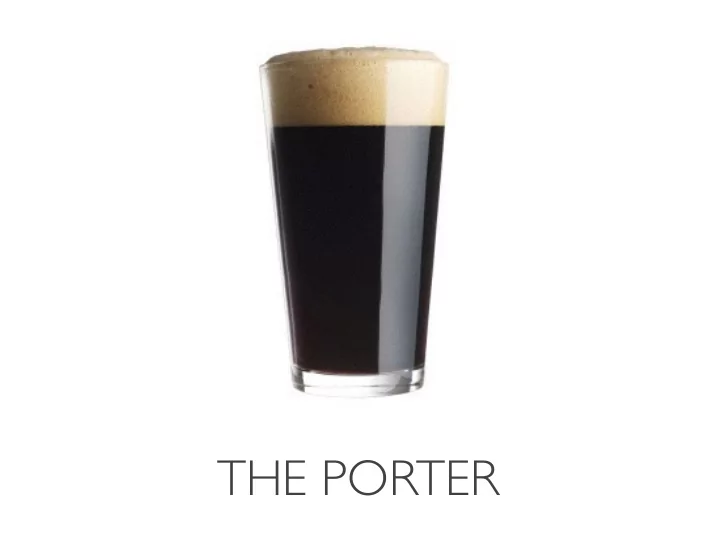
THE PORTER ? Popular with London street Porters in the late 1700s - - PowerPoint PPT Presentation
THE PORTER ? Popular with London street Porters in the late 1700s Engineered to cater to public tastes in England during the Industrial Revolution (1760-1830s) Old Ale (Stale or Soured) + Three Threads, = Entire Butt, New Ale (Brown or
12A Brown Porter: Chocolatey & Carmely, light roastiness (ale) 12B Robust Porter: More Roasty/Lightly Burnt (ale) 12C Baltic Porter: Malty Sweet, Light Toastiness, Fruity Notes (lagered)
Crisp, Slightly Fruity Subtle, Apple/Pear/Honey Clean/Balanced, Accentuates Hop Flavor Malty, Sweet Malty, Clean Rich/Malty, Full Bodied
Neutral but Slightly Fruity/Estery
13A Dry Stout: 4-5% ABV, Moderately roasty, coffee, cocoa, creamy, bitter, dry 13B Sweet Stout: 4-6% ABV, Cream-like sweetness 13C Oatmeal Stout: 4-6% ABV, Lightly sweet, thick, creamy, silky 13D Foreign Extra Stout: 5.5-8% ABV, Molasses, fruity, rum-like sweetness: brewed for tropical regions 13E American Stout: 5-7% ABV, Citrusy, resiny hops 13F Russian Imperial Stout: 8-12% ABV, Barleywine-like, high ABV 12A Brown Porter: 4-5.4% ABV, Chocolatey & Carmely, light roastiness (ale) 12B Robust Porter: 5-6.5% ABV, More Roasty/Lightly Burnt (ale) 12C Baltic Porter: 5.5-9% ABV, Malty Sweet, Light Toastiness, Fruity Notes (lagered)
BEERWESTMAG.COM: "101 // STOUT VS. PORTER", HTTP://WWW.BEERWESTMAG.COM/THE-MAGAZINE/101-STOUT-VS-PORTER/ WIKIPEDIA.COM: "STOUT", HTTP://EN.WIKIPEDIA.ORG/WIKI/STOUT WIKIPEDIA.COM: "ENGLISH PORTER", HTTP://EN.WIKIPEDIA.ORG/WIKI/ENGLISH_PORTER BEERCONNOISSEUR.COM: "THE DIFFERENCE BETWEEN PORTER AND STOUT", HTTP:// WWW.BEERCONNOISSEUR.COM/PORTER-VERSUS-STOUT CRAFTBREWINGBUSINESS.COM: "WHAT'S THE DIFFERENCE BETWEEN PORTER AND STOUT", HTTP:// WWW.CRAFTBREWINGBUSINESS.COM/BEER-OF-THE-MONTH/WHAT-IS-THE-DIFFERENCE-BETWEEN-PORTER-AND- STOUT BEERADVOCATE.COM: "WHAT THE HELL IS A PORTER", HTTP://BEERADVOCATE.COM/ARTICLES/305 CHOW.COM: "WHAT'S THE DIFFERENCE BETWEEN STOUT AND PORTER", HTTP://WWW.CHOW.COM/FOOD- NEWS/54830/WHATS-THE-DIFFERENCE-BETWEEN-STOUT-AND-PORTER/