The point dipole, induced by the incident field at the tip apex, is - - PowerPoint PPT Presentation

the point dipole induced by the incident field at the tip
SMART_READER_LITE
LIVE PREVIEW

The point dipole, induced by the incident field at the tip apex, is - - PowerPoint PPT Presentation

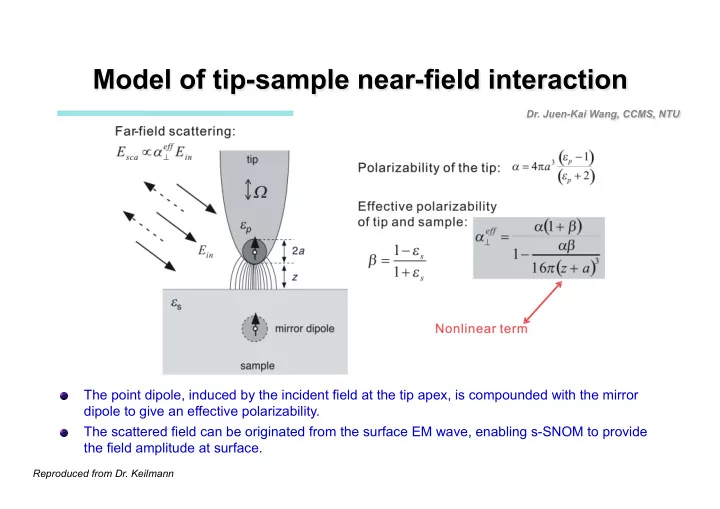
The point dipole, induced by the incident field at the tip apex, is compounded with the mirror dipole to give an effective polarizability. The scattered field can be originated from the surface EM wave, enabling s-SNOM to provide the


slide-1
SLIDE 1

Reproduced from Dr. Keilmann

  • The point dipole, induced by the incident field at the tip apex, is compounded with the mirror

dipole to give an effective polarizability.

  • The scattered field can be originated from the surface EM wave, enabling s-SNOM to provide

the field amplitude at surface.

slide-2
SLIDE 2
  • R. Hillenbrand and F. Keilmann, Phys. Rev. Lett. 85, 3029 (2000).
  • The interferometric setup measures amplitude and phase of the scattered radiation.
  • A heterodyne detection scheme is adopted to facilitate the detection of amplitude and phase.
  • The cross term is amplified by the reference beam.
  • The higher harmonic term is recorded to extract the near-field signal based on the nonlinear dependence of

the effective polarizability on the tip-sample sample

slide-3
SLIDE 3
  • The s-SNOM achieves ~5 nm resolution, suitable for the near-field studies of plasmonics.
slide-4
SLIDE 4
slide-5
SLIDE 5
  • Through Fourier transform, the obtained k-space image exhibits one large circle and two center-

shifted small circles and does not agree with the one obtained with FDTD method.

200 nm Ag film Hole diameter: 150 nm lex = 532 nm

Y.-C. Chang et al., Opt. Exp. 16, 740 (2008).

slide-6
SLIDE 6
  • Nanohole-induced and tip-induced surface plasmon waves
  • Both waves contribute to the detected scattering radiation of s-SNOM.

Y.-C. Chang et al., Opt. Exp. 16, 740 (2008).

slide-7
SLIDE 7
  • The s-SNOM image without the 2kSPW circle matches with the image calculated without the tip.

Y.-C. Chang et al., Opt. Exp. 16, 740 (2008).

200 nm Ag film Hole diameter: 150 nm lex = 532 nm