THE PHEBUS FACILITY AND RELATED STUDIES September 16 / 2005 - - PowerPoint PPT Presentation

the phebus facility and related studies
SMART_READER_LITE
LIVE PREVIEW

THE PHEBUS FACILITY AND RELATED STUDIES September 16 / 2005 - - PowerPoint PPT Presentation

TRTR - IGORR 2005 THE PHEBUS FACILITY AND RELATED STUDIES September 16 / 2005 Holiday Inn - Gaithersburg, MD Yves BELPOMO Thierry DOUSSON CEA DEN DER 1 The PHEBUS facility and related studies OUTLINES Context PHEBUS FP Programme


slide-1
SLIDE 1

1

TRTR - IGORR 2005 Yves BELPOMO – Thierry DOUSSON CEA DEN DER
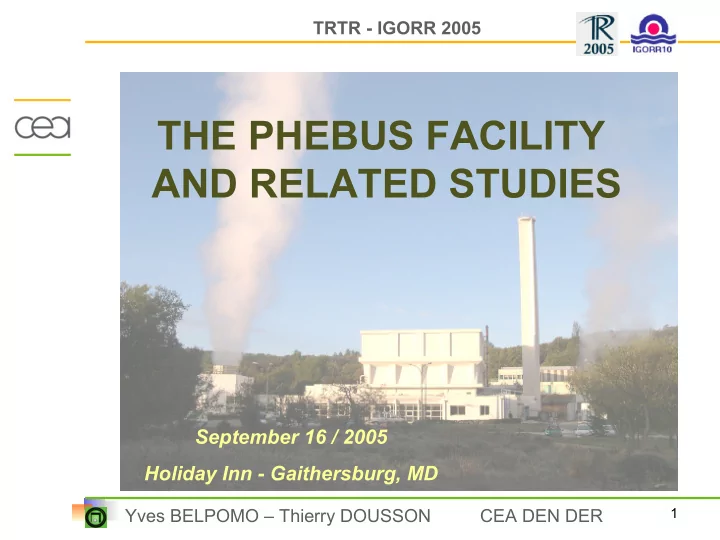
THE PHEBUS FACILITY AND RELATED STUDIES

September 16 / 2005 Holiday Inn - Gaithersburg, MD

slide-2
SLIDE 2

2

  • Y. BELPOMO CEA/DEN/DER Cadarache

The PHEBUS facility and related studies

OUTLINES

  • Context
  • PHEBUS FP Programme and FPT3 test
  • PHEBUS Facility description

 Reactor  Fission Products Lab

  • Main characteristics for other

experiments

slide-3
SLIDE 3

3

  • Y. BELPOMO CEA/DEN/DER Cadarache

General context

  • PHEBUS is a research reactor operated by CEA at the

Cadarache research centre

 Achieve integral experiences to improve the knowledge in case of incidental conditions and severe accidents consequences  Validate calculation codes through global experiences

At the present time, the arising question concerns the future programs to be carried out in PHEBUS.

  • Since its operational start, PHEBUS has been dedicated to

safety issues experiences in order to :

slide-4
SLIDE 4

4

  • Y. BELPOMO CEA/DEN/DER Cadarache

PHEBUS facility and FP Programme

  • History :

 1979 : Operational start of the PHEBUS facility reactor  From 1979 to 1990 : programmes LOCA, SDC  1990 : Operational start of the FP Laboratory. Global seism reinforcement.

  • While achieving international programmes managed by IRSN, the

PHEBUS facility has allowed a better understanding of core degradation modes and fission products release.

slide-5
SLIDE 5

5

  • Y. BELPOMO CEA/DEN/DER Cadarache

R eactor C ontainm ent M odel (10 m 3) Painted C ondensers Sum p (100 l) Sam pling furnaces Sam pling furnace E xperim ental C ell Phebus R eactor C ore Test A ssem bly gam m a Spectro Steam G enerator M odel A queous Sam pling F P C aisson Phebus R eactor

PHEBUS FP programme design

The international PHEBUS FP Programme reproduces (on a reduced scale 1/5000 vs 900 MW PWR) a core meltdown accident in a P.W.R.

slide-6
SLIDE 6

6

  • Y. BELPOMO CEA/DEN/DER Cadarache

Fuel Re-irradiation 8 days 36 h 5 hours Transition phase Expérimental phase

PHEBUS FP experience

slide-7
SLIDE 7

7

  • Y. BELPOMO CEA/DEN/DER Cadarache

PHEBUS FP Programme

FP Programme main improvements :

The PHEBUS FP test matrix :

  • FPT0 (1993)
  • FPT1 (1996)
  • FPT4 (1998)
  • FPT2 (2000)
  • FPT3 (2004)
  • FPT5 => STLOC1 postponed to 2012

⇒ The core degradation, corium relocation and corium pool formation, ⇒ The hydrogen production by oxidation during core degradation, ⇒ The nature and quantities of radioactive products released to the environment

slide-8
SLIDE 8

8

  • Y. BELPOMO CEA/DEN/DER Cadarache

PHEBUS facility

PHEBUS Reactor FP LAB & Containment vessel

slide-9
SLIDE 9

9

  • Y. BELPOMO CEA/DEN/DER Cadarache

PHEBUS reactor PHEBUS is a (max) 38 thermal MW pool type reactor During several days, 20 MW operating can be carried out

Main components

– A driver core dedicated to produce the neutron flux in order to :

  • Create short life fission products in

the experimental fuel

  • Bring to the experimental fuel the

representative nuclear heating

– A specific in pile pressurized water loop (155 b, 320 °C) dedicated to experimental fuel settlement, re-irradiation and degradation. – A leaktight cell, located vertically at the reactor core centre, in which takes place the experimental fuel device.

slide-10
SLIDE 10

10

  • Y. BELPOMO CEA/DEN/DER Cadarache

The PHEBUS reactor building also includes renewed tools such as :

  • A 250 kN handling crane (heavy maintenance in 2004),
  • A specific experimental device handling machine (control refurbishing

in 2004)

  • An immobilizing matrix injection equipment
  • Storage pools
  • An examination and control Equipment (tomographs and radiographs)

PHEBUS Reactor lay out

slide-11
SLIDE 11

11

  • Y. BELPOMO CEA/DEN/DER Cadarache

The FP laboratory building

The PHEBUS FP lab was erected in 1990. It mainly contains :

  • An instrumented containment vessel (350 m3) to receive

the fission products released during the experience.

  • Hot cells dedicated to experimental samples retrieval, gamma

spectrometry measurement, conditioning and storage.

slide-12
SLIDE 12

12

  • Y. BELPOMO CEA/DEN/DER Cadarache

PHEBUS containment vessel

slide-13
SLIDE 13

13

  • Y. BELPOMO CEA/DEN/DER Cadarache

PHEBUS FP circuits 1/2

slide-14
SLIDE 14

14

  • Y. BELPOMO CEA/DEN/DER Cadarache

PHEBUS FP circuits 2/2

slide-15
SLIDE 15

15

  • Y. BELPOMO CEA/DEN/DER Cadarache

Different options are possible for the future

  • f the PHEBUS facility:
  • PHEBUS ST-LOC

At the present time, an international expert group is studying safety experiences that could require the PHEBUS facility tools

  • Long term care and maintenance Program
  • Other experimental issues based on the facility

capabilities PHEBUS future options

slide-16
SLIDE 16

16

  • Y. BELPOMO CEA/DEN/DER Cadarache

Conclusion : Experimental capabilities A pressurized water loop reproducing PWR chemical, thermal and hydraulics conditions (until 160 bar and 320 °C) Experimental cell on the core vertical axis : Axisymetric neutron flux Adjustable Cooling flowrate (until 90 m3/h) Large Experimental cell diameter (124 mm) Highly skilled operators and revamped equipment The design and safety requirements of the PHEBUS FP programme allow a large experiences panel in the facility Driver core active height of 80 cm Power reserve allowing the neutronic spectrum adjustment for the experimental test device design

slide-17
SLIDE 17

17

  • Y. BELPOMO CEA/DEN/DER Cadarache

The PHEBUS reactor at work : FPT3 test, November 18, 2004 yves.belpomo@cea.fr -thierry.dousson@cea.fr

End

slide-18
SLIDE 18

18

  • Y. BELPOMO CEA/DEN/DER Cadarache

Driver core and pressurized water loop

slide-19
SLIDE 19

19

  • Y. BELPOMO CEA/DEN/DER Cadarache

PHEBUS : an international objective

The Phebus network gathers more than 40 international institutes PHEBUS operator : CEA

slide-20
SLIDE 20

20

  • Y. BELPOMO CEA/DEN/DER Cadarache

PHEBUS FPT3 test

slide-21
SLIDE 21

21

  • Y. BELPOMO CEA/DEN/DER Cadarache

PHEBUS Driver core

  • 36 Fuel elements with a

2.78% enrichment in 235U

  • 6 safety control rods

(hafnium)

  • 4 barriers between the

experimental fuel and the pool water

  • Graphite reflectors

layers

slide-22
SLIDE 22

22

  • Y. BELPOMO CEA/DEN/DER Cadarache

Liquid decontamination RC Dismantling Final dismantling and clean-up Active waste transfer Samplings storage Samplings preparation and gamma measurement

Vessel

CECILE CELENA

DEDA

Sampling retrieval

PHEBUS containment vessel dismantling Required operations

slide-23
SLIDE 23

23

  • Y. BELPOMO CEA/DEN/DER Cadarache

FPT3 main events

Tg=700°C 1400°C 1580°C Start relocation

P4 [obj. 2000°C max]

slide-24
SLIDE 24

24

  • Y. BELPOMO CEA/DEN/DER Cadarache

Positions des BCS

Bras anti envol

HN2

G2.1 G2.2

HN3 HN1 BN2 BN3 BN1

Pilotage dégradation sur 4 BCS

slide-25
SLIDE 25

25

  • Y. BELPOMO CEA/DEN/DER Cadarache

Instrumentation boîtier

slide-26
SLIDE 26

26

  • Y. BELPOMO CEA/DEN/DER Cadarache
slide-27
SLIDE 27

27

  • Y. BELPOMO CEA/DEN/DER Cadarache

PHEBUS ST LOC Programme

  • STLOC Programme:

 Restricted experimental objectives  PF LAB vessel required simplified manual interventions

  • PHEBUS ST-LOC : The test matrix consists in

five experiments

 3 «FP» type

  • High Burn-Up (52 -->70 GWJ/T)
  • MOX
  • Quench

 2 LOCA type (with irradiated fuel)

  • MOX and High Burn-up
slide-28
SLIDE 28

28

  • Y. BELPOMO CEA/DEN/DER Cadarache

PHEBUS FP lab

  • Liquid waste
  • They are transferred out of the

PHEBUS facility using a transport truck equipped with a double containment liner tank

  • The PHEBUS FP lab also includes

several equipment in order to deal with :

  • Solid waste
  • They are transferred outside the

vessel through a device assuming containment and radiological shield.