the The Wolfsberg Group Anti-Money Laundering Questionnaire - - PDF document

the
SMART_READER_LITE
LIVE PREVIEW

the The Wolfsberg Group Anti-Money Laundering Questionnaire - - PDF document

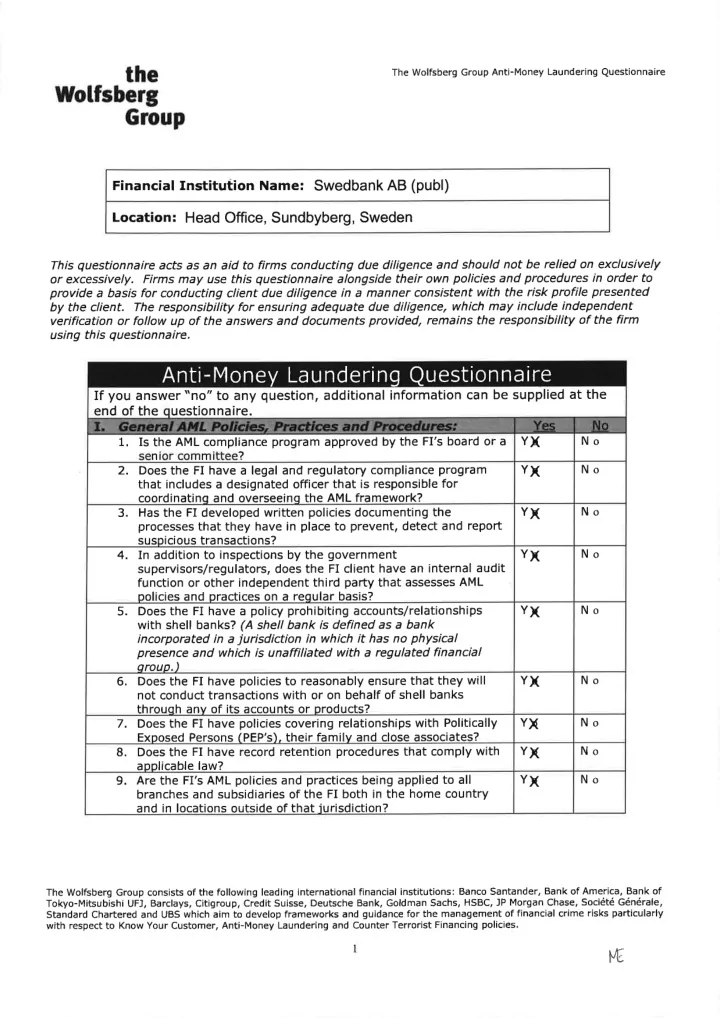
the The Wolfsberg Group Anti-Money Laundering Questionnaire Wolfsberg Group Financial Institution Name: Swedbank AB (publ) Location: Head Office, Sundbyberg, Sweden This questionnaire acts as an aid to firms conducting due diligence and should not


slide-1
SLIDE 1

the Wolfsberg

Group

The Wolfsberg Group Anti-Money Laundering Questionnaire

Financial Institution Name: Swedbank AB (publ)

Location: Head Office, Sundbyberg, Sweden

This questionnaire acts as an aid to firms conducting due diligence and should not be relied on exclusively

  • r excessively. Firms may use this questionnaire alongside their own policies and procedures in order to

provide a basis for conducting client due diligence in a manner consistent with the risk profile presented by the client. The responsibility for ensuring adequate due diligence, which may include independent verification or follow up of the answers and documents provided, remains the responsibility of the firm using th is q uestion na i re.

The Wolfsberg Group consists of the following leading international financial institutions: Banco Santander, Bank of America, Bank of Tokyo-Mitsubishi UFJ, Barclays, Citigroup, Credit Suisse, Deutsche Bank, Goldman Sachs, HSBC, lP Morgan Chase, Société Générale, Standard Chartered and UBS which aim to develop frameworks and guidance for the management of financial crime risks particularly

with respect to Know Your Customer, Anti-Money Laundering and Counter Terrorist F¡nancing policies.

If you answer "no" to any question, additional information can be supplied at the

1, Is the AML compliance program approved by the FI's board or a

No YX

n

m

?

end of the uestionnaire YX No

  • 2. Does the FI have a legal and regulatory compliance program

that includes a designated officer that is responsible for

coordinatinq and overseeinq the AML framework?

YX No

  • 3. Has the FI developed written policies documenting the

processes that they have in place to prevent, detect and report suspicious tra nsactions?

No

  • 4. In addition to inspections by the government

supervisors/regulators, does the FI client have an internal audit function or other independent third party that assesses AML

  • olicies and oractices on a reoular basis?

YX YX No

  • 5. Does the FI have a policy prohibiting accounts/relationships

with shell banks? (A shell bank is defined as a bank incorporated in a jurisdiction in which it has no physical

presence and which is unaffiliated with a regulated financial

qroup.)

YX No

  • 6. Does the FI have policies to reasonably ensure that they will

not conduct transactions with or on behalf of shell banks throuoh anv of its accounts or oroducts? YX No

  • 7. Does the FI have policies covering relationships with Politically

Exposed Persons (PEP's), their family and close associates?

YX No

  • 8. Does the FI have record retention procedures that comply with

aoolicable law? No

YX

  • 9. Are the FI's AML policies and practices being applied to all

branches and subsidiaries of the FI both in the home country and in locations outside of that jurisdiction?

Anti- Money La u ndering Question na lre

Ir[

slide-2
SLIDE 2

the Wolfsberg

Grcup

The Wolfsberg Group Anti-Money Laundering Questionnaire

No

  • 10. Does the FI have a risk-based assessment of its customer base

and their transactions?

No

  • 11. Does the FI determine the appropriate level of enhanced due

diligence necessary for those categories of customers and transactions that the FI has reason to believe pose a heiohtened risk of illicit activities at or throuoh the FI?

YX

  • 12. Has the FI implemented processes for the identification of those

customers on whose behalf it maintains or operates accounts or conducts transactions?

No

YX

No

  • 13. Does the FI have a requirement to collect information regarding

its customers' business activities?

  • 14. Does the FI assess its FI customers'AML oolicies or oractices?

YX No YX No

  • 15. Does the FI have a process to review and, where appropriate,

update customer information relating to high risk client information?

YX

No

  • 16. Does the FI have procedures to establish a record for each new

customer noting their respective identification documents and 'Know Your Customer' information?

  • 17. Does the FI complete a risk-based assessment to understand

the normal and exoected transactions of its customers? YX No

YX

No

  • 18. Does the FI have policies or practices for the identification and

reporting of transactions that are required to be reported to the authorities? Yo

nla

No

nla

  • 19. Where cash transaction reporting is mandatory, does the FI

have procedures to identify transactions structured to avoid such obliqations?

No

  • 20. Does the FI screen customers and transactions against lists of

persons, entities or countries issued by government/competent authorities?

YX

No

  • 21. Does the FI have policies to reasonably ensure that it only
  • perates with correspondent banks that possess licenses to
  • perate in their countries of oriqin?
  • 22. Does the FI adhere to the Wolfsberg Transparency Principles

and the appropriate usage of the SWIFT MT 2O2/2O2COV and

  • 23. Does the FI have a monitoring program for unusual and

potentially suspicious activity that covers funds transfers and monetary instruments such as travelers checks, money orders,

etc? messa e formats?1

MT2

Yq

I

YX

No No

E

I The four payment message standards to be observed are: ¡) FIs should not omit, delete, or alter ¡nformation in payment messages or orders for the purpose of

avoiding detection of that informat¡on by any other FI in the payment process; i¡) FIs should not use any particular payment message for the purpose of avolding detection of information by any other FI in the payment process; i¡i) Subject to applicable laws, FIs should cooperate as fully as practicable with other FIs in the payment process when request¡ng to provide informat¡on about the parties involved; and (¡v) FIs should strongly encourage the¡r correspondent banks to observe these principles. Source: http://www.wolfsbers-orinciples.comlpdflstandards/Wolfsbero NYCH Statement on Payment Messaoe Standards (2007).pdf

The Wolfsberg Group consists of the following leading international financial institutions: Banco Santander, Bank of America, Bank of Tokyo-Mitsubishi UFJ, Barclays, Citigroup, Credit Suisse, Deutsche Bank, Goldman Sachs, HSBC, JP Morgan Chase, Société Générale, Standard Chartered and UBS which aim to develop frameworks and guidance for the management of financial crime risks particularly with respect to Know Your Customer, Anti-Money Laundering and Counter Terrorist F¡nanc¡ng policies,

2

slide-3
SLIDE 3

the Wolfsberg

Group

The Wolfsberg Group Anti-Money Laundering Questionna¡re

YX No

  • 24. Does the FI provide AML training to relevant employees that

includes:

.

Identification and reporting of transactions that must be reported to government authorities.

.

Examples of different forms of money laundering involving the FI's products and services.

. Internal oolicies to orevent monev launderinq.

YX No

  • 25. Does the FI retain records of its training sessions including

attendance records and relevant training materials uqed ? No

YX

  • 26. Does the FI communicate new AML related laws or changes to

existing AML related policies or practices to relevant emolovees? Yo

NX

  • 27. Does the FI employ third parties to carry out some of the

functions of the FI? Yo

nla

No

nla

  • 28. If the answer to question 27 is yes, does the FI provide AML

training to relevant third parties that includes:

. Identification and reporting of transactions that must be

reported to government authorities.

.

Examples of different forms of money laundering involving the FI's products and services.

Internal policies to prevent money laundering.

I

Space for additional information:

(Please indicate which question the information is referring to.)

Name: Marie Ericsson

Title: AML Comoliance Officer

Signature:

ç*it^

Date: 18 Januarv 2018

The Wolfsberg Group consists of the following leading international financial institutions: Banco Santander, Bank of America, Bank of Tokyo-Mitsubishi UFi, Barclays, Citigroup, Crêd¡t Su¡ise, Deutsche Bank, Goldman Sachs, HSBC, JP Morgan Chase, Société Générale, Standard Chartered and UBS which aim to develop frameworks and guidance for the management of financial crime risks particularly with respect to Know Your Customer, Anti-Money Laundering and Counter Terrorist Financing policies'

J

slide-4
SLIDE 4