
SLIDE 1
The paths of New Zealand popular music through Nature’s Best
Nick Braae New Zealand Musicological Society Annual Conference University of Waikato 19-20 November 2016
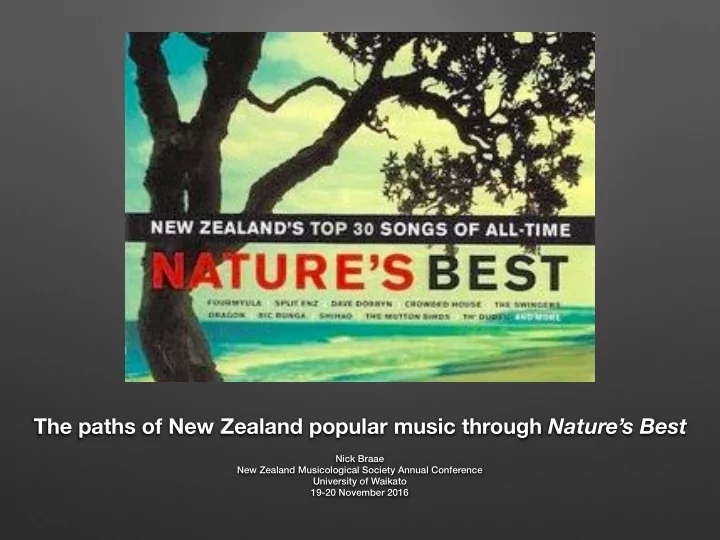
The paths of New Zealand popular music through Natures Best Nick - - PowerPoint PPT Presentation
The paths of New Zealand popular music through Natures Best Nick Braae New Zealand Musicological Society Annual Conference University of Waikato 19-20 November 2016 Studying New Zealand Popular Music Growth in the field Many Voices
The paths of New Zealand popular music through Nature’s Best
Nick Braae New Zealand Musicological Society Annual Conference University of Waikato 19-20 November 2016
(Johnson 2010); Home, Land & Sea (Keam and Mitchell 2011); Dunedin Soundings (Bendrups and Downes 2011)
(Moore 2009)
derivation (Lealand 1988; Shuker and Pickering 1994; Shuker 2003/04, 2008; Zuberi 2007; Mitchell 2009; Cattermole 2011; Meehan 2011)— question of ‘whether or not’?
fusions better than ‘derivative’ copies
Songs of All Time’; equivalent of the Rolling Stone ‘Top 500 Songs’ list
representation of New Zealand recording industry 1970 - 2000
understanding how cultural themes may be echoed in popular music
vocal techniques, form, production techniques; plus up to three additional traits
respective musical ‘worlds’ of the Nature’s Best songs (Covach 1994, 2003)
‘Nature’ Section-ending high vocal harmonies The Turtles’ ‘Happy Together’ Simon and Garfunkel’s ‘Sound of Silence’ The Beatles’ ’The Continuing Story of Bungalow Bill’ Modal harmonic language Four-track production Acoustic instrumentation; ‘natural’ percussion Unembellished vocal tone Straight groove Verse-Chorus form
1960s folk rock with ‘baroque’ pop influences
The Beatles’ ‘While My Guitar Gently Weeps’
influences’
and traditions’
River Band, Graham Bonnet, Rolling Stones (i.e. ‘mainstream’ 1970s rock)
segment of popular music landscape (post-punk, pub rock, new wave); continuing work in the 1990s strips away influences
1990s female singer- songwriter (Lisa Loeb - ‘Falling in Love’) Texture and instrumentation - acoustic guitar, ‘shimmering’ electric guitar, string section, bass guitar, drums Vocal stylings - slight lean on consonant sounds Björk - ‘Army of Me’ Pulsing mellotron The Beatles’ ‘Strawberry Fields Forever’ Harmonic language (descending bass lines)
Strawpeople - ‘Sweet Disorder’ (1994)
Trip-hop (Portishead - ‘Roads’)
Greg Johnson - ‘Liberty’ (1997)
Britpop (Blur - ‘She’s So High’)
Supergroove - ‘Can’t Get Enough’ (1994)
Funk-Rock (Lenny Kravitz - ‘Always on the Run’)
Shihad - ‘Bitter’ (1995)
Metal (Faith No More - ‘What a Day’)
1990s (Moore 2012)
protests (1981) and anti-nuclear protests (1980s)
being bold’ (interview with author, 2011); cf. 1990s view of borrowing freely (interviews with Sean Sturm and Julia Deans, 2011)
Zealand (e.g. John Dix’ Stranded in Paradise (1988, 2005); David Eagleton’s Ready to Fly: the Story of New Zealand Rock (2003))