The One Percent Principle 5,000,000 unaffiliated 2,500,000 are - - PowerPoint PPT Presentation

the one percent principle 5 000 000 unaffiliated 2 500
SMART_READER_LITE
LIVE PREVIEW

The One Percent Principle 5,000,000 unaffiliated 2,500,000 are - - PowerPoint PPT Presentation

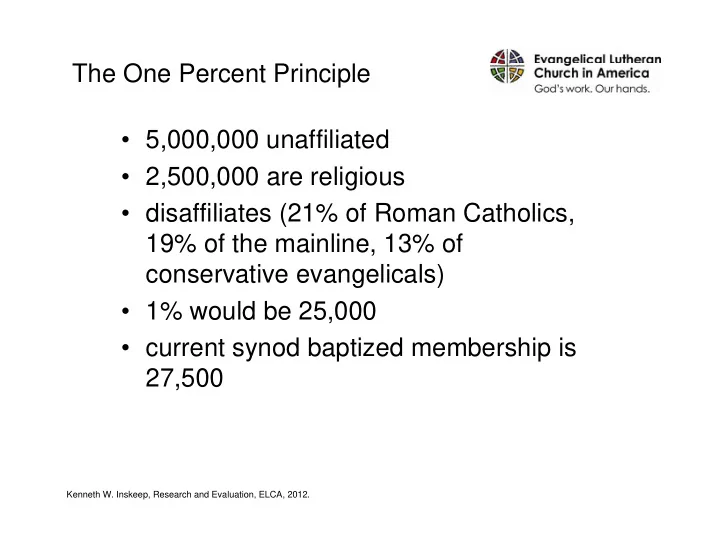
The One Percent Principle 5,000,000 unaffiliated 2,500,000 are religious disaffiliates (21% of Roman Catholics, 19% of the mainline, 13% of conservative evangelicals) 1% would be 25,000 current synod baptized membership is


slide-1
SLIDE 1

The One Percent Principle

  • 5,000,000 unaffiliated
  • 2,500,000 are religious
  • disaffiliates (21% of Roman Catholics,

19% of the mainline, 13% of conservative evangelicals)

  • 1% would be 25,000
  • current synod baptized membership is

27,500

Kenneth W. Inskeep, Research and Evaluation, ELCA, 2012.

slide-2
SLIDE 2

Characteristics of The Unaffiliated

  • Religious people are hypocritical,

judgmental and insincere.

  • Religions are partly true, but none are

completely true.

  • Religious organizations are too focused
  • n rules, not spirituality.
  • Religious leaders want money and power.
  • Religious people are anti-science.

Kenneth W. Inskeep, Research and Evaluation, ELCA, 2012.

slide-3
SLIDE 3

Theologically Atypical

  • Religious people are hypocritical,

judgmental and insincere.

  • Religions are partly true, but none are

completely true.

  • Religious organizations are too focused
  • n rules, not spirituality.
  • Religious leaders want money and power.
  • Religious people are anti-science.

Kenneth W. Inskeep, Research and Evaluation, ELCA, 2012.

slide-4
SLIDE 4

Congregational Vitality

  • Building and strengthening relationships

between members (participants) and God (worship, spiritual growth and faith practices)

  • Building and strengthening relationships

(internal) among members (caring and supportive)

  • Building and strengthening relationships

between members and the community (external) (evangelism, social justice, local and global community service).

Kenneth W. Inskeep, Research and Evaluation, ELCA, 2012.

slide-5
SLIDE 5

Congregational Vitality

The factors that influence a congregation's missional vitality are well known. Congregations with missional vitality have a widely shared commitment to reaching out into the community and a willingness to change as a means of reaching out. These characteristics are the product of strong adult faith formation programs that stress faith practices and spiritual growth.

Kenneth W. Inskeep, Research and Evaluation, ELCA, 2012.

slide-6
SLIDE 6

A Method to Change (Part I)

Because people are set in their ways, change begins with defining a clear, positive direction. This often means moving away from trying to fix a problem and moving toward better understanding what is already working.

Kenneth W. Inskeep, Research and Evaluation, ELCA, 2012.

slide-7
SLIDE 7

A Method to Change (Part II)

Change happens when it engages people's hearts and their emotions. People often know what they should do, but it is more comfortable emotionally (at least in the short-run) to follow

  • habit. Change is hard because it goes against

what is emotionally the easiest thing to do.

Kenneth W. Inskeep, Research and Evaluation, ELCA, 2012.

slide-8
SLIDE 8

Identity vs. Costs/Benefit

1. What does listening to scripture tell us about

  • urselves and about God?

2. What do our traditions tell us about ourselves and God? 3. What does listening to our neighbors and our communities tell us about the community and

  • urselves?

4. What is God calling us as a congregation to do in this situation as we participate in God's mission?

Who are we as a congregation and who does God want us to be?

Kenneth W. Inskeep, Research and Evaluation, ELCA, 2012.

slide-9
SLIDE 9

A Method to Change (Part III)

It is important to shape (re-shape ) the environment.

Kenneth W. Inskeep, Research and Evaluation, ELCA, 2012.

slide-10
SLIDE 10

Competencies

  • strategic thinking
  • new technologies,
  • leader development,
  • a missional focus,
  • cooperative ministries among congregations,
  • global relationships,
  • resource development (financial campaigns),
  • youth and young adult ministry,
  • conflict (most recently the aftermath of the sexuality

decision),

  • interpretation

Kenneth W. Inskeep, Research and Evaluation, ELCA, 2012.

slide-11
SLIDE 11

The Message

  • Jesus is given to us as a gift from God. We come to

know this gift through faith which according to Luther is nothing more or less than a "living, daring confidence" in the graciousness of God, "so certain that you could stake your life on it one thousand times".

  • According to Luther this kind of trust in and knowledge of

God will make us "joyful, confident and happy with regard to God and all creatures". According to Luther "through faith, a person will do good to everyone without coercion, willingly and happily; serving everyone, suffering everything for the love and praise of God, who has shown such grace".

Kenneth W. Inskeep, Research and Evaluation, ELCA, 2012.

slide-12
SLIDE 12

The Church We Want to Be

  • We want to be a church that belongs to Christ with a

place for everyone.

  • We want to be a church whose unity is in Jesus, who

gathers us around word and water, wine and bread.

  • We want to be a church that believes Jesus is God’s

“yes” to us and that our lives can be a “yes” to others.

  • We want to be a church that believes God is calling

us into the world--together (a church that rolls up its sleeves and gets to work (restoring and reconciling communities).

Kenneth W. Inskeep, Research and Evaluation, ELCA, 2012.

slide-13
SLIDE 13

The Church We Want to Be

  • We want to be a church that is a catalyst,

convener and bridge builder.

  • We want to be a church that is energized by

lively engagement in our faith and life (continually striving for a deeper understanding of what the death and resurrection of Jesus Christ means for the world.)

  • We want to be a church that is deeply

rooted and always being made new.

Kenneth W. Inskeep, Research and Evaluation, ELCA, 2012.