
SLIDE 1
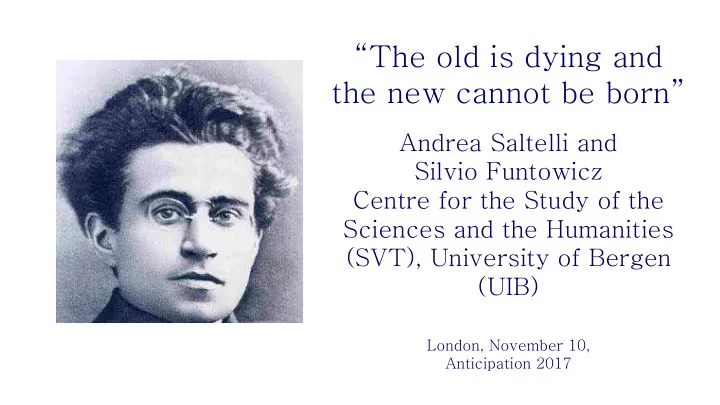
“The old is dying and the new cannot be born”
Andrea Saltelli and Silvio Funtowicz Centre for the Study of the Sciences and the Humanities (SVT), University of Bergen (UIB)
London, November 10, Anticipation 2017
The old is dying and the new cannot be born Andrea Saltelli and - - PowerPoint PPT Presentation
The old is dying and the new cannot be born Andrea Saltelli and Silvio Funtowicz Centre for the Study of the Sciences and the Humanities (SVT), University of Bergen (UIB) London, November 10, Anticipation 2017 Where to find this
“The old is dying and the new cannot be born”
Andrea Saltelli and Silvio Funtowicz Centre for the Study of the Sciences and the Humanities (SVT), University of Bergen (UIB)
London, November 10, Anticipation 2017
Where to find this talk: www.andreasaltelli.eu
Pre-clinical and clinical medical research, psychology,
chemistry, empirical economics …
https://replicationindex.wordpress.com/2017/02/02/reconstruction-of-a-train-wreck- how-priming-research-went-of-the-rails/comment-page-1/
“[…]questions have been raised about the robustness of priming results … your field is now the poster child for doubts about the integrity of psychological research…”
Richard Van Noorden, 2017, Brazilian citation scheme outed. Thomson Reuters suspends journals from its rankings for ‘citation stacking’. Nature, 27 August 2013
Use and abuse of metrics: from self- citation to citation cartels to citation stacking
Power asymmetries in the framing of issues: those who have the deepest pockets marshal the best evidence; Instrumental use of quantification to obfuscate; (Saltelli and Giampietro, 2017) Evidence based medicine hijacked to serve corporate agendas. Meta-analyses and guidelines serving vested interests. “Under market pressure, clinical medicine has been transformed to finance-based medicine” (Ioannidis, 2016)
Old and new heroes, while history repeats itself (Love canal, Flint…)
Lois Gibbs Marc Edwards
http://www.andreasaltelli.eu/file/repository/LOVE_CANAL.pdf https://en.wikipedia.org/wiki/Flint_water_crisis; http://flintwaterstudy.org/; http://www.nytimes.com/2016/08/21/magazine/flints-water-crisis-and-the- troublemaker-scientist.html
John and Laura Arnold Ben Goldacre, alltrials.net Brian Nosek, the Reproducibility Project. John Ioannidis, Meta-research innovation centre at Stanford Gary Taubes, The case against sugar
https://www.wired.com/2017/01/john-arnold-waging-war-on-bad-science/
… and billionaires?
http://www.economist.com/news /science-and- technology/21719438-about- change-findings-medical- research-are-disseminated-too Bill & Melinda Gates
Mark Zuckerberg & Priscilla Chan
Yoshiki Sasai
http://www.nature.com/news/stem-cell-pioneer-blamed-media-bashing-in-suicide-note-1.15715
Different cultures, different reactions
Smaldino PE, McElreath R., 2016 The natural selection of bad science. R. Soc. open sci. 3:
Smaldino PE, McElreath R., 2016 The natural selection of bad science. R. Soc. open sci. 3:
2015 2016
Adopted February 2017 at symposium AAAS after 5 y gestation. Hundreds of experts involved:
evidence based policy
For it is possible for a field to be diseased […] reforming a diseased field is a task of great delicacy […] not even an apparatus of institutional structures, can do anything to maintain or restore the health of a field in the absence of an essential ethical element operating through the interpersonal channel of communication.
Jerome R. Ravetz
Ravetz, J., 1971, Scientific Knowledge and its Social Problems, Oxford University Press.
Funtowicz, S. O. and Ravetz, J. R., 1990. Uncertainty and quality in science for policy, Dordrecht: Kluwer.
Something is not OK with the use of science for policy; Quality is lost if uncertainty is misunderstood or used instrumentally; The need for craft skills with numbers (NUSAP); …
Martin Luther Johann Tetzel
Science exhibits pathologies / corruptions comparable to the traffic in indulgencies which enraged Luther ~1517
Johannes Gutenberg
Seek inspiration in the radical 1970s-era movements that sought to change the world by changing first science itself Fight asymmetries; offer expertise to the weaker stakeholders; help those to shape the questions asked of science Fight methodological corruption, e.g. deconstructing shoddy quantifications Recast our public conversation about science
https://theconversation.com/scientists-march-on-washington-is-a-bad-idea-heres-why-73305 https://gizmodo.com/how-radical-70s-scientists-tried-to-change-the-world-1681987399
Read us on
Twitter: @andreasaltelli