The NPDGamma Experiment at the SNS Motivation Weak Interaction - - PowerPoint PPT Presentation

the npdgamma experiment at the sns motivation weak
SMART_READER_LITE
LIVE PREVIEW

The NPDGamma Experiment at the SNS Motivation Weak Interaction - - PowerPoint PPT Presentation

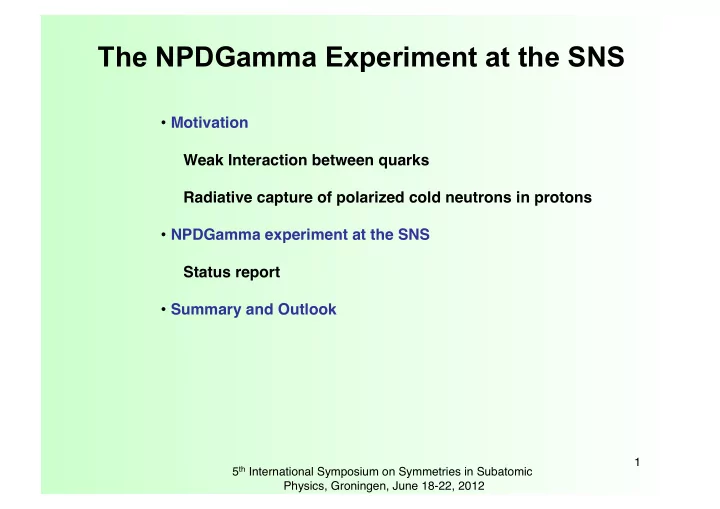
The NPDGamma Experiment at the SNS Motivation Weak Interaction between quarks Radiative capture of polarized cold neutrons in protons NPDGamma experiment at the SNS Status report Summary and Outlook 1 5 th International Symposium on


slide-1
SLIDE 1

The NPDGamma Experiment at the SNS

  • Motivation

Weak Interaction between quarks Radiative capture of polarized cold neutrons in protons

  • NPDGamma experiment at the SNS

Status report

  • Summary and Outlook

1 5th International Symposium on Symmetries in Subatomic Physics, Groningen, June 18-22, 2012

slide-2
SLIDE 2

N N N N ρ,π, ω W±,Z0

3

Hadronic Weak Interaction (HWI)

  • Probe of qq correlations in hadrons (range

W-Z exchange << N size).

  • Natural scale ~ x 10-7, set by relative size
  • f meson vs boson exchange amplitudes.
  • At low energy, the weak NN is sensitive to

qq neutral current effects.

  • Induce parity-odd effects in electron

scattering, nuclear decays, compound nuclear resonances, and atomic structure (nuclear anapole moments).

  • Above QCD scale Λ = 1 GeV, at the quark level, the qq weak

interaction can be written in a current-current form (ΔI= 0, 1, 2).

  • At the nucleon level, below Λ, five independent weak transition

amplitudes (ΔI= 0, 1, 2) are present in NN elastic scattering at low energy.

slide-3
SLIDE 3

4

 s ⋅  k

γ

 s ⋅( k

n × 

k

γ ) The PV γ-ray asymmetry in is dominated by the ΔI=1 parity-

  • dd transition amplitude (3S1-3P1) expected from the HWI between nucleons.

 n + p → d + γ

z

spin

 s  k

n

cosθ = ˆ s ⋅ ˆ k

γ

dσ dΩ ∝ 1 4π (1+ Aγ ,UD cosθ + Aγ ,LR sinθ)

slide-4
SLIDE 4
slide-5
SLIDE 5

5

slide-6
SLIDE 6

6

slide-7
SLIDE 7

Spin Spin

  • ct
  • ctet

NPDGamma – Experimental Setup

slide-8
SLIDE 8

LANSCE Results and Improvements for SNS

Aγ ,UD = −1.2 ± 2.1(stat.) ± 0.2(sys.)

[ ]×10−7

Aγ ,LR = −1.8 ±1.9(stat.) ± 0.2(sys.)

[ ]×10−7

M.T. Gericke et al., Phys. Rev C83, 015505 (2011)

slide-9
SLIDE 9

Spallation Neutron Source at ORNL

  • 1.4 GeV protons, 60Hz
  • Hg Spallation target neutrons
  • H2 moderator
  • 17 m SM guide, curved

10

slide-10
SLIDE 10

1B - Disordered Matʼls Commission 2010 2 - Backscattering Spectrometer Commission 2006 3 - High Pressure Diffractometer Commission 2008 4A - Magnetism Reflectometer Commission 2006 4B - Liquids Reflectometer Commission 2006 5 - Cold Neutron Chopper Spectrometer Commission 2007 18 - Wide Angle Chopper Spectrometer Commission 2007 17 - High Resolution Chopper Spectrometer Commission 2008 13 - Fundamental Physics Beamline Commissioned 2008 11A - Powder Diffractometer Commission 2007 12 - Single Crystal Diffractometer Commission 2009 7 - Engineering Diffractometer IDT CFI Funded Commission 2008 6 – EQ SANS Commission 2007 14B - Hybrid Spectrometer Commission 2011 15 – Spin Echo 9 – VISION

Spallation Neutron Source at ORNL Reached 1MW of power – September, 2009

11

slide-11
SLIDE 11

The NPDGamma Experiment at the SNS

12

slide-12
SLIDE 12

Magnetic Field Measurements

14

  • S. Balascuta et al, NIMA 671, 137-143 (2012)
slide-13
SLIDE 13

Photon CsI Detector System

15

There are 48 detectors arranged in 4 rings. ~ 3π geometrical solid angle.

slide-14
SLIDE 14

Detector Geometrical Factors

16

slide-15
SLIDE 15

Commissioning Phases I and II (began Dec, 2010)

  • Beam profile measured
  • Flux confirmed
  • Detailed studies of new shielding material

performed

  • Polarization of beam established
  • Precision measurements of detector locations

completed

  • Al and Chlorine data collection completed

Maximum flux is well-matched to the center of the detector array

20

slide-16
SLIDE 16

Beam Polarization Measurements

slide-17
SLIDE 17

Beam Polarization Measurements

19

Beam Polarization Measurements

slide-18
SLIDE 18

Aϒ from 35Cl and 27Al

19

  • 35Cl PV asymmetry is well known, it is enhanced

(10-5), and it is used as an initial check and to test important experimental systematics.

  • 27Al is the largest source of background in

NPDGamma and the PV asymmetry needs to be measured to about 3×10⁻⁸

.

slide-19
SLIDE 19

35Cl PV (up-down) and PC (left-right)

Asymmetries

22

slide-20
SLIDE 20

27Al PV (up-down) and PC (left-right)

Asymmetries

23

slide-21
SLIDE 21

27Al PV (up-down) and PC (left-right)

Asymmetries

  • The PV result is the most precise up to now. The statistical errors are < 4×10⁻⁸. This

will be the first statistically significant measurement of the asymmetry in the NPDGamma reaction.

  • The PC (left-right) result is statistically significant and somehow surprising. Three

factors :

  • Stern-Gerlach effect (B-field)
  • Mott-Schwinger effect (spin-orbit)
  • Direct reaction

24

slide-22
SLIDE 22

Liquid Para-Hydrogen Target

17

  • 16 L vessel of para-

hydrogen

  • Ortho-hydrogen scatters

the neutrons and leads to beam depolarization

slide-23
SLIDE 23

Production Data on Hydrogen- so far

25

slide-24
SLIDE 24

Status of the NPDGamma experiment

  • Numerous improvements to the experiment allow for the first measurement of Aγ

that will test theoretical predictions

  • Predicted size: 5x10⁻⁸ (DDH) - NPDGamma will make a 20% measurement

(1x10⁻⁸)

  • Results from Cl and Al out soon.
  • Production Hydrogen Data is underway !

26

slide-25
SLIDE 25
  • R. Alarcon1, P. Alonzi3, S. Balascuta1, L. Barron-Palos2, S. Baeßler3, J.D. Bowman4,J.R.Calarco9, R.D. Carlini5,

W.C. Chen6, T.E. Chupp7, C. Crawford8, M. Dabaghyan9, A. Danagoulian10, M. Dawkins11, N. Fomin10, S.J. Freedman13, T.R. Gentile6, M.T. Gericke14 R.C. Gillis11, K. Grammer12, G.F. Greene4,12, F. W. Hersman9, T. Ino15, G.L. Jones16, S. Kucucker12, B. Lauss17, W. Lee18, M. Leuschner11, W. Losowski11, E. Martin8, R. Mahurin14, M. McCrea14, Y. Masuda15, J. Mei11, G.S. Mitchell19, S. Muto15, M. Musgrave12, H. Nann11, S. Page14, D.Počanic3,S.I. Penttila4, D. Ramsay14,20, A. Salas Bacci10, S. Santra21, P.-N. Seo3, E. Sharapov23, M. Sharma7, T. Smith24, W.M. Snow11, W.S. Wilburn10 V. Yuan10

1Arizona State University 2Universidad Nacional Autonoma de Mexico 3University of Virginia 4Oak Ridge National Laboratory 5Thomas Jefferson National Laboratory 6National Institute of Standards and Technology 7Univeristy of Michigan, Ann Arbor 8University of Kentucky 9University of New Hampshire 10Los Alamos National Laboratory 11Indiana University 12University of Tennessee 13University of California at Berkeley 14University of Manitoba, Canada 15High Energy Accelerator Research Organization (KEK), Japan 16Hamilton College 17Paul Scherrer Institute, Switzerland 18Spallation Neutron Source 19University of California at Davis 20TRIUMF, Canada 21Bhabha Atomic Research Center, India 22Duke University 23Joint Institute of Nuclear Research, Dubna, Russia 24University of Dayton

The NPDGamma collaboration