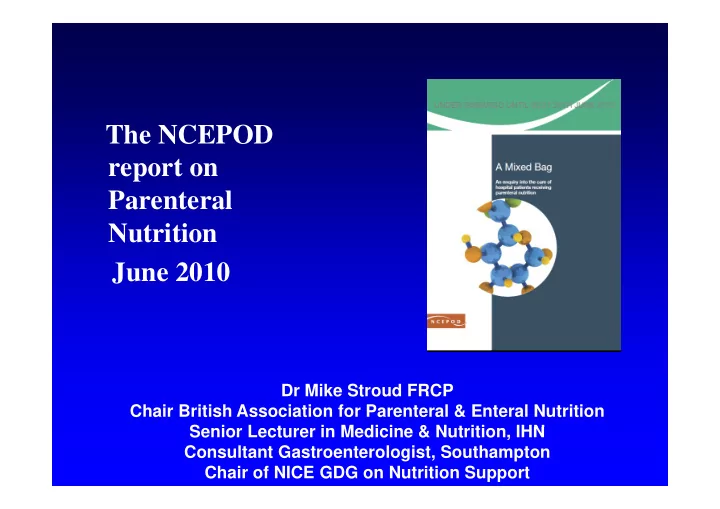
SLIDE 1 The NCEPOD The NCEPOD report on Parenteral Parenteral Nutrition June 2010
Dr Mike Stroud FRCP Chair British Association for Parenteral & Enteral Nutrition S i L t i M di i & N t iti IHN Senior Lecturer in Medicine & Nutrition, IHN Consultant Gastroenterologist, Southampton Chair of NICE GDG on Nutrition Support
SLIDE 2 A multi-disciplinary charity committed to raising awareness of malnutrition and i f i d i i
- ptions for its treatment; and examining
impacts on health outcomes, resource tili ti d h lth/ i l b d t utilization and health/social care budgets.
SLIDE 3 CAUSES OF MALNOURISHMENT
Conscious level Depression Poor diet - age, poverty, junk, exercise, alcohol Anorexia Dysphagia Obstruction Obstruction Vomiting Pancreatic failure Pancreatic failure Liver processing Jaundice Malabsorption I d M b li d d Increased Metabolic demands
Food intake, absorption, losses and demands
SLIDE 4 Effects of Undernutrition
Ventilation - loss of l & h i Psychology – depression & apathy Immunity – Increased risk
muscle & hypoxic responses li f tt h Renal function loss of Decreased Cardiac output liver fatty change, functional decline necrosis, fibrosis Renal function - loss of ability to excrete Na & H2O Impaired wound healing Hypothermia Impaired gut integrity and integrity and immunity Loss of strength Anorexia ? Micronutrient deficiency
SLIDE 5 Complications of abdominal
- perations for malignant disease
Meguid et al., Am J Surg 156, 1988 g , g ,
90 100
%
70 80 90
p a
40 50 60 Well nourished
t i e
20 30 40 Malnourished
e n t
10 Complication Rate Post-Operative
s
Complication Rate Post Operative Mortality
SLIDE 6 Nutritional |Care and Nutritional |Care and Quality - the BAPEN Agenda 2009/10 Agenda 2009/10 – a framework for
Malnutrition Matters Meeting Quality Standards in N t iti l C
Commissioners and Providers to establish
Nutritional Care
Ailsa Brotherton, Nicola Simmonds and Mike Stroud
safe quality care standards in nutritional
BAPEN Quality Group
standards in nutritional care from food and supplements at one end supplements at one end
hi hl i li d highly specialised PN at the other.
SLIDE 7 BAPEN Toolkit BAPEN Toolkit
F k t t Four key tenets:
- Screen to identify nutritional care needs followed by
d t il d t detailed assessment
- Care pathways in place with appropriate monitoring
- Training for all staff to appropriate levels
- Management structures in place to support the
delivery of safe nutritional care of the highest quality delivery of safe nutritional care of the highest quality
SLIDE 8 Starvation & Weight loss Starvation & Weight loss
(After Allison)
95 100
Decision Box % b
85 90 Catabolic
y
70 75 80 Catabolic Complete starvation Partial starvation
w e i
55 60 65
i g h
50 10 20 30 40 50 60 70
t Days
SLIDE 9 A Patient’s Journey A Patient’s Journey
95 100
% b
GP OP IP NBM f I 80 85 90 Catabolic
y
NBM for Ix Surgery 70 75 80 Catabolic Complete starvation Partial starvation
w e i
55 60 65
i g h
Not going 50 10 20 30 40 50 60 70
t
Not going well - Friday
Days
SLIDE 10
Nutrition support in adults: 2006 adults: 2006
SLIDE 11 Nutrition support
SCREEN RECOGNISE SCREEN RECOGNISE TREAT TREAT ORAL ENTERAL PARENTERAL MONITOR MONITOR REVIEW
SLIDE 12 Parenteral nutrition Parenteral nutrition
if patient malnourished/at risk of malnutrition and has either a non functional, inadequate or unsafe oral inaccessible or perforated gastrointestinal tract inadequate or unsafe oral
- r enteral nutritional intake
introduce progressively and monitor closely use the most appropriate route of access and mode of delivery stop when the patient is established on adequate
- ral intake from normal food or enteral tube feeding
D
SLIDE 13
The Evidence W t d t i IF l t Wanted – starving IF volunteers for PN RCTs for PN RCTs
SLIDE 14
Evidence for enteral for enteral and parenteral nutrition nutrition
IBO
SLIDE 15
The NCEPOD The NCEPOD report on Parenteral Parenteral Nutrition June 2010
SLIDE 16 BAPEN’s Response p
- Dismay
- Dismay
- Congratulations and welcome
g
– solid evidence that many hospitals deliver unsafe artificial nutrition to vulnerable adults and babies artificial nutrition to vulnerable adults and babies. – Generally irrefutable data confirming what BAPEN NICE d h h id f i BAPEN NICE and others have said for some time i.e standards in nutritional care must be improved to ensure all patients receive quality, safe and equal treatment from staff who are appropriately trained and supervised
SLIDE 17
? NSTs surely BAPEN NSTs
SLIDE 18
PN needed in Intestinal Failure – h ld b l l i Should be level 2 patients ?IFU
SLIDE 19 Finding % % Appropriate indication 71.3 28.7 Delay in identification 16 84 Delay in starting 9 91 Nutrition Team involved 52.7 47.3 Off the shelf with no additions 42.7 57.3 Adequate monitoring 56.7 43.3 Inappropriate additional IV fluids 21 79
SLIDE 20
SLIDE 21 Difficulties with definition and Difficulties with definition and methodology methodology
Refeeding syndrome
But its bad! But its bad!
SLIDE 22 NCEPOD Recommendations
- PN should only be given when necessary
- When PN is needed recognise early and take action
- When PN is needed recognise early and take action
- Patient assessment should be robust and purpose and
goal documented goal documented
- Regular documented clinical and biochemical
monitoring monitoring
- Additional IV fluids only if necessary
A i d i b h l f PN i
- Active education about the role of PN, its
complications and side effects All h i l h ld h PN f
- All hospitals should have a PN proforma
- Catheter and organizational
SLIDE 23 BAPEN’s Recommendation’s
- All acute hospitals must have multi-disciplinary NSTs
p p y with Senior Clinical Leadership
- All acute hospitals should have simple rolling system of
PN registration and audit t it ti d i d t d d – to monitor practice and secure improved standards – this could be delivered by extending BAPEN’s existing BANS database covering long-term home PN patients BANS database covering long-term home PN patients and it would support work by HIFNET - the newly established commissioning, management and clinical framework dealing with intermediate and long-term PN
This needs political will and DH support
SLIDE 24 BAPEN's Challenge g
- We challenge the Coalition Government to
i l t f ll th d ti f implement fully the recommendations from this NCEPOD report and those from the D li B d f h N i i A i Pl Delivery Board of the Nutrition Action Plan
– political leadership for malnutrition and risk – a public and professional awareness campaign
- n the impact of poor nutritional status on
health outcomes
SLIDE 25
BAPEN Agenda 2019/11 Safet in N tritional Care Safety in Nutritional Care
BAPEN ill t l l l d hi th h BAPEN will ensure top-level leadership through an
All Party Parliamentary Group on Nutritional Care and Hydration.
with parliamentary and professional partners
S i
with parliamentary and professional partners Ai T th t f t iti l f ll
Screening Catering
Aim - To ensure that safe nutritional care of all types continues to make its way up political,
g Oral Nutrition Supplements ETF
professional and practical agendas for the benefit of patients and people of all ages across primary,
ETF Under-hydration and IV fluids
p p p g p y, secondary and community settings.
PN
SLIDE 26
Th k Thank you